Mozart’s Fantasia in d minor, K. 397

mozart-fantasia

I have always really enjoyed playing Mozart’s Fantasia in d minor and when I was asked to play for the new piano dedication service at my church a couple years ago I knew what I would “dust off” to perform.

The Grove’s Dictionary of Music and Musicians defines the genre of musical fantasia as “a piece of instrumental music owning no restriction of formal construction, but the direct product of the composer’s impulse.”

The Fantasia in d minor has somewhat unusual rhythm, constantly changing tempo (seven different tempi occur throughout the piece), three cadenzas and its apparent lack of any recognizable musical form (as indicated by the “Fantasy” title). Although it begins in d minor, the final section is in D Major.

Mozart composed this, his third and final, Fantasia in 1782 and it was unfinished at the time of his death in 1791.  Even Mozart’s sister, “Nannerl”, who came across the work in 1807, was astounded to have discovered a previously unknown composition of such quality.

In its original form this Fantasia was probability only a fragment of what was to be a larger work. The closing bars which are most frequently performed today originated from an unauthorized print believed to have been composed in 1806 by August Eberhard Müller, one of Mozart’s admirers.

Because it was unfinished, many of the dynamic and pedal markings are nonexistant and left for the performer to choose.

As you can see from these videos, there is a wide range of tempi and interpretation from Frederich Gulda’s 4 minute, 36 second rendition 

to Glenn Gould’s version which lasts for 8 minutes, 22 seconds

Both these composers have added their own ornamentation to Mozart’s original work.

I will be playing from a G. Henley Verlag urtext edition instead of one of the many edited versions available.  I prefer to make my own musical decisions wherever possible.

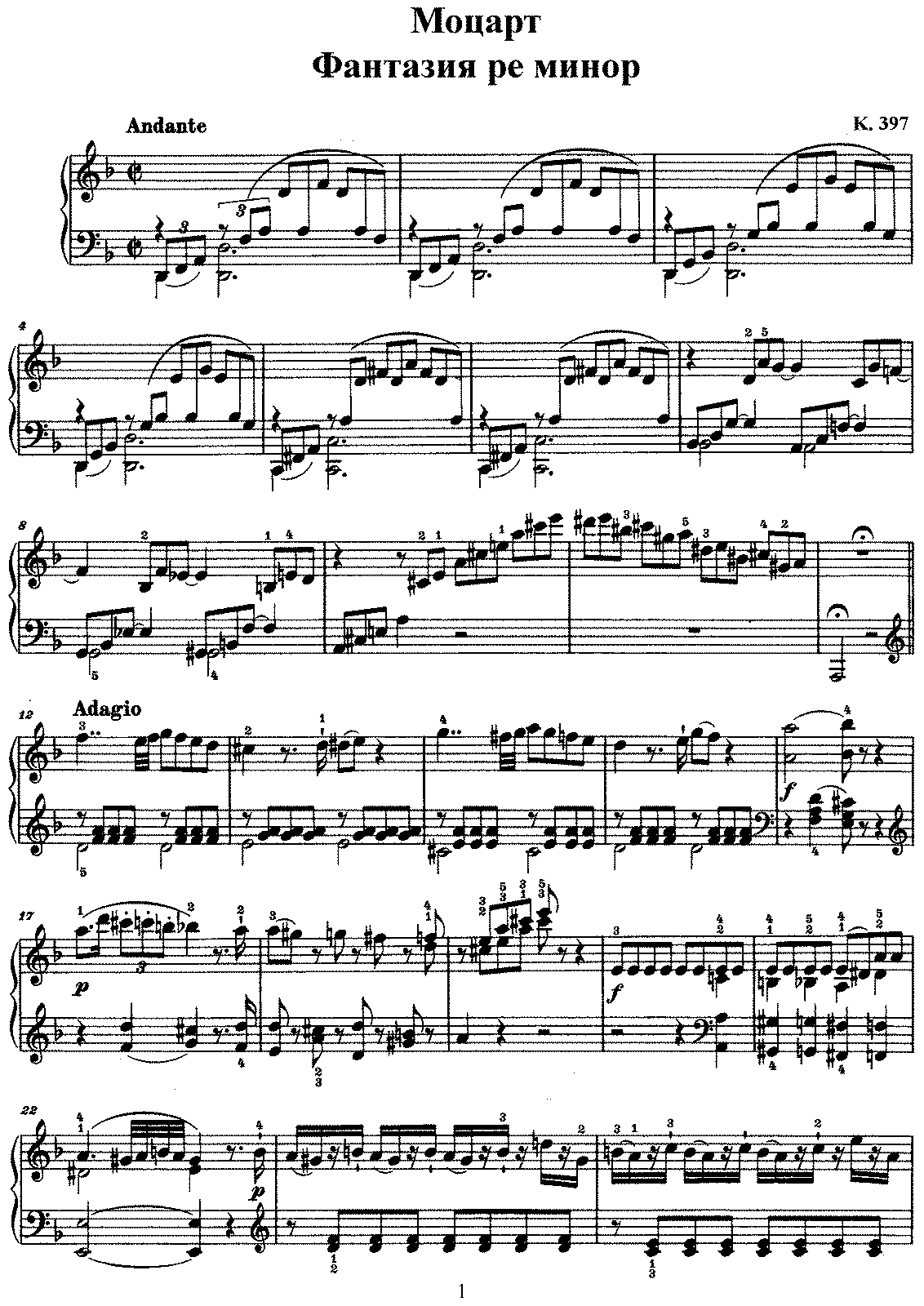
The version above is originally from http://imslp.org/wiki/Fantasia_in_D_minor,_K.397/385g_(Mozart,_Wolfgang_Amadeus)  I had printed it out as another source to compare with mine, since this one has different dynamic and other interpretive markings.  This version also has 3 notes which differ from the urtext edition.

I also used 3 other sources before I finally decided how I would shape my performance and choose my fingerings.

Some sites that I consulted as part of the learning process: 

I’ve played this for just about everyone I know and on 4 different pianos and it was ready on time!


Free Children’s Music Program

music-camp2015-header


At Pender’s Music Camp, rising second through sixth graders sing in choir, play Orff instruments, ring handbells, experiment with rhythm in a percussion class, learn to read music, and make crafts.

Friday afternoon traditionally concludes with musical performances which our campers perform for friends and family!

The Music Camp Final Program will be Friday, July 10 at 3:00 pm.

Directions to Pender

12401 Alder Woods Drive
Fairfax, VA 22033
Tel: 703.278.8023

It’s Not Too Late!

music-camp-2015


Pender’s annual summer Music Camp will be held on July 6-10 from 12:30pm-3:30pm. Our theme this year is “The Amazing Grace Race.” Children in rising 2nd through rising 6th grade are invited to participate. Rising 7-12th graders who are interested in volunteering can also sign up online through the Pender UMC website.

The cost is $25 per child, $50 per family (siblings only).

If you have any questions about Music Camp, please contact Theresa Carpenter or Nicole Parrish.

Why Work on Music Theory?

Music_Theory


Students at the O’Connor Music Studio know that music theory is always a part of lessons.  I strongly believe that theory is needed so that students understand what they are playing and why.

To me, theory work is just as important as playing.  A firm knowledge of musical structure makes playing everything easier.

Music knowledge learned through piano lessons transfers easily to other  musical activities.  Students in Fairfax County Public Schools, students learn to play recorder.  Students are sometimes surprised to learn that they already know all the notes – from their piano lessons!

When you sing in a choir, harmonize with Sweet Adelines, play an instrument in your school or community band/orchestra, join your church’s handbell choir (note:  Pender UMC has an excellent Handbell program), teach yourself guitar – theory will help in every instance. By learning to read, write, and understand this musical language, many more musical opportunities will be made available the rest of your life.

Most piano methods come with a theory book that matches page by page what concepts are being learned in the lesson books.  I actually recommend that students do the theory first when they get home, while the concepts are still fresh in their minds.

If the student is not in a piano method, I’m starting to use the Theory Time series.  Book One covers music alphabet, introduction to keyboard and staff, stem rule, steps & skips on a keyboard and staff, repeated notes, dynamics, treble clef lines & spaces, bass clef lines & spaces, quarter note & rest, half note & rest, whole note & rest, dotted half note, bar lines, double bar line, measures, time signatures, rhythm drill, vocabulary, ear training and a review test. Free ear training videos for each ear training exercise are hosted on the Theory Time YouTube channel. The Grade One workbook is appropriate for beginning 1st, 2nd or 3rd grade students. This workbook includes 51 pages, 13 lessons and 8 Fun Sheets.

For adults and more advanced students, I have a copy of All About Music Theory: A Fun and Simple Guide to Understanding Music which can be used as a review or a “try before buy”.

Stop procrastinating and go do your theory!

Local Music Event ~ at VBS

vbs-everest-feature


At this year’s VBS, kids will embark on an icy expedition where kids overcome obstacles with God’s awesome power. Anchor kids in rock-solid Bible truths that will guide them through life’s challenges.

In addition, each day kids will rotate through music, recreation, snack, craft, storytelling and even some “laboratory” time!

Basics:

  • July 6-10, 9:00 to 12:00 each day at Pender UMC,  12401 Alder Woods Drive, Fairfax, VA 22033
  • Music Camp will be from 12:30-3:30 the same dates.  Registration information coming soon.
  • Kids age 3 through 6th grade are welcome – note all children must be potty trained, teachers will NOT change diapers
  • Fees this year are $30 per child, $60 max per family.  This includes the price of the music CD. Pay $30 each for the first two children in your family.  Other children are no additional charge.
  • After you have registered 2 children, use  the form VBS 2015 (Family) so that you are not charged more than $60 for your family.
  • Contact Ann  Hines with questions
  • Contact Jami Flemmons for financial assistance

Please Read:

  • Online registration will begin in April
  • Please fill out a separate form for each child.
  • There is a total limit of 250 children.
  • Be sure to register your child, not yourself.  Click “Register Additional Individuals/Family”

Registration opens today April 1, 2015

Register the first and second child(ren) here.

If you have more than 2 children to register, choose VBS 2015 (Family) here.

Register yourself or your youth (rising 7-12 graders) to volunteer here.

Fun with Music for Young Children in Northern Virginia…


fun-music


The second semester of Fun With Music will meet from January 9-May 15, every Friday from 10-11:30 am in the Cornerstone Room (Room 215) of Pender United Methodist Church at 12401 Alder Woods Drive Fairfax, VA 22033.

This program is for moms and dads with their children ages 0 to 5. A fee of $30 covers the cost of food and supplies.

Each week there is 30 minutes of singing, a snack and toys are brought out for the children to play. The parents are served a breakfast and have the opportunity to fellowship with each other.

For questions, email Jim & Roberta Pont by clicking here.

Local Musical Events this Sunday!

christmas-music

The Pender UMC Choir, Handbells, Orchestra and Liturgical Dancer will present Joel Raney’s Christmas Cantata, Celebrate the Season, at 8:15 and 11:00 am on Sunday, December 7.

Contemporary and upbeat, this superb cantata celebrates the excitement, joy and true meaning of the Christmas season. Joel Raney retells the Christmas story through a unique partnering of creative, original songs with traditional carols. Most of the originals incorporate strains from traditional carols, weaving a tapestry with just enough familiarity  to warm our hearts and with enough originality to surprise our ears and lift our spirits. The styles he uses range from traditional classical, to jazz and everything in between.


At Pender’s neighbor, Christ Presbyterian:

The Cathedral Brass will perform “A Cathedral Brass Christmas” at Christ Presbyterian Church, Fairfax, on Sunday, December 7th at 4:00 pm. The concert features beloved Christmas carols and other holiday favorites, including ‘Twas the Night Before Christmas, narrated by Alan Cole.

Other selections includeLeRoy Anderson’s Suite of Carols, Antonio DiLorenzo’s The Toymaker, and Alfred Reed’s Joyeux Noel. Jazz trumpeter Roger Rossi, former member of the Army Blues, will be featured. The concert is free; voluntary donations are gratefully accepted.

Cathedral Brass is a brass choir based at Vienna Presbyterian Church and performs under the direction of L. Thomas Vining.

Summer Schedules!

It’s hard to believe but summer is nearly upon us.  FCPS students are getting out later this year due to snow days, so the regular school year piano lessons are going a bit longer, as well.

Here’s the basic schedule from now through the start of fall lessons.  Please remember that students must take at least 6 summer lessons to hold a current school year lesson time for the fall.

The last day of school is  June 25, so there are no lessons week of June 23 (school age students only.  Adults continue, as always)

No lessons 4th of July weekend – July 3-5

No lessons after noon the week of July 7-11 (Pender UMC Music Camp)

No lessons August 15-Sept 2


Lessons (11 adult lessons, 10 school age students offered):

June 2 9, 16, 23 (except FCPS students – last week of school), 30
July 7 (mornings only), 14, 21, 28
Aug 4, 11

Sept 8, the fall semester begins


If you need to reschedule, please call, email or FaceBook me and with at least 24-hours notice. There are some open spots available on the schedule.  You can view them here: https://ocms.youcanbook.me/.   Those times are “more like guidelines.  I will contact you to confirm any changes.  As always, the PW is “piano”.


happy_summer

Mozart’s Fantasia in d minor, K. 397

I have always really enjoyed playing Mozart’s Fantasia in d minor and when I was asked to play for the new piano dedication service at my church I knew what I would “dust off” to perform.

The Grove’s Dictionary of Music and Musicians defines the genre of musical fantasia as “a piece of instrumental music owning no restriction of formal construction, but the direct product of the composer’s impulse.”

The Fantasia in d minor has somewhat unusual rhythm, constantly changing tempo (seven different tempi occur throughout the piece), three cadenzas and its apparent lack of any recognizable musical form (as indicated by the “Fantasy” title). Although it begins in d minor, the final section is in D Major.

Mozart composed this, his third and final, Fantasia in 1782 and it was unfinished at the time of his death in 1791.  Even Mozart’s sister, “Nannerl”, who came across the work in 1807, was astounded to have discovered a previously unknown composition of such quality.

In its original form this Fantasia was probability only a fragment of what was to be a larger work. The closing bars which are most frequently performed today originated from an unauthorized print believed to have been composed in 1806 by August Eberhard Müller, one of Mozart’s admirers.

Because it was unfinished, many of the dynamic and pedal markings are nonexistant and left for the performer to choose.

As you can see from these videos, there is a wide range of tempi and interpretation from Frederich Gulda’s 4 minute, 36 second rendition 

to Glenn Gould’s version which lasts for 8 minutes, 22 seconds

Both these composers have added their own ornamentation to Mozart’s original work.

I will be playing from a G. Henley Verlag urtext edition instead of one of the many edited versions available.  I prefer to make my own musical decisions wherever possible.

The version below is originally from http://imslp.org/wiki/Fantasia_in_D_minor,_K.397/385g_(Mozart,_Wolfgang_Amadeus)  I had printed it out as another source to compare with mine, since this one has different dynamic and other interpretive markings.  This version also has 3 notes which differ from the urtext edition.

Mozart-fantasia-d-minor.pdf
Download this file

I also used 3 other sources before I finally decided how I would shape my performance and choose my fingerings.

Some sites that I consulted as part of the learning process: 

I’ve played this for just about everyone I know and on 4 different pianos and I think it’s ready for Sunday night!