• 1940 ~ The Southland Shuffle was recorded on Bluebird Records by Charlie Barnet and his orchestra. A young trumpet player named Billy May was featured.
• 1945 ~ Stephen Stills born, American rock guitarist, singer and songwriter for Buffalo Springfield and also Crosby, Stills, Nash and Young
• 1946 ~ John Paul Jones (Baldwin), Bass with Led Zeppelin
• 1969 ~ 30,000 copies of the John Lennon, Yoko Ono album, “Two Virgins”, were confiscated by police in Newark, NJ. John and Yoko were nude on the cover.
• 1970 ~ “Mame” closed at Winter Garden Theater New York City after 1508 performances
• 1972 ~ Don McLean received a gold record for his 8-minute-plus hit, American Pie.
• 1974 ~ Following eight years of inactivity, Bob Dylan toured for 39 dates in 25 cities. His first stop was in Chicago, IL. The tour was recorded and later released as a double-LP set titled, “Before the Flood”.
• 1975 ~ Milton J Cross, TV announcer (Met Opera Auditions), died at the age of 87
• 1981 ~ John Lennon’s(Just Like) Starting Over and the album “Double Fantasy” topped the pop music charts just weeks after the death of the former Beatle.
• 1985 ~ Soprano Leontyne Price bid adieu to the Metropolitan Opera in New York. She sang the title role of “Aida”. Price had been part of the Met since 1961.
• 1987 ~ The first woman inducted into the Rock and Roll Hall of Fame was ‘Lady Soul’: Aretha Franklin. Bill Haley was among the 14 others inducted on this date.
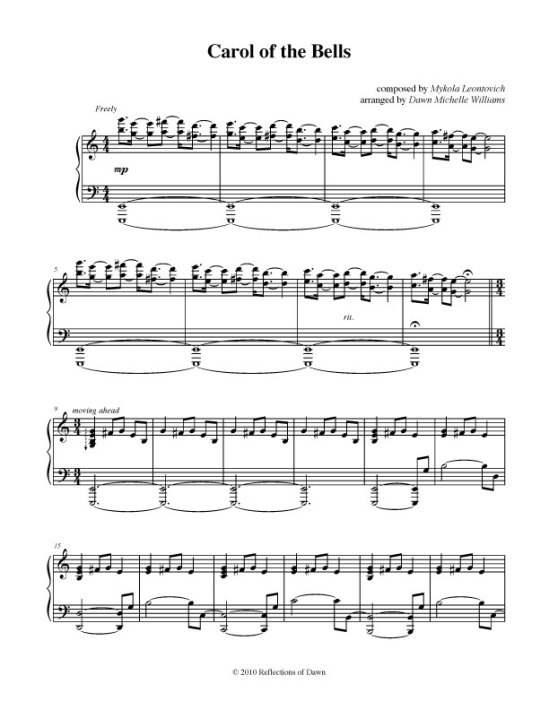
Carol of the Bells was composed by Mykola Dmytrovych Leontovych (1877-1921) in 1916. Originally titled Shchedryk, this Ukrainian folk song is sometimes called Ukrainian Bell Carol. “Shchedryk” which was associated with the coming New Year, originally celebrated in April.
Leontovych used this tune in 1904 along with lyrics by Peter J. Wilhousky to create the version that everyone knows today. It gained popularity during the 1920s and 1930s, and was introduced to an even wider audience when it was used in the movie “Home Alone”.
It was first performed in the Ukraine on the night of January 13, 1916, on the Julian calendar this is considered New Year’s Eve. In the United States the song was first performed on October 5, 1921 at Carnegie Hall.
This video is from the Christmas special of the Mormon Tabernacle Choir, presented at the BYU channel. The orchestra and choir produce a very beautiful sound.
Not the standard version –
The O’Connor Music Studio has several versions of this Christmas Carol available for loan, including this version from the Mannheim Steamroller:
• 1569 ~ Paul Sartorius, German organist and composer
• 1615 ~ Guillaume Dumanoir, II, French violinist and composer who composed dance music enjoyed by Louis XIV
• 1667 ~ Nathaniel Schnittelbach, composer, died at the age of 34
• 1715 ~ Girolamo Abos, composer of Italian opera and church music.
• 1720 ~ Carlo Antonio Campioni, Italian composer.
• 1757 ~ Daniel Read, American composer of the First New England School, and one of the primary figures in early American classical music.
• 1775 ~ Karl Marian Paradeiser, German composer, died at the age of 28.
• 1780 ~ Robert Archibald Smith, English composer.
• 1829 ~ Anton G Rubinstein, Russian pianist/conductor/composer
• 1840 ~ Frederick Scotson Clark, composer.
• 1848 ~ Frédéric Chopin played his final piano concert at a Polish benefit ball at Guildhall in London.
• 1850 ~ Giuseppe Verdi‘s opera Stifellio was first performed at the Teatro Grande in Trieste despite difficulties with the censors which resulted in cuts and changes.
• 1852 ~ Minnie Hauk, American soprano
• 1854 ~ First Performance of Anton Rubinstein‘s Ocean Symphony in Leipzig.
• 1860 ~ Edmund Scheucker, Viennese harpist.
• 1861 ~ Vaclav Suk, Czech-born Russian composer and violinist.
• 1861 ~ First Performance of Johannes Brahms‘ Piano Quintet No. 1 in g, Op. 25, at a rehearsal in Hamburg, with pianist Clara Schumann.
• 1862 ~ The work noted above received its official premiere with members of the Hellmesberger Quartet; Brahms at the piano, in Vienna.
• 1870 ~ Alfred Hill, Australian composer
• 1873 ~ David Karl Björling, Swedish tenor
• 1873 ~ W.C. Handy, American blues composer and bandleader
More information about Handy
• 1889 ~ George S. (Simon) Kaufman, Playwright: The Cocoanuts, A Night at the Opera, with Moss Hart, The Man Who Came to Dinner, You Can’t Take It with You
• 1893 ~ George Alexander Osborne, Irish pianist and composer (La Pluie de perles), died of natural causes at the age of 87
• 1894 ~ Debut of opera star Enrico Caruso in Mario Morelli’s L’Amico Francesco at Naples Teatro Nuovo.
• 1895 ~ Paul Hindemith, German-born American composer and conductor
Read quotes by and about Hindemith
More information about Hindemith
• 1896 ~ Lawrence Mervil Tibbett, American baritone
• 1905 ~ Eddie (Albert) Condon, Guitarist, bandleader, promoter of Dixieland Jazz
• 1908 ~ Conductor Arturo Toscanini made his debut in the United States this day. He appeared at the Metropolitan Opera House in New York, conducting Aida.
• 1931 ~ Bob Gibson, Singer, songwriter, leader of folk music movement in late ’50s, duo of Gibson and (Bob) Camp
• 1932 ~ The Palace in New York City closed its doors. It was the most famous vaudeville theater in America. Later, it became a movie house with live performances preceding the flicks; most notably: the team of Dean Martin and Jerry Lewis in their heyday.
• 1935 ~ The Rodgers and Hart musical, Jumbo, opened in New York City for a run of 233 performances.
• 1937 ~ Bob Crosby and his orchestra recorded South Rampart Street Parade on Decca Records.
• 1945 ~ Martine Van Hammel, Ballet, American Ballet Theatre
• 1955 ~ ‘Tennessee’ Ernie Ford drove to the top spot on the record charts on this day. Sixteen Tons, where he owed his “soul to the company store…”, became the fastest-selling record in history, jumping to #1 in just 3 weeks. The tune, on Capitol Records, stayed at #1 for eight weeks.
• 1964 ~ Albert Hay Malotte, composer, died at the age of 69
• 1964 ~ Diana Krall, Canadian Jazz pianist and singer
• 1970 ~ Anne Murray received a gold record for Snowbird. She was the first Canadian recording artist to receive a gold record.
• 2000 ~ Russ Conway, a British pianist known as the “Prince Charming of Pop” who sold
More than 30 million records in the 1950s and ’60s, died at age 75. He had 17 consecutive hits in the late 1950s and early 1960s, and won a silver disc when his record Roulette topped 250,000 sales – a total rapidly equaled by three other hits, Sidesaddle, China Tea and Snow Coach. Conway’s formal piano education consisted of one lesson at age 4. He left school at 14 and got work in a lawyer’s office. But he was sent to juvenile detention for three years for taking money he found in a package. In a detention center, he found a piano to play. While doing a stint as a pianist in a club, he was discovered by choreographer Irving Davies. He went on to provide piano accompaniment to a string of singers. Soon he was composing the songs that made him famous and won him the nicknames “Prince Charming of Pop” and the “Sheik of the Keyboard.”
• 2001 ~ Blue guitarist and singer Isaac Scott, a major figure in the city’s music scene for more than a quarter century, died of complications from diabetes. He was 56. A stream of musicians paid their respects to Scott, said his ex-wife, Eloise DePoe. He was found in his apartment Nov. 4 and never regained consciousness. Scott recorded several albums, including “The Isaac Scott Band,” “Big Time Blues Man” and “High Class Woman.” He also appeared on the compilation albums “Live at the San Francisco Jazz Festival” and “Live at the Roadhouse.” Primarily a “cover artist,” Scott did not write his own songs, which hindered national recognition. But he received several local honors, including the Washington Blues Society’s Hall of Fame (1991) and lifetime-achievement (2000) awards. He also performed at last year’s opening of the Experience Music Project. Scott taught himself piano and guitar, and started out playing gospel music, once touring the West Coast with the Five Blind Boys of Mississippi. In 1974, he turned his attention to blues, with a sound flavored by his love of Seattle-born guitar legend Jimi Hendrix. Like Albert Collins, an early influence, Scott played electric guitar with his thumb instead of a pick, which contributed to his distinctive sound. He also was known for his stamina, often playing two- and three-hour sets.
• 2001 ~ Tommy Flanagan, a jazz pianist who worked with such artists as Ella Fitzgerald, died of an arterial aneurysm. He was 71. Flanagan, part of his own classic jazz trio, accompanied Fitzgerald for 20 years, also acting as her musical director. He also worked for Tony Bennett. He became a celebrated figure in jazz with such trio albums as “Jazz Poet” (1989) and “Let’s” (1993). Flanagan’s trio included bassists George Mraz and Peter Washington, and drummers Kenny Washington, Lewis Nash and Albert Heath. Flanagan won the distinguished Danish Jazzpar Prize in 1993. Born in Detroit, Flanagan was the youngest of six children. He recorded “Sunset and the Mockingbird: The Birthday Concert,” live at the Vanguard in 1998. He was to appear at Iridium this holiday season.
. 1872 ~ Sergei Diaghilev, Russian impresario; founder of the Ballets Russes
More information about Diaghilev
. 1873 ~ Max Reger, German composer
Read quotes by and about Reger
More information about Reger
. 1900 ~ Charles-Louis Hanon, French piano pedagogue and composer, died
More about Hanon’s exercises
. 1917 ~ Dinu Lipatti, Rumanian pianist and composer
More information about Lipatti
. 1923 ~ Janine Dacosta, French pianist
. 1930 ~ Ornette Coleman, American jazz alto saxophonist and composer
More information about Coleman
. 1941 ~ Jimmy Dorsey and his orchestra recorded one of their biggest musical successes. It became one of Decca Records’ all-time greats. Green Eyes featured vocalists Helen O’Connell and Bob Eberly.
. 1946 ~ Ruth Pointer, Singer from The Pointer Sisters
. 2001 ~ Cuba-born entertainer Tony Alvarez of “El Show de Olga y Tony” died at age 85. Alvarez was best known for the television and radio programs he hosted with his wife, singer Olga Chorens. He began his career in Cuba in the 1940s as a singer and model, starring in a tango program on Channel Azul. In the 1960s, Alvarez and Chorens moved to Puerto Rico, where they began “El Show de Olga y Tony.” They later moved to New York, where they performed on WABC-TV, WPIX-TV and WNJU-TV from 1965 to 1972.
. 2001 ~ Elena Del Rubio, whose 60-year singing career with her sisters as the Del Rubio Triplets got a boost with campy covers of 1980s tunes, died of cancer. She was believed to be in her 70s. “It was a terrible blow to me,” said Milly, the only surviving sister. “Now I’m left alone.” Another triplet, Eadie, died in 1996. The sisters lived together in a mobile home overlooking the ocean. The trio that promoted itself as “3 Gals 3 Guitars 1 Birthday” performed for six decades in showcases ranging from television comedy to retirement homes. The three were in their 60s when they hit the Hollywood scene, dressed in identical miniskirts, go-go boots and big blonde hairdos. Calling themselves “song stylists,” the sisters’ diverse acts included mariachi strolling, country western music, Hawaiian-Calypso and holiday theme music.
. 2001 ~ Randall Hylton, a bluegrass performer who wrote Room at the Top of the Stairs, died in St. Thomas Hospital after suffering an aneurysm. He was 55. Hylton, who played guitar in the fingerpicking style of Chet Atkins and Merle Travis, was known for his ability to instantly write songs to fit any occasion. The 6-foot-6-inch performer also told jokes, did impersonations and could do guitar tricks, such as playing a song backward or two songs at once. Hylton’s songs were performed by more than 150 singers, including Ralph Stanley, Vern Gosdin, Mac Wiseman, Leo Kottke and Lester Flatt.
. 2001 ~ Herbie Jones, a jazz musician who worked with Duke Ellington and Billy Strayhorn, died of complications from diabetes. He was 74. Jones, a jazz trumpeter, composer, arranger and educator, toured five continents with the Ellington band. His recorded arrangements for the band were El Busto, Cootie’s Caravan, The Prowling Cat and The Opener, and he contributed to Ellington’s first and second Sacred Concerts. After leaving the Ellington band, Jones became the first director of Arts and Culture Inc., a New York City alternative school, and as a volunteer directed the Bugle Corps of the Police Athletic League in Harlem. In Ellington’s 1973 memoir, “Music Is My Mistress,” he called Jones “a great asset” to his orchestra in the 1960s. Jones often played first trumpet but rarely soloed.
. 2015 ~ Peter Katin died. He was a British classical pianist and pedagogue.
Today’s Listening Assignment is Country Gardens by Percy Grainger.
“Country Gardens” is an English folk tune collected by Cecil Sharp from the playing of William Kimber and arranged for piano in 1918 by Percy Grainger.
The tune and the Grainger arrangement for piano and orchestra is a favorite with school orchestras, and other performances of the work include morris dancing.
A piano version:
Piano duet (four-hands)
Clarinet solo
Orchestra
The Ambrosian Children’s Choir
From the Muppets
And, how a Morris Dance is done:
Find Country Gardens on IMSLP, Piano Maestro (under the method book section) and Piano Pronto: Movement 2
Today, we’ll be listening to the end of the William Tell Overture by Gioachino Rossini. This piece, originally the overture to an opera, has been arranged for piano and is in several method books, including Piano Pronto Movements 1 and 2. It’s also in Bastien Book 4 and Piano Maestro.
The original story
Maybe your grandparents watched the original Lone Ranger
Or you saw the newer Lone Ranger with Johnny Depp
Here’s the entire William Tell Overture played by an orchestra
Piano Solo
Franz Liszt made a really hard version for piano solo. See if you can follow along!
Piano Duet (1 piano, 4 hands)
Piano Duet arranged by Louis Moreau Gottschalk
Piano Duo (2 pianos, 8 hands)
Piano Quartet (4 pianos, 16 hands)
For pipe organ
For synthesizer
And then things get nuts with cartoons. Lots of cartoons used this music. Here are Mickey Mouse and friends
And Spike Jones
Handbells…
Poor Rossini – I think he’d have a fit if he knew how is music was being used.
What can I say about John Cage’s 4′33″? Pretty much anyone can play this anytime.
It consists of the pianist going to the piano, and not hitting any keys for four minutes and thirty-three seconds. (He uses a stopwatch to time this.) In other words, the entire piece consists of silence or rests.
On the one hand, as a musical piece, 4’33” leaves almost no room for the pianist’s interpretation: as long as he watches the stopwatch, he can’t play it too fast or too slow; he can’t hit the wrong keys; he can’t play it too loud, or too melodramatically, or too subduedly.
On the other hand, what you hear when you listen to 4’33” is more a matter of chance than with any other piece of music — nothing of what you hear is anything the composer wrote.
With orchestra and soloist
Next time you come to a lesson and haven’t practiced, just tell me you’re playing Cage’s 4’33”!
• 1638 ~ Nicolas Forme, Composer, died at the age of 71
• 1652 ~ Jacques Huyn, Composer, died at the age of 39
• 1690 ~ Giovanni Legrenzi, Italian Composer, died at the age of 63
• 1708 ~ Jacques Danican Philidor, Composer, died at the age of 51
• 1738 ~ Bonaventura Furlanetto, Composer
• 1796 ~ James S McLean patented his piano
• 1799 ~ Jacques-François-Fromental-Elie Halévy, French composer whose five-act grand opera La Juive (1835) was, with Giacomo Meyerbeer’s Les Huguenots, the prototype of early French grand opera.
• 1822 ~ Joseph Joachim Raff, German composer and teacher, greatly celebrated in his lifetime but nearly forgotten in the late 20th century.
• 1822 ~ Henry Wylde, Composer
• 1840 ~ Niccolò Paganini Composer and violinist died at the age of 57. He wrote six concertos for violin.
Read quotes by and about Paganini
More information about Paganini
• 1849 ~ “Blind” Tom Bethune, Pianist and composer
• 1878 ~ Isadora Duncan, Dancer
• 1878 ~ Carlo Marsili, Composer, died at the age of 49
• 1884 ~ Bax Brod, Composer
• 1888 ~ Louis Durey, Composer
• 1891 ~ Claude Adonai Champagne, Composer
• 1900 ~ Leopold Godowsky, Jr., American musician and photographic technician primarily known as a co-developer of Kodachrome film (1935).
• 1915 ~ Mario del Monaco, Italian opera singer famed for Verdi and Puccini
• 1928 ~ Thea Musgrave, Scottish composer, best known for her concertos operas and choral and other vocal works.
• 1929 ~ Donald Howard Keats, Composer
• 1930 ~ Eino Tamberg, Composer
• 1931 ~ Veroslav Neumann, Composer
• 1932 ~ Jeffrey Bernard, Singer
• 1935 ~ Ramsey Lewis, American jazz pianist, composer and bandleader
• 1935 ~ Elias Gistelinck, Flemish Composer
• 1939 ~ Don Williams, Country singer
• 1940 ~ Rene Koering, Composer
• 1942 ~ Priscilla Anne McLean, Composer
• 1947 ~ Liana Alexandra, Composer
• 1950 ~ Frank Sinatra made his TV debut as he appeared on NBC’s “Star-Spangled Review” with show biz legend, Bob Hope.
• 1957 ~ Siouxsie Sioux (Susan Dallion), Singer with Siouxsie and the Banshees
• 1957 ~ That’ll be the Day, by The Crickets and featuring Buddy Holly, was released by Brunswick Records. On September 14th, the tune became the most popular record in the U.S. It was the first hit for Holly and his group after two previous releases went nowhere on Decca Records in 1956.
• 1961 ~ Singer Johnny Cash turned TV actor. He appeared on the NBC drama, “The Deputy”.
• 1972 ~ “Applause” closed at the Palace Theater in New York City after 900 performances
• 1983 ~ Arnoldus Christian Vlok van Wyk, Composer, died at the age of 67
• 1988 ~ Melvin J “Cy” Oliver, American jazz composer and orchestra leader died at the age of 77
• 1994 ~ Red Rodney, Bebop-trumpeter died at the age of 66
• 1995 ~ C W Stubblefield, Music Promoter died at the age of 64
• 1995 ~ Ulysses Simpson Kay, Composer, died at the age of 78
• 1996 ~ Albert “Pud” Brown, Clarinetist and saxophonist died at the age of 79
• 1996 ~ Ivan Sutton, Concert Promoter died at the age of 82
• 2017 ~ Gregg Allman, the soulful singer-songwriter and rock n’ blues pioneer who founded The Allman Brothers Band with his late brother, Duane, and composed such classics as “Midnight Rider,” “Melissa” and the epic concert jam “Whipping Post,” died at age 69
. 1684 ~ Niccolo Amati, member of a family of violin makers in Cremona, Italy, died.
. 1904 ~ Lily (Alice) Pons, Singer
. 1905 ~ The Hippodrome opened in New York City with the gala musical revue, A Yankee Circus on Mars.
. 1913 ~ Lionel Hampton, American jazz vibraphonist, pianist, drummer and bandleader; played with Benny Goodman and recorded with Louis Armstrong. He was responsible for introducing the vibraphone into jazz.
. 1914 ~ George Bernard Shaw’s play “Pygmalion” opened in London with Mrs. Patrick Campbell as Eliza Doolittle and Sir Herbert Tree as Professor Higgins. This would later become the musical My Fair Lady by Lerner and Loewe.
. 1931 ~ Billy (Richard) Vaughn, Musician, orchestra leader, music director
. 1932 ~ Tiny Tim (aka Darry Dover, Larry Love) (Herbert Khaury), Ukulele playing, a falsetto singer, best known for Tiptoe Through the Tulips
. 1933 ~ Monserrat Caballé (1933) Spanish opera singer and a leading Verdi and Donizetti soprano
. 1938 ~ Fedor Chaliapin, foremost Russian operatic bass singer and one of opera’s greatest performers, died.
. 1939 ~ One of the classic theme songs of the Big Band era was recorded for Decca. Woody Herman’s orchestra recorded Woodchopper’s Ball.
. 1940 ~ Herbie Hancock, Oscar-winning American jazz/fusion musician, pianist and composer
. 1950 ~ David Cassidy, Singer
1954 ~ Bill Haley and His Comets recorded Rock Around the Clock for Decca Records. The song was recorded at the Pythian Temple, “a big, barnlike building with great echo,” in New York City. “Rock Around the Clock” was formally released a month later. It sold an estimated 25 million copies worldwide, making it the second biggest-selling single at the time behind Bing Crosby White Christmas
More information about Rock Around the Clock
. 1999 ~ BoxCar Willie, Country singing star, who blended a mellow voice with a rough-hewn hobo persona, died. He was 67.




 1954 ~ Bill Haley and His Comets recorded

