Today we will listen to Minuet in G. Several people composed a Minuet (a slow, stately ballroom dance for two in 3/4 time, popular especially in the 18th century) in the key of G including Beethoven, Mozart and Bach.
How are the same? How are they different?
JS Bach’s version
The Bach version also was “acquired” for a popular song in the 1960s
Beethoven
Rowlf from the Muppets plays the Beethoven Minuet
Mozart
So – never say to your teacher that “I already played that” – you never know which version s/he has in mind!
Today’s piece is a mashup of Andrew Lloyd Webber’s Phantom of the Opera and Bach’s d minor concerto. I think it’s a great sound and I eagerly awaited the sheet music which I finally located.
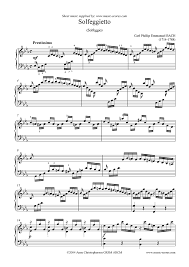
Solfeggietto is a short solo keyboard piece in c minor composed in 1766 by Carl Philipp Emanuel Bach. Carl Philipp Emanuel Bach was a German composer and the son of J.S. Bach.
“Solfeggietto” is an Italian word meaning “little study” or exercise.
The work is unusual for a keyboard piece in that the main theme is only one note being played at a time. The piece is commonly assigned to piano students and appears in many anthologies.
This piece is easily Bach’s best-known and is often performed by left-hand alone.
See if you can follow along. The notes with the stems down (even in the treble clef) are normally played with the left hand.
With just the left hand:
Electric Guitar
Bass Clarinet
Clarinet sextet
Harp
Are you any of these? This is the first annoying pianist. Too Humble – Solfeggietto in C minor by C.P.E. Bach
Johann Sebastian Bach’s towering monument of organ music, with its deep sense of foreboding, will forever be associated with Halloween.
Get a free copy of the sheet music at IMSLP or borrow a copy from the O’Connor Music Studio. I have this arranged for organ, piano, duet, 2-piano, simplified…
It’s also available in Piano Maestro, Piano Pronto Encore and Coda
• 1732 ~ Johann Christoph Friedrich Bach, composer and 5th son of Johann Sebastian Bach
• 1790 ~ Wilhelm Speyer, Composer
• 1805 ~ Karl Friedrich Curschmann, Composer
• 1846 ~ Adolphe Sax patented the saxophone he invented in 1840
• 1862 ~ Henry Holden Huss, Composer
• 1865 ~ Albert Herbert Brewer, Composer
• 1868 ~ Wagner’s opera “Die Meistersinger von Nuernberg” premiered in Munich
• 1887 ~ Adolf Schimon, Composer, died at the age of 67
• 1892 ~ Hilding Rosenberg, Swedish composer
• 1893 ~ Alois Hába, Czech opera composer and writer
• 1900 ~ Gunnar Ek, Composer (he died on 81st birthday)
• 1900 ~ Polibo Fumagalli, Composer, died at the age of 69
• 1903 ~ Louis Krasner, violinist
• 1906 ~ Luis Maria Millet, Composer
• 1908 ~ Nicolai Rimsky-Korsakov, Russian Composer, died at the age of 64. He was best known for his orchestral piece “Sheherezade” and the opera “The Golden Cockerel” as well as his re-orchestration of Moussorgsky’s opera “Boris Godunov.”
More information about Rimsky-Korsakov
• 1941 ~ Wayne King and his orchestra recorded Time Was, with Buddy Clark providing the vocal accompaniment, for Victor Records.
• 1944 ~ Ray Davies, Musician, guitar, singer, songwriter with The Kinks
• 1945 ~ Chris Britton, Guitarist with The Troggs
• 1946 ~ Brenda Holloway, American singer and songwriter
• 1946 ~ Heinrich Kaminski, Composer, died at the age of 59
• 1948 ~ Columbia Records announced that it was offering a new Vinylite long-playing record that could hold 23 minutes of music on each side. One of the first LPs produced was of the original cast of the Broadway show, South Pacific. Critics quickly scoffed at the notion of LPs, since those heavy, breakable, 78 RPM, 10- inch disks with one song on each side, were selling at an all-time high. It didn’t take very long though, for the 33-1/3 RPM album — and its 7-inch, 45 RPM cousin to revolutionize the music industry and the record buying habits of millions.
• 1951 ~ Nils Lofgren, Musician, guitar, keyboards, singer, songwriter
• 1958 ~ Splish Splash was recorded by Bobby Darin. It was his first hit and it took Darin only ten minutes to write the song.
• 1972 ~ Billy Preston received a gold record for the instrumental hit, Outa-Space. Preston, who played for gospel singer Mahalia Jackson, back in 1956, was also in the film St. Louis Blues as a piano player. He was a regular on the Shindig TV show in the 1960s; and recorded with The Beatles on the hits Get Back and Let It Be. Preston also performed at The Concert for Bangladesh in 1969. Many well-known artists have utilized his keyboard talents, including Sly & The Family Stone and the Rolling Stones.
• 1972 ~ Seth Bingham, Composer, died at the age of 90
• 1975 ~ Heinz Lau, Composer, died at the age of 49
• 1985 ~ Ron Howard directed his first music video. The TV star of The Andy Griffith Show and Happy Days also directed the film Cocoon, which included Gravity, the song used in the video. Michael Sembello, a guitarist who played on StevieWonder’s hits between 1974 and 1979 was responsible for Gravity.
• 1990 ~ June Christy passed away
• 1990 ~ Little Richard received a star on Hollywood’s walk of fame
• 1992 ~ Thomas Whitfield, Gospel vocalist, died of heart attack at 38
• 1993 ~ “Camelot” opened at the Gershwin Theater New York City for 56 performances
• 1997 ~ Art Prysock, Jazz musician, died at the age of 68
• 2000 ~ Alan Hovhaness, a prolific composer who melded Western and Asian musical styles, died at the age of 89.
More information about Hovhaness
• 2001 ~ Bluesman John Lee Hooker, whose foot-stompin’ and gravelly voice on songs like Boom Boom and Boogie Chillen electrified audiences and inspired generations of musicians, died of natural causes at the age of 83. He recorded more than 100 albums over nearly seven decades. He won a Grammy Award for a version of In The Mood, was inducted into the Rock and Roll Hall of Fame in 1991 and received a Lifetime Achievement Award at last year’s Grammys. His distinctive sound influenced rhythm and blues musicians, as well as rock ‘n’ rollers including Van Morrison, the Rolling Stones, Eric Clapton, Bruce Springsteen, Bonnie Raitt and ZZ Top. Hooker’s 1990 album “The Healer“, featured duets with Carlos Santana, Raitt and Robert Cray. It sold 1.5 million copies and won him his first Grammy Award, for a duet with Raitt on I’m in the Mood. Born in Clarksdale, Miss., August 22, 1917, Hooker was one of 11 children born to a Baptist minister and sharecropper who discouraged his son’s musical bent. In Detroit, he was discovered and recorded his first hit, Boogie Chillen, in 1948.
• 2003 ~ William Leslie died at the age of 78. He was a jazz saxophonist who toured the world with the Louis Jordan Band in the 1950s in Sellersville, Pa. He played with the Jordan Band in New York, Chicago, Las Vegas and Europe and on the television show “Your Hit Parade.” Mr. Leslie had played the saxophone since he was 12. After serving in World War II, he attended the Landis School of Music in West Philadelphia, Pa., on the GI Bill.
• 2015 ~ Gunther Schuller, American hornist and jazz composer (1994 Pulitzer Prize), died at the age of 89
Happy Birthday is a song that I like to have each of my students learn at various levels appropriate to their level. When a friend or family member has a birthday, it’s great to be able to sit down and play.
It’s only been fairly recently that piano students could have this music in their books.
“Happy Birthday to You”, more commonly known as simply “Happy Birthday”, is a song that is traditionally sung to celebrate the anniversary of a person’s birth. According to the 1998 Guinness World Records, “Happy Birthday to You” is the most recognized song in the English language, followed by “For He’s a Jolly Good Fellow”.
The melody, or part you sing, of “Happy Birthday to You” comes from the song “Good Morning to All”, which has traditionally been attributed to American sisters Patty and Mildred J. Hill in 1893, although the claim that the sisters composed the tune is disputed.
Patty Hill was a kindergarten principal and her sister Mildred was a pianist and composer. The sisters used “Good Morning to All” as a song that young children would find easy to sing. The combination of melody and lyrics in “Happy Birthday to You” first appeared in print in 1912, and probably existed even earlier.
“Happy Birthday” in the style of Bach, Mozart, Beethoven, Mendelssohn, Chopin, Liszt, Dvorak, and Stravinsky. Find the melody!
Lots of legal stuff below which you can skip…
None of the early appearances of the “Happy Birthday to You” lyrics included credits or copyright notices. The Summy Company registered a copyright in 1935, crediting authors Preston Ware Orem and Mrs. R. R. Forman. In 1988, Warner/Chappell Music purchased the company owning the copyright for US$25 million, with the value of “Happy Birthday” estimated at US$5 million. Based on the 1935 copyright registration, Warner claimed that the United States copyright will not expire until 2030, and that unauthorized public performances of the song are illegal unless royalties are paid to Warner. In one specific instance in February 2010, these royalties were said to amount to US$700. By one estimate, the song is the highest-earning single song in history, with estimated earnings since its creation of US$50 million.In the European Union, the copyright for the song expired on January 1, 2017.
The American copyright status of “Happy Birthday to You” began to draw more attention with the passage of the Sonny Bono Copyright Term Extension Act in 1998. When the U.S. Supreme Court upheld the Act in Eldred v. Ashcroft in 2003, Associate Justice Stephen Breyer specifically mentioned “Happy Birthday to You” in his dissenting opinion. American law professor Robert Brauneis, who extensively researched the song, concluded in 2010 that “It is almost certainly no longer under copyright.”
In 2013, based in large part on Brauneis’s research, Good Morning to You Productions, a company producing a documentary about “Good Morning to All”, sued Warner/Chappell for falsely claiming copyright to the song. In September 2015, a federal judge declared that the Warner/Chappell copyright claim was invalid, ruling that the copyright registration applied only to a specific piano arrangement of the song, and not to its lyrics and melody.
In 2016, Warner/Chappell settled for US $14 million, and the court declared that “Happy Birthday to You” was in the public domain.
Legal stuff is finished and people can now sing and play “Happy Birthday to You” whenever and wherever they want.
One of my all-time versions of Happy Birthday, in duet form – and I have the music if you want to tackle it.
• 1750 ~ Johann Valentin Rathgeber, German Composer, died at the age of 68
• 1806 ~ Isaac Strauss, Composer
• 1807 ~ Robert Fuhrer, Composer
• 1830 ~ Olivier Metra, Composer
• 1831 ~ Jan G Palm Curaçao, Bandmaster/choir master/composer
• 1857 ~ Sir Edward Elgar, British composer Elgar’s Pomp and Circumstance, usually heard at graduations, was featured in Disney’s Fantasia 2000.
Read quotes by and about Elgar
More information about Elgar
• 1858 ~ Harry Rowe Shelley, Composer
• 1863 ~ Paul Felix Weingartner, German conductor
• 1873 ~ François Hainl, Composer, died at the age of 65
• 1876 ~ Hakon Borresen, Composer
• 1891 ~ Ernst Kunz, Composer
• 1897 ~ Alexander Tansman, Composer
• 1900 ~ David Wynne, Composer
• 1909 ~ Robin Orr, Composer
• 1913 ~ Bert Farber, Orchestra leader for Arthur Godfrey and Vic Damone
• 1915 ~ Robert Moffat Palmer, American composer
• 1927 ~ Carl Butler, Country entertainer, songwriter
• 1927 ~ Freidrich Hegar, Composer, died at the age of 85
• 1929 ~ Alcides Lanza, Composer
• 1929 ~ Frederic Devreese, Composer
• 1932 ~ Sammy Turner (Samuel Black), Singer
• 1934 ~ Johnny Carter, American singer
• 1937 ~ Louis Vierne, Composer, died at the age of 66
• 1939 ~ Charles Miller, Saxophonist and clarinetist
• 1941 ~ William Guest, Singer with Gladys Knight & The Pips
• 1941 ~ Charlie Watts, Drummer with Rolling Stones
• 1944 ~ Marvin Hamlisch, American pianist, composer and arranger of popular music
More information about Hamlisch
• 1947 ~ Hermann Darewsky, Composer, died at the age of 64
• 1949 ~ Dynam-Victor Fumet, Composer, died at the age of 82
• 1949 ~ Ernest Ford, Composer, died at the age of 91
• 1960 ~ For the first time in 41 years, the entire Broadway theatre district in New York City was forced to close. The Actors Equity Union and theatre owners came to a showdown with a total blackout of theatres.
• 1964 ~ The original cast album of “Hello Dolly!” went gold — having sold a million copies. It was quite a feat for a Broadway musical.
• 1964 ~ “Follies Bergere” opened on Broadway for 191 performances
• 1972 ~ Franz Philipp, Composer, died at the age of 81
• 1977 ~ Henri D Gagnebin, Swiss organist and composer, died at the age of 91
• 1982 ~ “Blues in the Night” opened at Rialto Theater NYC for 53 performances
• 1983 ~ Stan Rogers, musician, died in aircraft fire
• 1985 ~ The Huck Finn-based musical “Big River” earned seven Tony Awards in New York City at the 39th annual awards presentation.
• 1986 ~ Daniel Sternefeld, Belgian conductor and composer died at the age of 80
• 1987 ~ Andres Segovia, Spanish classical guitarist, died at the age of 94. He established the guitar as a serious classical instrument through his numerous concerts and by his transcriptions of many pieces of Bach and Handel.
More information on Segovia
• 1987 ~ Sammy Kaye, Orchestra leader (Sammy Kaye Show), died at the age of 77
• 1994 ~ Prima Sellecchia Tesh, daughter of John Tesh and Connie Sellecca
• 1997 ~ Doc Cheatham, Jazz musician, died of stroke at the age of 91
• 2001 ~ Imogene Coca, the elfin actress and satiric comedienne who co-starred with Sid Caesar on television’s classic “Your Show of Shows” in the 1950s, died at the age of 92. Coca’s saucer eyes, fluttering lashes, big smile and boundless energy lit up the screen in television’s “Golden Age” and brought her an Emmy as best actress in 1951. Although she did some broad burlesque, her forte was subtle exaggeration. A talented singer and dancer, her spoofs of opera divas and prima ballerinas tiptoed a fine line between dignity and absurdity until she pushed them over the edge at the end. With Caesar she performed skits that satirized the everyday – marital spats, takeoffs on films and TV programs, strangers meeting and speaking in cliches. “The Hickenloopers” husband-and-wife skit became a staple.
• 2015 ~ Paul Karolyi, Hungarian composer, died at the age of 80
Piano Day, an annual worldwide event founded by a group of like-minded people, takes place on the 88th day of the year – in 2019 it’s the 29th March – because of the number of keys on the instrument being celebrated.
. 1788 ~ Charles Wesley, writer of over 5,500 hymns and, with his brother John, the founder of Methodism, died.
. 1871 ~ The Royal Albert Hall in London opened
. 1878 ~ Albert Von Tilzer, Composer. He was the composer of “Take Me out to the Ball Game” among other old favorites.
More information about Von Tilzer
. 1879 ~ “Eugene Onegin”, best-known opera by Russian composer Tchaikovsky, was first performed at the Maliy Theatre in Moscow
. 1947 ~ Bobby Kimball (Toteaux), Singer with Toto
. 1949 ~ Michael Brecker, Jazz musician, reeds with The Brecker Brothers
. 1951 ~ The King and I, the wonderful Rodgers and Hammerstein musical based on Margaret Langdon’s novel, Anna and the King of Siam, opened this night in 1951 on Broadway. The King and I starred Yul Brynner in the role of the King of Siam. The king who, along with his subjects, valued tradition above all else. From this day forward, the role of the King of Siam belonged to Yul Brynner and no other. Brynner appeared in this part in more than 4,000 performances on both stage and screen (the Broadway show was adapted for Hollywood in 1956). Anna, the English governess hired to teach the King’s dozens of children, was portrayed by Gertrude Lawrence. Ms. Lawrence and Mr. Brynner acted, danced and sang their way into our hearts with such memorable tunes as Getting to Know You, Shall We Dance, Hello, Young Lovers, I Whistle a HappyTune, We Kiss in a Shadow, I Have Dreamed, Something Wonderful, A Puzzlement and March of the Siamese Children. The King and I ran for a total of 1,246 outstanding performances at New York’s St. James Theatre.
. 1952 ~ Roy Henderson’s last singing performance was on this date in the role of Christus in Bach’s “St. Matthew Passion” at Southwark Cathedral, the Anglican cathedral on the south bank of the Thames in London.
. 1973 ~ Hommy, the Puerto Rican version of the rock opera Tommy, opened in New York City. The production was staged at Carnegie Hall.
. 1973 ~ After recording On the Cover of ‘Rolling Stone’, Dr. Hook finally got a group shot on the cover of Jann Wenner’s popular rock magazine. Inside, a Rolling Stone writer confirmed that members of the group (Dr. Hook and the Medicine Show) bought five copies of the magazine for their moms – just like in the song’s lyrics!
. 1980 ~ Annunzio Paolo Mantovani, Anglo-Italian conductor and arranger, died. Created the “Mantovani sound” that made him a highly successful recording artist and concert attraction.
. 1982 ~ Carl Orff, German composer of “Carmina Burana,” died.
. 1982 ~ Ray Bloch passed away
. 1999 ~ Legendary U.S. jazz and blues singer Joe Williams died aged 80.
. 2001 ~ John Lewis, a pianist who masterminded one of the most famous ensembles in jazz, the Modern Jazz Quartet, died at the age of 80. The M.J.Q., as the quartet was known, remained mostly unchanged from the mid-1950’s to the 90’s. It began recording in 1952 with Lewis, vibraphonist Milt Jackson, bassist Percy Heath and drummer Kenny Clarke. When Clarke moved to Paris in 1955, Connie Kay replaced him and the quartet continued until Kay’s death in 1994. Lewis contributed the bulk of the group’s compositions and arrangements, including Django and Two Degrees East, Three Degrees West, and he insisted members wear tuxedos to dignify jazz as an art. He was born in LaGrange, Ill., in 1920, and grew up in Albuquerque, N.M. His entree to the jazz world came during World War II, when he met Kenny Clarke, an established drummer in the nascent bebop movement. At Clarke’s urging, Lewis moved to New York after his discharge and eventually replaced Thelonious Monk as Dizzy Gillespie’s pianist. He also performed or recorded with Charlie Parker, Lester Young and Ella Fitzgerald. In 1952 he formed the M.J.Q. with Clarke, Jackson and Heath. The quartet was a steady seller of records and concert tickets well into the 1970’s. Lewis also taught music at Harvard and the City College of New York, and in the late 1950’s helped found the Lenox School of Jazz in Massachusetts.
. 2009 ~ Maurice Jarre, French composer (Doctor Zhivago-Acadamy Award winner in 1966), died at the age of 84
. 1731 ~ Johann Sebastian Bach‘s first performance of the St. Mark Passion. It was Good Friday that year.
. 1743 ~ It was the first London performance of Handel’s “Messiah”, and King King George II was in the audience. In the middle of the “Hallelujah Chorus, the King rose to his feet in appreciation of the great piece! The entire audience followed suit out of respect for the King. And so began the custom of standing during the singing of the “Hallelujah Chorus”.
More about Handel’s Messiah
. 1750 ~ Johann Matthias Sperger, Austrian contrabassist and composer.
. 1878 ~ Franz Schreker, Austrian composer and conductor
. 1887 ~ Anthony von Hoboken, Dutch music bibliographer; cataloguer of the works of Haydn
. 1917 ~ Johnny Guarnieri, Pianist, played with Benny Goodman and Artie Shaw; played at the Tail O’ The Cock in LA for a decade
. 1926 ~ Martha Wright (Wiederrecht), Singer on The Martha Wright Show
. 1927 ~ Régine Crespin, French soprano
. 1949 ~ Ric Ocasek (Richard Otcasek), Guitarist, singer with The Cars
. 1950 ~ Aaron Copland won an Oscar for his score to the movie The Heiress
. 1953 ~ Chaka Khan (Yvette Marie Stevens), Singer
. 1974 ~ Cher reached the top of the music charts as Dark Lady reached the #1 spot for a one-week stay. Other artists who shared the pop music spotlight during that time included: Terry Jacks, John Denver, Blue Swede, Elton John and MFSB.
. 1985 ~ Singer Billy Joel married supermodel Christie Brinkley in private ceremonies held in New York City.
. 1985 ~ Zoot (John Haley) Sims passed away. He was an American jazz saxophonist, playing mainly tenor and soprano.
. 1985 ~ We Are the World, by USA for Africa, a group of 46 pop stars, entered the music charts for the first time at number 21.
. 2000 ~ Ed McCurdy, a leading 1950s folk music figure whose songs were recorded by Johnny Cash, Arlo Guthrie and Joan Baez, in Halifax, Novia Scotia. He was 81.





 1829 ~ Louis Moreau Gottschalk, American pianist and composer
 MaryO'Studio