Eine Kleine Nachtmusik (Serenade No. 13 for strings in G major), K. 525, is a 1787 composition for a chamber ensemble by Wolfgang Amadeus Mozart. The German title means “a little serenade”, though it is often rendered more literally but less accurately as “a little night music.” The work is written for an ensemble of two violins, viola, and cello with optional double bass but is often performed by string orchestras and there are many arrangements for other instruments as we will see below.
Part of a full orchestral score:
Follow the score…
Easy piano sheet music might look like this:
The first movement of Mozart’s Eine Kleine Nachtmusik, with a graphical score.
One of my favorites, Barbershop-Style. Eine Kleine Not Musik by the Gas House Gang tells the story of The Magic Flute (from June 19) to the music of Eine Kleine Nachtmusik.
A piano transcription
For four recorders, all played by the same person
From the Muppets: The Great Gonzo performing Eine Kleine Nachtmusik on bagpipe while sitting on a ten-foot pole!
When my son and I played Eine Kleine Nachtmusik by Mozart arranged for 2 pianos November 30, 2014 we were the last people to play in the old Steinway Hall. Unfortunately, we didn’t have a good video camera 😦
Find this arranged for piano in Piano Pronto: Movement 2, Movement 3, Encore, Coda and Mozart: Exploring His Life and Music.
• 1819 ~ Jacques Offenbach, German-born French conductor, cellist and composer of operettas
Read quotes by and about Offenbach
More information about Offenbach
• 1833 ~ Philip Knapton, Composer, died at the age of 44
• 1837 ~ Giovanni Furno, Composer, died at the age of 89
• 1842 ~ Michael Umlauf, Composer, died at the age of 60
• 1861 ~ Arthur Battelle Whiting, Composer
• 1883 ~ Giannotto Bastianelli, Composer
• 1888 ~ Cesare Dominiceti, Composer, died at the age of 66
• 1899 ~ Anthon van der Horst, Dutch organist and composer
• 1922 ~ Vittorio Monti, Composer, died at the age of 54
• 1923 ~ Joseph Leopold Rockel, Composer, died at the age of 85
• 1924 ~ Chet Atkins (Chester Burton), Grammy Award-winning guitarist, made over 100 albums and elected to Country Music Hall of Fame in 1973.
• 1925 ~ Wilhelm Posse, Composer, died at the age of 72
• 1927 ~ John M Dengler, Jazz bass sax, trumpet, trombone
• 1928 ~ Robert Satanowski, Composer
• 1929 ~ Ingrid Haebler, Austrian pianist
• 1931 ~ Arne Nordheim, Norwegian conductor and composer
• 1934 ~ Cornel Taranu, Composer
• 1938 ~ Nikolay Avksentevich Martinov, Composer
• 1939 ~ first TV broadcast of an operetta, “The Pirates of Penzance” by Gilbert and Sullivan W2XBS (later WCBS-TV) in New York City televised Pirates of Penzance. It was presented to a very small viewing audience since television was a new, experimental medium at the time.
• 1936 ~ Billy Guy, Singer with The Coasters
• 1937 ~ Jerry Keller, Singer
• 1940 ~ Jehan Alain, French organist and composer, died in battle at 29
• 1942 ~ Brian Wilson, Bass player, singer with The Beach Boys, inducted into Rock and Roll Hall of Fame in 1988
• 1946 ~ André Watts, American pianist, Chicago Symphony Orchestra
• 1948 ~ George Frederick Boyle, Composer, died at the age of 61
• 1949 ~ Lionel Richie, Tenor sax, songwriter, singer with the Commodores
• 1951 ~ Peter Gordon, Composer
• 1953 ~ Cyndi Lauper, Singer
• 1953 ~ Alan Longmuir, Musician, bass with Bay City Rollers
• 1955 ~ Michael Anthony, Musician, bass with Van Halen
• 1955 ~ “Almost Crazy” opened at Longacre Theater New York City for 16 performances
• 1960 ~ John Taylor, Musician: guitar, bass with Duran Duran
• 1963 ~ The Beatles formed “Beatles Ltd” to handle their income
• 1969 ~ Guitarist Jimi Hendrix earned the biggest paycheck ever paid (to that time) for a single concert appearance. Hendrix was paid $125,000 to appear for a single set at the Newport Jazz Festival.
• 1970 ~ The Long and Winding Road, by The Beatles, started a second week in the number one spot on the pop music charts. The tune was the last one to be released by The Beatles.
• 1975 ~ Daniel Ayala Perez, Composer, died at the age of 68
• 1980 ~ Gustaf Allan Pettersson, Composer, died at the age of 68
• 1987 ~ Whitney Houston’s album, Whitney, debuted on Billboard magazine’s album chart at number one. Houston became the first female to have an LP debut at the top. The singer, daughter of Cissy Houston and cousin of Dionne Warwick, began her singing career at age 11 with the New Hope Baptist Junior Choir in New Jersey. Houston first worked as a backup vocalist for Chaka Khan and Lou Rawls; entered modeling in 1981, appearing in Glamour magazine and on the cover of Seventeen. Whitney married soul singer, Bobby Brown, in the late 1980s.
• 1997 ~ Lawrence Payton, singer with the Four Tops, died at the age of 59
In the United States and the rest of the northern hemisphere, the first day of the summer season is the day of the year when the Sun is farthest north (on June 20th or 21st). This day is known as the Summer Solstice.
Today’s listening assignment is Can-can from “Orpheus in the Underworld” by Jacques Offenbach. This piece is very often in early method books because of the descending C Major scale. Can you find it?
The can-can (or cancan as in the original French) is a high-energy, physically demanding dance that became a popular music hall dance in the 1840s, continuing in popularity in French cabaret to this day. Originally danced by both sexes, it is now traditionally associated with a chorus line of female dancers. The main features of the dance are the vigorous manipulation of skirts and petticoats, along with high kicks, splits, and cartwheels.
Many composers have written music for the cancan. Today’s selection is the most famous of these.
A ‘follow-along” video. This key has 6 flats, so the scale will be in what key?
Flute ensemble:
The original, for full orchestra
An animation
A dog barking the can-can?
Find this in many student books including Piano Pronto: Movement 1
• 1886 ~ Robert Herberigs, Flemish Composer and writer
• 1898 ~ Paul Muller-Zurich, Composer
• 1902 ~ Guy (Gaetano) Lombardo, Canadian-born American bandleader with The Royal Canadians: “The most beautiful music this side of heaven.”
• 1904 ~ Balis Dvarionas, Composer
• 1905 ~ Taneli Kuusisto, Composer
• 1910 ~ Edwin Gerschefski, Composer
• 1910 ~ Father’s Day was observed for the first time at Spokane, Wash., at the request of the the local YMCA and the Spokane Ministerial Association to earmark a Sunday to “honor thy father.” The idea originated in the mind of a Ms. John Bruce Dodd, a local housewife who was inspired by her admiration for the great job her father, William Smart, had done in raising his 6 children after his wife’s untimely and early death.
• 1912 ~ Jerry Jerome, American saxophonist
• 1913 ~ Sergey Ivanovich Taneyev, Russian Composer, died at the age of 58
• 1926 ~ DeFord Bailey was the first black to perform on Nashville’s Grand Ole Opry
• 1927 ~ Karel Kupka, Composer
• 1930 ~ Jul Levi, Composer
• 1932 ~ First concert performed in San Francisco’s Stern Grove
• 1936 ~ Tommy DeVito, Singer with The Four Seasons
• 1939 ~ Al Wilson, Musician, drummer, singer with Show and Tell
• 1940 ~ Maurice Jaubert, Composer, died at the age of 40
• 1942 ~ Spanky (Elaine) McFarlane, Singer with Spanky and Our Gang
• 1943 ~ Sheik Of Araby by Spike Jones & City Slickers peaked at #19
• 1951 ~ Ann Wilson, Singer with Heart
• 1953 ~ Larry Dunn, Musician, keyboards with Earth, Wind & Fire
• 1956 ~ Doug Stone, Singer
• 1960 ~ Loretta Lynn recorded Honky Tonk Girl
• 1961 ~ Little Egypt (Ying-Yang) by Coasters peaked at #23
• 1962 ~ Paula Abdul, Singer
• 1965 ~ I Can’t Help Myself, by The Four Tops, topped the pop and R&B charts. The Tops, who had no personnel changes in their more than 35 years together were inducted into the Rock and Roll Hall of Fame in 1990.
• 1966 ~ Marjan Kozina, Composer, died at the age of 59
• 1984 ~ Wladimir Rudolfovich Vogel, Composer, died at the age of 88
• 1988 ~ Zdenek Blazek, Composer, died at the age of 83
• 1994 ~ “She Loves Me” closed at Atkinson Theater New York City after 294 performances
• 1994 ~ “Twilight – Los Angeles 1992” closed at Cort New York City after 72 performances
• 1995 ~ Murray Dickie, Opera singer/director, died at the age of 71
• 1996 ~ Alan Ande Anderson, Opera director, died at the age of 78
• 1996 ~ Vivian Ellis, Composer, died at the age of 91
• 1997 ~ Bobby Helms, singer (Jingle Bell Rock), died at the age of 63
• 1997 ~ “Forever Tango!” opened at Walter Kerr Theater New York City
Today’s piece is one of those that piano students often try to learn on their own – or a friend will teach them the first 9 notes. It’s usually played too fast and, often in the wrong octave, or the first couple notes are repeated too many times.
This is one of two pieces that are so often played incorrectly that they have the distinction of being banned from competition in Northern Virginia Piano Teacher competitions.
Stay tuned for the other one!
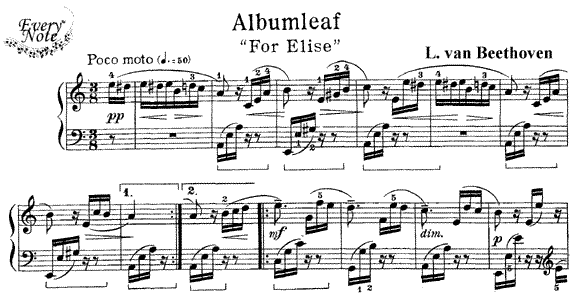
Für Elise was not published during Beethoven’s lifetime, having been discovered by Ludwig Nohl 40 years after the composer’s death. The identity of “Elise” is unknown.
The very basic melody:
From Wunderkeys – The Elise Session
The actual beginning is a little more involved.
And, there’s more!
If you’d like to learn to play this piece correctly, find the sheet music at IMSLP, Beethoven: Exploring His Life and Music, and countless compilations of classical music available at the O’Connor Music Studio.
Follow along:
By Valentina Lisitsa:
Ragtime!
The Big Piano at FAO Schwartz in NYC:
Glass harp:
The Mystery Behind Für Elise:
Youtube has many, many more versions. Beethoven would probably go nuts!
• 1686 ~ Johann Quirsfeld, Composer, died at the age of 43
• 1726 ~ Giuseppe Scarlotti (1723) Composer
• 1726 ~ Michel-Richard Delalande, Composer, died at the age of 68
• 1726 ~ August Holler (1744) Composer
• 1726 ~ Ignaz Joseph Pleyel (1757) Composer
• 1780 ~ Michael Henkel, Composer
• 1799 ~ Johann André, Composer, died at the age of 58
• 1821 ~ Charles Hague, Composer, died at the age of 52
• 1821 ~ Opera “Der Freischütz” by Carl Maria von Weber was produced in Berlin
• 1822 ~ Henry David Leslie, Composer
• 1850 ~ Richard Heuberger, Composer
• 1850 ~ Antoni Weinert, Composer, died at the age of 99
• 1859 ~ Joseph Hartmann Stuntz, Composer, died at the age of 65
• 1876 ~ August Rockel, Composer, died at the age of 61
• 1892 ~ Edward Steuermann, Composer
• 1901 ~ Jeanette MacDonald, Singer with Nelson Eddy
• 1902 ~ Louis Alter, Composer
• 1904 ~ Manuel Rosenthal, French composer
• 1905 ~ Eduard Tubin, Composer
• 1906 ~ Kaye Kyser, Bandleader Kay Kyser and His Kollege of Musical Knowledge
More information about Kyser
• 1907 ~ Benny Payne, American pianist for the Billy Daniels Show
• 1909 ~ Learmont Drysdale, Composer, died at the age of 42
• 1934 ~ Ray McKinley (1910) Musician, drummer, led Glenn Miller Band for the estate from 1956 until 1966.
• 1911 ~ Franjo Zaver Kuhac, Composer, died at the age of 76
• 1913 ~ Sammy Cahn, Composer and lyricist
More information about Cahn
• 1915 ~ Victor Legley, Composer
• 1917 ~ Akhmet Jevdet Ismail Hajiyev, Composer
• 1918 ~ Bob Carroll, Singer and actor
• 1923 ~ Herman Krebbers, Dutch violist and concertmaster
• 1925 ~ Herman “Ace” Wallace, Blues guitarist and singer
• 1927 ~ Simeon Pironkov, Composer
• 1933 ~ Tommy Hunt, American singer
• 1934 ~ Francisco Lacerda, Composer, died at the age of 65
• 1935 ~ August Reusner, Composer, died at the age of 64
• 1941 ~ Lamont Dozier, Composer
• 1942 ~ Hans Vonk, Dutch conductor
• 1942 ~ Arthur Willard Pryor, Composer, died at the age of 71
• 1942 ~ Paul McCartney, British rock singer, songwriter and guitarist
More information about McCartney
• 1944 ~ Paul Lansky, Composer
• 1944 ~ Douglas Young, Composer
• 1948 ~ Eva Marton, Hungarian soprano
• 1949 ~ “Along Fifth Avenue” closed at Broadhurst Theater NYC after 180 performances
• 1953 ~ Jerome Smith, Musician, guitarist with KC & The Sunshine Band
• 1955 ~ Walter Rein, Composer, died at the age of 61
• 1955 ~ Willy Burkhard, Composer, died at the age of 55
• 1962 ~ Volkmar Andreae, Swiss conductor and Composer, died at the age of 82
• 1964 ~ Alexander Shamil’yevich Melik-Pashayev, Composer, died at the age of 58
• 1965 ~ George Melachrino, Composer, died at the age of 56
• 1973 ~ Fritz Mahler, Composer, died at the age of 71
• 1977 ~ Fleetwood Mac worked Dreams to the number one spot on the pop music charts this day. It would be the group’s only single to reach number one. Fleetwood Mac placed 18 hits on the charts in the 1970s and 1980s. Nine were top-ten tunes.
‘The Magic Flute’ (German name: Die Zauberflöte) is Wolfgang Amadeus Mozart’s final opera, and it contains one of the most well-known arias in music. But what is ‘The Magic Flute’ all about?
An animated version:
Played as a piano/organ duo:
Arranged by Ferruccio Busoni for 2 pianos:
Why Mozart’s Magic Flute is a masterpiece – an introduction (The Royal Opera)
The accordion version:
Find this in Piano Pronto: Movement 3, Encore, Mozart: Exploring His Life and Music
• 1672 ~ Orazio Benevoli, Italian Composer, died at the age of 67
• 1725 ~ Joseph Anton Bauer, Composer
• 1750 ~ Michel Woldemar, Composer
• 1818 ~ Charles Gounod, French composer, conductor and organist
Read quotes by and about Gounod
More information about Gounod
• 1855 ~ Fritz Steinbach, Composer
• 1882 ~ Igor Stravinsky, Russian-born American composer Stravinsky’s Firebird is featured in Fantasia 2000 and his The Rite of Spring was featured in the original Fantasia
Read quotes by and about Stravinsky
More information about Stravinsky Grammy winner
• 1883 ~ Alexandre Cellier, Composer
• 1888 ~ Bernhard van den Sigtenhorst Meyer, Composer
• 1900 ~ Hermann Reuter, Composer
• 1902 ~ Sammy Fain (Samuel Feinberg), Oscar-winning musician, composer
More information about Fain
• 1908 ~ John Verrall, Composer
• 1910 ~ Red (Clyde Julian) Foley, Songwriter, singer
• 1910 ~ Herbert Owen Reed, Composer
• 1916 ~ Einar Englund, Composer
• 1917 ~ Dean Martin, Entertainer
• 1922 ~ Herbert Kelsey Jones, Composer
• 1926 ~ Manuel Enriquez, Composer
• 1941 ~ Johan Wagenaar, Dutch Composer (Cyrano de Bergerac), died at the age of 78
• 1930 ~ Romuald Twardowski, Composer
• 1932 ~ Mignon Dunn, American mezzo-soprano
• 1933 ~ Christian Ferras, French violinist/conductor
• 1939 ~ Dickie Doo (Gerry Granahan), Singer with Dickie Doo and The Don’ts
• 1942 ~ Norman Kuhlke, Musician, drummer with The Swinging Blue Jeans
• 1943 ~ Christopher Brown, Composer
• 1943 ~ Barry Manilow, , American singer/pianist (Mandy, I Write the Songs)
• 1951 ~ Carl Vogler, Composer, died at the age of 77
• 1952 ~ Alberto Williams, Argentine Composer (Etrerno Reposo), died at the age of 89
• 1953 ~ Walter Niemann, Composer, died at the age of 76
• 1957 ~ So Rare by Jimmy Dorsey Orchestra peaked at #2
• 1967 ~ “Somebody To Love” by Jefferson Airplane peaked at #5
• 1967 ~ Barbra Streisand: A Happening in Central Park performed
• 1968 ~ Ohio Express’ Yummy Yummy Yummy went gold
• 1969 ~ Jazz musician Charles Mingus came out of a two-year, self-imposed retirement to make a concert appearance at the Village Vanguard in New York City.
• 1972 ~ Long Haired Lover From Liverpool by Little Jimmy Osmond peaked at #38
• 1978 ~ Shadow Dancing, by Andy Gibb, reached the number one spot on the pop music charts for the first of seven weeks. Gibb had two other number one hits: I just want to Be Your Everything and (Love is) Thicker than Water. Gibb, the youngest of the Gibb brothers who made up the Bee Gees, hosted TV’s Solid Gold in 1981-82. Andy scored nine hits on the pop music charts in the 1970s and 1980s. He died of an inflammatory heart virus in Oxford, England in 1988.
• 1978 ~ Cheeseburger In Paradise by Jimmy Buffett peaked at #32
• 1983 ~ Peter Mennin(i), American Composer (Moby Dick), died at the age of 60
• 1986 ~ Kate Smith died in Raleigh North Carolina at 78
• 1991 ~ Country entertainer Minnie Pearl suffered a stroke at 78
• 1992 ~ Dewey Balfa, Bayou fiddler, died at the age of 65
• 1995 ~ The Who’s “Tommy” closed at St James Theater NYC after 899 performances
• 2008 ~ Cyd Charisse [Tula Finklea], American dancer and actress (Singin’ in the Rain), died at the age of 86
Today’s assignment is a very popular piece by Johann Pachelbel called Canon in D.
A canon is a technique that employs a melody with one or more imitations of the melody played after a given duration (e.g., quarter rest, one measure, etc.). The initial melody is called the leader, while the imitative melody, which is played in a different voice, is called the follower. The follower must imitate the leader, either as an exact replication of its rhythms and intervals or some transformation thereof. Repeating canons in which all voices are musically identical are called rounds—”Row, Row, Row Your Boat” and “Frère Jacques” are popular examples.
The original version:
Can you see why the cellist is bored?
Here’s what his music looks like
And that repeats over and over for the whole piece!
A bit of humor from a past cellist:
Variations on the theme:
Find it in Piano Pronto Finale and Coda
If your student is in Wunderkeys, The Pachelbel Session is a pop take on Pachelbel’s Canon in D. You can find the sheet music for this piece in WunderKeys Intermediate Performance Companion for Pop Studies Book 3.








 Grammy winner


 MaryO'Studio