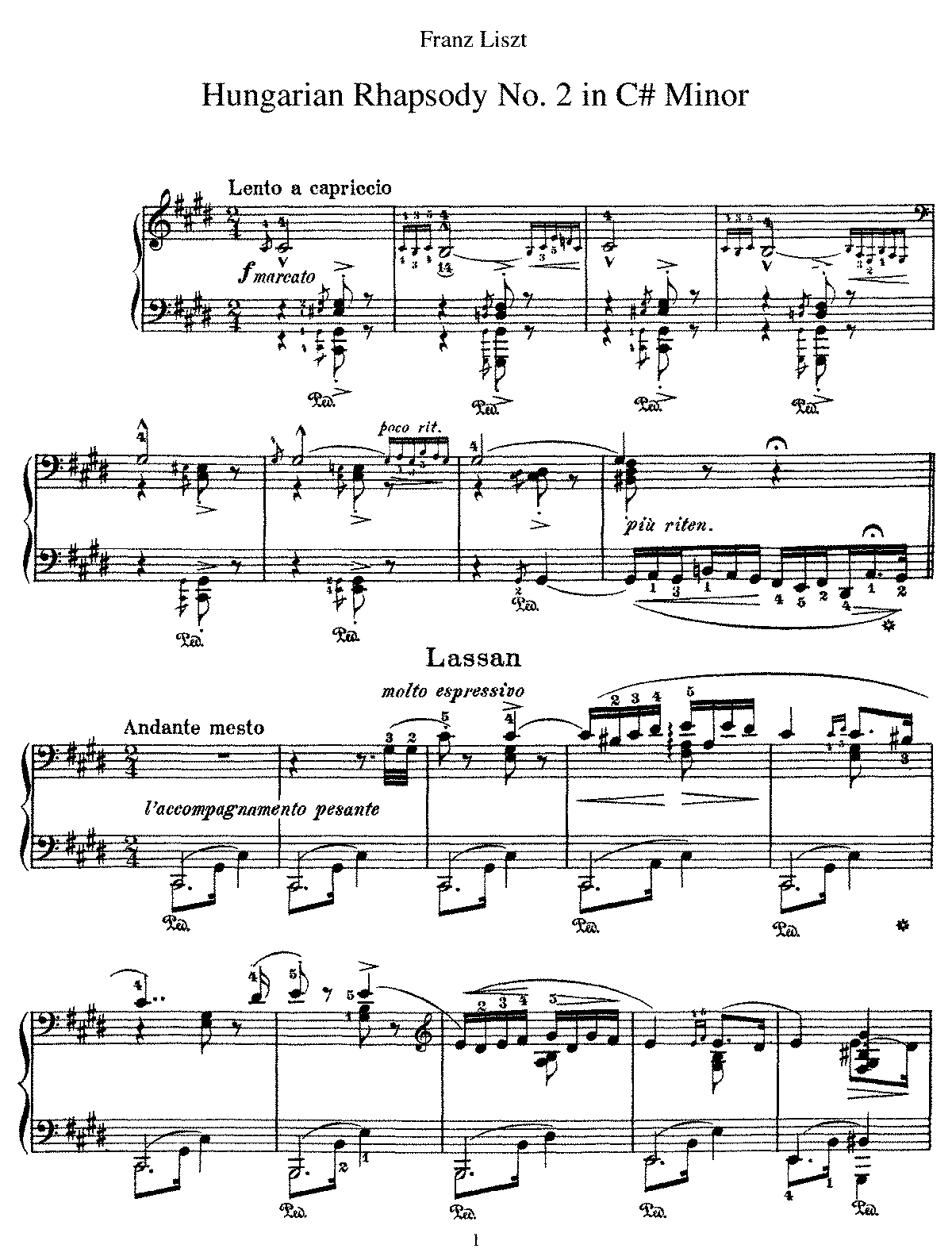
Danish comedian and pianist Victor Borge gives every impression of having been asked to play a duet with someone whom he not only doesn’t know, but doesn’t particularly like. Forced to come up with a mutually agreeable way of sharing the musical workload, he settles on the most difficult route possible.
It’s not clear why two pianists were needed for this performance of Liszt’s Hungarian Rhapsody No.2, S.244/2. I think that they did it just for the fun of it. The result is hilarious.
They’re not the only ones to tackle Liszt’s Hungarian Rhapsody No.2 as a piano duo. We also have these guys:
• 1829 ~ Alfonse Charles Renaud de Vilback, Composer
• 1832 ~ Alexander Charles Lecocq, Composer
• 1841 ~ Eduardo Caudella, Composer
• 1844 ~ Emile Paladilhe, Composer
• 1849 ~ Francois de Paule Jacques Raymond de Fossa, Composer, died at the age of 73
• 1858 ~ Julius Reubke, Composer, died at the age of 24
• 1867 ~ Bela Anton Szabados, Composer
• 1868 ~ Lvar Henning Mankell, Composer
• 1872 ~ Heinrich Esser, Composer, died at the age of 53
• 1875 ~ French composer Georges Bizet died at the age of 36, the same year his “Carmen” was first produced. It caused a scandal at first but went on to become one of opera’s most popular works.
More information on Bizet
• 1887 ~ Roland Hayes, American tenor
• 1887 ~ Emil Axman, Composer
• 1888 ~ Cark Reidel, Composer, died at the age of 60
• 1890 ~ Henryk Oskar Kolberg, Composer, died at the age of 76
• 1893 ~ Assen Karastoyanov, Composer
• 1898 ~ Nikolai Afanisev, Composer, died at the age of 77
• 1899 ~ Johann Strauss Jr., Viennese conductor and composer of waltzes including “The Blue Danube”, died at the age of 73.
More information on Strauss
• 1906 ~ Josephine Baker, American-born French jazz singer and dancer
• 1907 ~ Antonio Emmanvilovich Spadavecchia, Composer
• 1911 ~ Come Josephine in My Flying Machine hit #1
• 1913 ~ Josef Richard Rozkosny, Composer, died at the age of 79
• 1922 ~ Ivan Patachich, Composer
• 1926 ~ Carlos Veerhoff, Composer
• 1926 ~ Janez Maticic, Composer
• 1927 ~ Boots Randolph, American saxophonist (Yakety Sax)
• 1931 ~ The Band Wagon, a Broadway musical, opened in New York City. The show ran for 260 performances.
• 1932 ~ Dakota Staton (Aliyah Rabia), Jazz singer
• 1939 ~ Beer Barrel Polka hit #1 on the pop singles chart by Will Glahe
• 1942 ~ Curtis Mayfield, American rhythm-and-blues singer, songwriter, producer and guitarist Grammy Award-winner, inducted into the Rock and Roll Hall of Fame, March 15, 1999
• 1944 ~ Mike Clarke, Musician, drummer with The Byrds
• 1946 ~ Ian Hunter, Singer, songwriter with Mott the Hoople
• 1949 ~ Stephen Ruppenthal, Composer
• 1950 ~ Suzie Quatro (Quatrocchio), Singer
• 1951 ~ Deniece Williams, Singer
• 1952 ~ Frank Sinatra recorded the classic Birth of the Blues for Columbia Records
• 1959 ~ Ole Windingstad, Composer, died at the age of 73
• 1961 ~ Charles Hart, Lyricist: Phantom of the Opera
• 1961 ~ “Wildcat” closed at Alvin Theater NYC after 172 performances
• 1964 ~ The Hollywood Palace on ABC-TV hosted the first appearance of the first U.S. concert tour of The Rolling Stones. Dean Martin emceed the show. One critic called the Stones “dirtier and streakier and more disheveled than The Beatles.”
• 1971 ~ Yehudi Menuhin performed on a 250-year-old Stradivarius violin at Sothby’s auction house. It sold for $200,000.
• 1978 ~ Johnny Mathis and Deniece Williams combined their singing talents to reach the number one spot on the nation’s pop music charts with Too Much, Too Little, TooLate.
• 1986 ~ Arthur Charles Ernest Hoeree, Composer, died at the age of 89
• 1994 ~ Hub Matthijsen, Violinist/bandmaster, died at the age of 52
There’s more to a song than meets the ear, as Neil deGrasse Tyson finds out when he interviews singer/songwriter/producer Josh Groban. Josh shares how he got started playing his family’s electronic Casio piano while he was still in diapers, and whether he was a science geek in school.
In studio, concert pianist and MIT Lecturer in Music, Elaine Kwon, and co-host Chuck Nice add their voices to the chorus to help us hear the science woven into the songs. You’ll learn how artists breathe life into their music, and about the qualitative difference between human generated and automated music.
Explore the importance of the acoustics of a performance space, the effect music has on people, the difference between melody and harmony, the ranges the human voice is capable of, and which was more important, Charlie Parker’s personal style or his sax.
Plus, Neil and Josh discuss “acoustic panty removers”, Chuck admits to singing first soprano in his church choir, and we find out whether Rachmaninoff really had “big hands” and what rubato means.
• 1750 ~ Johann Valentin Rathgeber, German Composer, died at the age of 68
• 1806 ~ Isaac Strauss, Composer
• 1807 ~ Robert Fuhrer, Composer
• 1830 ~ Olivier Metra, Composer
• 1831 ~ Jan G Palm Curaçao, Bandmaster/choir master/composer
• 1857 ~ Sir Edward Elgar, British composer Elgar’s Pomp and Circumstance, usually heard at graduations, was featured in Disney’s Fantasia 2000.
Read quotes by and about Elgar
More information about Elgar
• 1858 ~ Harry Rowe Shelley, Composer
• 1863 ~ Paul Felix Weingartner, German conductor
• 1873 ~ François Hainl, Composer, died at the age of 65
• 1927 ~ Carl Butler, Country entertainer, songwriter
• 1927 ~ Freidrich Hegar, Composer, died at the age of 85
• 1929 ~ Alcides Lanza, Composer
• 1929 ~ Frederic Devreese, Composer
• 1932 ~ Sammy Turner (Samuel Black), Singer
• 1934 ~ Johnny Carter, American singer
• 1937 ~ Louis Vierne, Composer, died at the age of 66
• 1939 ~ Charles Miller, Saxophonist and clarinetist
• 1941 ~ William Guest, Singer with Gladys Knight & The Pips
• 1941 ~ Charlie Watts, Drummer with Rolling Stones
• 1944 ~ Marvin Hamlisch, American pianist, composer and arranger of popular music
More information about Hamlisch
• 1947 ~ Hermann Darewsky, Composer, died at the age of 64
• 1949 ~ Dynam-Victor Fumet, Composer, died at the age of 82
• 1949 ~ Ernest Ford, Composer, died at the age of 91
• 1960 ~ For the first time in 41 years, the entire Broadway theatre district in New York City was forced to close. The Actors Equity Union and theatre owners came to a showdown with a total blackout of theatres.
• 1964 ~ The original cast album of “Hello Dolly!” went gold — having sold a million copies. It was quite a feat for a Broadway musical.
• 1964 ~ “Follies Bergere” opened on Broadway for 191 performances
• 1972 ~ Franz Philipp, Composer, died at the age of 81
• 1977 ~ Henri D Gagnebin, Swiss organist and composer, died at the age of 91
• 1982 ~ “Blues in the Night” opened at Rialto Theater NYC for 53 performances
• 1983 ~ Stan Rogers, musician, died in aircraft fire
• 1985 ~ The Huck Finn-based musical “Big River” earned seven Tony Awards in New York City at the 39th annual awards presentation.
• 1986 ~ Daniel Sternefeld, Belgian conductor and composer died at the age of 80
• 1987 ~ Andres Segovia, Spanish classical guitarist, died at the age of 94. He established the guitar as a serious classical instrument through his numerous concerts and by his transcriptions of many pieces of Bach and Handel.
More information on Segovia
• 1987 ~ Sammy Kaye, Orchestra leader (Sammy Kaye Show), died at the age of 77
• 1994 ~ Prima Sellecchia Tesh, daughter of John Tesh and Connie Sellecca
• 1997 ~ Doc Cheatham, Jazz musician, died of stroke at the age of 91
• 2001 ~ Imogene Coca, the elfin actress and satiric comedienne who co-starred with Sid Caesar on television’s classic “Your Show of Shows” in the 1950s, died at the age of 92. Coca’s saucer eyes, fluttering lashes, big smile and boundless energy lit up the screen in television’s “Golden Age” and brought her an Emmy as best actress in 1951. Although she did some broad burlesque, her forte was subtle exaggeration. A talented singer and dancer, her spoofs of opera divas and prima ballerinas tiptoed a fine line between dignity and absurdity until she pushed them over the edge at the end. With Caesar she performed skits that satirized the everyday – marital spats, takeoffs on films and TV programs, strangers meeting and speaking in cliches. “The Hickenloopers” husband-and-wife skit became a staple.
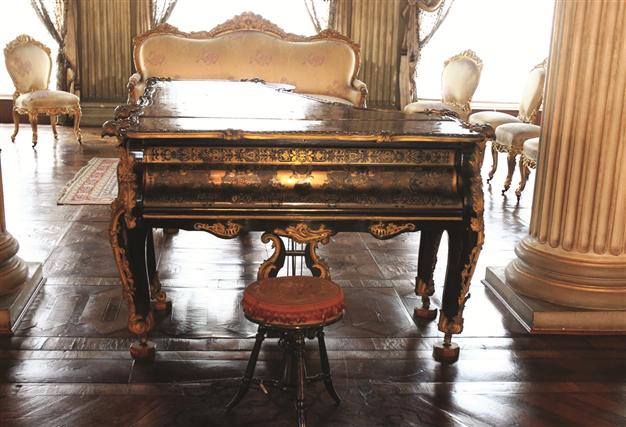
The pianos in Istanbul’s Dolmabahçe Palace, which hosted some 1 million people last year, draw great interest from local and foreign visitors for their magnificence and harmony with their surroundings.
National Palace guide Osman Nihat Bişgin said Dolmabahçe Palace was a Tanzimat (reform-era) palace, adding, “All features of the reform era are clearly seen in Dolmabahçe Palace. This process, which we call the Europeanization and westernization process, made western music enter Dolmabahçe Palace.”
He said the palace had a total of 12 pianos, and all of them had ornamentations suitable to the style and harmony of the palace.
Bişgin said the palace opened in 1856 and the pianos were brought there nearly at the same time. “The wives of sultans were taking piano education in the palace, particularly in the final years of the Ottomans. There are many pianos and none of them were inactive; all of them were being played,” he said.
He said most of the piano brands in the palace were Hertz, Pleyel, Gaveau and Erard, and that the number of grand pianos was less.
Speaking of a striking green piano in Zülvecheyn Hall on the upper floor of the palace, Bişgin said it was a classical Pleyel-brand palace piano.
“Since the magnificence and glory was dominant in the palace, the pianos draw our attention visually. Their sound is not very famous, but they are very important and famous visually,” he said.
Bişgin said Zülvecheyn Hall had gilded ornamentation on its white and beige ceiling, adding, “We see enormous harmony between the piano and the ceiling.”
He said the furniture in Dolmabahçe Palace was in its original place, and added, “We can say that the pianos belong to these halls. The pianos in the Zülvecheyn and Süfera halls were designed to add visual richness to halls like them. They are not generally played.”
Crystal piano and chair in the Glass Kiosk
As for the rare crystal piano in the Glass Kiosk, Bişgin said the following: “The Glass Kiosk is a big venue hidden behind the walls of the palace. Mustafa Kemal Atatürk greeted the public in this place. It is like a winter garden surrounded with glass. In harmony with this kiosk, there is a crystal piano. It is a Paris-made Gaveau piano. Its chair is crystal, too.”
Another piano in the palace is a plain black German-made Steinway. Bişgin said its sound was very strong and it was very valuable.
“It was produced as a Hamburg Steinway in 1912. Then the factory moved to the U.S. Accordingly, there were only five Steinway pianos made in Germany. This is one of them. Its estimated price is 200,000 euros. It also has the emblem of the sultan Abdulmecid,” Bişgin added.
Speaking of the piano, which was used during the acceptance of ambassadors in the Süfera Hall, Bişgin said, “Süfera is the plural of the word sefir [ambassador]. This hall was created to address foreigners. The furniture is gold-plated; the ceiling is the same. There is a boulle-work piano here to show the beauty of metal and gold. This piano is wonderful for decoration.”
• 1926 ~ Vasily Mikhaylovich Metallov, Composer, died at the age of 64
• 1929 ~ Yehudi Wyner, Composer
• 1934 ~ Pat (Charles Eugene) Boone, Singer, married to Red Foley’s daughter, Shirley
• 1935 ~ Alberto Cametti, Composer, died at the age of 64
• 1941 ~ Edo de Waart, Dutch conductor
• 1942 ~ Ernest Pingoud, Composer, died at the age of 53
• 1943 ~ Ely van Tongeren, Dutch guitarist and singer
• 1943 ~ Richard Goode, Concert pianist. In 1980 he won the Avery Fisher Award
• 1945 ~ Frederica Von Stade, American mezzo-soprano
• 1945 ~ Linda Scott, Singer
• 1946 ~ Carol Neblett, American soprano with the NYC Opera
• 1947 ~ Ron Wood, Guitar with Rolling Stones after 1975
• 1949 ~ Mike Levine, Rock keyboardist/bassist
• 1950 ~ Graham Russell, Singer with Air Supply
• 1955 ~ F Melius Christiansen, Composer, died at the age of 84
• 1959 ~ Celebrating a solid year at the top of the album charts was “Johnny’s Greatest Hits” on Columbia Records. The LP stayed for several more years at or near the top of the album charts. It became the all-time album leader at 490 weeks.
• 1960 ~ “Finian’s Rainbow” closed at 46th St Theater NYC after 12 performances
• 1961 ~ There was a new sound in the air this day. FM multiplex stereo broadcasting was enjoyed for the first time by listeners to FM radio in Schenectady, NY, Los Angeles and Chicago. The FCC adopted the standard a year later.
• 1964 ~ Rutkowski Bronislaw, Composer, died at the age of 66
• 1967 ~ The Beatles’ “Sgt. Pepper’s Lonely Hearts Club Band” was released. One of the first critically-acclaimed rock albums, “Sgt. Pepper’s” became the number one album in the world and was at the top of the U.S. album list for 15 weeks.
For tapping out a beat may help children learn difficult fraction concepts, according to new findings due to be published in the journal Educational Studies in Mathematics.
An innovative curriculum uses rhythm to teach fractions at a California school where students in a music-based programme scored significantly higher on math tests than their peers who received regular instruction.”Academic Music” is a hands-on curriculum that uses music notation, clapping, drumming and chanting to introduce third-grade students to fractions.The programme, co-designed by San Francisco State University researchers, addresses one of the most difficult – and important – topics in the elementary mathematics curriculum.”If students don’t understand fractions early on, they often struggle with algebra and mathematical reasoning later in their schooling,” said Susan Courey, assistant professor of special education at San Francisco State University.
• 1944 ~ Mick Ralphs, Guitarist with Mott the Hoople
• 1947 ~ Henri G Casadesus, French alto violist (viola d’amour) and composer, died at the age of 66
• 1948 ~ Jose Vianna da Motta, Composer, died at the age of 80
• 1955 ~ Raoul Gunsbourg, Composer, died at the age of 95
• 1961 ~ Rock ’n’ roll fans were ready for a good old-fashioned summertime as Chuck Berry’s amusement park, Berryland, opened near St. Louis, MO.
• 1962 ~ Eduardo Toldra, Composer, died at the age of 67
• 1969 ~ Stevie Wonder’sMy Cherie Amour was released by Tamla Records. The song made it to number four on the pop music charts on July 26 and stayed on the nation’s radios for eleven weeks.
• 1974 ~ William DeVaughn, a soul singer, songwriter and guitarist from Washington, DC, received a gold record for his only hit, Be Thankful for What You Got.
• 1976 ~ Ear doctors didn’t have to drum up business this day. There were plenty of walk-ins as The Who put out a total of 76,000 watts of power at 120 decibels. They played the loudest concert anyone had ever heard, making it into “The Guinness Book of World Records”.
• 1977 ~ “Beatlemania” opened at Winter Garden Theater NYC for 920 performances
• 1989 ~ First presentation of rock n roll Elvis awards
• 1994 ~ Herva Nelli, Soprano, died at the age of 85
• 1997 ~ “Once Upon a Matress,” closed at Broadhurst Theater NYC after 187 performances.
• 2002 ~ Mario Lago, an influential composer, actor and political dissident, died of lung failure. He was 90. Throughout a multifaceted career, Lago wrote more than 200 popular songs and appeared in 20 films and more than 30 telenovelas, Brazil’s version of television soap operas. He was also an active member of Brazil’s Communist Party, and was imprisoned six times during Brazil’s 1964-86 military regime. One of Lago’s most successful songs, Amelia, sang the praises of a woman happy with very little from her husband. The name came to signify a submissive woman in Brazilian slang. Lago continued acting until January, 2002 when he was hospitalized for a month with emphysema.
Here are 8 bits of wisdom from Play It Again that remind us that it is possible to make time for what matters most in the face of life’s demands and stresses.
Own Your Stress
Rusbridger is completely clear-eyed about just how stressful his job is, and by confronting — rather than denying — the reality of his stress, he’s able to seek out ways to reduce it. Being editor of the Guardian is “one of those jobs which expands infinitely to fill the time and then spill beyond it,” he writes. “An editor, particularly within a modern global media company, is never truly off duty.”
A typical day in the life of a newspaper editor, he writes, means “a hum of low-level stress much of the time, with periodic eruptions of great tension.”
Find Your Metaphor
When Rusbridger felt frustration and self-doubt — which was nearly all the time — he found it helpful to think of people who took on great challenges in different fields. This helped put his own project in perspective, and also let him feel solidarity with others who had taken on great challenges. He compares learning Chopin to climbing the Matterhorn, the forbidding mountain in the Alps.
He writes: “Jerry R. Hobbs, an American computational linguistics expert and amateur climber, described the mountain as ‘just about the hardest climb and ordinary person can do’, which, apropos the G minor Ballade, sounds familiar.”
You’re Not Alone
Rusbridger supplements his piano practice with lots of reading. One book in particular, Arnold Bennett’s 1910 How to Live on 24 Hours a Day, reminds him that the sense of having not enough time to do all we want to do is universal, and not exactly new.
As Bennett writes: “We never shall have any more time. We have, and we have always had, all the time there is.”
There’s Power In A Morning Routine
Rusbridger learns quickly that his daily 20 minutes have to happen in the morning, before the unpredictable demands of work kick in. Here is how he describes his routine:
“I get up half an hour earlier. I fit in ten minutes of yoga listening to the Todayprogramme – not exactly meditative. Then breakfast and the papers with more Today programme all at the same time. Then I slip upstairs to the sitting room to play before driving into work.”
Pursuing Your Passion Is An Investment
Even though his morning piano practice is a solitary activity, he undertakes it knowing that it will have social benefits. After all, when he was a child, his mother told him that playing the piano would help him make friends. She’s right, and he finds her message echoed in the pages of Charles Cooke’s book Playing the Piano for Pleasure: “The better you play, the more your circle of friends will expand. You can count on this as confidently as you can count on the sun rising. Music is a powerful magnet which never fails to attract new, congenial, long-term friends.”
Mortality Is A Good Motivator
When Rusbridger’s former girlfriend gets in touch to tell him that her breast cancer has returned, he finds himself reflecting on mortality, and thinking of other friends more or less his age who are undergoing treatment for various serious diseases. Each brush with illness or mortality strengthens his determination to lean the Ballade. “In terms of getting on with life’s ambitions,” he writes, “I’m hit by more than a tinge of carpe diem.”
“Amateur” Is Not An Insult
Rusbridger has no illusions or intentions about becoming a professional pianist. He’s a dedicated amateur from the start, and his conversations and meetings with other music lovers — both professional and amateur — is a reminder that “amateur” isn’t a value judgment (i.e. worse than a professional), but a worthy end in itself. In fact, it’s probably a good deal more enjoyable and less stressful than being a pro.
In conversation with Rusbridger, the New York Times music critic Michael Kimmelman talks about the perks of being an amateur. “You have another life, it’s a full and interesting life, but you decide to add this life as well because music gives you something that you can’t get from this other life. It isn’t about having a career and making a living from it, it’s about something that only music-making will give you.”
It’s Never Too Late
As he improves and comes closer to learning the entire Ballade, no one is as surprised as Rusbridger himself. “It’s a funny thing to discover about yourself in your mid-50s — that you spent the previous forty years not doing something on the assumption that you couldn’t do it, when all along you could.”
He is astonished to learn, after memorizing complex passages of the Ballade, just how powerful his own memory is. “Back in the summer of 2010 I had no idea of just how capable a 56-year-old brain was of learning new tricks,” he writes. “So it’s heartening to know that, quite well into middle age, the brain is plastic enough to blast open hitherto unused neural pathways and adapt to new and complicated tasks. So, no, it’s not too late.”
• 1909 ~ Benny Goodman, American jazz clarinetist, composer and bandleader. He became a leading player with his own bands during the 1930’s and also commissioned works from classical composers including Bartok and Copland.
More information on Goodman
• 1913 ~ Pee Wee (George) Erwin, Trumpet with Tommy Dorsey Band and Isham Jones Band
• 1913 ~ Cedric Thorpe Davie, Composer
• 1920 ~ George London, Baritone singer with Bel canto Trio (with Frances Yeend and Mario Lanza); member: Vienna State Opera, Metropolitan Opera; Artistic Director of the Kennedy Center for the Performing Arts; Director: National Opera Institute; head of the Washington Opera and established the George London Foundation for Singers in 1971.
• 1922 ~ ‘Smilin’ Ed McConnell debuted on radio, smiling and playing his banjo. McConnell quickly became a legend in the medium.
• 1962 ~ The King of Swing, Benny Goodman, turned 53 and led the first American jazz band to play in the Soviet Union. Goodman and his band played six concerts in the U.S.S.R.
• 1964 ~ The Beatles 1961 record of Cry for a Shadow was #1 in Australia