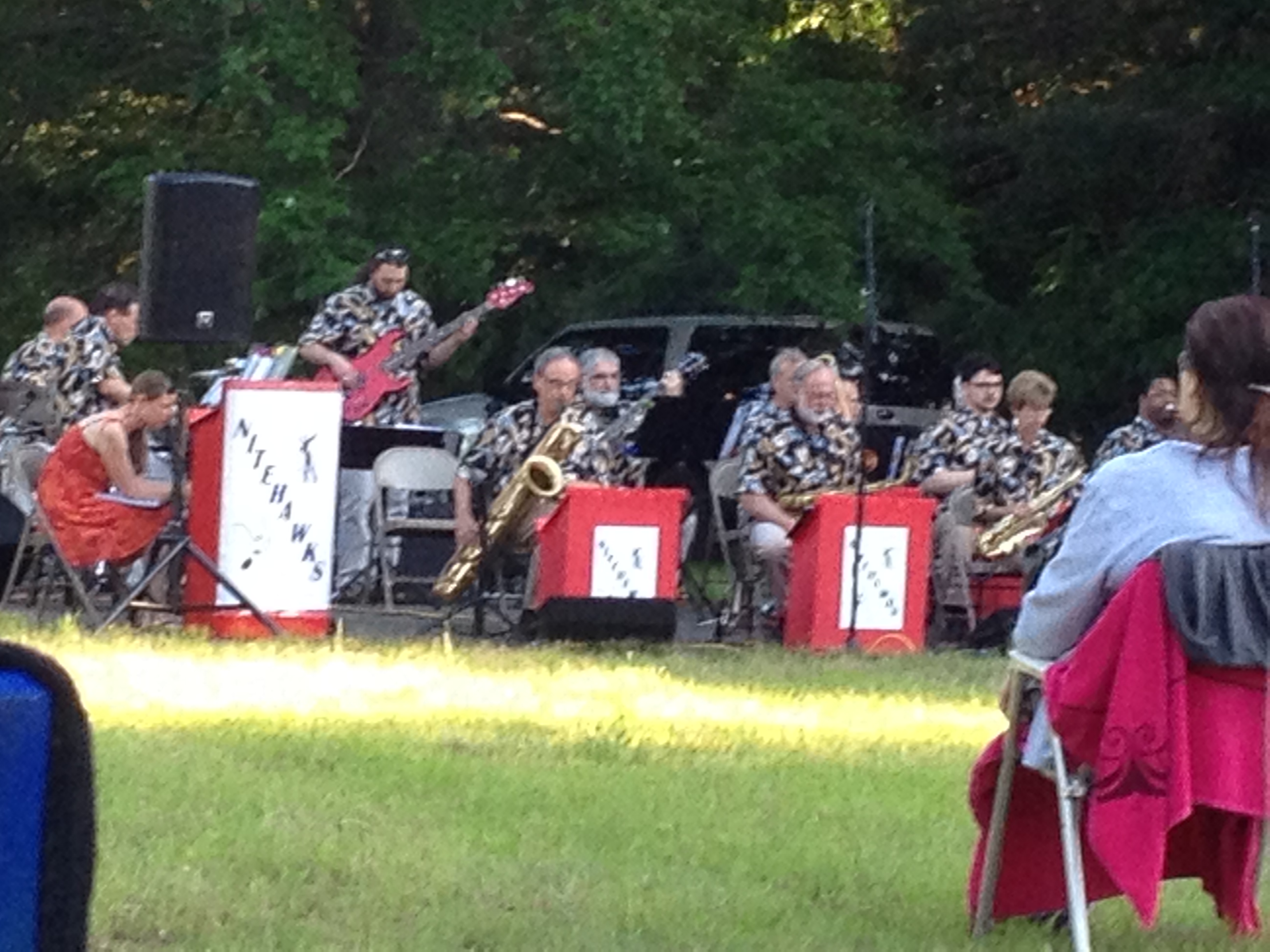
The Nitehawks Swing Band will be playing at Greenbriar Park Saturday, May 30 at 7:00 pm. All concerts at Greenbriar Park include free pretzels, soft drinks and ice cream. Bring a blanket or a chair!
The Nitehawks Swing Band has been entertaining audiences around the Washington, DC metropolitan area for over 15 years. From big band dance arrangements of Glenn Miller, Count Basie, and Duke Ellington to high energy jump and jive tunes, and slow, belly-rubbing ballads, and even a little rock & roll, they will set the mood and keep you dancing through the night. With a full group of Brass, Reeds, Rhythm and Vocals, they provide the full big band sound.
• 1911 ~ Sir William Gilbert, English librettist who together with the composer Sir Arthur Sullivan collaborated on many operettas, died of a heart attack after rescuing a woman from drowning. He was 74.
• 1911 ~ Carl M Story (1916) Fiddler
• 1912 ~ Fifteen women were dismissed from their jobs at the Curtis Publishing Company in Philadelphia, PA — for dancing the Turkey Trot while on the job!
• 1919 ~ (Walter) (Wladziu Valentino) Liberace, American concert pianist and showman. His trade mark was a candelabra on his piano.
More information about Liberace
• 1922 ~ Iannis Xenakis, Rumanian-born French theorist and composer
More information on Xenakis
• 1923 ~ Eugene Wright, Jazz musician, bass with Dukes of Swing, played with Brubeck
• 1935 ~ Josef Suk, Czech violinist and composer, died at the age of 61
• 1930 ~ Eleanor Fazan, Opera and show choreographer
• 1937 ~ Peter Kolman, Composer
• 1941 ~ Roy Crewsdon, Guitarist with Freddie and The Dreamers
• 1942 ~ The biggest selling record of all time was recorded. A little out of season, perhaps, but White Christmas, the Irving Berlin classic, was recorded by BingCrosby for Decca Records. The song was written for the film “Holiday Inn”. More than 30-million copies of Crosby’s most famous hit song have been sold and a total of nearly 70-million copies, including all versions of the standard, have been sold.
• 1943 ~ Hermann Hans Wetzler, Composer, died at the age of 72
• 1943 ~ “The Million Dollar Band” was heard for the first time on NBC radio. Charlie Spivak was the first leader of the band that featured Barry Wood as vocalist. The unusual feature of the show was the awarding each week of five diamond rings!
• 1945 ~ Gary Brooker, Keyboard player, singer
• 1948 ~ Linda Esther Gray, opera singer
• 1948 ~ Michael Berkley, Composer and broadcaster
• 1949 ~ Francis Rossi, Guitarist
• 1949 ~ Gary Brooker, Rock keyboardist with Procol Harum
• 1950 ~ Rebbie (Maureen) Jackson, Singer, oldest member of the Jackson family
• 1951 ~ Dimitrios Levidis, Composer, died at the age of 66
• 1961 ~ Uuno Kalervo Klami, Composer, died at the age of 60
• 1961 ~ Ricky Nelson reached the top spot on the “Billboard” singles chart withTravelin’ Man. It was was Nelson’s second chart-topping hit. Poor LittleFool made it to the top in August of 1958.
• 1996 ~ James George “Jimmy” Rowles, Jazz pianist, died at the age of 77
• 1997 ~ Jeff Buckley, Musician, drowned at age 30
• 2003 ~ Janet Collins, the first black prima ballerina to appear at the Metropolitan Opera and one of a few black women to become prominent in American classical ballet, died. She was 86. In 1951, Collins performed lead roles in “Aida” and Bizet’sCarmen and danced in “La Gioconda” and “Samson and Delilah” at the Met in New York City. That was four years before Marian Anderson made her historic debut as the first black to sing a principal role at the Met. Collins left the Met in 1954. During the 1950s, she toured with her own dance group throughout the United States and Canada and taught. Collins also danced in films, including the 1943 musical “Stormy Weather” and 1946’s “The Thrill of Brazil.” The Alvin Ailey American Dance Theater in 1974 paid homage to Collins and Pearl Primus as pioneering black women in dance.
Renowned pianist and conductor Daniel Barenboim has unveiled a new type of piano, which he says is a “sound alternative” to the standard concert grand piano that has not undergone much change over a century.
Barenboim, 72, launched the instrument at the Royal Festival Hall here on Tuesday, in advance of his Schubert recital series.
Declaring the new piano a “sound alternative”, Barenboim said: “I’ve fallen in love with it and I want to spend as much time with it as possible.”
The exterior of the new piano looks much the same as any other modern concert grand piano, but inside, there are some dramatic differences, The Guardian reported.
Designed by the Belgian instrument-maker Chris Maene, the Barenboim has straight parallel strings instead of the diagonal-crossed ones of a contemporary piano. The wooden soundboard veins go in different directions. The bridges, ribs and bracings are specially designed and the hammers and strings have been repositioned.
Barenboim, currently heading Berlin’s flagship opera house, the State Opera, said he intended to perform the entire series on the new piano.
Modern pianos have become highly standardised, with few changes to their fundamental design over the past 100 years.
They are largely cross-strung, with the bass strings crossing over the middle and treble strings in an “X” pattern, allowing the sound to be concentrated on the centre of the soundboard.
He developed his idea with Belgian instrument maker Chris Maene, with support from Steinway & Sons.
As well as the straight strings, the Barenboim-Maene piano features a double bridge and horizontal soundboard veins.
According to a press release, the piano “combines the touch, stability, and power of a modern piano with the transparent sound quality and distinguishable colour registers of more historic instruments”.
Pianist Gwendolyn Mok, who plays an 1875 straight-strung Erard piano, has said that such instruments possess superior clarity.
“If you look inside your own piano, you will notice that the strings are all crossing each other,” she told the San Francisco Examiner in 2013.
“With the straight strung piano you get distinct registral differences – almost like listening to a choir where you have the bass, tenor, alto, and soprano voices.
“It is very clear and there is no blending or homogenizing of the sound. It therefore gives you huge opportunities in experimenting with colour.”
• 1923 ~ György Ligeti, Hungarian-born Austrian composer
More information about Ligeti
• 1922 ~ Carl Tieke, Composer, died at the age of 58
• 1922 ~ Otto Krueger conducted the Detroit News Orchestra, the first known radio orchestra, which was heard on WWJ Radio in Detroit, MI. The “Detroit News” owned the radio station at the time.
• 1925 ~ Dietrich Fischer-Dieskau, German baritone. Known for his performance of opera, notably Mozart, Strauss and Wagner, he is also famed for his interpretation of German lieder.
• 1927 ~ Bernhard Lewkovitch, Composer
• 1930 ~ Julian Penkivil Slade, Composer
• 1931 ~ Peter Talbot Westergaard, Composer
• 1932 ~ Henning Christiansen, Composer
• 1934 ~ Julian Slade, Composer
• 1934 ~ Rob du Bois, Composer
• 1936 ~ Maki Ishii, Composer
• 1940 ~ Hans Dulfer, Tenor saxophonist and director of Paradiso
• 1940 ~ Theodor Streicher, Composer, died at the age of 65
• 1940 ~ Irving Berlin’s musical “Louisiana Purchase,” premiered in New York City
• 1944 ~ Gladys Knight, American rhythm-and-blues singer
• 1945 ~ John Fogerty, Songwriter, singer with Creedence Clearwater
• 1945 ~ Gary Stewart, Country singer
• 1954 ~ Achille Longo, Composer, died at the age of 54
• 1957 ~ The National Academy of Recording Arts and Sciences (NARAS) was established. This is the organization that brings us the Grammy Awards for all forms of musical entertainment each year.
• 1958 ~ Mikulas Schneider-Trvavsky, Composer, died at the age of 77
• 1959 ~ Johnson and Bart’s musical “Lock up your daughters,” premiered in London
• 1963 ~ Vissarion Yakovlevich Shebalin, Composer, died at the age of 60
• 1964 ~ John Finley Williamson, conductor of the Westminster Choir, died at the age of 76
• 1966 ~ Percy Sledge hit number one with his first, and what turned out to be his biggest, hit. When a Man Loves a Woman would stay at the top of the pop music charts for two weeks. It was the singer’s only hit to make the top ten and was a million seller.
• 1973 ~ Hans Schmidt-Isserstedt, German composer and conductor, died at the age of 73
• 1975 ~ The Doobie Brothers went gold with the album, “Stampede”. The group, formed in San Jose, CA, recorded 16 charted hits. Two made it to number one, becoming million-selling, gold record winners: Black Water in March, 1975 and What aFool Believes in April, 1979.
• 1977 ~ Jiri Reinberger, Composer, died at the age of 63
Pianist/composer Sergei Rachmaninov was possessed of both unusually large hands and a staggering lack of empathy when it came to writing piano music for other people. Hyung-ki Joo is by no means the first pianist to have been confounded by the mammoth chords of his Prelude in C sharp minor (Op.3, No.2).
He probably is the first to have come up with this particular solution helped by his partner in crime, violinist Aleksey Igudesman.
• 1638 ~ Nicolas Forme, Composer, died at the age of 71
• 1652 ~ Jacques Huyn, Composer, died at the age of 39
• 1690 ~ Giovanni Legrenzi, Italian Composer, died at the age of 63
• 1708 ~ Jacques Danican Philidor, Composer, died at the age of 51
• 1738 ~ Bonaventura Furlanetto, Composer
• 1796 ~ James S McLean patents his piano
• 1799 ~ Jacques-François-Fromental-Elie Halévy, French composer whose five-act grand opera La Juive (1835) was, with Giacomo Meyerbeer’s Les Huguenots, the prototype of early French grand opera.
• 1822 ~ Joseph Joachim Raff, German composer and teacher, greatly celebrated in his lifetime but nearly forgotten in the late 20th century.
• 1822 ~ Henry Wylde, Composer
• 1840 ~ Niccolò Paganini Composer and violinist died at the age of 57. He wrote six concertos for violin.
Read quotes by and about Paganini
More information about Paganini
• 1849 ~ “Blind” Tom Bethune, Pianist and composer
• 1878 ~ Isadora Duncan, Dancer
• 1878 ~ Carlo Marsili, Composer, died at the age of 49
• 1884 ~ Bax Brod, Composer
• 1888 ~ Louis Durey, Composer
• 1891 ~ Claude Adonai Champagne, Composer
• 1900 ~ Leopold Godowsky, Jr., American musician and photographic technician primarily known as a codeveloper of Kodachrome film (1935).
• 1915 ~ Mario del Monaco, Italian opera singer famed for Verdi and Puccini
• 1928 ~ Thea Musgrave, Scottish composer, best known for her concertos operas and choral and other vocal works.
• 1929 ~ Donald Howard Keats, Composer
• 1930 ~ Eino Tamberg, Composer
• 1931 ~ Veroslav Neumann, Composer
• 1932 ~ Jeffrey Bernard, Singer
• 1935 ~ Ramsey Lewis, American jazz pianist, composer and bandleader
• 1935 ~ Elias Gistelinck, Flemish Composer
• 1939 ~ Don Williams, Country singer
• 1940 ~ Rene Koering, Composer
• 1942 ~ Priscilla Anne McLean, Composer
• 1947 ~ Liana Alexandra, Composer
• 1950 ~ Frank Sinatra made his TV debut as he appeared on NBC’s “Star-Spangled Review” with show biz legend, Bob Hope.
• 1957 ~ Siouxsie Sioux (Susan Dallion), Singer with Siouxsie and the Banshees
• 1957 ~ That’ll be the Day, by The Crickets and featuring Buddy Holly, was released by Brunswick Records. On September 14th, the tune became the most popular record in the U.S. It was the first hit for Holly and his group after two previous releases went nowhere on Decca Records in 1956.
• 1961 ~ Singer Johnny Cash turned TV actor. He appeared on the NBC drama, “The Deputy”.
• 1972 ~ “Applause” closed at the Palace Theater in New York City after 900 performances
• 1954 ~ Liberace presented a three-hour, one-man concert at Madison Square Garden in New York City. 13,000 women and 3,000 men attended. The performance nearly broke the box office mark of 18,000 set by pianist Ignace Jan Paderewski.
• 1967 ~ “Sgt. Pepper’s Lonely Hearts Club Band”, by The Beatles, was released. It took the Fab Four only 12 hours to record their first album, “Please, Please Me”. It took them 700 hours to complete “Sgt. Pepper’s”.
• 1995 ~ Ron Weatherburn, Jazz pianist, died at the age of 61
• 1996 ~ Matima Kinuani Mpiosso, Musician, died at the age of 45
• 2002 ~ Oscar Florentino Tellez, one of San Antonio’s best known bajo sexto players who was a regular with the Grammy-winning Texas Tornados, died in a one-vehicle traffic accident near Cotulla. He was 56. Tellez, a native of Laredo, taught himself to play music as a small boy. By his teens, he had learned to play the bass, drums, accordion, the keyboard and the bajo sexto, a Mexican bass guitar that resembles a 12-string guitar. In Europe, Tellez was affectionately called the ‘Frito Bandito.’
• 2003 ~ Almir Chediak, a music producer who dedicated his life to preserving the memory of Brazilian popular music, was shot to death. He was 52. Chediak was best known for transcribing the music of Brazil’s top musicians such as Caetano Veloso and Antonio Carlos Jobim and publishing them in the form of song books. He was also a music professor who taught some of Brazil’s top stars, including Gal Costa, Tim Maia, Cazuza and Morares Moreira, and in recent years he had gone on teach a new generation of Brazilian musicians. He also wrote two music text books that took harmonic theory out of the conservatory and made it more accessible for popular musicians. His publishing company, Lumiar, also produced CDs of important Brazilian musicians.
• 1765 ~ Pierre-Joseph Le Blan, Composer, died at the age of 53
• 1767 ~ Ferdinand Franzl, Composer
• 1767 ~ Friedrich Johann Eck, Composer
• 1821 ~ Diederich Krug, Composer
• 1826 ~ Christian Friedrich Ruppe, Composer, died at the age of 72
• 1847 ~ Alphonse Goovaerts, Composer
• 1878 ~ Bill “Bojangles” (Luther) Robinson, Vaudeville dancer, tap-dancing coach for Sammy Davis, Jr. and Shirley Temple
More information about Robinson
• 1878 ~ Gilbert and Sullivan’s opera “HMS Pinafore” premiered in London
• 1887 ~ Gas lamp at Paris Opera caught fire, 200 died
• 1917 ~ Leon Felix Augustin Joseph Vasseur, Composer, died at the age of 72
• 1919 ~ Gino Negri, Composer
• 1921 ~ Hal David, Oscar-winning songwriter with Burt Bacharach
• 1924 ~ Theodore Morse, Composer, died at the age of 51
• 1925 ~ Aldo Clementi, Composer
• 1926 ~ Miles Davis III, American jazz trumpeter, bandleader, and composer. He combined be-bop, modal chord progressions and rock rhythms to create ‘cool jazz’. He was one of the major influences on the art from the late 1940s. Read quotes by and about Davis
• 1926 ~ Kitty Kallen, Singer
• 1928 ~ Frigyes Hidas, Composer
• 1929 ~ Beverly Sills, American soprano and opera administrator, chairperson of Lincoln Center; National Chair of March of Dimes’ Mothers’ March on Birth Defects
• 1934 ~ Gustav Theodore Holst, English Composer, died at the age of 59
More information about Holst
• 1936 ~ Tom T. Hall, Singer
• 1936 ~ Jan Levoslav Bella, Composer, died at the age of 92
• 1943 ~ Leslie Uggams, Singer
• 1943 ~ John ‘Poli’ Palmer, Musician, sax, flute, keyboard with Family
Memorial Day was originally called Decoration Day and was initiated to honor the soldiers for the Union and Confederate armies who died during the American Civil War.
Celebrations honoring Civil War heroes started the year after the war ended. The establishment of a public holiday was meant to unify the celebration as a national day of remembrance instead of a holiday celebrated separately by the Union and Confederate states. By the late 19th century, the holiday became known as Memorial Day and was expanded to include the deceased veterans of all the wars fought by American forces. In 1971, Memorial Day became a federal holiday.
The original national celebration of Decoration Day took place on 30 May 1868. When Memorial Day became a federal holiday, it was given the floating date of the last Monday in May.
• 1937 ~ Archie Shepp, African-American tenor saxophonist, one of the first improvisers and composers in free jazz, and one of its most eloquent spokesmen.
• 1938 ~ Art Kassel’s orchestra recorded a song for Bluebird Records that may not have been a smash hit, but had a great title: So You Left Me for the Leader of aSwing Band.
• 1941 ~ Bob Dylan, America folk and rock singer, songwriter and guitarist. He moved from folk to rock music in the 1960s, infusing the lyrics of rock and roll, previously concerned mostly with boy-girl romantic innuendo, with the intellectualism of classic literature and poetry. Hailed as the Shakespeare of his generation, Dylan sold more than 58 million albums.
• 1941 ~ Brian Dennis, Composer
• 1941 ~ Konrad Boehmer, Composer
• 1942 ~ Derek Quinn, Guitarist with Freddie and the Dreamers
• 1943 ~ James Levine, British conductor
• 1944 ~ Patti LaBelle (Holt), American soul-rock singer
• 1945 ~ Priscilla Presley, American actress and was wife of Elvis Presley
• 2002 ~ BBC News Online Conductor Colin Davis and The London Symphony were recognized for their successful partnership on the orchestra’s new record label and popular tenor Russell Watson was the big winner at the third Classical Brit awards Thursday, BBC News reports. Davis won the award for Best Male Artist, his recording of Berlioz’s Les Troyens received the Critics’ Choice award and the London Symphony Orchestra’s recording of Vaughan Williams’ “London” Symphony under Richard Hickox was named Best Ensemble/Orchestral Album at the ceremony, which took place in the Royal Albert Hall. In the only award voted for by radio listeners, Best Album, Watson beat Italian opera singer Cecilia Bartoli with his Encore disc. It was the second time Watson won Best Album. He also picked up an award for the biggest selling classical album in the UK. Bartoli won for Female Artist of the Year. The Contemporary Music award was won by Tan Dun, composer of the score for Crouching Tiger, Hidden Dragon. The Best Male Artist award recognizes Davis’ highly successful Berlioz CD series on the LSO Live label. During 2001, his interpretations of Symphonie Fantastique, La damnation de Faust and Les Troyenswere released to excellent reviews. Les Troyens won Grammys earlier this year for Best Opera and Best Overall Classical Recording. The LSO’s disc of Vaughan Williams’s Symphony No. 2 “A London Symphony” on Chandos was the first recording of the score in its original version.
• 2015 ~ Marcus Belgrave, jazz trumpeter, died. He recorded with a variety of famous musicians, bandleaders, and record labels since the 1950s.