
Fairfax County Schools Begin. Need I say more?

Fairfax County Schools Begin. Need I say more?

Let’s face it. Most kids don’t want to practice the piano. And if they do find the time to practice, it’s usually because their parent kept nagging them. How frustrating!
Piano teachers are frustrated too. It’s nearly impossible to teach students new concepts when they don’t understand the old ones–all because of a lack of practice.
If you’re a parent in this situation, I have just the solution you’re looking for.
In this upbeat book, I share all the tips I’ve discovered in my 14 years of teaching piano. You’ll learn fun, practical ways to get your kids to the keyboard.
But this easy-to-read guide goes one step further. I’ll show you simple ways to encourage better quality practice. Even if you’ve never had a music lesson in your life!
I wrote this book for kids of all ages. There are creative ideas for elementary students and also a section for teens.
There’s even a section for what to do if your child wants to stop taking piano lessons. That’s right, there is hope and my book will show you exactly how to get them interested in piano again.
Don’t be the kind of parent who sits on the sidelines waiting until their child wants to practice. Piano lessons are too expensive for you to let another “no-practice” day go by.
This book is your answer to get your child to the keyboard, have good quality practice and develop a life-long love of music.
Get it on Amazon
Thank you for your interest in the O’Connor Music Studio!
Available times are on Mondays, Wednesdays and Fridays during the day and after school for all ages and levels. There may be other times available if requested.
After you register, you will get a confirmation email with the information you need to access the Student Portal. After logging in you may choose from the available lesson times or request something different.
Your $20.00 interview deposit will be credited towards the second month of lessons.
If you are a transfer student, please bring your most recent method book(s) and notebook to the interview.
Prospective students must have a piano, organ or electric keyboard to use for daily practice.
Roadtrip! students (ages 4-5) are scheduled for half-hour lessons with their parents present.
Beginning children (ages 6 to 9) are scheduled for half-hour lessons.
Youth (ages 10 and up) may be scheduled for half-hour lessons or forty-five minute lessons.
Adults are highly encouraged to take hour-long lessons, but are always welcome to schedule half-hour lessons at first.
I look forward to meeting you!


When my students are first working with the Grand Staff, they are often confused about the placement of the various clefs.
In piano music, we generally use only the G-clef (Treble clef – not “trouble clef” as some think!) and the F-clef (Bass clef) I try to show students how the curvy part of the G-clef wraps around the G above middle C and the F-clef looks sort of like an F marking the F below middle C. I draw out G and F on the staff to show how these could have looked.
Originally, instead of a special clef symbol, the reference line of the staff was simply labeled with the name of the note it was intended to bear: F and C and, more rarely, G. These were the most often-used ‘clefs’ in Gregorian chant notation. Gregorian chant developed mainly in western and central Europe during the 9th and 10th centuries, with later additions and redactions.
Over time the shapes of these letters became stylized, leading to their current versions.


Stephen Powers first thought of his grand piano as an impressive piece of furniture.
But he enjoyed listening to music so much when friends played at parties at his home in North Wilmington that he began taking lessons.
“I enjoy having a couple of songs under my belt,” says Powers, a 52-year-old banker. “I play Happy Birthday. I play Getting to Know You for my mom.”
Powers is part of a boomlet of adults who are studying piano. Many took lessons briefly as children and regret giving it up. Some simply enjoy music. Others gravitated toward the keyboard because studies suggest piano improves mental acuity while reducing the odds of dementia.
A Swedish study published in 2014 in the International Journal of Alzheimer’s Disease found that when a twin played a musical instrument later in life, he or she was 64 percent less likely to develop dementia than the twin who did not play.
A study published in Frontiers in Psychology in 2013 evaluated the impact of piano lessons on cognitive function, mood and quality of life in adults age 60 to 84.
The group that studied piano showed significant improvement in tests that measure executive function, controlling inhibitions and divided attention, as well as enhanced visual scanning and motor ability. Piano students also reported a better quality of life.
Some grownups simply relish a challenge.
In the United Kingdom, Alan Rusbridger, editor of the Guardian, took to the keyboard at age 56. He chronicled the year he spent learning Chopin’s demanding No. Ballade 1 in G Minor in the book Play It Again: An Amateur Against the Impossible.
Richard Swarmer, 57, of Lewes, played the trumpet from grade school through college. He has sung in several choirs. This year, he began piano lessons.
Learning the piano isn’t easy even for someone with a musical background. Still, Swarmer appreciates that the creative thought process is different from the focus required by his job for a medical benefits company.
“I have thoroughly enjoyed taking piano lessons as an adult,” he says. “It provides a welcome respite from the demands of my job.”
Ethel Thirtel of North Wilmington is 71 and a student at the Music School of Delaware. She is also taking French lessons to help keep her intellect sharp.
“Both pursuits involve active studying and practice to master new skills,” she says.
To meet rising demand, the Music School of Delaware offers adults-only evening group classes to accommodate working people, says Matthew Smith, student and alumni relations officer. The school also provides instruction for adults 50 and older through the Osher Lifelong Learning Institute at University of Delaware.
“In addition to professionals, we are getting a lot more inquiries from older adults who are retired and have time on their hands,” he says.
Geri Smith, a Julliard-trained singer, musician and composer, has taught piano to children in public schools as well as private arts centers. Her adult students include a 59-year-old writer who took up piano after the death of her husband, a gifted musician.
“Teaching children is a different experience than teaching adults,” says Smith, of Unionville. “Kids pretty much do what you ask them to do but adults ask lots of questions. They want to know why things have to be done a certain way.”
An important part of learning piano is creating new pathways in the brain. A Harvard Medical School study examined the impact of practicing the piano on synapses, the connections between neurons that encode memories and learning.
Volunteers practiced two hours a day for five days, playing a five-finger exercise to the beat of a metronome. To learn how that impacted the neurons scientists used transcranial-magnetic-stimulation (TMS), in which a wire coil sends magnetic impulses to the brain.
They discovered that after a week of practice, the stretch of motor cortex devoted to the finger exercises had expanded like crabgrass.
“Playing the piano creates new synapses,” Smith says. “Think of it as creating a conduit so your right hand can talk to your left hand.”
Meldene Gruber of Rehoboth Beach, who has taught piano for more than 40 years, has seen a surge in adult students in the past two years. Now, half her students are adults.
“A number of my adults say they think playing the piano will help with mental acuity,” she says. “Playing the piano forces you to use both sides of the brain, which is great for neuron firing.”
Most adults have specific goals in mind, such as learning to play Christmas carols or a few favorite pieces.
“You don’t get adults who are focused on becoming concert pianists,” Gruber says. “They come for the joy of playing, not because their mothers made them.”
via Chopstick therapy: how piano lessons could help us age better — NewsWorks.
The following ornament table is a transcription of the one appearing in the Clavier-Büchlein vor Wilhelm Friedemann Bach, written by Johann Sebastian Bach for the keyboard instruction of his eldest son.
A scan of the original manuscript appears at Dave’s J.S. Bach Page.
The German title translates as “Explanation of various signs, showing how to play certain ornaments correctly.”{1} Bach gives the sign for each ornament on the upper of the paired staves, while the lower shows its execution directly beneath.
(This blog has) simply modernized the clefs in my transcription, since Bach’s manuscript uses soprano clefs, as several composers continued to do throughout the 18th century in place of the treble clef now used in all keyboard music.
After the transcription graphic showing the table, there appear clickable buttons which are keyed to AU sound files; you can click on any of the ornaments and hear a sound file play its execution.

Read the original blog post with the ornament table and listening files at J.S. Bach’s Ornament Table.
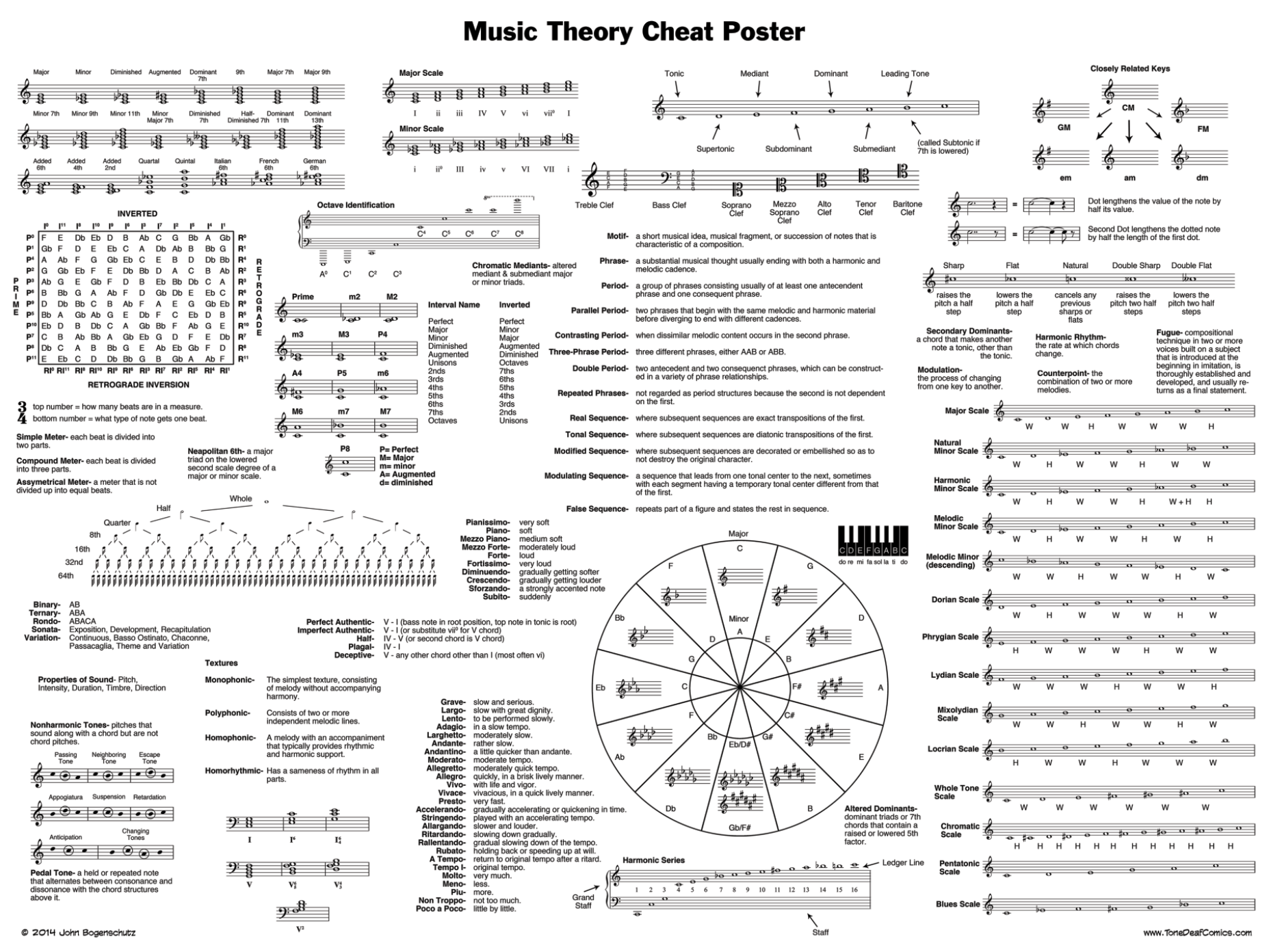
This is the first of a series of occasional online music games. Most of them will only show up in your Remind app.
The first of my students to complete the quiz will win a prize.

I have several copies of this book for the music studio so parents can check it out to see if it would be useful for them to buy for home use. If any of the studio parents have this book already, please let me know what you think.
Some of my adult students have this and have found it helpful in doing theory assignments.
From Amazon:
Help Your Kids with Music is a step-by-step visual guide to music theory and is the perfect primer to help students gain a solid foundation in music, no matter their age, skill level, or instrument.
Help Your Kids with Music clearly explains key concepts in five step-by-step chapters:
Sample pages:


What can I say about John Cage’s 4′33″? Pretty much anyone can play this anytime.
It consists of the pianist going to the piano, and not hitting any keys for four minutes and thirty-three seconds. (He uses a stopwatch to time this.) In other words, the entire piece consists of silence or rests.
On the one hand, as a musical piece, 4’33” leaves almost no room for the pianist’s interpretation: as long as he watches the stopwatch, he can’t play it too fast or too slow; he can’t hit the wrong keys; he can’t play it too loud, or too melodramatically, or too subduedly.
On the other hand, what you hear when you listen to 4’33” is more a matter of chance than with any other piece of music — nothing of what you hear is anything the composer wrote.
With orchestra and soloist
Next time you come to a lesson and haven’t practiced, just tell me you’re playing Cage’s 4’33”!
Happy Birthday is a song that I like to have each of my students learn at various levels appropriate to their level. When a friend or family member has a birthday, it’s great to be able to sit down and play.

It’s only been fairly recently that piano students could have this music in their books.
“Happy Birthday to You”, more commonly known as simply “Happy Birthday”, is a song that is traditionally sung to celebrate the anniversary of a person’s birth. According to the 1998 Guinness World Records, “Happy Birthday to You” is the most recognized song in the English language, followed by “For He’s a Jolly Good Fellow”.
The melody, or part you sing, of “Happy Birthday to You” comes from the song “Good Morning to All”, which has traditionally been attributed to American sisters Patty and Mildred J. Hill in 1893, although the claim that the sisters composed the tune is disputed.
Patty Hill was a kindergarten principal and her sister Mildred was a pianist and composer. The sisters used “Good Morning to All” as a song that young children would find easy to sing. The combination of melody and lyrics in “Happy Birthday to You” first appeared in print in 1912, and probably existed even earlier.
“Happy Birthday” in the style of Bach, Mozart, Beethoven, Mendelssohn, Chopin, Liszt, Dvorak, and Stravinsky. Find the melody!
Lots of legal stuff below which you can skip…
None of the early appearances of the “Happy Birthday to You” lyrics included credits or copyright notices. The Summy Company registered a copyright in 1935, crediting authors Preston Ware Orem and Mrs. R. R. Forman. In 1988, Warner/Chappell Music purchased the company owning the copyright for US$25 million, with the value of “Happy Birthday” estimated at US$5 million. Based on the 1935 copyright registration, Warner claimed that the United States copyright will not expire until 2030, and that unauthorized public performances of the song are illegal unless royalties are paid to Warner. In one specific instance in February 2010, these royalties were said to amount to US$700. By one estimate, the song is the highest-earning single song in history, with estimated earnings since its creation of US$50 million.In the European Union, the copyright for the song expired on January 1, 2017.
The American copyright status of “Happy Birthday to You” began to draw more attention with the passage of the Sonny Bono Copyright Term Extension Act in 1998. When the U.S. Supreme Court upheld the Act in Eldred v. Ashcroft in 2003, Associate Justice Stephen Breyer specifically mentioned “Happy Birthday to You” in his dissenting opinion. American law professor Robert Brauneis, who extensively researched the song, concluded in 2010 that “It is almost certainly no longer under copyright.”
In 2013, based in large part on Brauneis’s research, Good Morning to You Productions, a company producing a documentary about “Good Morning to All”, sued Warner/Chappell for falsely claiming copyright to the song. In September 2015, a federal judge declared that the Warner/Chappell copyright claim was invalid, ruling that the copyright registration applied only to a specific piano arrangement of the song, and not to its lyrics and melody.
In 2016, Warner/Chappell settled for US $14 million, and the court declared that “Happy Birthday to You” was in the public domain.
Legal stuff is finished and people can now sing and play “Happy Birthday to You” whenever and wherever they want.
One of my all-time versions of Happy Birthday, in duet form – and I have the music if you want to tackle it.


 MaryO'Studio