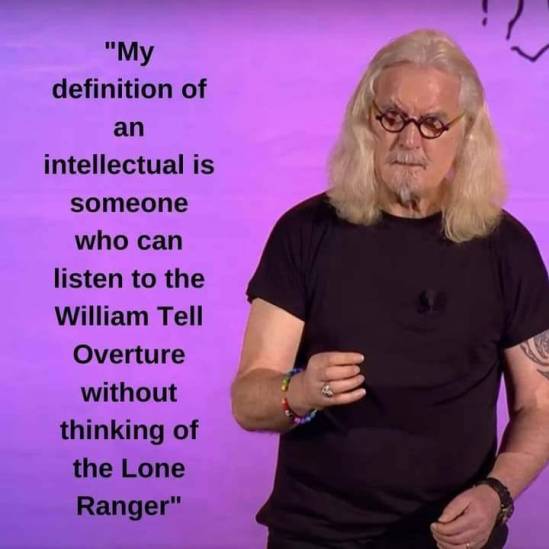
Billy Connolly and the William Tell Overture


Today, we’ll be listening to the end of the William Tell Overture by Gioachino Rossini.  This piece, originally the overture to an opera, has been arranged for piano and is in several method books, including Piano Pronto Movements 1 and 2.  It’s also in Bastien Book 4 and Piano Maestro.
The original story

Maybe your grandparents watched the original Lone Ranger

Or you saw the newer Lone Ranger with Johnny Depp

Here’s the entire William Tell Overture played by an orchestra

Piano Solo

Franz Liszt made a really hard version for piano solo. See if you can follow along!

Piano Duet (1 piano, 4 hands)

Piano Duet arranged by Louis Moreau Gottschalk

Piano Duo (2 pianos, 8 hands)

Piano Quartet (4 pianos, 16 hands)

For pipe organ

For synthesizer

And then things get nuts with cartoons. Lots of cartoons used this music. Here are Mickey Mouse and friends

And Spike Jones

Handbells…

Poor Rossini – I think he’d have a fit if he knew how is music was being used.

Have a nice day!

Piano Lessons For Very Young Children

RT_Front-cover

Student books in 6 different categories are available now in both digital and hardcopy.  There is now “To the Lake”, “Outdoor Adventure”, “To the Farm”, “Country Carnival” and two levels of “Rockstar Rally”.

  • Ideal for students ages 4 and up.
  • On the staff from the start
  • Music is a mix of familiar tunes and original pieces
  • Multi-key approach
  • 18 songs that can be learned by note or rote
  • Clean easy-to-follow pages (great for special needs students!)


Two levels of Roadtrip! are currently available in Piano Maestro.

Register for Roadtrip!  Students (ages 4-5) are scheduled for half-hour lessons with their parents present.

Daily Listening Assignments ~ August 7

To a Wild Rose is the first piece from Ten Woodland Sketches, Op. 51, by the American composer Edward MacDowell. It was completed in 1896, Numerous arrangements of the piece have been made. Though the original was for solo piano, it has been arranged for two sopranos, alto and piano.

It has been said that the piece is best played by children, as they wouldn’t embellish it heavily but perform it quite simply. Find it in Piano Pronto Movement 4 and other books.

Chamber Orchestra

A beginning band

Flute

Harp

Tuba

Daily Listening Assignments ~ August 4

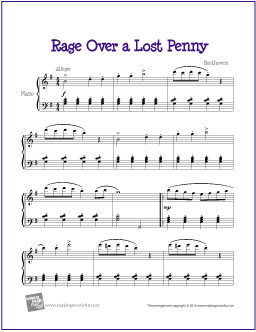
Today’s piece is Beethoven’s Rage Over a Lost Penny found in Piano Pronto Movement 4, Songs I Love to Play 2 and Beethoven: Exploring His Life and Music. The official title is The “Rondo alla ingharese quasi un capriccio” in G major, Op. 129 (Italian for “Rondo in the Hungarian [i.e. gypsy] style, almost a caprice”).

The story goes –

At one point Beethoven was composing this piece, a booming and boisterous piece that exuded energy and vitality.

One night a neighbor heard a loud dispute.

Beethoven was in a rage, accusing a maid of stealing a gold penny. The maid ran out and was never heard from again.

The neighbor then heard furniture crashing, and he could only conclude that the great Maestro was tipping over furniture, madly looking for the lost gold penny.

The story spread through the neighborhood and became part of the legend of Beethoven’s bad moods and curmudgeonly behavior.

An easier version

A tad faster

From Piano Pronto

Orchestra

Daily Listening Assignments ~ July 30

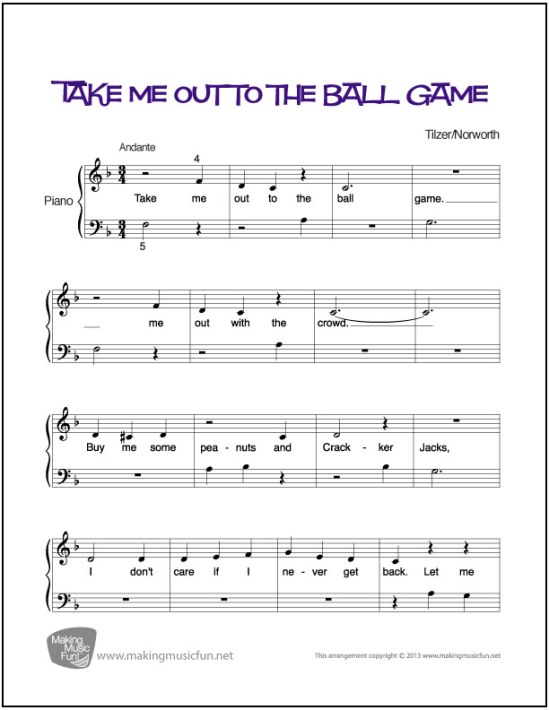
Today’s piece is a fine baseball standard “Take Me Out to the Ballgame” by Jack Norworth and Albert Von Tilzer.  The song’s chorus is traditionally sung during the middle of the seventh inning of a baseball game. Fans are generally encouraged to sing along, and at some ballparks, the words “home team” are replaced with the team name.

Find it in Piano Pronto Songs I love to Play 2 and Alfred Premier 2B among others.

Below are the lyrics to the chorus of the 1908 version, which is out of copyright.

Chorus

Take me out to the ball game,
Take me out with the crowd;
Buy me some peanuts and Cracker Jack,
I don’t care if I never get back.
Let me root, root, root for the home team,
If they don’t win, it’s a shame.
For it’s one, two, three strikes, you’re out,
At the old ball game.

From the movie Take Me Out to the Ballgame

Muppets

Organ

Ragtime Piano

Player piano

Orchestra

Daily Listening Assignments ~ July 27

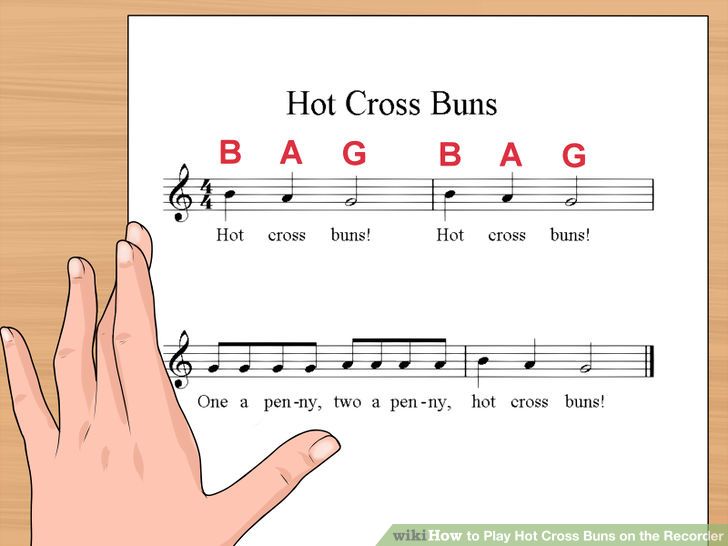
Today we listen to Hot Cross Buns.  “Hot Cross Buns” is an English language nursery rhyme, Easter song, and street cry referring to the spiced English bun known as a hot cross bun, which is associated with the end of Lent and is eaten on Good Friday in various countries.

This is from Keyboard Kickoff:

Theme and Variations

This version gets harder and harder as it goes

In case that made you hungry

More about Hot Cross Buns

Daily Listening Assignments ~ July 22

Today we listen to Beethoven’s “Moonlight Sonata”. The real name for this work is The Piano Sonata No. 14 in C♯ minor “Quasi una fantasia”, Op. 27, No. 2. It was completed in 1801 and dedicated in 1802 to his pupil, Countess Giulietta Guicciardi

The piece is one of Beethoven’s most popular compositions for the piano, and it was a popular favorite even in his own day.

It’s in the Piano Pronto Beethoven book as well as many compilations of classical music.

Arranged for piano and orchestra

An animation

The above were all of the first movement only.  Here’s the whole sonata played by Valentina Lisitsa:

Daily Listening Assignments ~ July 21

Today’s piece is called the British Grenadiers and I’ve included it because most students today haven’t heard of the piece OR know what a grenadier is.  Find this in Keyboard Kickoff, Prelude and many other piano method books.

“The British Grenadiers” is a traditional marching song of British, Australian and Canadian military units whose badge of identification features a grenade.   The original melody dates from the 17th century.

Some talk of Alexander, and some of Hercules
Of Hector and Lysander, and such great names as these
But of all the world’s great heroes
There’s none that can compare
With a tow, row row row, row row row
To the British Grenadiers

When e’er we are commanded to storm the palisades
Our leaders march with fuses, and we with hand grenades;
We throw them from the glacis about the enemies’ ears
With a tow, row row row, row row row
For the British Grenadiers

Then let us fill a bumper, and drink a health to those
Who carry caps and pouches, and wear the louped clothes
May they and their commanders live happy all their years
Sing tow, row row row, row row row
For the British Grenadiers

In the examples below you can hear the steady marching drumbeat.

The band of the Highlands and Lowlands plays “The British Grenadiers” at Edinburgh Castle

Fife and drum

Piano

Guitar

A piano tutorial

A different take

Daily Listening Assignments ~ July 18


hall-mountain


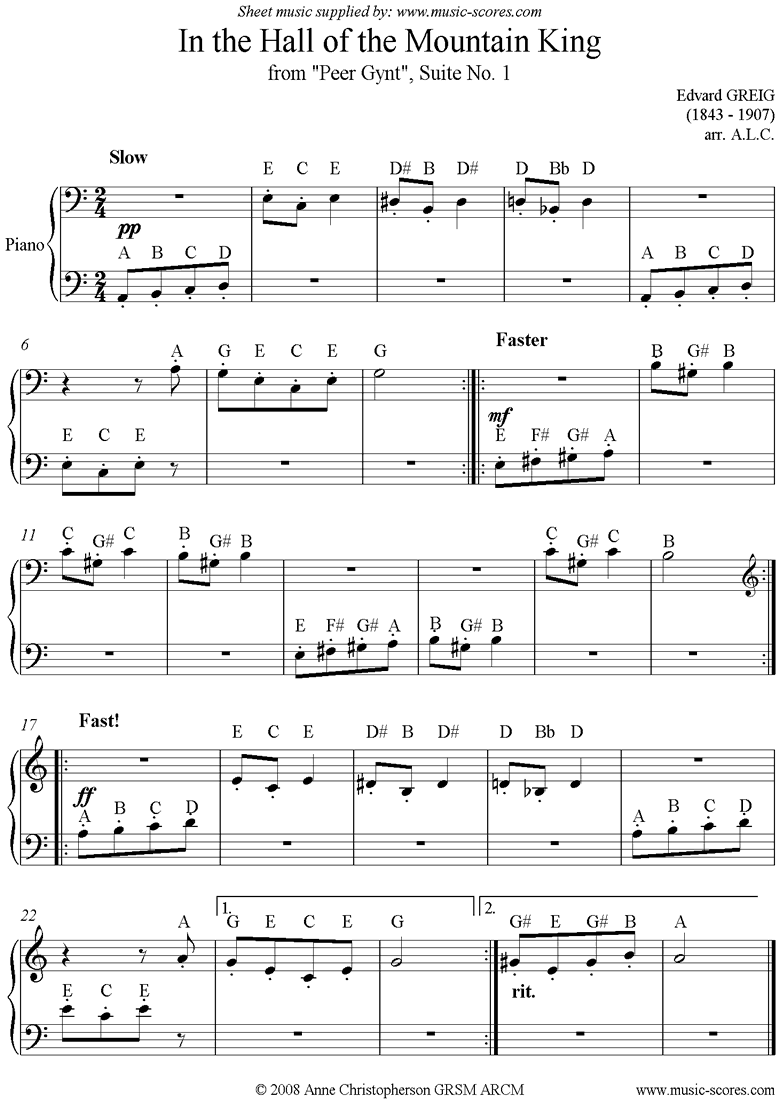
“In the Hall of the Mountain King” is a piece of orchestral music composed for the sixth scene of act 2 in Henrik Ibsen’s 1867 play Peer Gynt. It was originally part of Opus 23 but was later extracted as the final piece of Peer Gynt, Suite No. 1, Op. 46. Its easily recognizable theme has helped it attain iconic status in popular culture, where it has been arranged by many artists, including for the piano.

Borrow a copy of the sheet music from the O’Connor Music Studio.  I have this arranged for piano, duet, 2-piano, simplified…


8 part vocal orchestra (plus a tiny pair of cymbals)


Pianist Paul Barton


Solo piano sheet music – Video Score


Orchestral version