Today we’re going to listen and learn about the opera Carmen.
I chose this for today since it’s the anniversary of French composer Georges Bizet‘s death.
Georges Bizet was born in Paris, France. Both his parents were musicians, and they actually wanted their son to become a composer when he grew up! Bizet loved music, but he also loved to read books. His parents wound up hiding his books so that he would spend more time on his music.
When Georges was 10 years old, his father enrolled him in the Paris Conservatory. While he was there, he wrote his only symphony, but it wasn’t performed until many years after he died. Bizet graduated from the Conservatory with awards in both composition and piano.
Bizet also composed operas. His most famous opera is Carmen. When Carmen first opened in Paris, the reviews were terrible. Many critics said there were no good tunes in it, so audiences stayed away.
In the middle of the night during the first round of Carmen performances, Bizet died. He was only 36. Four months later, Carmen opened in Vienna, Austria, and was a smash hit. It is now one of the most popular operas ever written. Bizet never knew that audiences would come to consider it his masterpiece.
Vladimir Horowitz made Carmen his own by turning it into a fantasy (or the more musical spelling – fantasie).
The fantasia (Italian; also English: fantasy, fancy, fantazy, phantasy, German: Fantasie, Phantasie, French: fantaisie) is a musical composition with its roots in the art of improvisation. Because of this, like the impromptu, it seldom approximates the textbook rules of any strict musical form.
When you play wrong notes for an audience, just tell the audience it’s a “Fantasie”, not the original work!
As you can see, Carmen is a popular work. Here it is for two pianos, played by Anderson and Roe.
The Canadian Brass tell the story of Carmen in their own humorous words.
This is the month for graduations of all sorts, college, high school, even preschool. Perhaps you know someone who is graduating this year. Maybe it’s you!
This piece by Sir Edward Elgar is called Pomp and Circumstance and usually heard at graduations. It was featured in Disney’s Fantasia 2000.
Edward Elgar’s father was a musician who tuned pianos, owned a music shop and was employed as a church organist. The young Edward learned to play the organ and violin at a young age and composed his first short piece at the age of 10. His first job was as assistant organist to his father. His main love was composition, although his music was not successful until his Enigma Variations were published in 1899. This work made him famous.
Until Elgar, there had not been a major creative composer in England since Handel’s death in 1759. He became known as England’s greatest composer and was widely recognized in his day. Unfortunately, Elgar’s fame waned at the end of his life – he composed little music during his last fifteen years and withdrew from almost all musical contact. It was not until the 1960’s that his music again became popular.
Today, we start with Spring from the Four Seasons by Vivaldi. Many OCMS students have played this already in one of their Piano Pronto books. It’s also available in Piano Maestro.
If you have it in your piano book, today would be a great day to review it. (HINT – there might be a quick review at your next lesson!)
Vivaldi was born in Venice, Italy, March 4, 1678 and spent most of his life there. His father taught him to play the violin, and the two would often perform together.
He taught at an orphanage for girls and wrote a lot of music for the girls to play. People came from miles around to hear Vivaldi’s talented students perform the beautiful music he had written.
Many people think Vivaldi was the best Italian composer of his time. He wrote concertos, operas, church music and many other compositions. In all, Antonio wrote over 500 concertos.
His most famous set of concertos is The Four Seasons which is a group of four violin concerti. Each of which gives a musical expression to a season of the year. They were written about 1721 and were published in 1725 in Amsterdam.
Here’s a piano version similar to the one in Movement 1 but in a different key.
Students in Wunderkeys may get this version:
And the original with Itzhak Perlman playing and conducting!
Want to play a version of this but aren’t using these books? Just ask!
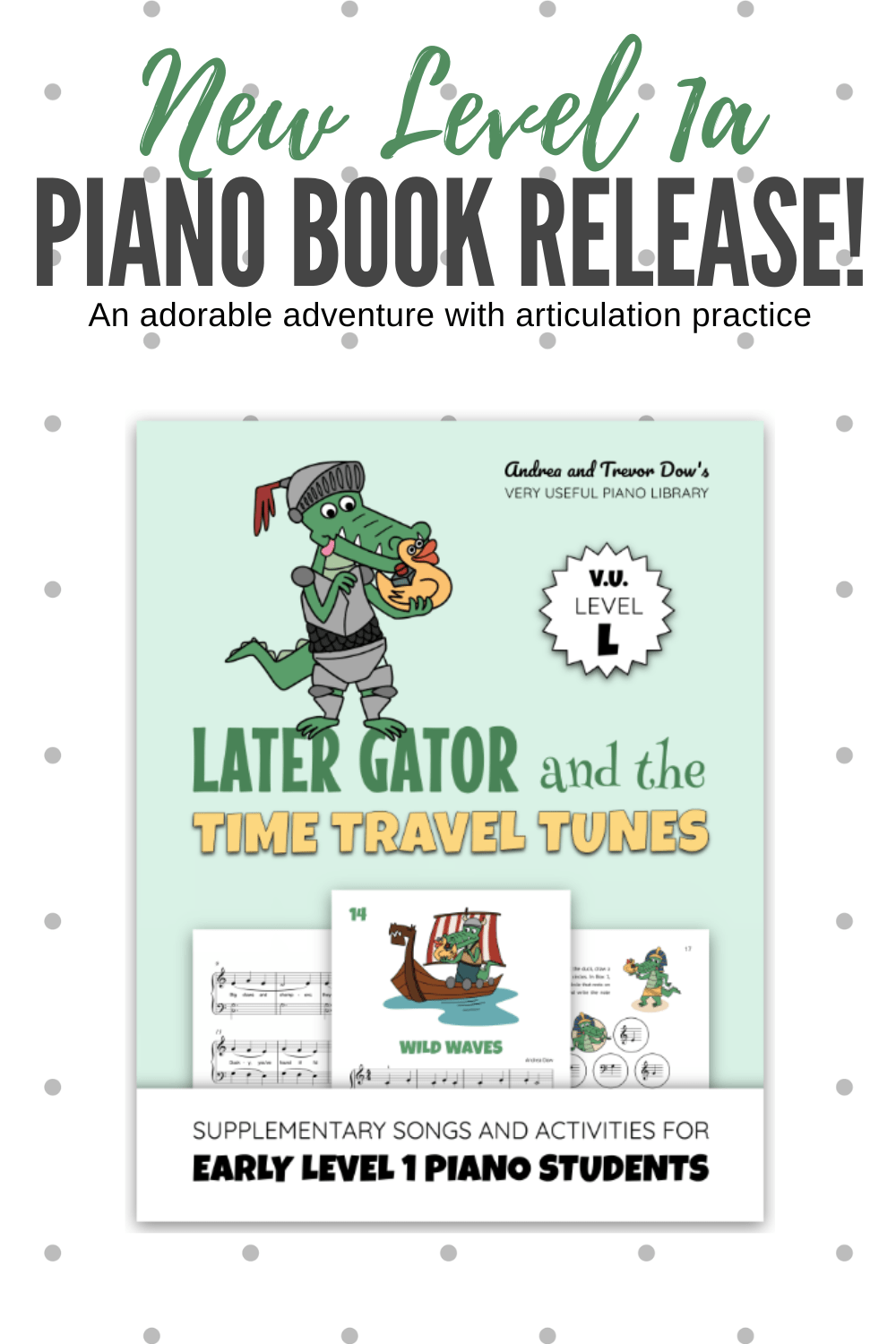
An Early Level 1 Piano Book For End-Of-Year Success
In Later Gator and the Time Travel Tunes, a lonely alligator stumbles upon a squeaky duck and suddenly finds himself zipping through time on a wild and hilarious adventure.
From dinosaur stomping grounds to medieval castles, ancient Egyptian pyramids to Viking voyages, your students will tag along with Gator while reinforcing key piano skills:
C 5-finger scales
Hands-together coordination
Staccato and legato articulation
Introductory left-hand accompaniments
This early level 1 piano book is designed to keep lessons exciting while targeting the exact skills students need at this crucial stage.
It’s a story-driven approach that turns essential early learning into an irresistible experience — exactly what students need when attention spans are pulled in a dozen directions.
As always, O’Connor Music Studio students are provided with all books at no charge as appropriate. Later Gator and the Time Travel Tunes is also available on amazon.
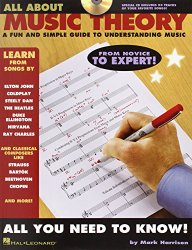
As all my students know, I teach theory with all piano and organ lessons. Sometimes, it’s from a theory book that matches a lesson book, sometimes on the fly on an “as needed” basis.
This book looks like it would be interesting to use as a review or to look ahead and see what’s coming. I have just ordered a copy for the studio if you want to check it out at the next lesson.
If you wish there was a fun and engaging way to help you understand the fundamentals of music, then this is it. Whether it’s learning to read music, understanding chords and scales, musical forms, or improvising and composing, this enjoyable guide will help you to finally start understanding the structure and design of music.
This fun-filled, easy-to-use guide includes:
* Music notation
* Scales and modes
* Melody harmonization and counterpoint
* Chord progressions
* Song form and structure
Listen and learn with the CD that has 90 tracks, including over 50 popular songs such as:
* Beauty and the Beast
* Candle in the Wind
* Imagine
* In the Air Tonight
* Killing Me Softly with His Song
* Let It Be
* Message in a Bottle
* Misty
* Satin Doll
* Take the ‘A’ Train
* Unchained Melody
* What’d I Say
* and more!
Since the first release of this classic Schirmer edition over 100 years ago, almost anyone who has taken piano lessons for more than two years has played from The Virtuoso Pianist.
Most anyone who has ever played piano has a love-hate relationship with the “Hanon”.
The Virtuoso Pianist (Le Pianiste virtuose) by Charles-Louis Hanon, is a compilation of sixty exercises meant to train the pianist in speed, precision, agility, and strength of all of the fingers and flexibility in the wrists.
First published in Boulogne, in 1873, The Virtuoso Pianist is Hanon’s most well-known work, and is still widely used by piano instructors and pupils although some teachers are getting away from the mechanical playing these can produce.
Personally, I’ve sometimes played these on “auto-pilot” since all one really needs is to get the first pattern going, then move up a step, up a step…
Notes by C. L. Hanon: Preparatory exercises for the Acquirement of Agility, Independence, Strength and Perfect Evenness in the Fingers. For studying the 20 exercises, begin with the metronome set at 60, gradually increasing the speed up to 108.
The exercises are intended to address common problems which could hamper the performance abilities of a student. These include “crossing of the thumb”, strengthening of the fourth and fifth fingers, and quadruple- and triple-trills.
The exercises are meant to be individually mastered and then played consecutively in the sections they are placed in.
Apart from increasing technical abilities of the student, when played in groups at higher speeds, the exercises will also help to increase endurance. The exercises are divided in three parts:
Exercises 1 – 20: Labeled “preparatory exercises”, these are also the most famous exercises, and are used to develop finger strength and independence. Each exercise contains a sequence of 8 semiquavers, beginning on C, which is then repeated starting on D, and so on across two octaves. The exercise is then repeated in reverse down two octaves to the starting C. The exercises are intended to be practiced in groups of three, except for the first two which are practiced together.
Exercises 21 – 43: Labeled “further exercises for the development of a virtuoso technique.” This more difficult section is meant to be played after the pianist has fully mastered Part 1. Part 2 includes scales and arpeggios.
Exercises 44 – 60: Labeled “virtuoso exercises for mastering the greatest technical difficulties.” Since this section is considerably more difficult, Hanon recommends the mastery of both previous parts before proceeding to this one. This part includes repeated notes,, and more.
After all three parts are mastered, Hanon recommends all exercises be played through daily to retain technique.
The O’Connor Music Studio has several editions of this work, including:
Hanon: The Virtuoso Pianist in Sixty Exercises, Complete. Since the first release of this classic Schirmer edition over 100 years ago, almost anyone who has taken piano lessons for more than two years has played from The Virtuoso Pianist . Millions of copies have been sold of these progressive exercises which guide a player’s technique, building finger independence and strength. This was the first American edition released of this music, and remains a classic at a remarkably affordable price.
Junior Hanon (Alfred Masterwork Edition). A slight condensation of Hanon’s first exercises. The simplification in layout and range make the exercises appear less difficult to a young student. Includes the complete Book 1 and excerpts from Books 2 & 3 of C. L. Hanon’s famous studies, The Virtuoso Pianist in 60 Exercises.
Hanon for Students, Bk 1: 6 Varied Exercises from The Virtuoso Pianist for Late Elementary Pianists. Hanon for Students, Book 1, contains the first six exercises from The Virtuoso Pianist, Book 1. The exercises are notated in eighth notes for one octave so that students may begin to use them effectively at the late-elementary level. Each exercise appears five times to be played with a legato touch, varied articulation, varied dynamics, varied rhythm, and transposed to F or G.
Jazz Hanon. Inspired by Charles-Louis Hanon’s The Virtuoso Pianist the essential technical method for any classical player these new volumes present a modern-day equivalent for the musician seeking to play the key piano styles of the 20th century. Each book develops basic technique and true facility in each genre through authentic, progressive exercises and etudes. The music in these books is fun to play for pianists at every level, building the necessary skills in each style while providing extensive musical and stylistic insight.
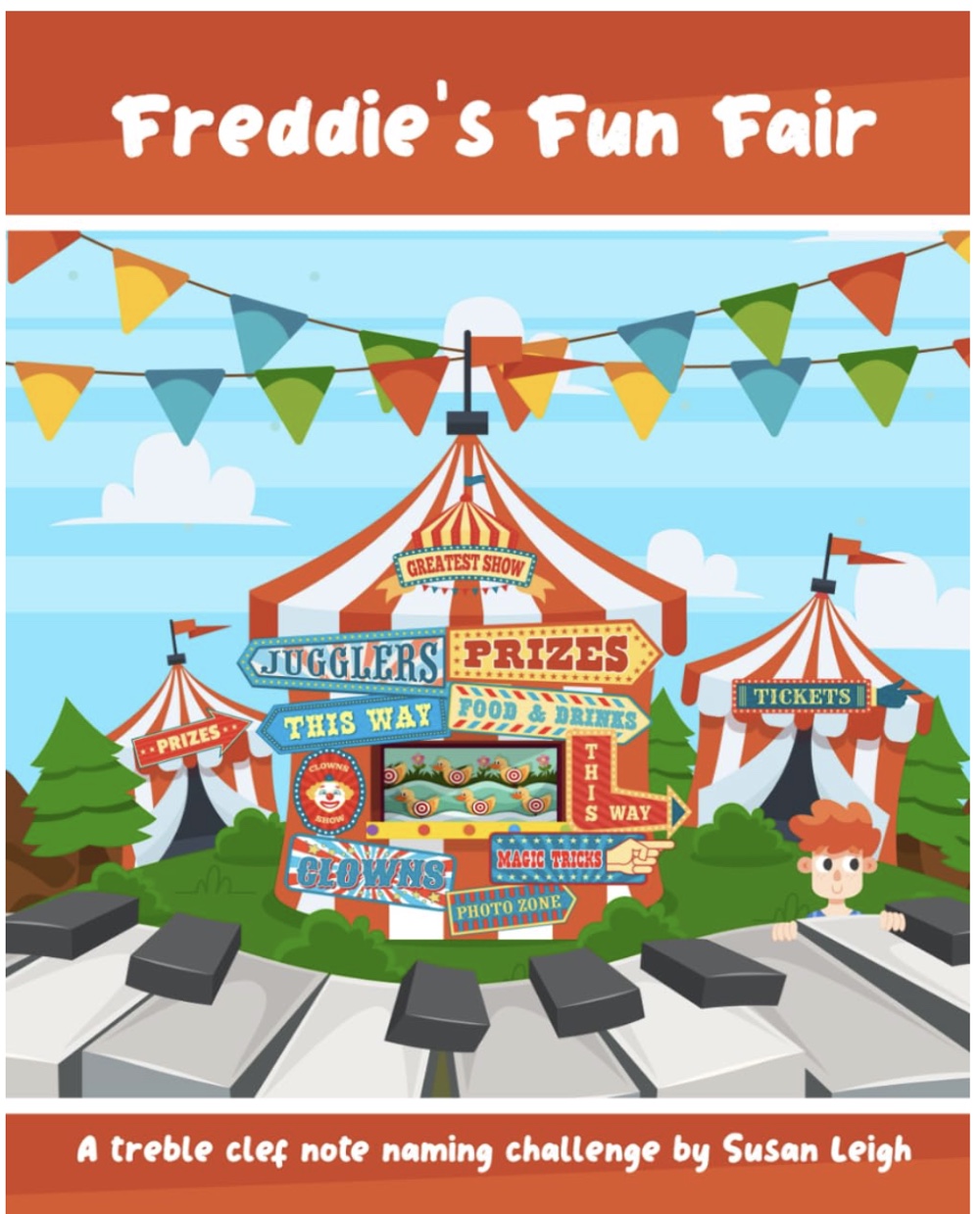
Susan Leigh’s other books have been a huge hit with students and I’m sure this one will be, too. It was just published and I’ve ordered it to arrive in time for students returning after winter break.
The note range includes all the lines and spaces of the treble clef stave, making it ideal for instrumentalists who play the piano, flute, saxophone and more.
Puzzles include traditional fairground games like the Coconut Shy, Bumper Cars, Hoopla, Toy Grabber, Skittles and Test Your Strength. There are match ups, scrambles, mazes, and also games against the clock like Tabletop Giraffe Racing, Splash the Shark and Whack-a-monster.
Students compete against Freddie in all events until the overall winner is crowned. There are two certificates to compete for; but who will win gold or silver and become the ultimate champion of both the treble clef and the fairground?!
Music theory has never sounded so catchy with this witty remake of the holiday classic The Christmas Song (with apologies to Mel Torme) Try not to laugh at the ending.
Though it is a bit humorous, this version titled ‘Intervals Roasting’, with lyrics by David Rakowski, attempts to encapsulate the fundamentals of music theory in just over two minutes.
It does a good job of explaining the intervals and harmonic structure of the song and also gives you an idea of how to use music theory to analyze or compose music.
The O’Connor Music Studio has a copy if anyone wants to learn this 🙂
“O Come, All Ye Faithful,” originally penned in the reverent Latin tones as “Adeste Fideles,” is a Christmas carol shrouded in mystery and rich in history. This beloved hymn, a staple of holiday celebrations, is thought to have been crafted by a medley of historical figures. Among them are John Francis Wade (1711–1786), John Reading (1645–1692), and even King John IV of Portugal (1604–1656). The hymn’s origins are further mystified by the earliest manuscript bearing King John IV’s name, found nestled in the Ducal Palace of Vila Viçosa’s library.
Initially composed with four verses, the hymn has since blossomed into an eight-verse masterpiece, transcending language barriers and cultural divides. Its verses have been translated into a multitude of languages, spreading its message of faith and joy worldwide. The English rendition by Frederick Oakeley, an English Catholic priest, penned in 1841, has particularly resonated in the hearts of English-speaking audiences globally, becoming a cherished rendition of this classic hymn.
Today, “O Come, All Ye Faithful” stands not just as a carol but as a symbol of Christmas spirit and unity. If you’re drawn to the allure of this timeless hymn and wish to bring its melody into your own celebrations, the O’Connor Music Studio offers a variety of versions for those eager to learn and share in the joy and majesty of this classic Christmas carol. Whether you’re a seasoned musician or a curious beginner, the store provides a gateway to experiencing and sharing the enduring magic of “O Come, All Ye Faithful.”