Music for Halloween: Jaws

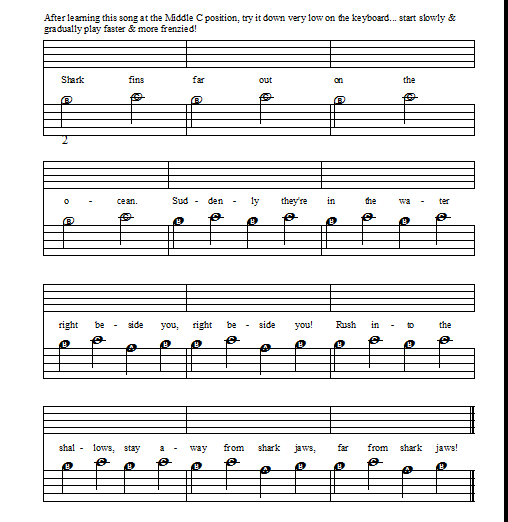
Nearly everyone can figure out the first 2 notes to this spooky piece – just play the B and C notes really low on your keyboard!  It doesn’t seem logical that just two notes could cause such a sense of foreboding, but John Williams managed it. His soundtrack to Spielberg’s Jaws has been keeping people out of the sea since 1975.  This piece is available in Halloween Favorites (Big-note Piano) and many others.

John Williams conducts his theme from Jaws with the Boston Pops Orchestra at Tanglewood.

Piano interpretation by Giorgio Rizzarelli

Piano duet

For guitar

Music for Halloween: The Addams Family

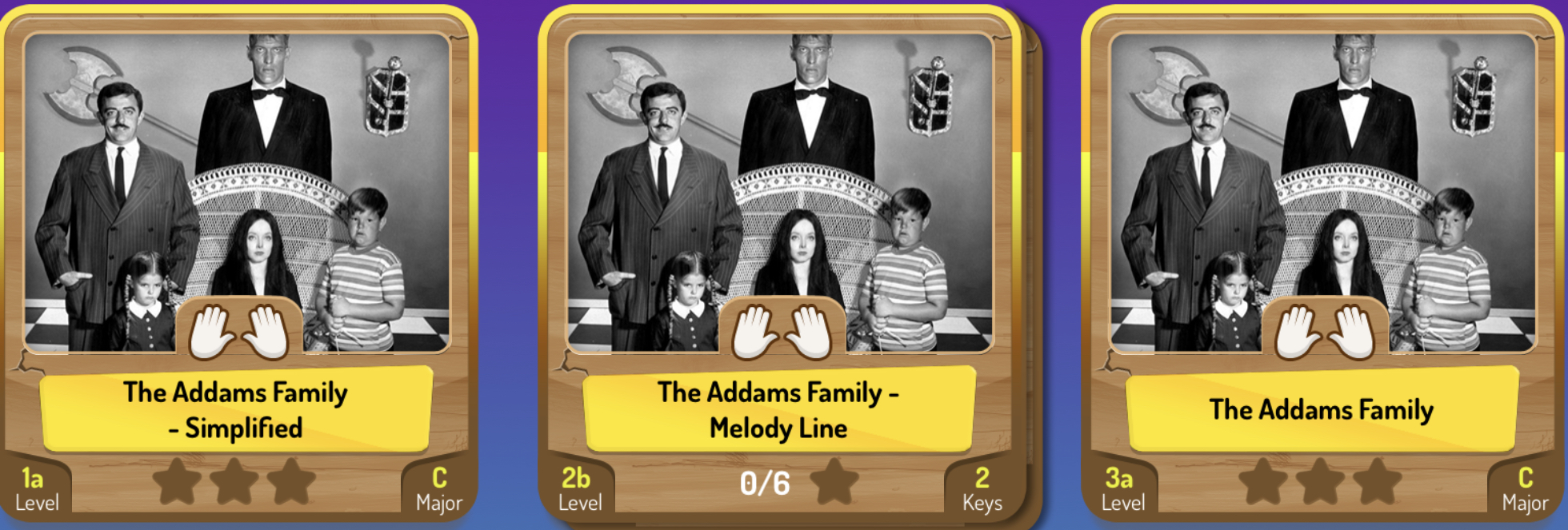
Students always find this piece fun with its finger snaps.  There are three versions in Piano Maestro and it’s in several piano books including Halloween Songbook (Easy Piano).  There was a a new Addams Family animated movie out in 2019, so your students are going to be snapping all over the place when this Halloween rolls around.

The original:

The cartoon opening:

All intros from 1964-1998

Piano:

Organ:

Sing along:

It’s all about the finger snap!

Fall 2025 Listening and Coloring Pages


I have purchased a set of Shades of Sound Listening & Coloring Book: Halloween for the studio.

Each week, I will print out some of the pages for your student and put them in his/her notebook.  They are also available in your Parent/Student Portal.   After listening to the music on YouTube, the student may color the pages.

After they are colored, please return them to the notebook so that there will be a complete book when finished.

If you are an adult and want to listen and color, too, just let me know and I’ll print you a set.

From the website:

The Shades of Sound Listening and Coloring Books are a great way to encourage students to listen to great piano and orchestral repertoire. Students of all ages will love coloring the fun pictures while listening to and learning from the music of the great composers.

This Shades of Sound Halloween edition includes 13 spooky pieces of piano and orchestral literature, ranging from the Baroque to the Modern period. By spending just 5-10 minutes per day listening for just a few days per week, students can listen to and complete the whole book in a few weeks.

Aspiring pianists need to know the literature, hear the greats perform, and be inspired and excited by the great music that is available! Just as writers need to read, read, read, pianists need to listen! Through this fun curriculum, students will learn about the musical periods and the great composers and their works. Listening repertoire selected includes selections from the standard solo piano literature, as well as solo piano and orchestra literature and orchestral works.

My hope is that students can add just 5-10 minutes of listening per day to their normal practicing. Listening to great music will change their understanding of music and will vastly increase their music history knowledge. It will excite and inspire them, encourage further study and listening, give them new pieces to add to their own repertoire wish list, infuse more great music into their lives, homes and families, and will boost their musicianship and expression to the next level.

The Halloween Shades of Sound book includes 13 different pieces, including:

  • Totentanz by Liszt
  • Le Cimetiere, from Clairs de Lune by Abel Decaux
  • Graceful Ghost Rag by William Bolcom
  • Night on Bald Mountain by Mussorgsky/Rimsky-Korsakov
  • Tarantelle, from Music for Children Op. 65 No. 4 by Prokofiev
  • Tarantella by Albert Pieczonka
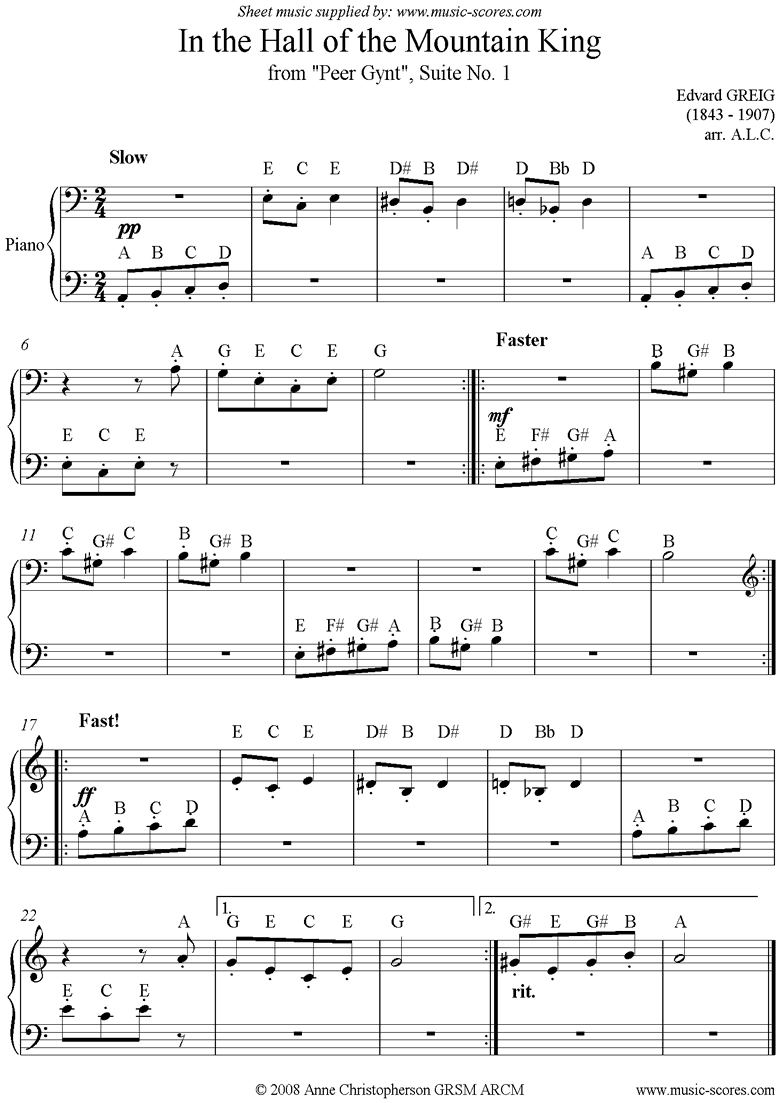
  • In the Hall of the Mountain King by Grieg
  • Toccata and Fugue in D minor, BWV 565 by Bach
  • Funeral March, from Piano Sonata No. 2 in B-flat minor by Chopin
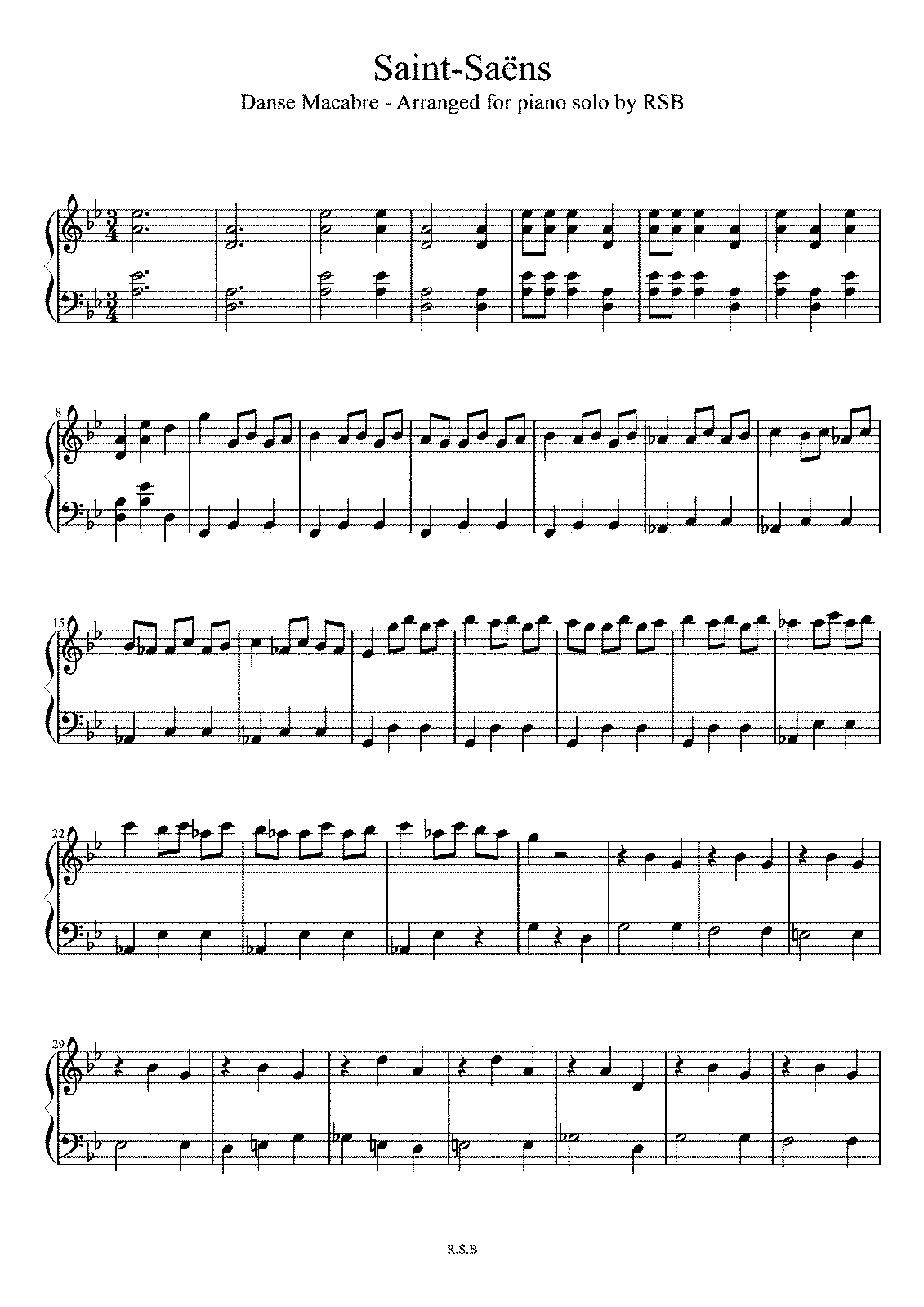
  • Danse Macabre by Saint-Saens
  • The Banshee by Henry Cowell
  • Scarbo, from Gaspard de la nuit by Ravel
  • The Sorcerer’s Apprentice by Paul Dukas

Students may use The Playful Piano – Halloween Listening YouTube playlist to listen along with their book using quality recordings. The playlist is ordered to go right along with the book, and also includes 5 extra pieces (some pages include optional “Further Listening” examples students may listen to).


Sing or Play Happy Birthday Whenever You Want

happy birthday


You’re legal now!

None of the companies that have collected royalties on the “Happy Birthday” song for the past 80 years held a valid copyright claim to one of the most popular songs in history, a federal judge in Los Angeles ruled on Tuesday.

In a stunning reversal of decades of copyright claims, the judge ruled that Warner/Chappell never had the right to charge for the use of the “Happy Birthday To You” song. Warner had been enforcing a copyright since 1988, when it bought Birch Tree Group, the successor to Clayton F. Summy Co., which claimed the original disputed copyright.

Judge George H. King ruled that a copyright filed by the Summy Co. in 1935 granted only the rights to specific piano arrangements of the music, not the actual song.

Read more at http://www.latimes.com/local/lanow/la-me-ln-happy-birthday-song-lawsuit-decision-20150922-story.html

The following version is in the O’Connor Music Studio library, if you wish to borrow it.  It is also available on amazon.com

A Manuscript of Mozart’s Piano Sonata K331 was Discovered in Budapest in 2014

mozart-sonata-k331

The manuscript of Mozart’s A major piano sonata K331 has been discovered in Budapest. Having spent the majority of its life in the Budapest’s National Széchényi Library for decades, the coveted manuscript was rediscovered by Haydn scholar Balazs Mikusi.

“When I first laid eyes upon the manuscript, the handwriting already looked suspiciously ‘Mozartish’,” said Mikusi, who is the head of the music collection at National Szechenyi Library. “Then I started reading the notes, and realised it is the famous A Major sonata … My heart rate shot up.”

The piece was composed in 1783 and contains Mozart’s most popular jam, “Turkish March,” which has become a piano lesson staple all over the world.

Although, unfortunately, Mikusi can’t say how or when these pages found their way to Hungary; they reveal subtle differences from the published editions of the sonata. The key variances are seen in the phrasing, dynamics and occasionally the notes themselves.

“It is very rare that a Mozart manuscript pops up. Moreover the A Major Sonata had no known manuscript, so it is a really big discovery,” he said.

The library has only released teasing images of the manuscript, nothing more.

From Manuscript of Mozart’s Piano Sonata K331 Discovered in Budapest’s National Széchényi Library : Classical : Classicalite.

The whole sonata:

Musicophilia – Tales of Music and the Brain by Oliver Sacks

sacks-music

Writer and neurologist Oliver Sacks, who died on Sunday, August 30, 2015 at age 82, spent his life wondering on the myriad connections among biology, thought, emotion and perception.

For those of us who obsess over the how and why of music, Sacks’ work on sound and its effects on the brain – and vice versa – was particularly illuminating. His book on the subject, “Musicophilia: Tales of Music and the Brain,” remains essential reading for those who want to understand the mechanics of music.

Through bountiful research and mesmerizing case studies, Sacks addressed topics including music and amnesia, music therapy, musical prodigies and those who suffer from debilitating aural hallucinations.

Read more at Oliver Sacks & music: On brainworms, hallucinations and sonic overload – LA Times

The O’Connor Music Studio has a copy of Musicophilia: Tales of Music and the Brain if anyone would like to borrow it.

Treble Maker!


When my students are first working with the Grand Staff, they are often confused about the placement of the various clefs.

In piano music, we generally use only the G-clef (Treble clef – not “trouble clef” as some think!) and the F-clef (Bass clef)  I try to show students how the curvy part of the G-clef wraps around the G above middle C and the F-clef looks sort of like an F marking the F below middle C.  I draw out G and F on the staff to show how these could have looked.

Originally, instead of a special clef symbol, the reference line of the staff was simply labeled with the name of the note it was intended to bear: F and C and, more rarely, G. These were the most often-used ‘clefs’ in Gregorian chant notation.  Gregorian chant developed mainly in western and central Europe during the 9th and 10th centuries, with later additions and redactions.

Over time the shapes of these letters became stylized, leading to their current versions.


Vivaldi’s Spring ~ From Piano Maestro

vivaldi


Vivaldi, one of the greatest baroque composers, has a very interesting story. He ran an orphanage in the 18th century in Italy that became famous all over the western world for its musically talented children. A lot of his pieces were written for specific children in his school. Vivaldi learned the violin from his father, and was trained as a priest. He was nicknamed “the red priest” for his red hair and was apparently somewhat sure of himself, having claimed once he can compose a concerto faster than it can be copied.

Vivaldi wrote over 500 pieces, most of which are lost today. He is considered one of the greatest musical landmarks in history, having inspired many composers that followed him, including J.S.Bach and others.

Other fun facts about Vivaldi can be found here.

Vivaldi’s Spring is available on Piano Maestro, which is available to my students free of charge.

Billy Connolly and the William Tell Overture


Today, we’ll be listening to the end of the William Tell Overture by Gioachino Rossini.  This piece, originally the overture to an opera, has been arranged for piano and is in several method books, including Piano Pronto Movements 1 and 2.  It’s also in Bastien Book 4 and Piano Maestro.
The original story

Maybe your grandparents watched the original Lone Ranger

Or you saw the newer Lone Ranger with Johnny Depp

Here’s the entire William Tell Overture played by an orchestra

Piano Solo

Franz Liszt made a really hard version for piano solo. See if you can follow along!

Piano Duet (1 piano, 4 hands)

Piano Duet arranged by Louis Moreau Gottschalk

Piano Duo (2 pianos, 8 hands)

Piano Quartet (4 pianos, 16 hands)

For pipe organ

For synthesizer

And then things get nuts with cartoons. Lots of cartoons used this music. Here are Mickey Mouse and friends

And Spike Jones

Handbells…

Poor Rossini – I think he’d have a fit if he knew how is music was being used.

Have a nice day!

Back To School Book Of Note Reading Boosters

Some students will be getting this new book the first lesson this fall.  With The Back To School Book Of Note Reading Boosters, you and your students have a jam-packed resource that can be used at home for extra practice or during lessons for off-the-bench activities.

Inside your students will discover back-to-school-themed mazes, color-it mystery pictures, word searches, pattern play, dot-to-dot journeys, tic tac toe, and board games; all designed to reinforce note reading in C position.

In addition, the book includes a build-your-own note printing solo, a mix and match sight reading solo, and a make-a-motive composing solo.

This year, show students just how fun note reading can be with The Back To School Book Of Note Reading Boosters.

Enjoy!