
A helpful guide to reading sheet music created by an unqualified individual.

A helpful guide to reading sheet music created by an unqualified individual.

Singin’ in the Rain is from a wonderful old movie of the same name and you can find it in Alfred Premier Piano Course Book 3. The movie offers a lighthearted depiction of Hollywood in the late 1920s, with the three stars portraying performers caught up in the transition from silent films to “talkies”.
Another version of the same song, sung a bit differently
From the Alfred Piano book


Student books in 5 different categories are available now in both digital and hardcopy. There is now “To the Lake”, “Outdoor Adventure”, “To the Farm”, “Country Carnival” and two levels of “Rockstar Rally”.
Two levels of Roadtrip! are currently available in Piano Maestro.
Register for Roadtrip! Students (ages 4-5) are scheduled for half-hour lessons with their parents present.
The Polovtsian Dances form an exotic scene at the end of act 2 of Alexander Borodin’s opera Prince Igor.
The work remained unfinished when the composer died in 1887, although he had worked on it for more than a decade. A performing version was prepared by Nikolai Rimsky-Korsakov and Alexander Glazunov in 1890. One of the more famous dances is found in Piano Pronto Movement 4 and Alfred Premier Piano Course Book 3,.
Can you find it in here?
Follow the score!
A different dance
The dance that’s usually in method books

This is another piece I just like to listen to, partly because of the bagpipes. I do have sheet music, but it’s not quite the same!
This melody was composed by German musicians Ulrich Roever and Michael Korb[1] in 1982 for a Highland games held in Germany. It has been proposed as the Scottish national anthem to replace unofficial anthems Scotland the Brave and/or Flower of Scotland.
I heard it first here, at the Edinburgh Tattoo
One of my favorite versions
And, from the Mormon Tabernacle Choir
From the Red Hot Chili Pipers

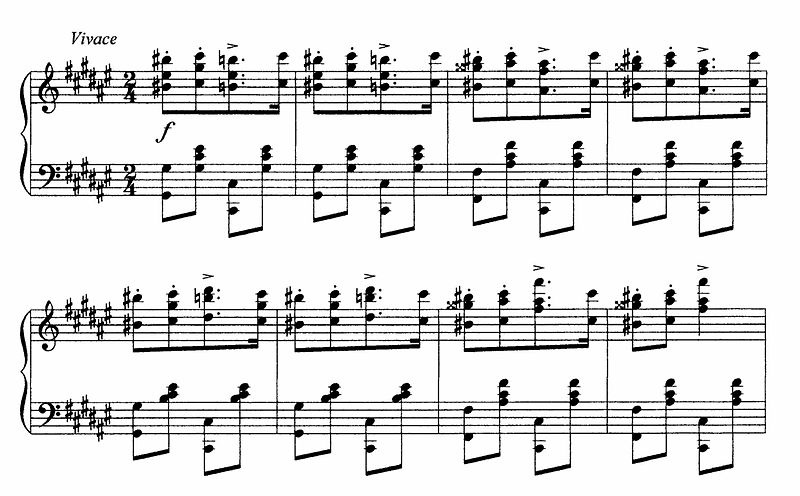
Hungarian Rhapsody No. 2, S.244/2, is the second in a set of 19 Hungarian Rhapsodies by composer Franz Liszt, and is by far the most famous of the set. Few other piano solos have achieved such widespread popularity, offering the pianist the opportunity to reveal exceptional skill as a virtuoso, while providing the listener with an immediate and irresistible musical appeal.
In both the original piano solo form and in the orchestrated version this composition has enjoyed widespread use in animated cartoons. Its themes have also served as the basis of several popular songs.
It is probable that you have heard this piece of music somewhere at one time or another because it is perhaps the most prominent piece of classical (romantic, actually) music featured in animated cartoons across the years.
Now, let the anvils fall and dynamite explode!
And, in real life, Valentina Lisitsa plays Liszt’s Hungarian Rhapsody No. 2
This piece is available in Piano Pronto Movement 5 and several anthologies of classical music.
To a Wild Rose is the first piece from Ten Woodland Sketches, Op. 51, by the American composer Edward MacDowell. It was completed in 1896, Numerous arrangements of the piece have been made. Though the original was for solo piano, it has been arranged for two sopranos, alto and piano.
It has been said that the piece is best played by children, as they wouldn’t embellish it heavily but perform it quite simply. Find it in Piano Pronto Movement 4 and other books.
Chamber Orchestra
A beginning band
Flute
Harp
Tuba

Today’s piece is Hungarian Dance #5 by Johannes Brahms. It’s available in Alfred Premier Piano Course Book 4 and many anthologies of classical music.
The Hungarian Dances are a set of 21 lively dance tunes based mostly on Hungarian themes, completed in 1869.
They vary from about a minute to five minutes in length. They are among Brahms’s most popular works and were the most profitable for him. Each dance has been arranged for a wide variety of instruments and ensembles. Brahms originally wrote the version for piano four hands and later arranged the first ten dances for solo piano.
Orchestra
Piano Duo
This has been embellished quite a bit
Violin
Ragtime (Bill Edwards)

The Piano Puzzlers book is available in the O’Connor Music Studio library if you’d like to give any a try. Piano Puzzlers as heard on American Public Media’s “Performance Today.” Includes 32 tunes with songs by Gershwin, Berlin, Arlen, Porter, Rodgers, Fats Waller, Lennon & McCartney, and others disguised in the styles of Bach, Handel, Haydn, Mozart, Beethoven, Brahms, Schubert, Schumann, Chopin, Janacek, Debussy, Ravel, Rachmaninoff, Stravinsky, Prokofiev, Bartok, and Copland.
Includes an introduction by Fred Child, host of “Performance Today” as well as background info by Bruce Adolphe. “Bruce Adolphe has taken a common musician’s party game and elevated it to high art and truly funny musical slapsticks. The Piano Puzzlers are a unique combination of extraordinary insight into the styles of many composers subtle, expert workmanship and great, great fun!”
From http://jasonmorris.blogsome.com/2008/08/08/piano-puzzlers/
If you’re a music geek (like me), I have a program for you. Now, let me be clear, to fully qualify as a music geek…you must have a fond appreciation for classical music (no, Poison, Quiet Riot, and Zepplin do not count as classical music). So, if you’re a “music geek” without an appreciation for classical music…well, I hate to burst your bubble…but, you’re not truly a music geek. Instead, you’re a music appreciator, but not a geek. So, if you just listen to indie music and scowl at anything on a label larger than Matador…don’t bother following the link I’ll provide…the fun will be lost on you…And, you probably won’t have a chance.
Every Wednesday night, on my way home from WNL, I turn on my local NPR station to listen to Piano Puzzlers on Performance Today. It’s absolutely incredible. A pianist/composer (Bruce Adolphe) takes a familiar folk or pop tune and sets it inside a classical masterpiece (or in the style of a particular composer). Sometimes it’s easy…sometimes it’s ridiculously difficult. There are days when I say, “got it” on the first pass. Then there are days when I say, “what the heck?” And, more often than not, I’m able to get either the popular/folk tune or the composer.
This is sad to admit, but there are nights when I’ll slow down on the drive home or sit in the car in the driveway to finish an episode. In fact, I get a little worked up if someone stops me after WNL…as I might miss the beginning of Piano Puzzlers (it usually hits around 8:20pm on our local station).
Take a listen to some of the archives and see if you can figure it out! It’s really cool…but probably only appreciated by music geeks (the kind of people that listen to NPR for their musical programs and not just the snipets of cool indie rock between segments on All Things Considered…which is a great show too).

I have several copies of this book for the music studio so parents can check it out to see if it would be useful for them to buy for home use. If any of the studio parents have this book already, please let me know what you think.
Some of my adult students have this and have found it helpful in doing theory assignments.
From Amazon:
Help Your Kids with Music is a step-by-step visual guide to music theory and is the perfect primer to help students gain a solid foundation in music, no matter their age, skill level, or instrument.
Help Your Kids with Music clearly explains key concepts in five step-by-step chapters:
Sample pages:

 MaryO'Studio