
Another student favorite, Ghostbusters, has 2 versions in Piano Maestro.

Another student favorite, Ghostbusters, has 2 versions in Piano Maestro.
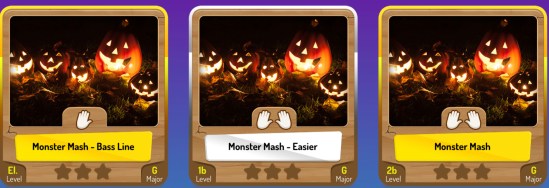
The Monster Mash by Bobby “Boris” Pickett is in Piano Maestro with 3 different levels to play. The song was released as a single in August 1962 along with a full-length LP (record) called The Original Monster Mash, which contained several other monster-themed tunes. The “Monster Mash” single was #1 on the Billboard Hot 100 chart on October 20–27 of that year, just before Halloween. It has been a perennial Halloween favorite ever since.
Singing pumpkins
From Disney
From a contest winner

If you’re lucky enough to be traveling, I hope you have a wonderful time off and see you next Monday.
Keep practicing!


Jelly Roll Morton, born Ferdinand Joseph La Menthe in 1885, was one of the most influential composers of the jazz era, bridging an important gap between ragtime, blues, and jazz. In a sense, he was the first great jazz composer.
His career began in New Orleans, where he began to experiment with a unique blend of blues, ragtime, Creole, and Spanish music in bordellos as a piano player. Along with being a musician, he also worked as a gambler, pool shark, vaudeville comedian, and was known for his flamboyant personality and diamond front tooth.
Morton became successful when he started making what would be some of the first jazz recordings in 1923 with “the New Orleans Rhythm Kings”. Whether he played on the West Coast, New Orleans, or in Chicago, his recordings were always very popular. He joined the group “the Red Hot Peppers” in 1924 and made several classic albums with the Victor label.
Nothing but success came to him until 1930, when “Hot Jazz” began to die out, and big bands began to take over. Morton died in 1941, claiming that a voodoo spell was the cause of his demise.

I have purchased a set of Shades of Sound Listening & Coloring Book: Halloween for the studio.
Each week, I will print out some of the pages for your student and put them in his/her notebook. They are also available in your Parent/Student Portal. After listening to the music on YouTube, the student may color the pages.
After they are colored, please return them to the notebook so that there will be a complete book when finished.
If you are an adult and want to listen and color, too, just let me know and I’ll print you a set.
From the website:
The Shades of Sound Listening and Coloring Books are a great way to encourage students to listen to great piano and orchestral repertoire. Students of all ages will love coloring the fun pictures while listening to and learning from the music of the great composers.
This Shades of Sound Halloween edition includes 13 spooky pieces of piano and orchestral literature, ranging from the Baroque to the Modern period. By spending just 5-10 minutes per day listening for just a few days per week, students can listen to and complete the whole book in a few weeks.
Aspiring pianists need to know the literature, hear the greats perform, and be inspired and excited by the great music that is available! Just as writers need to read, read, read, pianists need to listen! Through this fun curriculum, students will learn about the musical periods and the great composers and their works. Listening repertoire selected includes selections from the standard solo piano literature, as well as solo piano and orchestra literature and orchestral works.
My hope is that students can add just 5-10 minutes of listening per day to their normal practicing. Listening to great music will change their understanding of music and will vastly increase their music history knowledge. It will excite and inspire them, encourage further study and listening, give them new pieces to add to their own repertoire wish list, infuse more great music into their lives, homes and families, and will boost their musicianship and expression to the next level.
The Halloween Shades of Sound book includes 13 different pieces, including:
- Totentanz by Liszt
- Le Cimetiere, from Clairs de Lune by Abel Decaux
- Graceful Ghost Rag by William Bolcom
- Night on Bald Mountain by Mussorgsky/Rimsky-Korsakov
- Tarantelle, from Music for Children Op. 65 No. 4 by Prokofiev
- Tarantella by Albert Pieczonka
- In the Hall of the Mountain King by Grieg
- Toccata and Fugue in D minor, BWV 565 by Bach
- Funeral March, from Piano Sonata No. 2 in B-flat minor by Chopin
- Danse Macabre by Saint-Saens
- The Banshee by Henry Cowell
- Scarbo, from Gaspard de la nuit by Ravel
- The Sorcerer’s Apprentice by Paul Dukas
Students may use The Playful Piano – Halloween Listening YouTube playlist to listen along with their book using quality recordings. The playlist is ordered to go right along with the book, and also includes 5 extra pieces (some pages include optional “Further Listening” examples students may listen to).


Destined to become one of the world’s greatest pianists, Vladimir Horowitz was born in 1903 in Kiev, Russia. While most young children were playing games, Vladimir was playing with the ivories. His time was well spent as he was fully capable of performing publicly by the time he was sixteen.
Within four years, the young piano virtuoso was entertaining audiences at recitals throughout Leningrad – 23 performances in one year, where he played over 200 different works of music, never repeating a composition. After Leningrad, Horowitz played in concerts in Berlin, Hamburg and Paris.
In 1928, the Russian pianist traveled to the United States to play with the New York Philharmonic Orchestra at Carnegie Hall. Arturo Toscanini chose Horowitz to perform his first solo with the New York Philharmonic. It was there that Horowitz met his bride-to-be, Toscanini’s daughter, Wanda. The two were wed in Milan in 1933. New York became Horowitz’ permanent home in 1940. He became a U.S. citizen a few years later, devoting the rest of his career to benefit performances, and helping young, aspiring artists.
His return to the concert stage in May of 1965 was a triumphant success, as was his television recital, Vladimir Horowitz at Carnegie Hall.
Just three years before his death, Vladimir Horowitz returned to his homeland to perform once again for the Russian people on April 20, 1986. They felt he had been away far too long … close to sixty years.
 anniversary of Horowitz’s death

You’re legal now!
None of the companies that have collected royalties on the “Happy Birthday” song for the past 80 years held a valid copyright claim to one of the most popular songs in history, a federal judge in Los Angeles ruled on Tuesday.
In a stunning reversal of decades of copyright claims, the judge ruled that Warner/Chappell never had the right to charge for the use of the “Happy Birthday To You” song. Warner had been enforcing a copyright since 1988, when it bought Birch Tree Group, the successor to Clayton F. Summy Co., which claimed the original disputed copyright.
Judge George H. King ruled that a copyright filed by the Summy Co. in 1935 granted only the rights to specific piano arrangements of the music, not the actual song.
Read more at http://www.latimes.com/local/lanow/la-me-ln-happy-birthday-song-lawsuit-decision-20150922-story.html
The following version is in the O’Connor Music Studio library, if you wish to borrow it. It is also available on amazon.com

Johann Sebastian Bach (1685-1750) was also apparently a coffee enthusiast. So much so that he wrote a composition about the beverage. Although known mostly for his liturgical music, his Coffee Cantata (AKA Schweigt stille, plaudert nicht, BWV 211) is a rare example of a secular work by the composer. The short comic opera was written (circa 1735) for a musical ensemble called The Collegium Musicum based in a storied Zimmerman’s coffee house in Leipzig, Germany. The whole cantata seems very much to have been written with the local audience in mind.
Coffee Cantata is about a young vivacious woman named Aria who loves coffee. Her killjoy father is, of course, dead set against his daughter having any kind of caffeinated fun. So he tries to ban her from the drink. Aria bitterly complains:
Father sir, but do not be so harsh!
If I couldn’t, three times a day,
be allowed to drink my little cup of coffee,
in my anguish I will turn into
a shriveled-up roast goat.Ah! How sweet coffee tastes,
more delicious than a thousand kisses,
milder than muscatel wine.
Coffee, I have to have coffee,
and, if someone wants to pamper me,
ah, then bring me coffee as a gift!
The copywriters at Starbucks marketing department couldn’t have written it any better. Eventually, daughter and father reconcile when he agrees to have a guaranteed three cups of coffee a day written into her marriage contract.

George Gershwin lived between September 26, 1898 and July 11, 1937. He is considered to be a twentieth century composer.
If you hate homework but like roller skating, you have something in common with American composer George Gershwin. Born in Brooklyn, New York to Russian immigrant parents, George loved to play street hockey, ‘cat’, and punch ball. He didn’t even have an interest in music until his family got him a piano when he was twelve. Nine years later he had his first hit, “Swanee”, with lyrics written by Irving Caesar. No one else in the Gershwin family was musical, but George was fascinated by music. When he heard a schoolmate play the violin, George struck up a friendship with the boy who introduced him to the world of concert music.
Gershwin’s American in Paris and Rhapsody in Blue (featured in Disney’s newly released Fantasia 2000) proved that jazz was powerful enough to combine will with symphonic music. Gershwin was only 26 years old at the time when he composed Rhapsody in Blue. No matter how you hear it, “Rhapsody in Blue” will remain the signature of one of the most influential of composers, songwriters and pianists in American music history.
His play Porgy and Bess has been produced as both a film and an opera.


 MaryO'Studio