August 26: Today in Music History

• 1661 ~ Louis Couperin, composer, died

• 1813 ~ Daniel Gottlob Turk, composer, died at the age of 63

• 1873 ~ Lee DeForest, Inventor of the triode vacuum tube, possibly the most significant invention that made radio possible.

• 1894 ~ Arthur Loesser, American pianist and writer

• 1915 ~ Humphrey Searle, British composer and writer

• 1919 ~ Ronny Graham (Ronald Montcrief Stringer), Singer, actor

• 1928 ~ Peter Appleyard, British jazz vibraphonist and drummer

• 1939 ~ The radio program Arch Oboler’s Plays presented the NBC Symphony, for the first time, as the musical backdrop for the drama, This Lonely Heart.

• 1942 ~ Vic Dana, Singer

• 1949 ~ Bob Cowsill, Singer with The Cowsills

• 1957 ~ John O’Neill, Musician, guitar with That Petrol Emotion

• 1958 ~ Ralph Vaughan Williams, Composer, passed away.

• 1960 ~ Branford Marsalis, Musician, saxophone, bandleader with The Tonight Show, toured with Sting
More information about the Marsalis family

• 1967 ~ Brian Epstein passed away

• 1970 ~ Jimi Hendrix opened his recording studio in New York City. Because of its state-of-the-art 36-track recording capability, it attracted many top rock groups.

• 2000 ~ George Edmund Sandell, a noted violin and viola player, teacher and inventor died at the age of 88.
Sandell studied in New York under the viola virtuoso William Primrose and on scholarship at the Royal Swedish Conservatory in Stockholm.

Sandell moved to Los Angeles in 1938, where he played with the Los Angeles Philharmonic and the Pasadena and Santa Monica Symphonies.

Along with classical music, he performed pop, swing and Latin music, and played with the string sections of big band luminaries Harry James, Jimmy Dorsey and  Xavier Cugat.

Sandell also played on some of Frank Sinatra’s recordings and worked for most of the big Hollywood studios on orchestral soundtracks, including the soundtrack for the movie Citizen Kane.

In 1947, he invented the Gee-Bee, a kitchen sponge with a plastic handle for washing dishes. He sold the company to DuPont in 1953.

• 2001 ~ Alix Williamson, the classical music publicist who suggested to Baroness Maria von Trapp that she write a book about her family’s experiences, died at the age of 85.

Williamson’s suggestion resulted in the Rodgers and Hammerstein musical “The Sound of Music.”

She represented artists such as André Watts and Frederica von Stade and helped the New York Grand Opera get a citation in the Guinness Book of World Records for its performances of a complete cycle of Verdi’s operas in Central Park. Williamson also ghostwrote books.

• 2018 ~ Neil Simon died at the age of 91. He was an American playwright, screenwriter and author. He wrote more than 30 plays and nearly the same number of movie screenplays, mostly adaptations of his plays. He received more combined Oscar and Tony nominations than any other writer.

What A Parent Needs to Know About Piano Maestro

Piano Mania


It will be fun watching your child improve their piano skills all while having fun using Piano Maestro in lessons each week!

As your child’s teacher (or YOUR teacher!), I’m looking forward to seeing the progress they will make when they start using it at home each day. This guide will help you understand how this app will benefit your child and how to get it set up on your own iPad.

Overview
What is Piano Maestro?

Piano Maestro is the ultimate piano practice tool that will have students quickly playing their favorite classical, pop, rock, TV and video game songs and themes. It is available in the App Store and works on the iPad.

What skills does it improve?
• Note reading
• Sight reading
• Rhythm
• Inner pulse
• Confidence

What makes it so fun?
• Upbeat background tracks
• Stunning graphics
• Instant rewards and feedback
• Satisfaction of playing REAL music

It works with an acoustic piano?

Yes! Your child practices on your real acoustic or digital piano. Piano Maestro listens from the iPad’s built-in microphone. No wires needed.

I’m already paying for lessons. What value does this add?

Sometimes I wish I could be there with your child to encourage them to keep practicing daily. I’m sure it’s not always easy, as unforeseen challenges will arise.

Since our time each week is just too short, this app will give me eyes on the ground and it will keep them practicing longer and improving more quickly.

How will it be used in lessons?

I will spend a few minutes of each lesson helping your child master a couple of new songs all while having fun! I will also teach them how to use the practice options at home.

At the end of the lesson, we will choose Home Challenge assignments within the app that will show up in your account at home. I’ll get updates when progress is made.


Getting Started
Wow, this sounds awesome. Now, how do I get started?

1) Download Piano Maestro on your iPad from the AppStore
2) Create a JoyTunes account with a parent’s email, under which, you can have multiple profiles for each member of the family.
3) Create a profile for each family member (that means you too Mom and Dad!) inside the Parent/Teacher zone (top right-hand corner of the main screen)
4) Connect to your teacher, me! After creating a profile in the “profiles” tab of the parent/teacher zone, select the student’s profile and click “connect to teacher.” Once I approve the connection to your child, they will receive full access to all content for FREE! I will then also begin receiving weekly progress reports.
5) Start Playing – I will now start assigning you homework, meanwhile, get started on Journey Mode.

When you connect to the O’Connor Music Studio, Piano Maestro is free for as long as you study here.

August 25: Today in Music History

Screenshot 2016-08-25 10.48.11

• 1879 ~ New York’s Madison Square Garden displayed a real floating ship in a gigantic water tank as Gilbert and Sullivan’s operetta, H.M.S. Pinafore, was performed.

• 1902 ~ Stefan Wolpe, German-born American composer

• 1909 ~ Ruby (Ethel Hilda) Keeler, Dancer, actress

• 1913 ~ Bob Crosby, Bandleader with The Bob Cats, brother of Bing Crosby

• 1918 ~ Leonard Bernstein, American conductor, composer and pianist
Read quotes by and about Bernstein
Links to more information about Bernstein
Grammy winner

• 1939 ~ Dorothy embarked on a journey down the yellow brick road with a lion, a tin man and a scarecrow in the classic film “The Wizard of Oz.”

• 1941 ~ Skinnay Ennis and his orchestra recorded the tune Don’t Let Julia Fool Ya.

• 1942 ~ Walter Williams, Singer with The O’Jays

• 1955 ~ Elvis Costello (Declan McManus), Musician, songwriter

• 1961 ~ Billy Ray Cyrus, Singer

• 1964 ~ The Beatles received a gold record for their hit single A Hard Day’s Night. It was the third gold record for the Fab Four. They would collect 18 more through 1970.

• 1971 ~ Ted Lewis passed away.  He was an American entertainer, bandleader, singer, and musician.

• 1982 ~ The group, Fleetwood Mac, received a gold record for the album Mirage.

• 2001 ~ Aaliyah died at the age of 22. She was a R&B singer and budding actress who made her film debut in “Romeo Must Die” and was killed in a plane crash in the Bahamas.

• 2001 ~ Jazz musician John Nelson, the father of pop star Prince, died at the age of 85. Nelson was the model for a character in the 1984 Prince movie “Purple Rain.” He also co-wrote songs on several of his son’s hit albums.
In the 1950s, Nelson was a pianist in the jazz group Prince Rogers Trio featuring singer Mattie Shaw. Shaw and Nelson married, and they named their son Prince Roger Nelson.
Nelson left the household when Prince was about 10 and his sister Tyka was 8. The father and son reconciled after Prince began his climb to fame.
Nelson co-wrote Computer Blue on the Purple Rain album, The Ladder on Around the World in a Day; Christopher Tracy’s Parade and Under the Cherry Moon on Parade and Scandalous on the Batman soundtrack.

• 2008 ~ Josef Tal, Israel composer (Israeli art music), died at the age of 97

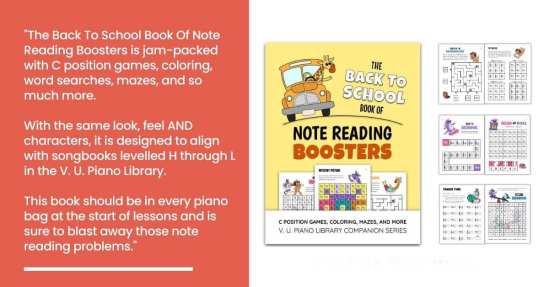
Back To School Book Of Note Reading Boosters

Some students will be getting this new book the first lesson this fall.  With The Back To School Book Of Note Reading Boosters, you and your students have a jam-packed resource that can be used at home for extra practice or during lessons for off-the-bench activities.

Inside your students will discover back-to-school-themed mazes, color-it mystery pictures, word searches, pattern play, dot-to-dot journeys, tic tac toe, and board games; all designed to reinforce note reading in C position.

In addition, the book includes a build-your-own note printing solo, a mix and match sight reading solo, and a make-a-motive composing solo.

This year, show students just how fun note reading can be with The Back To School Book Of Note Reading Boosters.

Enjoy!

August 24: Today in Music History

today

• 1837 ~ Théodore Dubois, French organist and composer

• 1856 ~ Felix Mottl, Austrian conductor, composer and arranger

• 1919 ~ Neils Viggo Bentzon, Danish composer

• 1924 ~ Louis Teicher, Pianist with the duo, Ferrante and Teicher

• 1938 ~ David Freiberg, Bass guitar with Jefferson Starship

• 1938 ~ Mason Williams, Guitarist, Emmy Award-winning writer

• 1941 ~ Ernest Wright, Singer with Little Anthony and the Imperials

• 1943 ~ John Cipollina, Guitarist with Quicksilver Messenger Service

• 1944 ~ Jim Brady, Singer with The Sandpipers

• 1945 ~ Ken Hensley, Musician, guitar, keyboard, composer, with Uriah Heep

• 1955 ~ Jeffrey Daniel, Singer with Shalamar

• 1969 ~ Arlo Guthrie’s Alice’s Restaurant premiered in both New York and Los Angeles.

• 1979 ~ B.B. King celebrated his 30th year in show business at a special celebration held at the Roxy Theatre in Los Angeles, CA.

• 1985 ~ Huey Lewis and The News reached the top. The Power of Love was #1 on the Billboard Hot 100 for two weeks.

August 23: Today in Music History

today

• 1854 ~ Moritz Moszkowski, Polish-born German pianist and composer
More information about Moszkowski

• 1900 ~ Ernst Krenek, Austrian-born American composer, conductor and pianist

• 1905 ~ Constant Lambert, British composer, conductor and writer

• 1912 ~ Gene (Eugene Curran) Kelly, Dancer, actor: Singin’ in the Rain, An American in Paris, Anchors Aweigh, The Three Musketeers, Marjorie Morningstar, Inherit the Wind, North and South Book I; director: Singin’ in the Rain, Hello, Dolly!, A Guide for the Married Man, The Cheyenne Social Club

• 1917 ~ Tex (Sol) Williams, American country-western singer

• 1923 ~ Billy Jones and Ernie Hare, The Happiness Boys, were heard on radio for the first time. The two were billed as radio’s first comedians and were also credited with creating and performing the first singing commercial.

• 1936 ~ Rudy Lewis, Singer with Drifters

• 1942 ~ Patricia McBride, Ballerina: New York City Ballet. For many years she was Mikhail Baryshnikov’s only partner

• 1943 ~ LIFE magazine spotlighted a dance craze that was sweeping the U.S.A., the Lindy Hop

• 1947 ~ Keith Moon, Singer, drummer with The Who

• 1947 ~ Margaret Truman, daughter of U.S. President Harry S Truman, presented her first public concert.  Margaret sang before 15,000 people at the Hollywood Bowl. The concert did not get great reviews. In fact, the critics didn’t like Margaret’s singing at all. And Margaret’s dad didn’t like the critics, and said so, from the White House.

• 1949 ~ Rick Springfield, Singer

• 1951 ~ Mark Hudson, Singer with The Hudson Brothers

• 1951 ~ Jimi Jamison, Singer with Survivor

• 1953 ~ Bobby G. (Gubby), Singer with Bucks Fizz

• 1960 ~ Oscar (Greeley Clendenning) Hammerstein II passed awa.

• 1962 ~ Shaun Ryder, Singer with Happy Mondays

• 1966 ~ The U.S. premiere of the motion picture Help!, starring The Beatles, was held for thousands of moviegoers wanting to see the group’s first, color, motion picture. Their first film, A Hard Day’s Night, had been produced in black and white.

• 1990 ~ David Rose passed away

• 2001 ~ Kathleen Freeman, a veteran character actress whose face if not her name was known to audiences from television sitcoms, the film classic “Singin’ in the Rain” and Broadway’s “The Full Monty,” died of lung cancer at the age of  82.
Freeman gave her final performance in “The Full Monty”. She played a sassy piano player in the hit musical and earned a Tony nomination in May 2001.

Big, brash and funny were Freeman’s trademarks in playing recalcitrant maids, demented nuns, mouthy housekeepers, battle-ax mothers, irate landladies and nosy neighbors.

Starting in the Golden Age of television, Freeman appeared in such shows as “Topper,” “The Donna Reed Show,” “The Beverly Hillbillies,” “The Dick Van Dyke Show,” “Hogan’s Heroes,” “The Lucy Show,” “The Golden Girls,” “Murphy Brown” and “Married … With Children.”

“This will sound very corny and I’m sorry,” Freeman said last year in an Associated Press interview, “but I have always had the sense I was put here to do this: I am somebody who is around to help the world laugh. I have always had that sense. Corny but absolutely true.”

In “Singin’ in the Rain,” considered by many to be the best movie musical ever made, she played Jean Hagen’s frustrated voice teacher. Among Freeman’s other films were the sci-fi thriller “The Fly,” “The Rounders” with Henry Fonda, “Far Country” with Jimmy Stewart, and “North to Alaska” starring John Wayne. More recently she appeared in “Dragnet,” “Gremlins II,” “Nutty Professor II: The Klumps” and both “Blues Brothers” comedies.

Freeman was born in Chicago and was propelled into show business at age 2. Her parents had a vaudeville act, Dixon and Freeman, in which their daughter did a little dance.

Freeman attended the University of California at Los Angeles, where she majored in music and was going to be a classical pianist. Then, she said, “A terrible thing happened. I got in a play and got a laugh. I just said a line and, `boom.”‘

Freeman then worked in many small theater groups, including the Circle Players, acting for such eminent directors – and actors – as Charles Laughton, Charlie Chaplin and Robert Morley.

At the same time, the early 1950s, the television explosion took over Los Angeles. From her first regular sitcom role, as the maid in “Topper,” Freeman went on to do just about every sitcom of the last 50 years.

For all her voluminous credits, Freeman’s stage credits were mostly on the road – touring as Miss Hannigan in “Annie” for 18 months, then in “Deathtrap” and later with Lauren Bacall in “Woman of the Year.”

Her only other Broadway appearance was for five months in the 1978 production of “13 Rue de l’Amore” starring Louis Jordan.

• 2001 ~ Frank Emilio Flynn, a blind pianist and Latin jazz pioneer who performed with many great American jazz artists, died at the age of 80.

Flynn lost his sight at age 13 but continued to study and perform classical works, transcribed into Braille, with the Symphonic Orchestra of Havana.

Flynn’s great passion was jazz, and in the 1950s he developed his own jazz-influenced ballad style, known in Cuba as “feeling.”

Performing with the Quinteto Cubana de Musica Moderno, or Cuban Quintet of Modern Music, he developed into one of the most important Cuban jazz musicians of his era.

He played at New York’s Lincoln Center in 1998 with trumpeters Alfredo Armenteros and Wynton Marsalis.

• 2018 ~ George Walker, Trailblazing American Composer, died at the age of 96

August 14: Today in Music History

today

1778 ~ Augustus Toplady, English hymn-writer who wrote Rock of Ages, died.

• 1868 ~ Leone Sinigaglia, Italian composer

• 1888 ~ An audio recording of English composer Arthur Sullivan’s “The Lost Chord”, one of the first recordings of music ever made, is played during a press conference introducing Thomas Edison’s phonograph in London, England.

• 1926 ~ Buddy (Armando) Greco, Singer and pianist

• 1937 ~ Brian Fennelly, American composer, pianist and conductor

• 1940 ~ Dash Crofts, Drums, mandolin and keyboard with Champs; singer is a duo with Seals and Crofts

• 1941 ~ David Crosby (Van Cortland), American rock singer, guitarist and songwriter. Performed with The Byrds as well as Crosby, Stills, Nash and Young

• 1941 ~ Connie Smith (Meadows), Singer

• 1946 ~ Larry Graham, Bassist and singer with Sly and the Family Stone as well as Graham Central Station

• 1971 ~ Elton John put the finishing touches to his Madman Across the Water LP at Trident Studios, London. Since the album’s release on Feb 2, 1972, it has sold over two million copies in the U.S. alone.

• 1981 ~ The BBC recording of the Royal Wedding of Prince Charles and Lady Diana reached number one on the album charts in Britain.

• 1985 ~ Michael Jackson took control of the Beatles’ publishing rights. It was during their collaboration on 1983’s “Say Say Say” that former Beatle Paul McCartney is said to have advised King of Pop Michael Jackson to invest some of his enormous wealth in music publishing. It was sound financial advice that McCartney may have come to regret giving on August 14, 1985, when Michael Jackson purchased the publishing rights to the vast majority of the Beatles’ catalog for $47 million, outbidding McCartney himself.

• 2000 ~ Leonard Kwan, a master of slack key guitar whose composition Opihi Moemoe is considered a classic of the genre, died at the age of 69. Kwan began recording in 1957 and most recently recorded two albums for George Winston’s Dancing Cat Records. The second was released in September.

Kwan also was the first slack key guitarist to publicly share his instrument tunings in an instruction book.
Hawaiian slack key, or ki ho`alu, is a unique musical style dating to the 1830s, when Spanish and Mexican cowboys arrived in the islands. Some of the guitar strings are slacked from the standard tuning and songs are played in a finger-picking style, with the thumb playing bass. In 1960, he recorded, Slack Key, the world’s first all-instrumental slack key album.

• 2001 ~ Nicholas Orloff, a dancer and ballet teacher, died at the age of 86.
Orloff was known for his performance of the Drummer, a character he originated in David Lichine’s 1940 “Graduation Ball.”
He was a popular teacher with the Ballet Theater and other schools. He continued to teach in Manhattan schools even after suffering from a stroke three years ago.

Orloff appeared in the 1950 French film “Dream Ballerina” and on Broadway in the musical “Pipe Dream.”
He also was the ballet master of the Denver Civic Ballet in the mid- 1970s.
Born in Moscow, Orloff trained in Paris. He performed with the Ballet Russe de Monte Carlo, the Original Ballet Russe, Ballet Theater, as the American Ballet Theater was known, and the Grand Ballet du Marquis de Ceuvas.

• 2001 ~ Daniel Adrian Carlin, an Emmy-winning music editor who worked with soundtrack composers Lalo Schifrin and Ennio Morricone, died of complications from lung cancer and pulmonary fibrosis. He was 73.
Carlin edited the music for “Scorpio,” “The Outlaw Josey Wales,” “Ghost,” “Gorillas in  the Mist,” “Dead Poets Society” and “Cliffhanger.” He won a music-editing Emmy in 1987 for his work on the miniseries “Unnatural Causes.”
He was founder in 1972 of La Da Music. Now known as Segue Music, it is considered the leading film and television editing company.

How to Play using J.S. Bach’s Ornaments

The following ornament table is a transcription of the one appearing in the Clavier-Büchlein vor Wilhelm Friedemann Bach, written by Johann Sebastian Bach for the keyboard instruction of his eldest son.

A scan of the original manuscript appears at Dave’s J.S. Bach Page.

The German title translates as “Explanation of various signs, showing how to play certain ornaments correctly.”{1} Bach gives the sign for each ornament on the upper of the paired staves, while the lower shows its execution directly beneath.

(This blog has) simply modernized the clefs in my transcription, since Bach’s manuscript uses soprano clefs, as several composers continued to do throughout the 18th century in place of the treble clef now used in all keyboard music.

After the transcription graphic showing the table, there appear clickable buttons which are keyed to AU sound files; you can click on any of the ornaments and hear a sound file play its execution.


ornaments

Read the original blog post with the ornament table and listening files at J.S. Bach’s Ornament Table.

August 13: Today in Music History

today

• 1820 ~ Sir George Grove, British musicographer and educator.  Grove was editor of the Dictionary of Music and Musicians, the latest revised editions of which still carry his name

• 1860 ~ Annie Oakley born as Phoebe Anne Oakley Moses. She was a markswoman and member of Buffalo Bill Cody’s “Wild West Show” which toured America. The Irving Berlin musical, Annie Get Your Gun, was based on her life.

• 1912 ~ Jules Massenet, French composer of the operas Werther and Manon died.

• 1919 ~ George Shearing, British-born American jazz pianist and composer

• 1924 ~ The first country music record to sell one million copies reached that point on this day. It was The Prisoner’s Song, recorded by Vernon Dalhart. He became a Country Music Hall of Famer in 1981.

• 1930 ~ Don Ho, Singer

• 1930 ~ Guy Lombardo and his orchestra recorded Go Home and Tell Your Mother, on Columbia Records.

• 1948 ~ Kathleen Battle, American soprano, Metropolitan Opera diva, performed with the NY Philharmonic, Chicago Symphony, Boston Symphony, Berlin Philharmonic, Vienna Philharmonic, Orchestre de Paris

• 1949 ~ Cliff Fish, Musician, bassist with Paper Lace

• 1951 ~ Dan Fogelberg, Singer

• 1952 ~ “Hound Dog” was recorded for the first time by Big Mama Thornton

Elvis Presley’s “Hound Dog” (1956) is one of the biggest and most instantly recognizable pop songs in history. It’s a song so closely associated with the King of Rock and Roll, in fact, that many may mistakenly assume that it was a Presley original. In fact, the story of the song that gave Elvis his longest-running #1 hit (11 weeks) in the summer of 1956 began four years earlier, when “Hound Dog” was recorded for the very first time by the rhythm-and-blues singer Ellie Mae “Big Mama” Thornton in Los Angeles, California.

• 1958 ~ Feargal Sharkey, Singer with The Undertones

• 1987 ~ Vincent Persichetti, American composer died at the age of 72

• 2001 ~ Neil Cooper, the founder of the ROIR rock and reggae record label, died of cancer. He was 71.
Cooper started Reach Out International Records in 1979 and put out his first release – on cassette only – in 1981 by James Chance and the Contortions.
He then produced a catalog of cassettes by rock groups such as Bad Brains, Glenn Branca, Television, MC5, G.G. Allin, Johnny Thunders, and New York Dolls. ROIR’s reggae releases included Lee “Scratch” Perry, the Skatalites, Prince Far I, and Big Youth among others.
The cassette releases were a way to sidestep the artists’ exclusive contracts with other record labels. Vinyl album and compact disc versions were later issued.
Cooper also worked as an agent for MCA and Famous Artists before starting his label.

• 2003 ~ Ed Townsend, who wrote hit songs including 1958’s “For Your Love” and Marvin Gaye’s controversial “Let’s Get It On,” died at the age of 74.   Townsend had written more than 200 songs.    Nat King Cole and Etta James were among the stars who recorded Townsend’s songs. One of his first hits was “For Your Love” – which Townsend recorded himself.
Townsend also wrote and produced the Impressions’ 1974 No. 1 R&B hit “Finally Got Myself Together (I’m A Changed Man).”

Piano Puzzlers!

puzzlers


The Piano Puzzlers book is available in the O’Connor Music Studio library if you’d like to give any a try.  Piano Puzzlers as heard on American Public Media’s “Performance Today.” Includes 32 tunes with songs by Gershwin, Berlin, Arlen, Porter, Rodgers, Fats Waller, Lennon & McCartney, and others disguised in the styles of Bach, Handel, Haydn, Mozart, Beethoven, Brahms, Schubert, Schumann, Chopin, Janacek, Debussy, Ravel, Rachmaninoff, Stravinsky, Prokofiev, Bartok, and Copland.

Includes an introduction by Fred Child, host of “Performance Today” as well as background info by Bruce Adolphe. “Bruce Adolphe has taken a common musician’s party game and elevated it to high art and truly funny musical slapsticks. The Piano Puzzlers are a unique combination of extraordinary insight into the styles of many composers subtle, expert workmanship and great, great fun!”


From http://jasonmorris.blogsome.com/2008/08/08/piano-puzzlers/

If you’re a music geek (like me), I have a program for you. Now, let me be clear, to fully qualify as a music geek…you must have a fond appreciation for classical music (no, Poison, Quiet Riot, and Zepplin do not count as classical music). So, if you’re a “music geek” without an appreciation for classical music…well, I hate to burst your bubble…but, you’re not truly a music geek. Instead, you’re a music appreciator, but not a geek. So, if you just listen to indie music and scowl at anything on a label larger than Matador…don’t bother following the link I’ll provide…the fun will be lost on you…And, you probably won’t have a chance.


Every Wednesday night, on my way home from WNL, I turn on my local NPR station to listen to Piano Puzzlers on Performance Today. It’s absolutely incredible. A pianist/composer (Bruce Adolphe) takes a familiar folk or pop tune and sets it inside a classical masterpiece (or in the style of a particular composer). Sometimes it’s easy…sometimes it’s ridiculously difficult. There are days when I say, “got it” on the first pass. Then there are days when I say, “what the heck?” And, more often than not, I’m able to get either the popular/folk tune or the composer.


This is sad to admit, but there are nights when I’ll slow down on the drive home or sit in the car in the driveway to finish an episode. In fact, I get a little worked up if someone stops me after WNL…as I might miss the beginning of Piano Puzzlers (it usually hits around 8:20pm on our local station).


Take a listen to some of the archives and see if you can figure it out! It’s really cool…but probably only appreciated by music geeks (the kind of people that listen to NPR for their musical programs and not just the snipets of cool indie rock between segments on All Things Considered…which is a great show too).


Play Piano Puzzlers HERE!