WRONG – this post, and others in this category, isn’t about ornaments at Christmas but about those funny looking marks over your music and how to play them.
The trill (or shake, as it was known from the 16th until the 19th century) is a musical ornament consisting of a rapid alternation between two adjacent notes, usually a semitone or tone apart, which can be identified with the context of the trill.
A trill provides rhythmic interest, melodic interest, and harmonic interest. Sometimes it is expected that the trill will end with a turn or some other variation. Such variations are often marked in the music.
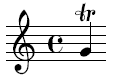
A trill in your music can look like this
Or like this tr~~~~~~~~~~~~~
Trills can be played differently, depending on the period in which the composer was living so it is important to know the time period of your piece.
Baroque trills (aka shakes in this time period) have several ways to be played as shown in this chart:
A table depicting how to perform different types of trills (or shakes) when playing music from the Baroque period (1600-1750).
The Baroque trill continuing through Mozart’s time usually begins on the note above the main note.
In music after the time of Mozart, the trill usually begins on the principal note.
Often, your music will have suggestions about how they should be played written above the music. If not, ASK!
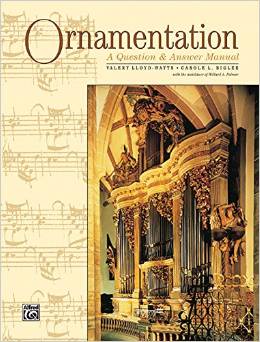
A really good book which explains about the trill and other ornaments is this one, available as a reference book in the O’Connor Music Studio:
Some trill exercises:
Questions? Write them down and don’t forget to ask at your next lesson!
. 1895 ~ Mario Castelnuovo-Tedesco, Italian-born American composer
. 1897 ~ Johannes Brahms, German composer and pianist, died. He wrote four symphonies as well as concerti for piano and violin and highly-esteemed chamber works.
. 1924 ~ Doris Day, Singer
. 1942 ~ Wayne Newton, American singer of popular music
. 1944 ~ Tony Orlando, Singer, Tony Orlando and Dawn
. 1948 ~ Garrick Ohlsson, American pianist, winner of Poland’s Frederic Chopin piano competition in 1970. More about this competition.
. 1949 ~ Dean Martin and Jerry Lewis debuted on radio in an NBC program that ran until 1952.
. 1950 ~ Kurt Weil, German composer, died, best known for his “Threepenny Opera” and for his collaboration with actress and singer Lotte Lenya whom he married in 1926.
. 1952 ~ Harry Belafonte recorded his first songs for RCA Victor at Manhattan Center in New York City.
. 1952 ~ Hugo Winterhalter backed up the singer with an 18-piece orchestra. Among the sides recorded were Dogs A-Roving and Chimney Smoke.
. 1955 ~ Fred Astaire appeared on television for the first time on The Toast of the Town, with host, Ed Sullivan. Already an established dancer in films, Astaire was quick to become a TV sensation as well.
. 1965 ~ Bob Dylan appeared on the pop music charts for the first time. Subterranean Homesick Blues entered the Top 40 at number 39. The song stayed on the charts for eight weeks. Dylan would chart a total of 12 singles on the pop charts between 1965 and 1979. He appeared in the films Don’t Look Back, Eat the Document and Pat Garrett and Billy the Kid. He made the film Renaldo and Clara in 1978. Dylan co-starred in the film Hearts of Fire in 1987. He became a member of the Traveling Wilburys and was inducted into the Rock and Roll Hall of Fame in 1988. Dylan won the Grammy’s Lifetime Achievement Award in 1991.
. 1986 ~ For the first time in six years, major record companies decided to raise prices – between three and five percent.
. 1986 ~ Peter Pears, British operatic tenor, died. He was a collaborator with composer Benjamin Britten and first interpreter of many of Britten’s works, notably “Peter Grimes.”
. 1999 ~ Lionel Bart, British composer of the musical “Oliver!,” died aged 68.
. 2001 ~ Lester “Big Daddy” Kinsey, a blues singer-guitarist known for his croaky voice, died of prostate cancer. He was 74. Kinsey and his sons, Kenneth, Donald and Ralph, became known as “Big Daddy” Kinsey and His Fabulous Sons. The sons now form the Gary-based Kinsey Report and record for Alligator Records, a Chicago blues label. The Kinsey Report has toured with the likes of the Allman Brothers Band. In the early ’90s, the elder Kinsey experienced one of his career highlights with I Am the Blues, a major-label release on Polygram. The album boasted a host of blues standouts backing up Kinsey, including Buddy Guy, James Cotton, Sugar Blue and Pinetop Perkins.
2015 ~ Andrew Porter died. He was a renowned music critic and scholar and translator of opera.
. 1826 ~ Charles-Valentin Alkan made his public performance debut at the piano, in Paris
. 1851 ~ Adolph Brodsky. He was a Russian Empire violinist
. 1905 ~ Kurt Herbert Adler, Austrian-born American conductor and opera director
. 1912 ~ Herbert Mills, Singer with The Mills Brothers
. 1939 ~ Marvin Gaye, American soul singer and songwriter, inducted into Rock and Roll Hall of Fame in 1987
. 1941 ~ Leon Russell, American rock singer songwriter and instrumentalist
. 1942 ~ Glenn Miller and his orchestra recorded American Patrol for Victor Records. The jitterbug tune became one of Miller’s most requested hits.
. 1947 ~ Emmylou Harris, Grammy Award-winning singer for Elite Hotel in 1976 and Blue Kentucky Girl in 1978.
. 1963 ~ Best Foot Forward opened in New York City. Liza Minnelli was the lead actress in this off-Broadway revival of the show which enjoyed a run of 224 performances.
. 1964 ~ The Beach Boys recorded their next single ‘I Get Around’, which became their first US No.1 in the summer of this year. The song begins with a multi-part a cappella introduction that quickly shifts into rock-style verses sung by Mike Love and a pop chorus sung in falsetto by Brian Wilson
. 1985 ~ A day after its release, the album, We are the World, was certified gold with sales in excess of 500,000 copies.
. 1987 ~ One of the greatest jazz drummers of all time, Buddy Rich died aged 69 due to complications caused by a brain tumour. Rich worked with many acts including, Frank Sinatra, Ella Fitzgerald, Louis Armstrong, Tommy Dorsey’s band, Dizzy Gillespie and Oscar Peterson. Rush’s Neil Peart organized a pair of 90s tribute albums (titled Burning for Buddy), which also featured the work of Kenny Aronoff, Dave Weckl, Steve Gadd, Max Roach, Steve Smith and Matt Sorum.
I thought this would surely interest all piano teachers and lovers out there – JoyTunes’ just came out with new piano teaching GLOVES!
Take a look in the clip and share it to all piano lovers everywhere.
The JoyTunes gloves, still in beta version, will turn you into Mozart in the blink of an eye! Don’t know how to play piano? These gloves will take you from 1 note to Beethoven in a flash. Our gloves allow your hands to auto magically bend and move to play any song your heart desires! Check out the video for more info.
. 1985 ~ The long-awaited album, We Are the World, was finally released. Eight rock stars donated previously unreleased material for the LP. Three-million copies of the award-winning single of the same name had already been sold. The song, We Are the World, was number five, and moving up, on the Billboard magazine pop single’s chart this day.
. 1991 ~ Martha Graham passed away. She was an American modern dancer and choreographer.
. 2001 ~ Eva Heinitz, who fled Nazi Germany in the prime of her career as a cello performer and was one of the first professional viola da gamba players in modern times, died at the age of 94. Heinitz, a native of Berlin, soared to prominence as a brilliant, temperamental soloist with the greatest orchestras of Europe in her 20s. Initially instructed on the cello, Heinitz taught herself to play the smaller instrument and performed the Bach Passions under the direction of Wilhelm Furtwangler and Otto Klemperer, who called her the world’s best viola da gamba player. Heinitz, who once described herself as “51 percent” Jewish, fled Germany in 1933. She lived in Paris and London, moved to New York in 1939 and was hired by Fritz Reiner as a section cellist with the Pittsburgh Symphony. She came to Seattle in 1948 and was hired as faculty cellist at the University of Washington. During her 28-year tenure, she became one of the founders of the early-music revival, which brought a renewed interest in music and instruments of the 17th and 18th centuries. In 1991, her international colleagues gathered in Indiana and accorded her the title “Grande Dame du Violoncelle” – great lady of the cello.
. 2001 ~ Trinh Cong Son, Vietnam’s most beloved singer-songwriter who opposed the Vietnam War and sought postwar reconciliation, died after a long battle with diabetes at the age of 62. Dubbed the “Bob Dylan of Vietnam” by American folk singer Joan Baez for his anti-war songs, his music is still widely performed in Vietnam and in overseas Vietnamese communities. Son, who was persecuted by the South Vietnamese government in the late 1960s and early ’70s, wrote more than 600 songs. His pacifist songs about the futility of war were banned at the time, but bootleg copies circulated throughout South Vietnam and overseas. When the war ended, most of Son’s family fled overseas but he stayed. He was equally unpopular with the new Communist government for his songs about reconciliation and spent 10 years in forced labor “re-education camps.” But by the late ’80s, he regained popularity, and his songs are still performed by some of Vietnam’s biggest pop artists.
. 2001 ~ Theodore M. “Ted” McCarty, a key figure in the development of the electric guitar and former president of Gibson Guitar Co., died at the age of 91. In his 18 years as president at Gibson, McCarty transformed the Kalamazoo, Mich.-based maker of acoustic musical instruments into the purveyor of guitars to the stars. The solid-body electric guitar was considered something of a gimmick when McCarty left the Wurlitzer Co. to join Gibson in 1948. He had a degree in commercial engineering and had been an engineering designer for the military during World War II. Despite not being musically inclined, McCarty saw possibilities in the electric guitar. At Gibson, he helped bring to life the Les Paul series, named for the bluesguitarist who endorsed it, the Explorer series, widely used by both rock and country guitarists, and the radical Flying V. McCarty later bought the Bigsby Co., which manufactures vibratos for guitars. He sold the company and retired in 1999.
. 2015 ~ Cynthia Lennon, the late John Lennon’s wife from 1962-1968, has died at age 75.


![A table depicting how to perform different types of trills when playing music from the Baroque period (1600-1750).[4] Note the similarity between the symbol for trill and that of the mordent.](https://oconnormusicstudio.com/wp-content/uploads/2015/03/baroque_trill_instructions.png)




 . 1866 ~ Ferruccio Busoni, Italian pianist and composer
 MaryO'Studio