National Flag Day is celebrated annually in the United States on June 14. This day commemorates the adoption of the United States flag on June 14, 1777.
On National Flag Day, Americans show respect for the U.S. Flag and what it represents. Our independence and unity as a nation is represented by our flag. The flag has become a powerful symbol of Americanism and is flown proudly.
Betsy Ross is given credit, by many, for creating the first American flag. Since 1977, the design of the flag has been officially modified 26 times. For 47 years, the 48-star flag was in effect. In 1959, the 49-star version became official on July 4. President Eisenhower ordered the 50-star flag on August 21, 1959.
Seventeen-year-old Robert G. Heft of Ohio is credited with designing the 50-star American flag. Of the more than 1,500 designs that were submitted to President Dwight D. Eisenhower, his was chosen.
• 1911 ~ “Petrushka”, one of the earliest works of Russian composer Igor Stravinsky, was first performed in Paris.
• 1917 ~ Sy (Simon) Zentner, Bandleader, trombonist with the Boyd Raeburn Orchestra
• 1919 ~ Leif Kayser, Composer
• 1927 ~ Knut Wiggen, Composer
• 1928 ~ Damaso Ledesma, Composer, died at the age of 60
• 1929 ~ Kurt Equiluz, Austrian tenor
• 1938 ~ Gwynne Howell, British opera singer
• 1939 ~ Lionel Hampton and his band recorded Memories of You for Victor Records.
• 1940 ~ Bobby Freeman, Singer
• 1944 ~ The wire recorder was patented by Marvin Camras. Wire recorders were the precursor of much easier to use magnetic tape recorders.
• 1948 ~ Liz Phillips, Composer
• 1948 ~ Dennis Locorriere, Musician, guitarist, singer
• 1954 ~ Nikolai Obouhov, Composer, died at the age of 62
• 1954 ~ Jorge Santana, rocker
• 1958 ~ Frank Zappa graduated from Antelope Valley High School in Lancaster, California
• 1959 ~ “Sammy Kaye Show,” last aired on ABC-TV
• 1960 ~ Alley-Oop by Dyna-Sores peaked at #59
• 1962 ~ Eugene Goossens, British Composer (Perseus), died at the age of 69. A member of a famed musical family, he spent his later years conducting in Australia where he trained many musicians.
• 1970 ~ The Summertime by Mungo Jerry hit #1 in England
• 1970 ~ The Beatles’ “Let It Be,” album went #1 & stayed #1 for 4 weeks
• 1970 ~ The Beatles’Long & Winding Road, single went #1 & stayed #1 for 2 weeks
• 1970 ~ The song Make It with You, by David Gates and Bread, was released. It turned out to be a number-one hit on August 22, 1970. Though Bread had a dozen hits, including one other million-seller (Baby I’m-A Want You, 1971); Make It with You was the soft-pop group’s only number one tune.
• 1971 ~ Singer Francis Albert Sinatra made an attempt to retire from show business following a performance this night at the Music Center in Los Angeles, CA. ‘Ol’ Blue Eyes’ got a bit restless in retirement, however, and was back in Sinatra – The Main Event at Madison Square Garden in November 1973.
• 1972 ~ Clyde L Mcphatter, American singer with the Drifters, died at the age of 39
• 1973 ~ Alvin Derold Etler, Composer, died at the age of 60
• 1973 ~ Frantisek Suchy, Composer, died at the age of 82
• 1976 ~ Bob Marley performed in Amsterdam
• 1980 ~ Billy Joel’sGlass Houses hit #1
More information on Joel
• 1984 ~ Marinus de Jong, Dutch Composer, died at the age of 92
• 1986 ~ Benny Goodman, American Jazz clarinetist, composer and bandleader died
More information on Goodman
• 1988 ~ George Harrison released This is Love
• 1989 ~ Jerry Lee Lewis got a star on the Hollywood Walk of Fame
• 1990 ~ “Les Miserables” opened at South Alberta Jubilee Centre, Calgary
• 1993 ~ “Someone Who’ll Watch Over Me” closed at Booth NYC after 232 performances
• 2001 ~ Makanda McIntyre, a jazz musician and educator, died at the age of 69. McIntyre’s best-known album was “Looking Ahead” (1960). He taught music in Manhattan schools and at Wesleyan University, Smith College, Fordham University and the New School. He was the founder and chairman of the American music, dance and theater program at the State University at Old Westbury, N.Y. McIntyre was born in Boston. After serving in the Army, he studied at the Boston Conservatory of Music and later earned a doctorate from the University of Massachusetts. Formerly Ken McIntyre, he changed his name to Makanda after a stranger in Zimbabwe handed him a piece of paper on which was written, “Makanda,” a word in the Ndebele and Shona languages meaning “many skins.”
• 2012 ~ Graeme Bell, Australian pianist and composer, died at the age of 97
Today’s piece is slow and easy-going. The name “Largo” itself means slow. Antonin Dvorák wrote this as a part of his Symphony No. 9 in E minor, also known as From the New World, Op. 95, B. 178, or just the New World Symphony.
Popularly known as the New World Symphony, it was composed in 1893 while Dvořák was the director of the National Conservatory of Music. It is by far his most popular symphony, and one of the most popular of all symphonies. In older literature and recordings, this symphony was often numbered as Symphony No. 5.
Astronaut Neil Armstrong took a tape recording of the New World Symphony along during the Apollo 11 mission, the first Moon landing, in 1969.
Find Largo in Keyboard Kickoff, Prelude (it’s called River Road), Movement 2 and Piano Maestro
For Piano
And orchestra
The theme from the Largo was adapted into the spiritual-like song “Goin’ Home”, often mistakenly considered a folk song or traditional spiritual, by Dvořák’s pupil William Arms Fisher, who wrote the lyrics in 1922.
.
Pipe Organ
Recorder
And sung
Whenever I think of slow things, I’m reminded of this clip from the old TV Show, Taxi
• 1928 ~ Vic Damone (Vito Farinola), American singer of popular music
• 1930 ~ Jim Nabors, Singer
• 1935 ~ Ella Fitzgerald recorded her first sides for Brunswick Records. The tunes were Love and Kisses and I’ll Chase the Blues Away. She was featured with Chick Webb and his band. Ella was 17 at the time and conducted the Webb band for three years following his death in 1939.
• 1938 ~ Ian Partridge, British tenor
• 1941 ~ “Chick” Corea, American Grammy Award-winning (4) Jazz musician and composer
• 1942 ~ Walter Leigh, Composer, died at the age of 36
• 1942 ~ Paul Whiteman and his orchestra recorded Travelin’ Light on Capitol Records of Hollywood, California. On the track with Whiteman’s orchestra was the vocal talent of ‘Lady Day’, Billie Holiday.
• 1944 ~ Reg Presley, Singer with Troggs
• 1947 ~ Jazeps Medins, Composer, died at the age of 70
• 1948 ~ William Tell Overture by Spike Jones (originally an opera by Rossini) peaked at #6. See the Daily Listening Assignment for more videos.
Original:
• 1951 ~ Bun Carlos (Brad Carlson), Musician, drummer with Cheap Trick
• 1951 ~ Brad Delp, Musician, guitarist, singer with Boston
• 1957 ~ James F “Jimmy” Dorsey, American orchestra leader, died at the age of 53
• 1962 ~ John N Ireland, English Composer/pianist, died at the age of 82
• 1965 ~ The Queen of England announced that The Beatles would receive the coveted MBE Award. The Order of the British Empire recognition had previously been bestowed only upon British military heroes, many of whom were so infuriated by the news, they returned their medals to the Queen. In fact, John Lennon wasn’t terribly impressed with receiving the honor. He returned it (for other reasons) four years later.
• 1965 ~ Rolling Stones released Satisfaction
• 1965 ~ Sonny and Cher made their first TV appearance, “American Bandstand”
• 1966 ~ Hermann Scherchen, German conductor and music publisher, died at the age of 74
• 1966 ~ The Dave Clark Five set record as they appear for twelfth time on Ed Sullivan
• 1968 ~ Fidelio Friedrich Finke, Composer, died at the age of 76
• 1968 ~ “What Makes Sammy Run?” closed at 84th St Theater NYC after 540 performances
• 1977 ~ “Pippin” closes at Imperial Theater NYC after 1944 performances
• 1982 ~ Paul Simon and Art Garfunkel performed in Rotterdam
• 1989 ~ Peter Conrad Baden, Composer, died at the age of 80
• 1992 ~ “Batman Returns”, music by Danny Elfman, was released in America
• 1993 ~ Three Little Pigs by Green Jelly hit #17
• 1994 ~ Cab Calloway suffered a massive stroke at his home White Plaines NY
• 1995 ~ Arturo Benedetti Michelangeli, Italian Pianist, died at the age of 75. He was hailed as one of the greatest pianists of the 20th century.
• 1996 ~ MacKenzie John, Pipe major, died at the age of 83
• 2000 ~ Robert J. Lurtsema, a classical music show host with a sonorous voice and unique delivery who became a fixture of the Boston radio scene over nearly three decades, died of lung disease. He was 68. Lurtsema, who worked at WGBH-FM for more than 28 years, is well-known to classical music buffs as the host of “Morning pro musica”, which could be heard throughout the Northeast.
• 2006 ~ György Ligeti, Hungarian classical composer (Le Grand Macabre), died at the age of 83
The other day, a student and I were looking at a piece with a l-o-n-g crescendo marking on it and she wondered how long the longest crescendo was in any piece.
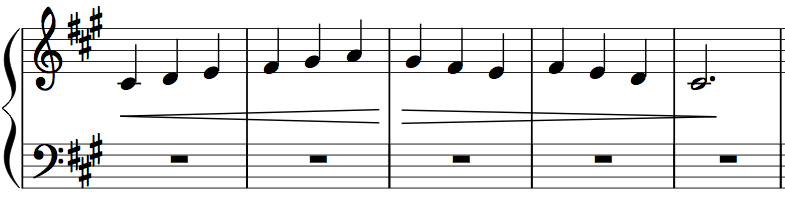
For those who don’t remember, crescendo means to get louder and decrescendo means to get softer. The sample below gets louder, then softer.
But I got a bit off-track. While my student was trying her hand (no pun intended!) and the long crescendo, I looked up how long the longest one might be and found…
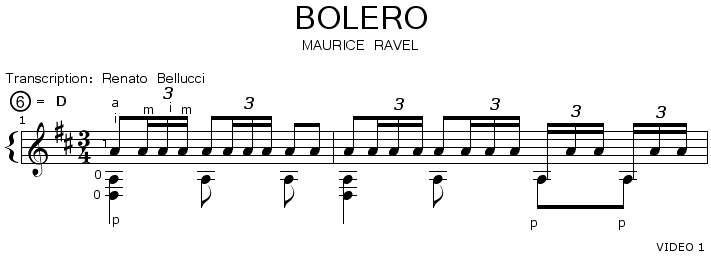
The longest crescendo in music is probably Ravel’s “Bolero,” which is, in fact, one long crescendo. Another very long crescendo occurs in the first movement of Shostakovich’s “Leningrad” Symphony. … “Rossini crescendos” are much shorter but quite effective. Jul 26, 2013
Most everyone, including my student, knows that this is possibly my least favorite piece of music but I still played a bit of it for her anyway.
Although not really a piano piece
From Russia
I like this flashmob version best
In a video that looks just like a segment of Disney’s Silly Symphonies or Fantasia, artist Simon Brethé animates the pentagram, making the notes of Ravel’s Bolero do feats ranging from charming a snake (the oboe) to serenading a girl at her window (the saxophone). At one point of the performance, one member of the string ensemble gets his bow tangled in the pentagram, a distraction that, subsequently, wreaks havoc in the entire orchestra.
• 1941 ~ Shirley Owens Alston, Singer with The Shirelles
• 1946 ~ Matthew Fisher, English keyboardist with Procol Harum
• 1954 ~ Will Rossiter, Composer, died at the age of 87
• 1964 ~ Louis Gruenberg, Composer, died at the age of 79
• 1964 ~ Rolling Stones recorded their 12×5 album at Chess Studios Chicago
• 1966 ~ The BeatlesPaperback Writer was released in England
• 1966 ~ The Beatles recorded Rain, first to use reverse tapes
• 1966 ~ Janis Joplin’s first live concert in the Avalon Ballroom, San Francisco
• 1966 ~ The Mamas and The Papas won a gold record for Monday, Monday
• 1968 ~ Yury Sergeyevich Milyutin, Composer, died at the age of 65
• 1972 ~ Elvis Presley recorded a live album at NY’s Madison Square Garden
• 1972 ~ The Rolling Stones double album Exile On Main Street went to No.1 on the UK chart, the band’s seventh UK No.1 album. In 2010, the re-released album entered the UK chart at No.1, almost 38 years to the week after it first occupied that position. The Rolling Stones are the first act to ever have a studio album return to No.1 after it was first released.
• 1972 ~ Sammy Davis, Jr. earned his place at the top of the popular music charts for the first time, after years in the entertainment business. His number one song, The Candy Man, stayed at the top for three consecutive weeks. The Candy Man was truly a song of fate for Sammy. He openly did not want to record the song, but did so as a favor to MGM Records head Mike Curb, since it was to be used in the film, Willy Wonka and the Chocolate Factory. Davis said he would give the tune one take, “and that’s it!” Sure enough, in that one-time recording, Sammy nailed it. The Candy Man stayed on the pop charts for 16 weeks. The best the legendary performer had done before was 12 weeks for Love Me or Leave Me in 1955 and 11 weeks for I’ve Gotta Be Me (from Golden Rainbow) in 1969. After The Candy Man became a hit, Davis included it in his stage shows and concerts — and collected huge royalties from it.
• 1976 ~ Paul McCartney and Wings set a record for an indoor concert crowd as 67,100 fans gathered in Seattle, WA to hear the former Beatle and his new group.
• 1982 ~ Addie “Micki” Harris, American singer with the Shirelles, died at the age of 42
• 1985 ~ Nineteenth Music City News Country Awards: Statler Brothers, Barbara Mandrell
• 1990 ~ “Meet Me St Louis” closed at Gershwin Theater NYC after 253 performances
• 1992 ~ Hachidal Nakamura, Composer, died at the age of 61 of heart failure
• 1996 ~ Thirtyth Music City News Country Awards: Alan Jackson
• 2001 ~ Pianist Yaltah Menuhin, last of three famous siblings whose musical talents brought them fame at an early age, died at the age of 79. Yaltah, the youngest, and her sister Hepzibah, also a pianist, did not achieve the international renown of their brother, the violinist Yehudi Menuhin. But they often appeared with him in concerts around the world, including the Bath Festival in Britain, where Yehudi was artistic director in the 1960s. Yaltah Menuhin was born in San Francisco, to Russian-Jewish parents. Like her siblings, she began studying music as a child, and moved about the world performing. Her brother was astonishing audiences with his virtuosity by the age of 7. Yaltah Menuhin and her husband, pianist Joel Ryce, often performed together as a duo in the United States, and she also performed with violist Michael Mann.
• 2001 ~ Harold S. Grossbardt, a founder of Colony Records, the famed record collector’s store in Manhattan, died at the age of 85. Grossbardt founded the store in 1948 with his partner, Sidney Turk, and the shop quickly became popular with music lovers. Hundreds of musicians, including Frank Sinatra, John Lennon and Michael Jackson, shopped at the store. Grossbardt worked at Colony Records until his retirement in 1988.
• 2004 ~ US singer, songwriter Ray Charles died aged 73. Glaucoma rendered Charles blind at the age of six. He scored the 1962 UK & US No.1 single ‘I Can’t Stop Loving You’ plus over 30 other US Top 40 singles and the 2005 US No.1 album ‘Genius Loves Company.’ Charles who was married twice and fathered twelve children by nine different women appeared in the 1980 hit movie, The Blues Brothers was also the winner of 17 Grammy Awards.
National Donald Duck Day is observed annually on June 9th. This day commemorates the birthday of the funny animal cartoon character, Donald Duck. Donald made his first screen debut on June 9, 1934, in The Wise Little Hen.
• 1361 ~ Philippe de Vitry, French Composer and poet, died at the age of at 69
• 1656 ~ Thomas Tomkins, Composer, died
• 1717 ~ Louis Le Quointe, Composer, died at the age of 64
• 1810 ~ (Carl) Otto (Ehrenfried) Nicolai, Composer
More information about Nicolai
• 1828 ~ Carlo Marsili, Composer
• 1829 ~ Gaetano Braga, Composer
• 1832 ~ Manuel Garcia, Composer, died at the age of 57
• 1849 ~ Joseph Vezina, Composer
• 1849 ~ The term recital used for the first time to describe a solo performance by an instrumental player. The first recitalist was Franz Liszt
• 1865 ~ Carl Nielsen, Danish composer and conductor
More information about Nielsen
• 1865 ~ Alberic Magnard, Composer
• 1870 ~ Erik Drake, Composer, died at the age of 82
• 1879 ~ Oscar Back, Austrian-Dutch viola player
• 1886 ~ Kusaku Yamada, Composer
• 1888 ~ Hugo Kauder, Composer
• 1890 ~ The opera “Robin Hood” premiered in Chicago
• 1891 ~ Cole Porter, American composer and lyricist for the musical theater. His many famous musicals include “Anything Goes”, “Kiss Me Kate” and “Can Can”.
More information about Porter
• 1892 ~ Friedrich Wilhelm Langhans, Composer, died at the age of 59
• 1900 ~ Fred Waring, Musician, conductor and inventor of the Waring Blender
• 1972 ~ Bruce Springsteen signed a record deal with Columbia
• 1975 ~ David Frederick Barlow, Composer, died at the age of 48
• 1975 ~ Tony Orlando and Dawn received gold record for He Don’t Love You
• 1980 ~ Fourteenth Music City News Country Awards, Statler Brothers & Loretta Lynn
• 1984 ~ Cyndi Lauper’s first #1 Time After Times
• 1986 ~ Twentieth Music City News Country Awards, Statler Brothers & Loretta Lynn
• 1990 ~ Michael Jackson was hospitalized with inflamed rib cartilage
• 1991 ~ Claudio Arrau, Chilian/American pianist and composer, died at the age of 88
• 1991 ~ Bruce Springsteen wed his backup singer Patty Scialfa
• 1991 ~ Max van Praag, Dutch singer, died at the age of 77
• 1992 ~ Clarence Miller, Blues/jazz vocalist, died at the age of 69 of a heart attack
• 1993 ~ Arthur Alexander, Singer/songwriter, died at the age of 53
• 1995 ~ Frank Chacksfield, Conductor/arranger, died at the age of 81
• 2000 ~ Jazz bassist Burgher “Buddy” Jones, who played in big bands behind Peggy Lee and Frank Sinatra and toured with Harry James and Tommy Dorsey, died at the age of 76.
A native of Hope, Ark., Jones was a childhood friend of the late Virginia Kelley, mother of President Clinton. At 17, Jones went to the University of Kansas City, where he met and befriended saxophonist Charlie Parker. Jones later introduced Parker to his wife, Chan. Jones played in the Elliot Lawrence band, when its arrangers included Al Cohn, Tiny Kahn and Johnny Mandel. As a staff musician for CBS in New York in the 1950s and 1960s,
Jones played for the Jack Sterling radio show and in bands behind Lee and Sinatra. In 1996, Jones was inducted into the Arkansas Jazz Hall of Fame.
• 2020 ~ Bonnie Pointer, who rose to fame as a member of the Pointer Sisters, died at age 69.
Joseph Haydn’s music contains many jokes, and the Surprise Symphony includes probably the most famous of all: a sudden very loud (fortissimo chord) at the end of the otherwise soft (piano) opening theme in the variation-form second movement. The music then returns to its original quiet dynamic, as if nothing had happened, and the ensuing variations do not repeat the joke. (In German it is commonly referred to as the Symphony “mit dem Paukenschlag”—”with the kettledrum stroke”).
In Haydn’s old age, his biographer George August Griesinger asked him whether he wrote this “surprise” to awaken the audience. Haydn replied:
No, but I was interested in surprising the public with something new, and in making a brilliant debut, so that my student Pleyel, who was at that time engaged by an orchestra in London (in 1792) and whose concerts had opened a week before mine, should not outdo me. The first Allegro of my symphony had already met with countless Bravos, but the enthusiasm reached its highest peak at the Andante with the Drum Stroke. Encore! Encore! sounded in every throat, and Pleyel himself complimented me on my idea.
The first time I saw this video during a piano lesson, both my students and I were surprised, too!
The melody is pretty basic and sometimes used to teach skips. I remember having it in one of my first books with words similar to See the Happy Little Frog, Hopping now from Log to Log.
Here’s a piano version.
Can you find the “surprise” indicated by the sforzando? Hint. It looks like this: Sforzando is one of those Italian words you get to learn in music and means a strong, sudden accent on a note or chord. Sforzando literally means subito forzando (fz), which translates to “suddenly with force.”
There’s some information about Haydn and this symphony in this video.
and this one
Beethoven’s Wig added some words
For 2 pianos, 8 hands. They’ve added their own surprise around minute 3.
• 1742 ~ Omobono Stradivari, Italian viol maker, son of Antonio, died at the age of 62
• 1753 ~ Nicolas-Marie Dalayrac, Composer
• 1783 ~ Joseph Lincke, Composer
• 1796 ~ Felice de Giardini, Composer, died at the age of 80
• 1805 ~ Luigi Ricci, Composer
• 1810 ~ Robert Schumann, German composer best known for his song cycles and piano music.
Read quotes by and about Schumann
More information about Schumann
• 1812 ~ Spyridon Xyndas, Composer
• 1814 ~ Friedrich Heinrich Himmel, Composer, died at the age of 48
• 1834 ~ George Garrett, Composer
• 1837 ~ Jan Kleczynski, Composer
• 1856 ~ Natalia Janotha, Composer
• 1858 ~ Antonio Nicolau, Spanish Composer and conductor
• 1876 ~ George Sand (Armandine-Aurore-Lucile Dupin), French author and romantic companion of the composer of Chopin, died at the age of 71
• 1881 ~ Prospero Bisquertt, Composer
• 1884 ~ Henry Clay Work, Composer, died at the age of 51
• 1888 ~ Poul Julius Ouscher Schierbeck, Composer
• 1906 ~ Christian Frederik Emil Horneman, Composer, died at the age of 65
• 1908 ~ Johan Lindegren, Composer, died at the age of 66
• 1913 ~ Janos Jagamas, Composer
• 1918 ~ Robert Preston [Meservey], American actor
• 1919 ~ Jacob Fabricius, Composer, died at the age of 78
• 1923 ~ Karel Goeyvaerts, Flemish Composer of Summer Games
• 1926 ~ Anatol Vieru, Composer
• 1927 ~ Paul Whiteman and his orchestra recorded When Day is Done on Victor Records.
• 1928 ~ Jiri Dvoracek, Composer
• 1930 ~ Yannis Ioannidis, Composer
• 1932 ~ Hans Gunter Helms, Composer
• 1936 ~ James Darren (Ercolani), Singer
• 1940 ~ Frederick Shepherd Converse, American Composer, died at the age of 69
• 1940 ~ Sherman Garnes, Rock vocalist with Frankie Lymon and The Teenagers
• 1940 ~ Nancy Sinatra, Singer
• 1942 ~ Chuck Negron, Singer with Three Dog Night
This is a more advanced piece but I really like it. Some students may have heard this since it’s an alarm tone on my phone. My dog, Mimi, recognizes this music as her signal to go out for a walk!
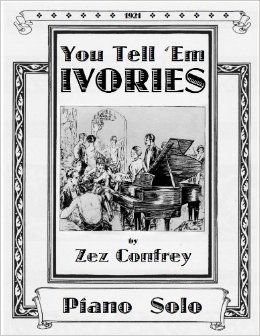
I just love Zez Confrey’s music. It’s not overplayed like some of Scott Joplin’s works but it’s just as much fun.
This is a piece I have often played in recitals and just for fun.
If any of my students are interested in tackling this piece, just let me know and we’ll start learning!
In 1921 Confrey wrote his novelty piano solo “Kitten on the Keys”, inspired by hearing his grandmother’s cat walk on the keyboard of her piano. It became a hit, and he went on to compose many other pieces in the genre.
Considered to be one of the fastest and most challenging of all “novelty” piano solos, “Dizzy Fingers” was composed in 1923. and was Confrey’s other biggest seller.
He left behind more than a hundred piano works, songs and miniature operas, and numerous piano rolls, music publications and sound recordings.
Not surprisingly, this piece is not available on Piano Maestro!
“This collection represents a cross-section of Confrey’s works and encompasses the broad range of his styles. Besides his famous 1920s novelty works (including Kitten on the Keys), there are many wonderful, lesser-known gems of remarkable quality included here from later in his career. Appearing for the first time in print are transcriptions of one of his disc recordings (Poor Buttermilk) and two of his player piano roll arrangements (My Pet and Humorestless). Many of Confrey’s later works have long been out of print and are included here for the first time in decades.”






 MaryO'Studio