Chopsticks, Again!

Chopsticks

Stephen Powers first thought of his grand piano as an impressive piece of furniture.

But he enjoyed listening to music so much when friends played at parties at his home in North Wilmington that he began taking lessons.

“I enjoy having a couple of songs under my belt,” says Powers, a 52-year-old banker. “I play Happy Birthday. I play Getting to Know You for my mom.”

Powers is part of a boomlet of adults who are studying piano. Many took lessons briefly as children and regret giving it up. Some simply enjoy music. Others gravitated toward the keyboard because studies suggest piano improves mental acuity while reducing the odds of dementia.

A Swedish study published in 2014 in the International Journal of Alzheimer’s Disease found that when a twin played a musical instrument later in life, he or she was 64 percent less likely to develop dementia than the twin who did not play.

A study published in Frontiers in Psychology in 2013 evaluated the impact of piano lessons on cognitive function, mood and quality of life in adults age 60 to 84.

The group that studied piano showed significant improvement in tests that measure executive function, controlling inhibitions and divided attention, as well as enhanced visual scanning and motor ability. Piano students also reported a better quality of life.

Some grownups simply relish a challenge.

In the United Kingdom, Alan Rusbridger, editor of the Guardian, took to the keyboard at age 56. He chronicled the year he spent learning Chopin’s demanding No. Ballade 1 in G Minor in the book Play It Again: An Amateur Against the Impossible.

Richard Swarmer, 57, of Lewes, played the trumpet from grade school through college. He has sung in several choirs. This year, he began piano lessons.

Learning the piano isn’t easy even for someone with a musical background. Still, Swarmer appreciates that the creative thought process is different from the focus required by his job for a medical benefits company.

“I have thoroughly enjoyed taking piano lessons as an adult,” he says. “It provides a welcome respite from the demands of my job.”

Ethel Thirtel of North Wilmington is 71 and a student at the Music School of Delaware. She is also taking French lessons to help keep her intellect sharp.

“Both pursuits involve active studying and practice to master new skills,” she says.

To meet rising demand, the Music School of Delaware offers adults-only evening group classes to accommodate working people, says Matthew Smith, student and alumni relations officer. The school also provides instruction for adults 50 and older through the Osher Lifelong Learning Institute at University of Delaware.

“In addition to professionals, we are getting a lot more inquiries from older adults who are retired and have time on their hands,” he says.

Geri Smith, a Julliard-trained singer, musician and composer, has taught piano to children in public schools as well as private arts centers. Her adult students include a 59-year-old writer who took up piano after the death of her husband, a gifted musician.

“Teaching children is a different experience than teaching adults,” says Smith, of Unionville. “Kids pretty much do what you ask them to do but adults ask lots of questions. They want to know why things have to be done a certain way.”

An important part of learning piano is creating new pathways in the brain. A Harvard Medical School study examined the impact of practicing the piano on synapses, the connections between neurons that encode memories and learning.

Volunteers practiced two hours a day for five days, playing a five-finger exercise to the beat of a metronome. To learn how that impacted the neurons scientists used transcranial-magnetic-stimulation (TMS), in which a wire coil sends magnetic impulses to the brain.

They discovered that after a week of practice, the stretch of motor cortex devoted to the finger exercises had expanded like crabgrass.

“Playing the piano creates new synapses,” Smith says. “Think of it as creating a conduit so your right hand can talk to your left hand.”

Meldene Gruber of Rehoboth Beach, who has taught piano for more than 40 years, has seen a surge in adult students in the past two years. Now, half her students are adults.

“A number of my adults say they think playing the piano will help with mental acuity,” she says. “Playing the piano forces you to use both sides of the brain, which is great for neuron firing.”

Most adults have specific goals in mind, such as learning to play Christmas carols or a few favorite pieces.

“You don’t get adults who are focused on becoming concert pianists,” Gruber says. “They come for the joy of playing, not because their mothers made them.”

via Chopstick therapy: how piano lessons could help us age better — NewsWorks.

On August 2 ~ in Music History

today

• 1891 ~ Sir Arthur Bliss, British composer
Read quotes by and about Bliss

• 1900 ~ Helen Morgan (Riggins), Pop Singer

• 1905 ~ Karl Amadeus Hartmann, German composer

• 1924 ~ Joe Harnell, Conductor and arranger

• 1925 ~ John Dexter, Opera director, Mid-America Chorale

• 1921 ~ Enrico Caruso, Italian operatic tenor, died in Naples.

• 1926 ~ The first demonstration of the Vitaphone system, that combined picture and sound for movies, was held at the Warner Theatre in New York City. John Barrymore and Mary Astor starred in the demonstration film for the new moving picture projector.

• 1935 ~ Hank Cochran, Pop Singer and songwriter

• 1937 ~ Garth Hudson, Musician, keyboard with The Band

• 1937 ~ Benny Goodman and his quartet recorded Smiles for Victor Records. Playing with Goodman’s clarinet on the famous song were Lionel Hampton, Teddy Wilson and Gene Krupa.

• 1939 ~ Edwin Patten, Singer with Gladys Knight & The Pips

• 1941 ~ Doris Kenner-Jackson (Coley), Singer with The Shirelles

• 1943 ~ Kathy Lennon, Singer with The Lennon Sisters

• 1951 ~ Andrew Gold, Singer, son of composer Ernest Gold

• 1991 ~ Jeri Southern passed away

• 1997 – Nigeria’s musician Fela Anikulapo-Kuti, who popularized the Afro-music beat globally, died of AIDS aged 58.

• 2000 ~ Helen Quinn, who for more than 30 years presided over the Metropolitan Opera patrons who lined up to buy standing-room tickets, died at the age of 76. Often called the Queen of Standees by those who allowed her to take charge of the ticket queue, Quinn was herself a veteran of standing-room lines at the Met, and attended five or six performances a week, almost always as a standee. In 1966, on her own initiative, she imposed a system on the standee process that the throng of regulars was apparently happy to abide by, and to which the Met gave tacit approval.

• 2001 ~ Ron Townson, the portly centerpiece singer for the Grammy-winning pop group  The 5th Dimension, died of renal failure after a four-year battle with kidney disease. He was 68.  Other members of the reconstituted group – known for such 1960s hits as Aquarius/Let the Sun Shine In, Wedding Bell Blues and Stoned Soul Picnic – performed at the Capitol Fourth music and fireworks show on July 4 in Washington, D.C.   Declining health had forced Townson to retire from The 5th Dimension in 1997, bringing to an end a career that saw him tour with such music legends as Nat King’ Cole and Dorothy Dandridge, appear in operas and direct choirs. He helped front The 5th Dimension when the group’s smooth mixture of pop, jazz, gospel, and rhythm and blues won it four Grammys in 1968 for the Jimmy Webb song Up Up and Away. Other hits included One Less Bell to Answer and Sweet Blindness. As various members left The 5th Dimension in the 1970s to pursue solo projects, Townson formed the group Ron Townson and Wild Honey. Later, he reunited with McLemore and LaRue in a new version of The 5th Dimension that included Phyllis Battle and Greg Walker. He also appeared on television and in films, including the 1992 movie The Mambo Kings.

• 2002 ~ Freidann Parker, co-founder of the Colorado Ballet, died at the age of 77.  Colorado Ballet co-founder Lillian Covillo met Parker in the late 1940s in a dance class taught by Martha Wilcox. The two began the Covillo-Parker School of Dance, and then a fledgling ballet company. After an ambitious double bill in 1961, they created Colorado Concert Ballet, which presented Denver’s first Nutcracker the following season. Every performance sold out. By 1978, the board of directors more than doubled its budget to $100,000, and Colorado Ballet was born. Today its budget has grown to $7 million with a roster of 40 dancers. Parker’s first dance lessons were with Iris Potter. She later trained with modern-dance pioneer Hanya Holm.

On August 1 ~ in Music History

Be sure your student reads and listens to Today’s Daily Listening Assignment


• 1779 ~ Francis Scott Key, born
More information about Key
Listen to Francis Scott Key’s Star Spangled Banner
Read about the Star Spangled Banner

• 1877 ~ Angela Diller, American pianist and educator

• 1919 ~ Oscar Hammerstein I passed away

• 1930 ~ Lionel Bart, Broadway Composer

• 1930 ~ Geoffrey Holder, Dancer

• 1939 – American bandleader Glenn Miller recorded In the Mood which later became his theme tune.

• 1942 ~ Jerry Garcia, American rock guitarist, banjo, lyricist and singer with The Grateful Dead

• 1942 ~ Jimmy Dorsey and his orchestra recorded Charleston Alley, on Decca Records.

• 1942 ~ The American Federation of Musicians went on strike. Union president James C. Petrillo told musicians that phonograph records were “a threat to members’ jobs.” As a result, musicians refused to perform in recording sessions over the next several months. Live, musical radio broadcasts continued, however.

• 1947 ~ Rick Anderson, Musician, bass with The Tubes

• 1947 ~ Rick Coonce, Singer, drummer with The Grassroots

• 1953 ~ Robert Cray, Guitar

• 1960 ~ Chubby Checker’s The Twist was released. The song inspired the dance craze of the 1960s.

• 1971 ~ The Concert for Bangladesh was held at Madison Square Garden in New York City. George Harrison, Ringo Starr, Eric Clapton, Bob Dylan, Leon Russell, Ravi Shankar and Billy Preston performed. A multi-record set commemorating the event was a super sales success. Together, the concert and the album raised over $11 million to help the starving minions of Bangladesh.

• 1981 ~ MTV (Music Television) made its debut at 12:01 a.m.

• 1984 ~ Singer Jermaine Jackson made a guest appearance on the TV soap opera, As the World Turns.

• 1997 ~ Russian pianist Sviatoslav Richter died of a heart attack in a Moscow hospital. He was 82.

• 2007 ~ Tommy Makem, Irish folk singer died

• 2017 ~ Goldy McJohn, Canadian musician (Steppenwolf), died at the age of 72


August 1, 2019 ~ Daily Listening Assignment


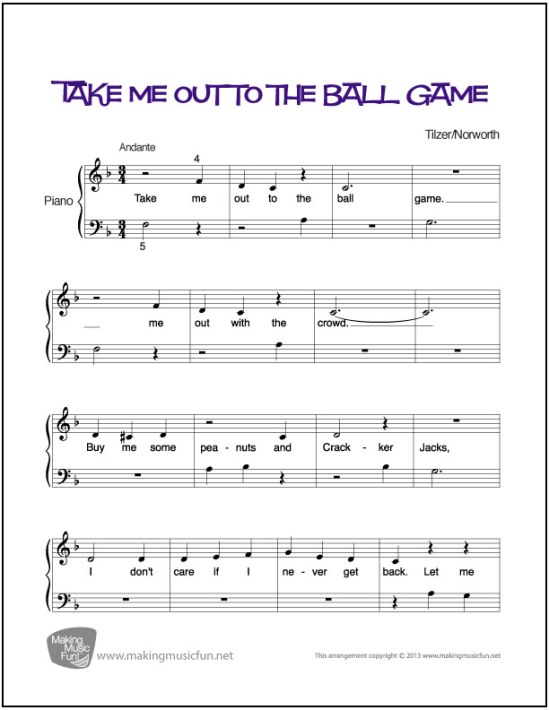
Today’s piece is a fine baseball standard “Take Me Out to the Ballgame” by Jack Norworth and Albert Von Tilzer.  The song’s chorus is traditionally sung during the middle of the seventh inning of a baseball game. Fans are generally encouraged to sing along, and at some ballparks, the words “home team” are replaced with the team name.

Find it in Piano Pronto Songs I love to Play 2 and Alfred Premier 2B among others.

Below are the lyrics to the chorus of the 1908 version, which is out of copyright.

Chorus

Take me out to the ball game,
Take me out with the crowd;
Buy me some peanuts and Cracker Jack,
I don’t care if I never get back.
Let me root, root, root for the home team,
If they don’t win, it’s a shame.
For it’s one, two, three strikes, you’re out,
At the old ball game.


From the movie Take Me Out to the Ballgame

Muppets

Organ


Ragtime Piano


Player piano


Orchestra


On July 31 ~ in Music History

today


Be sure your student reads and listens to Today’s Daily Listening Assignment


• 1828 ~ François Auguste Gevaert, Belgian composer, musicologist, conductor and organist

• 1845 ~ The French Army introduced the saxophone to its military band. The musical instrument was the invention of Adolphe Sax of Belgium.

• 1847 ~ Ignacio Cervantes, Pianist

• 1886 ~ Franz Liszt, Hungarian composer and pianist died. Originator of the symphonic poem, he was a prolific teacher and a huge influence on Richard Wagner and Richard Strauss.
More information about Liszt

• 1911 ~ George Liberace, Violinist, conductor; administrator of Liberace Museum; brother of pianist/entertainer Liberace

• 1918 ~ Jan La Rue, American musicologist

• 1918 ~ Hank Jones, Pianist. He accompanied Billy Eckstine and Ella Fitzgerald. He led the Hank Jones Trio

• 1919 ~ Mornam Del Mar, British conductor

• 1923 ~ Ahmet Ertegun, Recording Executive

• 1939 ~ John West, Musician, guitarist with Gary Lewis and the Playboys

• 1942 ~ Harry James and his band recorded the classic I’ve Heard that Song Before, for Columbia Records. Helen Forrest sang on the million-seller.

• 1943 ~ Lobo, Singer

• 1946 ~ Gary Lewis (Levitch), Singer with Gary Lewis and the Playboys, entertainer Jerry Lewis’ son

• 1946 ~ Bob Welch, Guitarist and singer with Fleetwood Mac

• 1947 ~ Karl Green, Musician, guitar and harmonica with Herman’s Hermits

• 1964 ~ Jim Reeves, popular U.S. country music singer, died in an air crash near Nashville.

• 1985 ~ Prince was big at the box office with the autobiographical story of the Minneapolis rock star, Purple Rain. The flick grossed $7.7 million in its first three days of release on 917 movie screens. The album of the same name was the top LP in the U.S., as well.

• 2019 ~ Hal (Harold Smith) Prince died at the age of 91, He was an American theatrical producer and director associated with many of the best-known Broadway musical productions of the 20th century.

Over the span of his career, he garnered 21 Tony Awards, more than any other individual, including eight for directing, eight for producing the year’s Best Musical, two as Best Producer of a Musical, and three special awards.

On July 30 ~ in Music History

today


Be sure your student reads and listens to Today’s Daily Listening Assignment


• 1751 ~ Maria Anna Mozart, Austrian pianist and Wolfgang’s sister, born in Salzburg, Austria


• 1899 ~ Gerald Moore, British pianist and accompanist

• 1909 ~ Adolph Baller, Pianist

• 1926 ~ Martin Bookspan, American music critic, administrator and broadcaster

• 1929 ~ Christine McGuire, Singer with The McGuire Sisters

• 1936 ~ Buddy (George) Guy, Blues guitar, singer, on BBC TV

• 1941 ~ Buddy Guy, Blues Musician

• 1941 ~ Paul Anka, Canadian singer and songwriter of popular music. He composed Johnny’s Theme (Tonight Show Theme) and had 33 hits over 3 decades, including “Diana” and “Puppy Love”.

• 1942 ~ Frank Sinatra recorded the last of 90 recordings with the Tommy Dorsey Orchestra on Victor Records. His last side was There are Such Things, which became number one in January of 1943. Sinatra moved on as a solo singing sensation.

• 1942 ~ Stagedoor Canteen was first heard on CBS radio. The show was broadcast live from New York City and 500 servicemen were entertained each week by celebrities who freely donated their time for the war (WWII) effort.

• 1945 ~ David Sanborn, Grammy Award-winning musician, saxophone, flute, composer of the TV movie score to Finnegan Begin Again

• 1947 ~ Marc Bolan (Feld), Singer with T. Rex

• 1956 ~ Singer Brenda Lee recorded her first hit for Decca Records. Jambalaya and Bigelow 6-500 started a new career for the petite 11-year-old from Lithonia, GA (near Atlanta). Brenda Mae Tarpley (Brenda Lee) had been singing professionally since age six. She recorded 29 hit songs in the 1960s and became a successful country singer in 1971. Brenda Lee had a pair of number one tunes with I’m Sorry and I Want to be Wanted. She recorded a dozen hits that made it to the top 10.

• 1958 ~ Kate Bush, Singer

• 2002 ~ Leonard Litman, who ran two top Pittsburgh entertainment venues in the 1940s and ’50s that attracted stars such as Ella Fitzgerald, Miles Davis and Bill Haley’s Comets, died of Alzheimer’s disease. He was 88. Litman owned Lenny Litman’s Copa, a nightclub that flourished in the city’s downtown from 1948 to 1959. Earlier, he ran the influential Mercur’s Music Bar. After the Copa closed in 1959, Litman continued to promote concerts and made a brief foray into sports in the 1960s when he and his brothers invested in an American Basketball League team. Litman worked as the Pittsburgh correspondent for Billboard Magazine from 1948 to 1960 and as a correspondent for Variety for decades.

• 2003 ~ Sam Phillips, American record producer and founder of Sun Records and Sun Studios, died at the age of 80


• 2016 ~ Gloria DeHaven, American musical actress (Step Lively), died at the age of 91

On July 29 ~ in Music History

today


Be sure your student reads and listens to Today’s Daily Listening Assignment


• 1856 ~ Robert Schumann passed away.  Schumann was a German composer and influential music critic. He is widely regarded as one of the greatest composers of the Romantic era. Schumann left the study of law, intending to pursue a career as a virtuoso pianist.
More information about Schumann

• 1887 ~ Sigmund Romberg, Hungarian-born American operetta composer, founding member of ASCAP. He was famous for his operettas “Desert Song”, “Maytime” and “Student Prince”

• 1916 ~ Charlie Christian, American guitarist and blues singer

• 1917 ~ Homer (Henry D. Haynes), Comedy singer, duo: Homer and Jethro

• 1925 ~ Mikis Theodorakis, Composer

• 1930 ~ Paul Taylor, Dancer with the Martha Graham Dance Company, New York City Ballet, Paul Taylor Dance Company, Emmy Award-winning choreographer, Kennedy Center Honors in 1992 “…for enhancing the lives of people around the world and enriching the culture of our nation.”

• 1933 ~ Randy Sparks, Folk singer, songwriter with the New Christy Minstrels

• 1935 ~ Peter Schreier, German tenor

• 1946 ~ Neal Doughty, Keyboards with REO Speedwagon

• 1953 ~ Geddy Lee, Bass, singer with Rush

• 1965 ~ The Queen of England attended the premiere of the motion picture, Help!, starring The Beatles. The command performance was held at the London Pavilion. The film later earned first prize at the Rio De Janeiro Film Festival in Brazil.  The Beatles later said the film was shot in a “haze of marijuana”. According to Starr’s interviews in The Beatles Anthology, during the Austrian Alps film shooting, he and McCartney ran off over the hill from the “curling” scene set to smoke a joint.

• 1966 ~ Martina McBride, Country singer

• 1970 ~ Sir John Barbirolli died. He was the British conductor of the Halle Orchestra, and was a famous interpreter of English music, Mahler and Italian opera.

• 1973 ~ Wanya Morris, Rock Singer

• 1974 ~ Singer “Mama” Cass Elliot, American folk-pop singer died.

• 1984 ~ Fred Waring, American musician and conductor died at the age of 84. He was also a promoter, financial backer and eponym of the Waring Blendor, the first modern electric blender on the market.

• 2018 ~ Tomasz Stańko, Polish trumpeter (Astigmatic), died at the age of 76

July 29, 2019 ~ Daily Listening Assignment


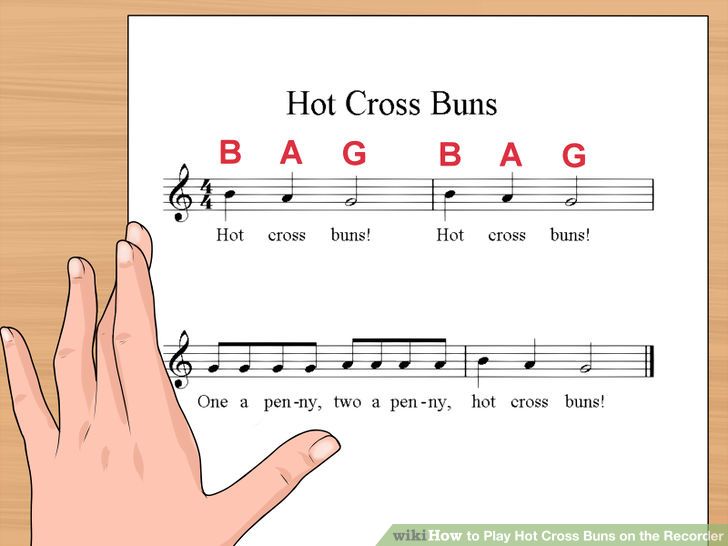
Today we listen to Hot Cross Buns.  “Hot Cross Buns” is an English language nursery rhyme, Easter song, and street cry referring to the spiced English bun known as a hot cross bun, which is associated with the end of Lent and is eaten on Good Friday in various countries.


This is from Keyboard Kickoff:

Theme and Variations


This version gets harder and harder as it goes


In case that made you hungry


On July 28 ~ in Music History

today

OCMS1741 ~ Antonio Vivaldi died
More information about Vivaldi

• 1750 ~ Johann Sebastian Bach, German composer and organist, died. Composer of “St Matthew Passion” and “Brandenburg Concertos”, his output covered every musical genre with innovations in format, quality and technical demands.
More information about Bach

• 1796 ~ Ignace Bösendorfer, Italian Pianomaker
More information about Bösendorfer

• 1811 ~ Guilia Grisi, Italian soprano

• 1901 ~ Rudy (Hubert Prior) Valee, Bandleader and singer. Valee was one of the first, before Bing Crosby, to popularize the singing style known as “crooning”.

• 1914 ~ Carmen Dragon, Classical music conductor, bandleader and father of singer, ‘Captain’ Daryl Dragon

• 1915 ~ Frankie Yankovic, Polka King, Grammy Award-winning musician, accordion

• 1933 ~ The singing telegram was introduced on this day. The first person to receive a singing telegram was singer Rudy Vallee, in honor of his 32nd birthday.

• 1934 ~ Jacques d’Amboise, Ballet dancer with the New York City Ballet

• 1937 ~ Peter Duchin, American bandleader, pianist, son of musician, Eddy Duchin

• 1938 ~ George Cummings, Guitarist with Dr. Hook

• 1939 ~ Judy Garland sang one of the most famous songs of the century with the Victor Young Orchestra. The tune became her signature song and will forever be associated with the singer-actress. Garland recorded Over the Rainbow for Decca Records. It was the musical highlight of the film, The Wizard of Oz.

• 1941 ~ Riccardo Muti, Italian conductor

• 1945 ~ Rick Wright, Keyboards with Pink Floyd

• 1949 ~ Peter Doyle, Singer with The New Seekers

• 1949 ~ Simon Kirke, Drummer with Free

• 1958 ~ Three years after his Cherry Pink and Apple Blossom White reached number one, Cuban-born bandleader Perez Prado captured the top spot again, with Patricia. Prado was known as the Mambo King for his popular, Latin-flavored instrumentals.

• 1969 ~ Frank Loesser passed away

• 1972 ~ Helen Traubel passed away

• 2001 ~ Bass guitarist Leon Wilkeson, one of the founding members of legendary rock band Lynyrd Skynyrd, died at the age of 49. The band, best known for songs What’s your Name?, Sweet Home Alabama and Freebird, debuted in 1973 and was named after the members’ high school gym teacher, Leonard Skinner. Wilkeson was involved in a 1977 plane crash in Mississippi that killed band members Ronnie Van Zant, Steve Gaines and Cassie Gaines. The group disbanded after the crash but re-formed with others in 1987 for a reunion tour. The band toured for most of the 1990s and had a concert scheduled for Aug. 23 in Jacksonville.

• 2002~ Thomas Calvin “Tommy” Floyd, whose twangy voice sold Luck’s beans in the 1950s, died. He was 89 and suffered from Alzheimer’s disease. Floyd was one of Asheboro’s best-known voices, between his music career and his jobs announcing at radio stations. Floyd organized the Blue Grass Buddys in 1942. The group played for radio shows and performed around the Southeast, appearing in concert with bluegrass legends Lester Flatt and Earl Scruggs. In 1950, Luck’s sponsored the band, provided that Floyd plug the product at shows. His jingle went: “Luck’s pinto beans, Luck’s pinto beans. Eat ’em and you’ll never go wrong. Luck’s pinto beans.” Luck’s sponsored him as a host for 15-minute country music spots on television stations in the Southeast. Luck’s discontinued the sponsorship in 1953.

• 2002 ~ Eddy Marouani, who managed the careers of some of the most famous figures in French music, including Edith Piaf and Jacques Brel, died. He was 81. He also steered the careers of singers Michel Sardou, Serge Lama and comedian Michel Boujenah. Marouani headed the agency “Office Parisien du Spectacle” and presided over one the biggest families of French impresarios. Marouani published his memoirs in 1989, entitled “Fishing for Stars, Impresario Profession.”