Destined to become one of the world’s greatest pianists, Vladimir Horowitz was born in 1903 in Kiev, Russia. While most young children were playing games, Vladimir was playing with the ivories. His time was well spent as he was fully capable of performing publicly by the time he was sixteen.
Within four years, the young piano virtuoso was entertaining audiences at recitals throughout Leningrad – 23 performances in one year, where he played over 200 different works of music, never repeating a composition. After Leningrad, Horowitz played in concerts in Berlin, Hamburg and Paris.
In 1928, the Russian pianist traveled to the United States to play with the New York Philharmonic Orchestra at Carnegie Hall. Arturo Toscanini chose Horowitz to perform his first solo with the New York Philharmonic. It was there that Horowitz met his bride-to-be, Toscanini’s daughter, Wanda. The two were wed in Milan in 1933. New York became Horowitz’ permanent home in 1940. He became a U.S. citizen a few years later, devoting the rest of his career to benefit performances, and helping young, aspiring artists.
His return to the concert stage in May of 1965 was a triumphant success, as was his television recital, Vladimir Horowitz at Carnegie Hall.
Just three years before his death, Vladimir Horowitz returned to his homeland to perform once again for the Russian people on April 20, 1986. They felt he had been away far too long … close to sixty years. Horowitz’s birthday
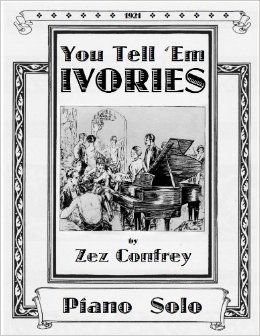
“This collection represents a cross-section of Confrey’s works and encompasses the broad range of his styles. Besides his famous 1920s novelty works (including Kitten on the Keys), there are many wonderful, lesser-known gems of remarkable quality included here from later in his career. Appearing for the first time in print are transcriptions of one of his disc recordings (Poor Buttermilk) and two of his player piano roll arrangements (My Pet and Humorestless). Many of Confrey’s later works have long been out of print and are included here for the first time in decades.”
• 1361 ~ Philippe de Vitry, French Composer and poet, died at the age of at 69
• 1656 ~ Thomas Tomkins, Composer, died
• 1717 ~ Louis Le Quointe, Composer, died at the age of 64
• 1810 ~ (Carl) Otto (Ehrenfried) Nicolai, Composer
More information about Nicolai
• 1828 ~ Carlo Marsili, Composer
• 1829 ~ Gaetano Braga, Composer
• 1832 ~ Manuel Garcia, Composer, died at the age of 57
• 1849 ~ Joseph Vezina, Composer
• 1849 ~ The term recital used for the first time to describe a solo performance by an instrumental player. The first recitalist was Franz Liszt
• 1865 ~ Carl Nielsen, Danish composer and conductor
More information about Nielsen
• 1865 ~ Alberic Magnard, Composer
• 1870 ~ Erik Drake, Composer, died at the age of 82
• 1879 ~ Oscar Back, Austrian-Dutch viola player
• 1886 ~ Kusaku Yamada, Composer
• 1888 ~ Hugo Kauder, Composer
• 1890 ~ The opera “Robin Hood” premiered in Chicago
• 1891 ~ Cole Porter, American composer and and lyricist for the musical theater. His many famous musicals include “Anything Goes”, “Kiss Me Kate” and “Can Can”.
More information about Porter
• 1892 ~ Friedrich Wilhelm Langhans, Composer, died at the age of 59
• 1900 ~ Fred Waring, Musician, conductor and inventor of the Waring Blender
• 1991 ~ Max van Praag, Dutch singer, died at the age of 77
• 1992 ~ Clarence Miller, Blues/jazz vocalist, died at the age of 69 of a heart attack
• 1993 ~ Arthur Alexander, Singer/songwriter, died at the age of 53
• 1995 ~ Frank Chacksfield, Conductor/arranger, died at the age of 81
• 2000 ~ Jazz bassist Burgher “Buddy” Jones, who played in big bands behind Peggy Lee and Frank Sinatra and toured with Harry James and Tommy Dorsey, died at the age of 76. A native of Hope, Ark., Jones was a childhood friend of the late Virginia Kelley, mother of President Clinton. At 17, Jones went to the University of Kansas City, where he met and befriended saxophonist Charlie Parker. Jones later introduced Parker to his wife, Chan. Jones played in the Elliot Lawrence band, when its arrangers included Al Cohn, Tiny Kahn and Johnny Mandel. As a staff musician for CBS in New York in the 1950s and 1960s, Jones played for the Jack Sterling radio show and in bands behind Lee and Sinatra. In 1996, Jones was inducted into the Arkansas Jazz Hall of Fame.
On Monday, Google’s homepage ran a picture to celebrate the 360th birthday of Bartolomeo Cristofori, inventor of the piano and keeper of instruments for the Medicis in Florence. The instrument Cristofori invented was originally called a “harpsichord with soft and loud” even though the distinction between the two is large (the harpsichord produces sound by plucking strings, the piano by striking them with a hammer). Only three of the newfangled instruments he made – all of them dating from the 1720s – survive.
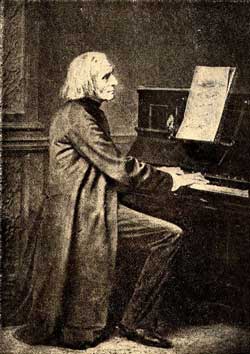
More than a century later the piano recital was devised. It was Liszt who first decided to have the whole stage to himself, and set the fashion for dispensing with the mixture of celebrities and supporting acts that had prevailed up to that time. As he wrote about his audacity to a friend: “Le concert, c’est moi!” And he called his appearance at the Hanover Square Rooms in London in June 1840 not a concert but a recital.
The composer-pianists of the day concentrated on their own works. Liszt set a marker in this regard, too, choosing music that ranged from Bach through Beethoven and up to Chopin. He set the pattern for playing from memory, and cemented the platform layout we know today by turning the then-conventional position of the instrument on the stage through 90 degrees. He was what we would now call a sex symbol as well as a star musician, and the new arrangement allowed the audience to see his impressive profile as well as to hear the instrument more clearly. The standards he set have survived without significant alteration right up to the present.
Student recitals can be lots of fun and create valuable experiences for pianists. Unfortunately, they can also be a source of anxiety or stress if students aren’t ready and/or guidelines aren’t followed.
There are guidelines and rules of behavior all performers and audience members should follow during recitals, concerts or other performances.
Audience members must remember the reason for their visit to the recital hall – to listen quietly, actively and appreciatively to the music being offered by the performers.
For the performer:
1. Dress appropriately. Performers being nicely dressed (or following the recital theme) shows respect for the audience, the teacher and themselves!
Girls in knee-length or longer skirts/dresses or slacks. No spaghetti straps, no platform shoes, flip-flops, bedroom slippers or athletic footwear.
Do not wear dangling, jingling jewelry – especially bracelets. You may need to remove rings if they twist around easily.
Boys in dress pants and buttoned dress shirts with ties preferred, or suits.
IMPORTANT: Remember to practice several times in your outfit, shoes included. You don’t want to get to the recital and find that you can’t use the pedal properly because of your shoes.
2. Clean hands! Dirty, sticky, or oily fingers can hurt your performance and bother the next pianist. If you complete a long piece and notice some keys are slippery with sweat (a very common issue), notify your instructor so they can clean the keyboard before the next performer.
2. When it is your turn, stand quickly and walk up to the stage. Do not run!
Bow before you perform to acknowledge the applause. Audiences used to know that it was appropriate to clap for the musician who was entering the stage to perform. This now isn’t always the case (I will start clapping if it doesn’t happen automatically). Students should bow to their applauding audience before they sit down at the bench (not acknowledging applause is generally considered to be rude).
2. Enter the bench from the side furthest from your audience. This was a biggie for my former piano teacher and I’m reminded of it every time I see a student slink in from the “front side”… or climb over the top. I used to think this was awfully stuffy – but when you see a student do it, it just looks right.
3. Hands in your lap before you begin. I use this with my students to give them a moment to hear the first few measures in their mind before they begin. Once fingers are on the keys it means you’re ready to play. If the bench needs adjusting it should be done first… and then hands should be placed in your lap before beginning to play.
Play the scale of the piece in your head and think over tempo, markings, etc. Then arch your hands onto the piano and position feet on the pedals or flat on the floor–NEVER under the stool. Proceed to play!
3. Should you make a mistake while performing, you should try to continue playing without starting over or repeating. This makes sufficient practice before the recital very Very VERY important!
If playing more than one piece, you should acknowledge applause in between with a nod or smile.
4. Hands in lap after you finish. So many piano students are already lifting themselves off the bench as they play the final note (perhaps really eager to return to their seat in the audience!?) Learning to place your hands in your lap after finishing gives the audience a moment to truly relish what they just heard.
5. Rise and stand at the edge of the piano (with left hand on the wood). Bow from the hips, don’t curtsey. Bowing nicely takes practice! In handbells, we bow towards the table and say silently “I love handbells”. The same can be said in piano recitals – “I LOVE Piano”.
6. Walk calmly off the stage or away from the piano. No running… no matter how badly you want to get back to your seat!
For the audience:
Recitals are a special occasion and so it is customary to dress nicely.
• Please arrive a little early in order to find a comfortable place to sit.
• Make sure all your invited guests understand the importance of arriving on time. If they arrive late, it makes it difficult for those performing.
• Please invite as many friends and family members as you’d like. Our recital hall has lots of room, and can accomodate likely as many as you’d like to invite. And if not, then a standing room only crowd would be a fantastic crowd to have, and a wonderful problem to deal with!
• Turn off all cell phones and any electrical devices that may produce sound.
• Once the recital begins, please listen and be quiet. Crying babies should be taken out. They are not happy, and neither is the audience or the performer!
• If you arrive late, please wait to enter between pieces when you hear applause. Do not enter the recital hall or switch seats while someone is performing.
• The soloist will bow and your response is to applaud politely!
• No whistling, yelling, or other loud methods of congratulation. While boisterous congratulations are meant to show support for the performer, it may actually cause unintended problems instead. The best way to show appreciation for the performance is with thunderous applause, and an occasional “bravo” at the end of an especially great performance.
• Compositions that have movements or suites are, in general, performed without applause in the middle.
• Respect the performers. Unnecessary noise from whispering, talking, candy wrappers, etc. during a program is not acceptable. Reading, studying, and writing letters during a program are also inappropriate.
• Please stay until the performance or event is completely over. Attending a recital so that other families will serve as audience to your student, and then leaving before the other performers have finished is rude, inconsiderate and unacceptable. If you have other obligations or matters to attend to before the recital is over, please do not attend.
• Flash photography is not appropriate during a performance. The flash can disrupt the performer’s concentration.
• Enjoy! Your presence is the greatest affirmation!
For Everyone:
No Perfume! Your perfume or cologne will linger around the piano after you leave the stage (especially under hot lights), and it might give the next pianist some sinus or eye irritation; or, at the very least, create a distraction that can prevent them from getting “in the zone.”
So often transfer students will come to me and play a piece they’ve been working on. When they make a mistake, they’ll stop and start the piece all over again instead of correcting the mistake on the spot and moving on.
If they do this at home in practice, they’ll have played the beginning part many times more than the ending – or they may have never gotten to the ending at all!
The infographic above shows a way to get around this problem. It’s also great for memorizing pieces during recital preparation.
Similar to this are some pieces in the early pages of beginning method books. Lines 1, 2 and 4 will be identical with only line 3 being changed.
If a student plays this over and over all the way through, he’s learned line 1 three times better than line 3. I always suggest practicing line 3 by itself several times to help counter this problem.
My piano teacher friend, Michelle, posted pictures of her students the other day. Apparently, they participated in some type of competition/recital, and with pride their teacher shared the results.
They stood smiling into the camera each holding a certificate that announced his or her status in the competition. Seeing them brought back my own memories of piano lessons and recitals. I smiled as I looked into the bright faces of those talented young people.
When I was a kid I wanted nothing more than to learn to play the piano. I had a favorite aunt who played so well and my daddy played by ear better than some folks who read music.
Oh yes, I imagined myself sitting at the keyboard, fingers flying while the family sang along to some favorite hymn or Christmas carol. Daddy would grin with pride and maybe join in playing his harmonica.
It was lovely dream. There was only one little glitch in this plan. I needed lessons in order to make it come true.
So, my parents signed me up with Mrs. Simmons who lived across the street. She was one of the best piano teachers in town and lucky me, all I had to do was cross the street for my lessons.
I’m not sure what I expected, but it was with great disappointment I realized I was not going to produce a beautiful song after only one lesson. Heck, I wasn’t going to produce much more than a repetitive playing of the scales after several lessons.
I recited, Every — Good — Boy — Does — Fine, All — Cars — Eat — Gas, FACE, GBDFA to help me remember the treble and clef lines and spaces. And I played the notes over and over until the sand in the hourglass timer told me it was time to stop. (I’m pretty sure Mother was overjoyed when that last piece of sand fell through the hole.)
When I finally got to the point of making a noise that sounded like something musical, it was, if I remember correctly, a little ditty about a frog — not exactly the moving hymn I imagined playing.
Eventually, I progressed to playing an entire piece of music. That meant I was ready to take part in the annual piano recital. I’d love to say I was excited at the prospect of publicly showing the great strides I’d made in piano playing. In truth, I was more excited about getting to wear an evening gown and lipstick.
For three years, I stuck with the lessons and with the practicing. For three years, I showed up for the recital and played the piece my teacher assigned. I have a picture of myself seated at the piano in my parents’ living room on the night of one of those recitals.
My hair is a perfect flip and I’m wearing a white gown that I imagined made me look like a cross between an angel and a fairy. I have my hands resting on the keys and I’m smiling into the camera like some diva about to launch into a classical masterpiece.
At some point, (probably had something to do with being a teenager and boys) I let go of my dreams of tickling the ivories. I did learn one Christmas carol, which my family heard until they were pretty much sick of it.
As I looked at Michelle’s students holding their certificates, I thought about the dedication it took for them to play so well. I also thought about all those teachers, like my friend and like Mrs. Simmons, who have the calling and the incredible patience it takes to try to teach another human to play a piano, especially when the student is not realistic about what it takes to master the instrument and more interested in evening gowns.
The thought-provoking talk on February 10th was given by Keith Pascoe, second violinist of the Vanbrugh Quartet, in connection with tomorrow night’s violin and piano recital by Ray Chen and Julien Quentin. Pascoe came up with a great title, David and Goliath, The Ballet of Unequals: A Stradivari and Model D Steinway Recital. Using videos from YouTube as illustrations (which unfortunately allowed in snippets of a couple of unwanted advertisements), Pascoe began at the beginning, with the emergence of the piano and violin as instruments in their own right, and traced some of the changes they have both undergone in the centuries since.
The piano has become bigger, stronger and louder. Not only were extra notes added to the keyboard, but the early wooden frames were replaced with cast iron. The violin may not have grown externally, but the shape of the body was remoulded, the neck and fingerboard realigned, and internal buttressing extended, all with the intention of producing greater sound.
What composers did with the combination of violin and piano – and before that, violin and harpsichord – changed too. In the typical baroque violin sonata, the violin was to the fore. In the classical era, the roles were reversed, although this reversal has long been dishonoured by performers. And in the 19th century, the balance as we know it today began to take hold. That balance usually presents the two performers in a master-servant relationship, the violinist usually the boss whose bidding is carried out by the pianist.
• 1701 ~ Johann Joachim Agrell, Composer
More information about Agrell
• 1735 ~ Paul Revere, American patriot and music engraver
• 1764 ~ In a stunning demonstration of prodigious talent, the Royal Family at Versailles in France was treated to a brilliant recital by an eight year old musician. His name was Wolfgang Amadeus Mozart.
• 1878 ~ Edwin Franko Goldman, Composer
1900 ~ Xavier Cugat (Francisco de Asís Javier Cugat Mingall de Brue y Deulofeo). Spanish violinist, composer and band leader, married to Abbe Lane and Charo
More information about Cugat
• 1925 ~ Lucrezia Bori and John McCormack of the famous Metropolitan Opera in New York City made their singing debuts on radio this day. The broadcast over what was WEAF Radio (now WABC) encouraged others to sing on radio. Some of those were Hootie and the Blowfish, and Barry Manilow.
• 1928 ~ Frank Pourcel, Composer, violinist
• 1942 ~ Country Joe McDonald, Singer with Country Joe & the Fish
• 1953 ~ A sad day in country music, as the legendary Hank Williams died at the young age of 29. Undisputedly, the biggest star in the history of country music, Hank Williams’ legacy is being carried on by his son, Hank Williams, Jr.
• 1955 ~ Elvis Presley appeared at The Eagles Hall in Houston Texas. Presley went on to play over 250 shows in 1955.
• 1968 ~ A group known as The Blue Velvets decided to change its name this day and it’s a good thing they did. The new name soon became a national pop music favorite as Creedence Clearwater Revival climbed to stardom.
• 2000 ~ Ray Walston, who found commercial success playing a comical devil in the play “Damn Yankees” and an extraterrestrial on the sitcom “My Favorite Martian,” of natural causes at the age of 86. Walston caught the biggest break of his career when he won a Tony in 1955 for his performance in Broadway’s “Damn Yankees.” The smash musical told the story of a frustrated baseball fan who sells his soul. His screen debut came in the 1957 movie “Kiss Them For Me” with Cary Grant, and the next year he played the devil again in the film version of “Damn Yankees.” Walston snagged the role that would stick with him for a lifetime – that of a lovable alien on the TV show “My Favorite Martian” in 1963. The show was immensely popular, but Walston felt so typecast that he tried to highlight his dramatic abilities by returning to the stage when the TV comedy went off the air in 1966. He stayed in theater for several years before re-emerging with a succession of solid supporting roles in movies and television. Nearly 30 years after the end of the lighthearted “My Favorite Martian,” Walston’s role on “Picket Fences” as acerbic Judge Henry Bone earned Walston successive Emmys in 1995-96.


 Horowitz’s birthday








 MaryO'Studio