Practicing Piano Exercises

hanon1


These tips work for more than just exercises!

  • Practice each hand separately first.
  • Practice slowly in the beginning (metronome on 60 or less). If you played it easily, and precisely with the metronome, move the tempo up one notch. Continue to practice in this way until you reach your goal speed.
  • Practice with various dynamics. Practice soft, loud and everything in between.
  • As you practice, vary the touch. Play staccato, play legato, and play two-note slurs.
  • Practice in different rhythms.
  • Try to practice Hanon Exercises in  other keys, starting with the white keys (C, D, E, F, G, A, and B) and then going to the black keys (D-flat, E-flat, G-flat,A-flat, and B-flat).
  • And as Charles-Louis Hanon recommends it, practice his exercises by lifting the fingers high and with precision, playing each note very distinctly.

The piano industry is slowly going out of tune | Public Radio International

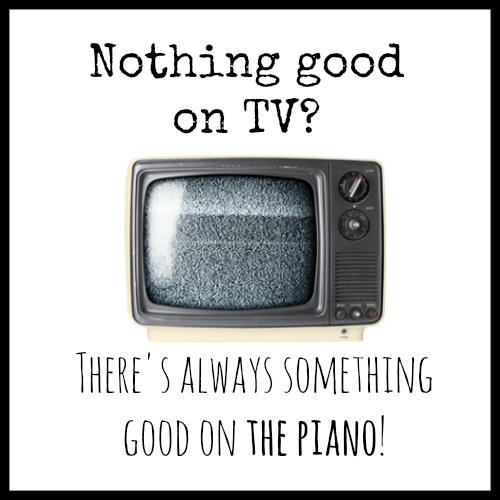
Vintage TV set isolated on white background with static


The piano was once the heart of the home. In 1909, people bought more than 350,000 of the instruments.

“Back in the early 1900s, there were very little forms of entertainment,” says Stephen Scharbrough, a second-generation piano tuner and technician. “It was a time that was pre-radio, so if you wanted entertainment, music, or something to interact with at your house, place of business, or a restaurant or bar, you had to hire a musician or pianist.”

The piano eventually caught on, and individuals learned how to play the piano on their own to entertain themselves. But today, “things have obviously changed a bit since then,” Scarborough says.

The television has adopted the piano’s former role in the modern era, and children are easily entertained with tablets instead of having to practice musical scales. Annual piano sales have dropped to between 30,000 and 40,000.

Instead of serving as the family entertainment center, Scharbrough says pianos are now owned by specific sets of people. “It’s the family that places priority on self-discipline and has a respect for arts and music,” he says.

Read the entire article at The piano industry is slowly going out of tune | Public Radio International.

via

It’s Never Too Late!

“I used to play piano, when I was a child,” Fitzgerald explained. “My mother liked it, because she could just say, ‘Go play piano!’ and I’d go off and play it by myself.”

Fitzgerald stopped playing when she was young, due to the large size of her family. None of her brothers or sisters were much interested in the instrument, and she began to feel uncomfortable about her hobby.

She explained that big families can’t afford everything, and that keeping an expensive object like a piano for just one person would have been selfish.

So Fitzgerald gave up her piano, grew up, and moved on. But she always remembered her love of the piano. And when she moved into the Cartmell Home, and found out about the lessons, she was hooked.

“I decided to give it a try,” she said, laughing, “I’ve already got one foot in the grave! When else will I get the chance to?”

Although Fitzgerald’s skill with the instrument has atrophied since she was younger, (she laughs while pointing out that her music practice book is designed for children) her innate talents are as sharp as ever.

“I’ve always had an ear for music” she explains, “I can play a tune just from hearing it.”

Read the entire article at Returning to the keys: retired techer takes piano lessons after decades.

Finding The Right Teacher For Your Music-Loving Kid: Deceptive Cadence

NOT Mrs. O'Connor!

NOT Mrs. O’Connor!

See if a prospective teacher allows a trial lesson to test how the personalities mesh. And be sure to ask lots of questions. What’s the teacher’s background as a musician and as an instructor? What kinds of teaching materials and music does she use? How much practice time is expected for students, and does that vary by the student’s age? Does the teacher have access to student ensembles? What kinds of performance opportunities will he provide? Will the teacher allow the student to record the lesson? This can be a terrific practice aid, especially when it comes to remembering how something is supposed to sound. Does she teach any music theory or composition? What are the expectations for students and for their parents?

A good teacher can be a friendly, encouraging and inspiring presence — even when a student hits rough patches. He will point out the student’s weaknesses without being harsh or dismissive, suggest innovative ways to overcome challenges, and create engaging ways to tackle even rote activities like playing scales or honing fine motor skills. The instructor’s age and experience might or might not be a deciding factor; for example, I’m consistently impressed by the range of tricks my own child’s very youthful private teacher has up her sleeve to turn what could easily be drudgery into fun. Not to mention the huge helpings of good humor and patience she brings to her tiny charges!

Read more at Finding The Right Teacher For Your Music-Loving Kid : Deceptive Cadence : NPR.

Practising the Piano – The Myth of the Instant Fix

When they make a mistake they hack away at it until it finally yields, and simply move on. What they have actually practised is getting it wrong three or four times in a row and right on the fifth attempt. What, then, are the chances of getting it right the first time in the context of the flow of the piece?

via Practising the Piano – The Myth of the Instant Fix.