Parents! How to Help Your Students Practice ~ Day Six

We have established that regular practice routines will not happen without proactive piano parents. So, how can parents be proactive practice assistants even if they have never touched a piano?

Day 6. The Piano Studio Janitor: Parents are the ultimate, and original, janitors. While it is important that students learn to organize their own practice spaces, if parents are looking for a simple task to get involved in practice sessions, getting the home piano space in order before each practice session can be very helpful.

Parents! How to Help Your Students Practice ~ Day Five

We have established that regular practice routines will not happen without proactive piano parents. So, how can parents be proactive practice assistants even if they have never touched a piano?

Day 5. The Youtube Liaison: As students get older, it can get harder for piano parents to be active in the home practice process. By transitioning from an authoritative role to an assistant role, parents can be supportive by performing simple tasks such as searching out quality Youtube performances of pieces their children are playing. It can be a really useful experience for teen piano players to see and hear performances of the pieces they are about to play.

Parents! How to Help Your Students Practice ~ Day Four

We have established that regular practice routines will not happen without proactive piano parents. So, how can parents be proactive practice assistants even if they have never touched a piano?

Day 4. The Lead Vocalist: Most people are not too comfortable with breaking out into song in public, but they will happily sing in front of their own children. Parents of your littlest piano students should be encouraged to sing along with song lyrics. Just make sure that the sing-alongs happen with songs their children already know quite well. Sing-alongs do not work when a song is first being learned.

Parents! How to Help Your Students Practice ~ Day Three

We have established that regular practice routines will not happen without proactive piano parents. So, how can parents be proactive practice assistants even if they have never touched a piano?

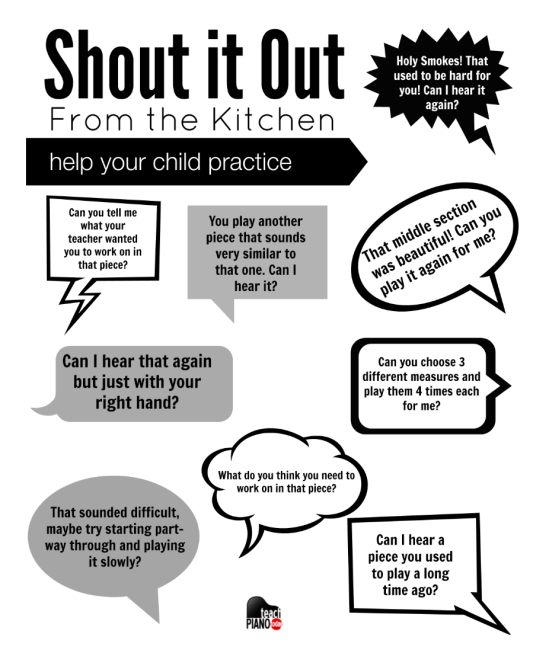
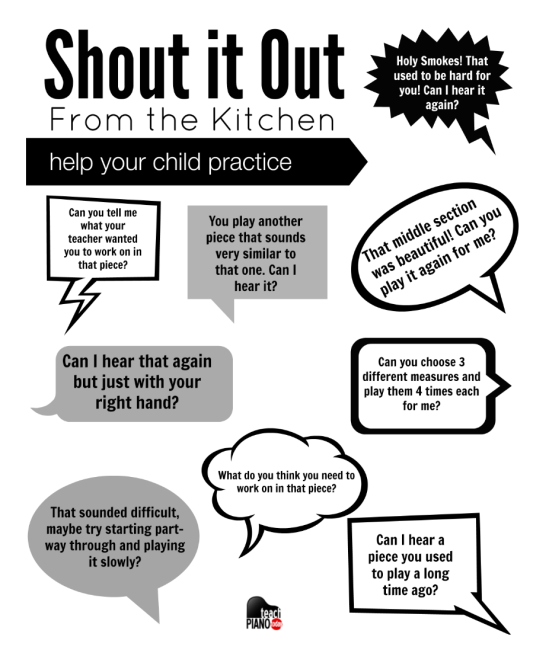
Day 3. The Piano Piece Request Line: The most accomplished piano students always revisit pieces from their past to brush up on skills and to simply revisit some old favorites. During practice sessions, parents can get involved by requesting their children to perform some pieces that they have enjoyed hearing from past recitals, playing classes or just for fun.

Daily Listening Assignments 2020


This summer, I’ve decided to add a new feature to piano lessons.  I know that many families travel during the summer months and it’s sometimes difficult to practice.

These daily assignments, June through August will help you and your students learn a bit more about the pieces they’re learning during the year – or maybe give ideas for something that they’d like to learn.

Each piece has a bit of composer info and several different interpretations, some of which are very humorous.  Some of the assignments appear in Piano Maestro so be sure to have that handy, if your student uses that.

Some days give hints that the assignment of the day may be played (or reviewed) at the next lesson so please be sure that your student takes note of that (no pun intended!)

Find them here, under Daily Listening Assignment starting June 1 at 9:00 am.

Have a safe and musical summer!

A Great Book For Parents or Adult Students


I have several copies of this book for the music studio so parents can check it out to see if it would be useful for them to buy for home use.  If any of the studio parents have this book already, please let me know what you think.

Some of my adult students have this and have found it helpful in doing theory assignments.


From Amazon:

Help Your Kids with Music is a step-by-step visual guide to music theory and is the perfect primer to help students gain a solid foundation in music, no matter their age, skill level, or instrument.

Help Your Kids with Music clearly explains key concepts in five step-by-step chapters:

  • The Basics explains the types of instruments, notation for keyboard and stringed instruments, the “musical alphabet,” and counting a beat.
  • Rhythm covers the length of notes and rests, as well as basic rhythms and meters, phrasing, syncopation, tempo, and using a metronome.
  • Tone and Melody includes everything a student needs to know about tones and how they work together to build a melody.
  • Chords and Harmony shows how intervals work together and includes examples for horn and woodwind instruments.
  • Form and Interpretation helps students understand how musical form can aid appreciation and interpretation for classical, jazz, blues, and other musical styles.

Sample pages:


Daily Listening Assignments 2019


This summer, I’ve decided to add a new feature to piano lessons.  I know that many families travel during the summer months and it’s sometimes difficult to practice.

These daily assignments, June through August will help you and your students learn a bit more about the pieces they’re learning during the year – or maybe give ideas for something that they’d like to learn.

Each piece has a bit of composer info and several different interpretations, some of which are very humorous.  Some of the assignments appear in Piano Maestro so be sure to have that handy, if your student uses that.

Some days give hints that the assignment of the day may be played (or reviewed) at the next lesson so please be sure that your student takes note of that (no pun intended!)

Find them here, under Daily Listening Assignment starting June 1 at 9:00 am.

Have a safe and musical summer!