Christmas Music, Part 12 – Still, Still, Still

Still, Still, Still

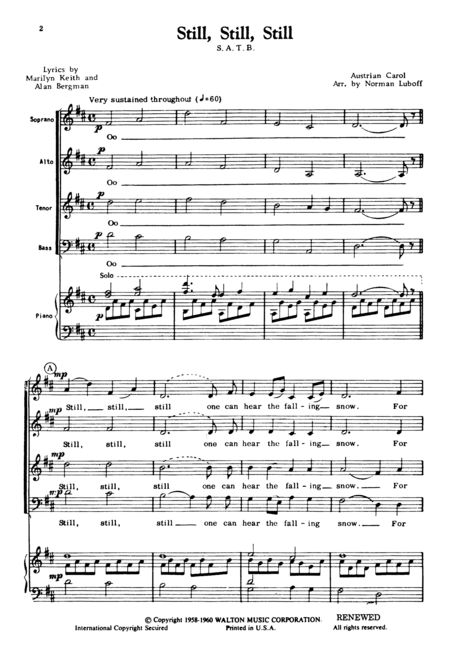
Still, Still, Still is an Austrian Christmas carol and lullaby. In German its first line is “Still, still, still, weil’s Kindlein schlafen will!” (Hush, hush, hush, for the little child wants to sleep!)

The melody is a folk tune (authorship unknown) from the State of Salzburg. The tune appeared for the first time in 1865 in a folksong collection of Maria Vinzenz Süß (1802-1868), founder of the Salzburg Museum; it has changed slightly over the years but remains attributed to G. Götsch.

The words, which run to six verses in German, describe the peace of the infant Jesus and his mother as they sleep. There are various English translations.  This is one version:

Still, still, still,
One can hear the falling snow.
For all is hushed,
The world is sleeping,
Holy Star its vigil keeping.
Still, still, still,
One can hear the falling snow.

Sleep, sleep, sleep,
‘Tis the eve of our Saviour’s birth.
The night is peaceful all around you,
Close your eyes,
Let sleep surround you.
Sleep, sleep, sleep,
‘Tis the eve of our Saviour’s birth.

Dream, dream, dream,
Of the joyous day to come.
While guardian angels without number,
Watch you as you sweetly slumber.
Dream, dream, dream,
Of the joyous day to come.
Christmas Music, Part 10 – O Come, O Come Emmanuel

O Come, O Come Emmanuel

O Come, O Come Emmanuel

O come, O come, Emmanuel is the mid-19th century translation by John Mason Neale and Henry Sloane Coffin of the Ecclesiastical Latin text “Veni, veni, Emmanuel”.

The text is based on the Biblical prophecy from Isaiah 7:14 that states that God will give Israel a sign that will be called Emmanuel (Literally: God with us). Matthew 1:23 states fulfillment of this prophecy in the birth of Jesus of Nazareth.

O come, O come, Emmanuel
And ransom captive Israel
That mourns in lonely exile here
Until the Son of God appear
Rejoice! Rejoice! Emmanuel
Shall come to thee, O Israel.

O come, Thou Rod of Jesse, free
Thine own from Satan’s tyranny
From depths of Hell Thy people save
And give them victory o’er the grave
Rejoice! Rejoice! Emmanuel
Shall come to thee, O Israel.

O come, Thou Day-Spring, come and cheer
Our spirits by Thine advent here
Disperse the gloomy clouds of night
And death’s dark shadows put to flight.
Rejoice! Rejoice! Emmanuel
Shall come to thee, O Israel.

O come, Thou Key of David, come,
And open wide our heavenly home;
Make safe the way that leads on high,
And close the path to misery.
Rejoice! Rejoice! Emmanuel
Shall come to thee, O Israel.

O come, O come, Thou Lord of might,
Who to Thy tribes, on Sinai’s height,
In ancient times did’st give the Law,
In cloud, and majesty and awe.
Rejoice! Rejoice! Emmanuel
Shall come to thee, O Israel.

Christmas Music, Part 7 – Hark the Herald Angels Sing

hark

Charles Wesley (1707-1788),  the younger brother of John Wesley wrote the words to this Christmas Carol.

Charles was a hymn writer and a poet, also known as one of the people who began the Methodist movement in the Church of England. Hark the Herald Angels Sing appeared in 1739 in a book called Hymns and Sacred Poems.

Wesley envisioned this being sung to the same tune as his hymn, Christ the Lord Is Risen Today,  and in some hymnals it is included along with the more popular version.

This hymn was regarded as one of the Great Four Anglican Hymns and published as number 403 in “The Church Hymn Book” (New York and Chicago, USA, 1872).

To celebrate the invention of the printing press, Felix Mendelssohn composed a cantata in 1840 called Festgesang or “Festival Song”. The melody of Mendelssohn’s cantata was then used by William H. Cummings and adapted it to the lyrics of Wesley’s “Hark the Herald Angels Sing”.

Hark the herald angels sing
“Glory to the newborn King!
Peace on earth and mercy mild
God and sinners reconciled”
Joyful, all ye nations rise
Join the triumph of the skies
With the angelic host proclaim:
“Christ is born in Bethlehem”
Hark! The herald angels sing
“Glory to the newborn King!”

And, of course, no one can do it better than The Mormon Tabernacle Choir.


Christmas Music, Part 6 – Just In Time For Christmas

From RevKev, Pender’s Former Associate Pastor – “As it was, so it is, Christmas about Jesus. We are all distracted by the glitz and festivities, but let us hear the sound of Angels and the call to worship our Newborn King. Just in time for Christmas, a gift from God to you: A baby in a manger who would love us through and through.

Just In Time For Christmas, the latest album release by JC Reigns. 100% of the sales from this CD go to Western Fairfax Christian Ministries to support their mission of providing life-essential support to those needing assistance.

CDs available for purchase at the WFCM Thrift Store in Chantilly, Va. Visit www.jcreigns.org for more information and for a link to purchase digital copies.”

More from JC Reigns

Christmas Music, Part 5 – Carol of the Bells

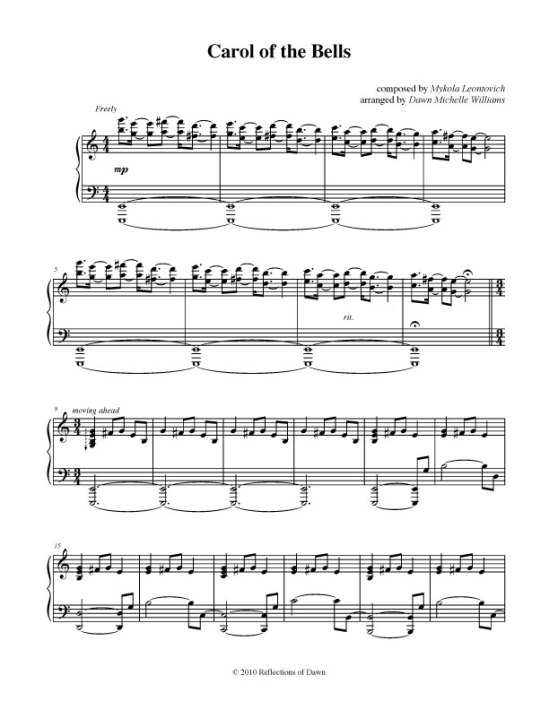
Carol of the BellsCarol of the Bells was composed by Mykola Dmytrovych Leontovych (1877-1921) in 1916. Originally titled Shchedryk, this Ukrainian folk song is sometimes called Ukrainian Bell Carol. “Shchedryk” which was associated with the coming New Year, originally celebrated in April.

Leontovych used this tune in 1904 along with lyrics by Peter J. Wilhousky to create the version that everyone knows today. It gained popularity during the 1920s and 1930s, and was introduced to an even wider audience when it was used in the movie “Home Alone”.

It was first performed in the Ukraine on the night of January 13, 1916, on the Julian calendar this is considered New Year’s Eve. In the United States the song was first performed on October 5, 1921 at Carnegie Hall.

This video is from the Christmas special of the Mormon Tabernacle Choir, presented at the BYU channel. Very beautiful sound of bells, the orchestra and choir, enjoy the video!

Not the standard version –

The O’Connor Music Studio has several versions of this Christmas Carol available for loan, including this version from the Mannheim Steamroller:


Christmas Music, Part 4 – I Heard The Bells on Christmas Day

I Heard the Bells on Christmas Day


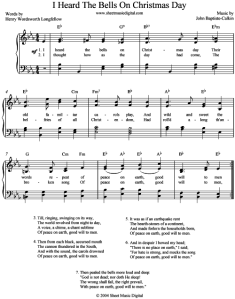
“I Heard the Bells on Christmas Day” is a Christmas carol based on the 1863 poem “Christmas Bells” by American poet Henry Wadsworth Longfellow. The song tells of the narrator’s despair, upon hearing Christmas bells, that “hate is strong and mocks the song of peace on earth, good will to men”. The carol concludes with the bells carrying renewed hope for peace among mankind.

This version is done by Casting Crowns.  I chose it because the Pender choir sang this on Christmas Eve with past-Associate Pastor Dan Elmore singing the solo…and I fell in love with this version.

As seen on 2008 TBN Christmas special. “I Heard The Bells On Christmas Day” is available on Casting Crowns’ Christmas album, Peace On Earth.

More traditionally, the Mormon Tabernacle Choir’s version:

I heard the bells on Christmas Day
Their old, familiar carols play,
and wild and sweet
The words repeat
Of peace on earth, good-will to men!

And thought how, as the day had come,
The belfries of all Christendom
Had rolled along
The unbroken song
Of peace on earth, good-will to men!

Till ringing, singing on its way,
The world revolved from night to day,
A voice, a chime,
A chant sublime
Of peace on earth, good-will to men!

Then from each black, accursed mouth
The cannon thundered in the South,
And with the sound
The carols drowned
Of peace on earth, good-will to men!

It was as if an earthquake rent
The hearth-stones of a continent,
And made forlorn
The households born
Of peace on earth, good-will to men!

And in despair I bowed my head;
“There is no peace on earth,” I said;
“For hate is strong,
And mocks the song
Of peace on earth, good-will to men!”

Then pealed the bells more loud and deep:
“God is not dead, nor doth He sleep;
The Wrong shall fail,
The Right prevail,
With peace on earth, good-will to men.”

Christmas Music, Part 3 – Angels We Have Heard On High

Angels We Have Heard On High

Angels We Have Heard On High

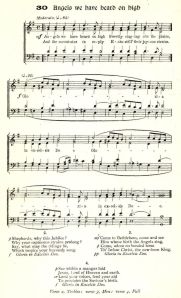
Angels we have heard on high
Sweetly singing o’er the plains
And the mountains in reply
Echoing their joyous strains
CHORUS:
Gloria, in excelsis Deo!
Shepherds, why this jubilee?
Why your joyous strains prolong?
What the gladsome tidings be
Which inspire your heavenly song? ChorusCome to Bethlehem and see
Him Whose birth the angels sing;
Come, adore on bended knee,
Christ the Lord, the newborn King. ChorusSee Him in a manger laid
Jesus Lord of heaven and earth;
Mary, Joseph, lend your aid,
With us sing our Savior’s birth. Chorus

This is a traditional French carol (Les Anges dans nos Campagnes) that was translated into English by Bishop James Chadwick.

This carol commemorates the story of the birth of Jesus Christ found in the Gospel of Luke, in which shepherds outside Bethlehem encounter a multitude of angels singing and praising the newborn child.

In 2009, Andrea Bocelli and David Foster collaborated to produce a Christmas album with a number of other music legends. This is “Angels We Have Heard on High” with choir and orchestra.

The Piano Guys, Peter Hollens, David Archuleta, and The Mormon Tabernacle Choir get together to sing “Angels We Have Heard On High”

Christmas Music, Part 2 – Joy To The World

Joy_To_The_World-Antioch

Joy To The World

Joy to the World, the Lord is come!

Let earth receive her King.

Isaac Watts wrote  the words to “Joy to the World” in 1719, based on Psalm 98 in the Bible. The hymn originally glorified Christ’s triumphant return at the end of the age, rather than a song celebrating His first coming. Only the second half of Watts’ lyrics are still used today.

The music was adapted and arranged to Watts’ lyrics by Lowell Mason in 1839 from an older melody which was then believed to have originated from Handel. The name “Antioch” is generally used for the hymn tune.

As of the late 20th century, “Joy to the World” was the most-published Christmas hymn in North America.

There are versions of Joy to the World available at the O’Connor Music Studio for any level of playing, starting with Pre-Reading, all the way up through Advanced and duets.

Christmas Music, Part 1 – Sleigh Ride

Sleigh Ride

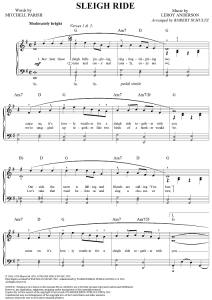
I’ve always liked Leroy Anderson’s Sleigh Ride as a secular Christmas song 🙂  It’s not technically a Christmas song since the words never mention Christmas but it’s often played now so it seems like a way to ease into the season.

Anderson had the original idea for the piece during a heat wave in July 1946;  he finished the work in February 1948.  Lyrics, about a person who would like to ride in a sleigh on a winter’s day with another person, were written by Mitchell Parish in 1950.

The orchestral version was first recorded in 1949 by Arthur Fiedler and The Boston Pops Orchestra. The song was a hit record and has become the equivalent of a signature song for the orchestra.

A new last year, fun arrangement has been made for piano duet.  I have copies here for loan and it’s available on amazon (of course! What isn’t?)

Pender Christmas VBS Registration

christmas-vbs-2015-feature

Who: Kids Ages 3 (must be potty-trained)- 6th Grade

What:“Under Wraps: The Gift We Never Expected”

Where: Pender UMC Christmas VBS

Why: Celebrate Christmas and the Gift of Jesus Christ

When: Saturday, Dec. 5th @ 10 am – 2 pm

Cost: $10 per Kid or $20 total per Family


Join us for Christmas VBS on December 5, 2015 while your parents enjoy the gift of time to prepare for Christmas. We will enjoy music, crafts, lunch, recreation, a story and more! 

RSVP: Register online on our website by clicking on this link, beginning November 1st & ending November 30th.