November 10 ~ On This Day in Music

today

. 1483 ~ Martin Luther, German religious reformer, composer of hymns and flutist

.1668 ~ François Couperin, French composer and organist
Read more about Couperin

.1888 ~ Fritz Kreisler, a 13-year-old violinist from Vienna, made his American debut in New York City.

https://youtu.be/TjXAc5NxsHI

.1900 ~ “Floradora” opened in New York City this day. The play was received by cheering audiences.

.1928 ~ Ennio Morricone, Italian composer/musician

.1939 ~ Muggsy Spanier and his band recorded Dipper Mouth Blues on Bluebird Records.

.1944 ~ Tim Rice, British author and librettist
Read more about Rice

.1956 ~ Billie Holiday returned to the New York City stage at Carnegie Hall after a three-year absence. The concert was called a high point in jazz history.

.1969 ~ On this day, twenty years after the first release of “Rudolph the Red-Nosed Reindeer”, Gene Autry received a gold record for the single.

.1969 ~ “Can you tell me how to get … how to get to Sesame Street?” The classic, “Sesame Street” debuted on 170 Public Broadcasting stations and 20 commercial outlets. Created by the Children’s Television Workshop, the show starred endearing characters including Gordon, Susan, Bob, Bert, Ernie, the Cookie Monster, Oscar the Grouch and, of course, Big Bird!

https://youtu.be/LXqMzmFSX_4

.1986 ~ “Bruce Springsteen & The E Street Band Live/1975-85”, the long-anticipated album by ‘The Boss’, hit record stores this day. Fans made the LP a one~day sellout, buying over a million copies and generating more first-day dollars than any record in 30 years. It’s a five-disc, 40-song set.

.1993 ~ “Joseph and the Amazing Technicolor Dreamcoat” opened at Minskoff Theater in New York for 223 performances

.1994 ~ Carmen McRae passed away

.2014 ~ “Uptown Funk” single released by Bruno Mars (Billboard Song of the Year 2015, Grammy Record Of The Year, Grammy Song of the Year 2016)

.2015 ~ Allen Toussaint passed away.  He was a New Orleans-based pianist, songwriter and Rock and Roll Hall of Famer.

.2015 ~ Robert Lawson Craft died.  He was an American orchestral conductor, scholar and writer. Mr. Craft spent nearly a quarter-century as Stravinsky’s amanuensis, rehearsal conductor, musical adviser, globe-trotting traveling companion and surrogate son. After Stravinsky’s death in 1971, at 88, he was a writer, lecturer, conductor, public intellectual and keeper of the Stravinskian flame.

September 4: On This Day in Music

• 1824 ~ Anton Bruckner, Austrian composer and organist
More information about Bruckner
Read quotes by and about Bruckner

• 1892 ~ Darius Milhaud, French composer
More information about Milhaud

• 1905 ~ Meade “Lux” Lewis, American jazz pianist

• 1907 ~ Edvard Grieg passed away

• 1928 ~ Wingy Manone recorded Downright Disgusted for Vocalion Records. Playing drums for Wingy was a young sideman named Gene Krupa.

• 1930 ~ Mitzi Gaynor (Franchesca Mitzi Marlene de Charney von Gerber), Singer, dancer, actress

• 1942 ~ Merald ‘Bubba’ Knight, Singer with Gladys Night and the Pips

• 1944 ~ Gene Parsons, Drummer with The Byrds

• 1946 ~ Gary Duncan (Grubb), Musician, guitar with Quicksilver Messenger Service

• 1946 ~ Greg Elmore, Musician, drums with Quicksilver Messenger Service

• 1950 ~ Ronald LaPread, Bass with Commodores

• 1951 ~ Martin Chambers, Drummer with The Pretenders

• 1959 ~ Mack the Knife was banned from radio – at least from WCBS Radio in New York
City. Teenage stabbings in the city had people pretty uptight; therefore, the ban.

• 1971 ~ The Lawrence Welk Show was seen for the last time on ABC~TV. ABC felt the show attracted “too old an audience … not good for attracting advertisers.” Syndication allowed the champagne music to continue until 1982 as a weekly favorite for millions of people. Welk charted a half-dozen tunes on the pop music charts between 1956 and 1961, including the number one song, Calcutta, in 1960.

• 1982 ~ After six weeks, Eye of the Tiger, by Survivor, dropped out of the top spot on the music charts. The song, from the movie, Rocky III, dropped all the way to number 2 (for two weeks), then to number 3 for one week and to number 4 for two weeks before starting to fade. That’s what we call a hit, folks! It was the group’s biggest, earning them a platinum record.

• 2001 ~ Robert Pagent, a dancer and choreographer who appeared in the original productions of Oklahoma! and Carousel died at the age of 87. Born Robert Weisser in Pittsburgh, Pagent began his career in European classical ballet troupes in the 1930s. In 1942 he adopted the stage name Robert Pagent and was square-dance caller in the premier of Agnes de Mille’s cowboy-themed ballet, Rodeo. It was the start of a long friendship and collaboration with DeMille and choreographer Jerome Robbins. The following year he replaced an injured dancer in the original cast of Oklahoma! a night after its opening. Two years later he appeared in the premiere of Carousel. Pagent was a choreographer for television in the 1950s and 60s, including the Miss America Pageant. He staged Rudolph Nureyev’s first U.S. television appearance.

• 2003 ~ Susan Chilcott, one of Britain’s leading opera singers, died. She was 40. Chilcott, a soprano, had performed across Europe and with the Metropolitan Opera in New York City. Chilcott made her Royal Opera House debut in Covent Garden June 2003 to glowing reviews, playing Lisa in Tchaikovsky’s “Queen Of Spades” opposite Placido Domingo.

• 2003 ~ Tibor Varga, a conductor and violinist known for his teaching and for his performances of Béla Bartók and other modern masters, died. He was 82. Varga was born in Hungary and made his public debut with Mendelssohn’s E minor concerto when he was 10. He began touring in Europe while a teenager and studied in Budapest and in Berlin. After World War II he performed widely as a violin virtuoso. In 1947 he moved to England, where he obtained British citizenship. He founded the Tibor Varga Chamber Orchestra in Detmold, Germany, in 1954, then moved to Switzerland, where he was based the rest of his life. He continued to conduct the Detmold-based orchestra until 1988. His repertoire covered baroque, classical and romantic works, but he was best known for his performances of modern composers including Stravinsky, Schoenberg and Berg.

• 2016 ~ David Brown, American guitarist (Santana), died at the age of 53

Piano Puzzlers!

puzzlers


The Piano Puzzlers book is available in the O’Connor Music Studio library if you’d like to give any a try.  Piano Puzzlers as heard on American Public Media’s “Performance Today.” Includes 32 tunes with songs by Gershwin, Berlin, Arlen, Porter, Rodgers, Fats Waller, Lennon & McCartney, and others disguised in the styles of Bach, Handel, Haydn, Mozart, Beethoven, Brahms, Schubert, Schumann, Chopin, Janacek, Debussy, Ravel, Rachmaninoff, Stravinsky, Prokofiev, Bartok, and Copland.

Includes an introduction by Fred Child, host of “Performance Today” as well as background info by Bruce Adolphe. “Bruce Adolphe has taken a common musician’s party game and elevated it to high art and truly funny musical slapsticks. The Piano Puzzlers are a unique combination of extraordinary insight into the styles of many composers subtle, expert workmanship and great, great fun!”


From http://jasonmorris.blogsome.com/2008/08/08/piano-puzzlers/

If you’re a music geek (like me), I have a program for you. Now, let me be clear, to fully qualify as a music geek…you must have a fond appreciation for classical music (no, Poison, Quiet Riot, and Zepplin do not count as classical music). So, if you’re a “music geek” without an appreciation for classical music…well, I hate to burst your bubble…but, you’re not truly a music geek. Instead, you’re a music appreciator, but not a geek. So, if you just listen to indie music and scowl at anything on a label larger than Matador…don’t bother following the link I’ll provide…the fun will be lost on you…And, you probably won’t have a chance.


Every Wednesday night, on my way home from WNL, I turn on my local NPR station to listen to Piano Puzzlers on Performance Today. It’s absolutely incredible. A pianist/composer (Bruce Adolphe) takes a familiar folk or pop tune and sets it inside a classical masterpiece (or in the style of a particular composer). Sometimes it’s easy…sometimes it’s ridiculously difficult. There are days when I say, “got it” on the first pass. Then there are days when I say, “what the heck?” And, more often than not, I’m able to get either the popular/folk tune or the composer.


This is sad to admit, but there are nights when I’ll slow down on the drive home or sit in the car in the driveway to finish an episode. In fact, I get a little worked up if someone stops me after WNL…as I might miss the beginning of Piano Puzzlers (it usually hits around 8:20pm on our local station).


Take a listen to some of the archives and see if you can figure it out! It’s really cool…but probably only appreciated by music geeks (the kind of people that listen to NPR for their musical programs and not just the snipets of cool indie rock between segments on All Things Considered…which is a great show too).


Play Piano Puzzlers HERE!

June 25: Today’s Music History

today


Be sure your student reads and listens to Today’s Daily Listening Assignment


• 1522 ~ Franchinus Gaffurius, Composer, died at the age of 71

• 1709 ~ Francesco Araja, Composer

• 1735 ~ Benvenuto Robbio San Rafaele, Composer

• 1767 ~ Georg Philipp Telemann, German late-baroque Composer, died at the age of 86.

• 1785 ~ Pierre Talon, Composer, died at the age of 63

• 1796 ~ Ferdinando Giorgetti, Composer

• 1860 ~ Gustave Charpentier, French composer

• 1862 ~ Vasily Georgiyevich Wrangell, Composer

• 1870 ~ Opera “Die Walküre” by Richard Wagner was produced in Munich

• 1876 ~ John Patton, Trumpeter, died at Little Bighorn

• 1878 ~ Jean Gallon, Composer

• 1884 ~ Hans Rott, Composer, died at the age of 25

• 1886 ~ Nineteen-year-old Arturo Toscanini moved from the cello section to the conductor’s stand of the Rio de Janeiro Orchestra. The maestro conducted Verdi’s opera, Aida, this day.

• 1887 ~ George Abbott, Director: Damn Yankees, The Pajama Game

• 1889 ~ Ethel Glenn Hier, Composer

• 1897 ~ Hans Barth, German pianist and composer

• 1901 ~ Adolf Brunner, Composer

• 1910 ~ The first performance of “The Firebird”, a ballet by Igor Stravinsky, took place in Paris.

• 1921 ~ Peter Charles Arthur Wishart, Composer

• 1922 ~ Johnny Smith, Jazz musician, guitarist

• 1925 ~ Clifton Chenier, American blues singer

• 1925 ~ Ziggy Talent, American singer

• 1928 ~ William Joseph Russo, Composer

• 1935 ~ Kurt Schwertsik, Composer

• 1935 ~ Eddie Floyd, Singer with Falcons

• 1936 ~ Harold Melvin, American singer

• 1938 ~ A Tisket A Tasket by Ella Fitzgerald with Chick Webb hit #1

• 1940 ~ Clint Warwick (Eccles), Musician, bass with The Moody Blues

• 1945 ~ Carley Simon, American Grammy Award-winning singer – Best New Artist in 1971; Academy Award-winning song, Let the River Run, 1988

• 1946 ~ Allen Lanier, Musician, guitarist, keyboards with Blue Oyster Cult

• 1946 ~ Ian McDonald, Musician, instrumentalist with Foreigner

• 1952 ~ “Wish You Were Here” opened at Imperial Theater New York City for 597 performances

• 1955 ~ “Can Can” closed at Shubert Theater New York City after 892 performances

• 1961 ~ Pat Boone spent this day at number one for one last time with Moody River. Boone, a teen heart-throb in the 1950s, had previously walked his way up the music charts, wearing white buck shoes, of course, with these other hits: Ain’t That a Shame, I Almost Lost My Mind, Don’t Forbid Me, Love Letters in the Sand and April Love.

• 1963 ~ George Michael (Yorgos Panayiotou), Singer

• 1966 ~ The Beatles’ Paperback Writer, single went #1 & stayed #1 for 2 weeks

• 1967 ~ 400 million watched The Beatles “Our World” TV special

• 1969 ~ The Guess Who from Canada received a gold record for their hit single, These Eyes.

• 1971 ~ Stevie Wonder released Where I’m Coming From

• 1976 ~ Johnny Mercer, American songwriter, died at the age of 66 He wrote the lyrics for a number of award-winning songs including Moon River.

• 1977 ~ Endre Szervanszky, Composer, died at the age of 65

• 1977 ~ Petko Staynov, Composer, died at the age of 80

• 1983 ~ “Evita” closed at Broadway Theater New York City after 1568 performances

• 1987 ~ Boudleaux Bryant, Songwriter for the Everly Brothers, died at the age of 67

• 1990 ~ Peggy Glanville-Hicks, Australian Composer, died at the age of 77

• 1992 ~ “Les Miserables” opened at Vinorhady Theatre, Prague

• 2000 ~ Andrew Lloyd Webber’s Cats, the longest-running production in Broadway history, closed after 7,397 performances.

• 2000 ~ Arnold Black, a composer and violinist who started a beloved classical music program in the rural Berkshires, died at the age of 77.

• 2002 ~ Nellie Monk, wife and muse of the jazz musician Thelonious Monk, died of a cerebral hemorrhage. She was 80. Born Nellie Smith in St. Petersburg, Fla., she moved to New York with her family and met Thelonious Monk at the age of 16 at a neighborhood basketball court. Throughout their nearly four-decade relationship, Thelonious Monk, who was known as an eccentric absorbed in his work, depended on his wife for financial and emotional support. Nellie Monk worked as a seamstress during World War II, and afterward occasionally made clothes for her husband and others. While she was never her husband’s official manager, she paid musicians, collected money from promoters, and made sure band members had plane tickets. Thelonious Monk wrote a famed ballad, Crepuscule With Nellie, when she was undergoing surgery for a thyroid problem in 1957. The couple was together from about 1947 until Thelonious Monk died in 1982.

June 13: Today’s Music History

today

Be sure your student reads and listens to Today’s Daily Listening Assignment

• 1550 ~ Johann Spangenberg, Composer, died at the age of 66

• 1592 ~ Tobias Michael, Composer

• 1627 ~ Fidel Molitor, Composer

• 1701 ~ Angelo Antonio Caroli, Composer

• 1736 ~ Henryk Klein, Composer

• 1757 ~ Christian Ludwig Dieter, Composer

• 1761 ~ Anton Wranitzky, Composer

• 1765 ~ Anton Eberl, Composer

• 1775 ~ Antoni Henryk Radziwill, Composer

• 1839 ~ Martin-Pierre Dalvimare, Composer, died at the age of 66

• 1824 ~ Julius Eichberg, Composer

• 1829 ~ Antonio Zamara, Composer

• 1863 ~ Josef Venantius von Woss, Composer

• 1869 ~ Ede Poldini, Composer

• 1873 ~ Angelo Maurizio Gaspare Mariani, Composer, died at the age of 51

• 1875 ~ Max d’Ollone, Composer

• 1888 ~ Elisabeth Schumann, German-born American soprano

• 1899 ~ Carlos Chávez, Principal Mexican composer and conductor

• 1903 ~ Philipp Kutev, Composer

• 1905 ~ Doc Cheatham, Jazz musician

• 1911 ~ “Petrushka”, one of the earliest works of Russian composer Igor Stravinsky, was first performed in Paris.

• 1917 ~ Sy (Simon) Zentner, Bandleader, trombonist with the Boyd Raeburn Orchestra

• 1919 ~ Leif Kayser, Composer

• 1927 ~ Knut Wiggen, Composer

• 1928 ~ Damaso Ledesma, Composer, died at the age of 60

• 1929 ~ Kurt Equiluz, Austrian tenor

• 1938 ~ Gwynne Howell, British opera singer

• 1939 ~ Lionel Hampton and his band recorded Memories of You for Victor Records.

• 1940 ~ Bobby Freeman, Singer

• 1944 ~ The wire recorder was patented by Marvin Camras. Wire recorders were the precursor of much easier to use magnetic tape recorders.

• 1948 ~ Liz Phillips, Composer

• 1948 ~ Dennis Locorriere, Musician, guitarist, singer

• 1954 ~ Nikolai Obouhov, Composer, died at the age of 62

• 1954 ~ Jorge Santana, rocker

• 1958 ~ Frank Zappa graduated from Antelope Valley High School in Lancaster, California

• 1959 ~ “Sammy Kaye Show,” last aired on ABC-TV

• 1960 ~ Alley-Oop by Dyna-Sores peaked at #59

• 1962 ~ Eugene Goossens, British Composer (Perseus), died at the age of 69. A member of a famed musical family, he spent his later years conducting in Australia where he trained many musicians.

• 1970 ~ The Summertime by Mungo Jerry hit #1 in England

• 1970 ~ The Beatles’ “Let It Be,” album went #1 & stayed #1 for 4 weeks

• 1970 ~ The Beatles’ Long & Winding Road, single went #1 & stayed #1 for 2 weeks

• 1970 ~ The song Make It with You, by David Gates and Bread, was released. It turned out to be a number-one hit on August 22, 1970. Though Bread had a dozen hits, including one other million-seller (Baby I’m-A Want You, 1971); Make It with You was the soft-pop group’s only number one tune.

• 1971 ~ Singer Francis Albert Sinatra made an attempt to retire from show business following a performance this night at the Music Center in Los Angeles, CA. ‘Ol’ Blue Eyes’ got a bit restless in retirement, however, and was back in Sinatra – The Main Event at Madison Square Garden in November 1973.

• 1972 ~ Clyde L Mcphatter, American singer with the Drifters, died at the age of 39

• 1973 ~ Alvin Derold Etler, Composer, died at the age of 60

• 1973 ~ Frantisek Suchy, Composer, died at the age of 82

• 1976 ~ Bob Marley performed in Amsterdam

• 1980 ~ Billy Joel’s Glass Houses hit #1
More information on Joel

• 1980 ~ Paul McCartney released Waterfall
More information on McCartney

• 1984 ~ Marinus de Jong, Dutch Composer, died at the age of 92

• 1986 ~ Benny Goodman, American Jazz clarinetist, composer and bandleader died
More information on Goodman

• 1988 ~ George Harrison released This is Love

• 1989 ~ Jerry Lee Lewis got a star on the Hollywood Walk of Fame

• 1990 ~ “Les Miserables” opened at South Alberta Jubilee Centre, Calgary

• 1993 ~ “Someone Who’ll Watch Over Me” closed at Booth NYC after 232 performances

• 2001 ~ Makanda McIntyre, a jazz musician and educator, died at the age of 69. McIntyre’s best-known album was “Looking Ahead” (1960). He taught music in Manhattan schools and at Wesleyan University, Smith College, Fordham University and the New School. He was the founder and chairman of the American music, dance and theater program at the State University at Old Westbury, N.Y. McIntyre was born in Boston. After serving in the Army, he studied at the Boston Conservatory of Music and later earned a doctorate from the University of Massachusetts. Formerly Ken McIntyre, he changed his name to Makanda after a stranger in Zimbabwe handed him a piece of paper on which was written, “Makanda,” a word in the Ndebele and Shona languages meaning “many skins.”

• 2012 ~ Graeme Bell, Australian pianist and composer, died at the age of 97

Daily Listening Assignments ~ June 5, 2025

Happy Birthday is a song that I like to have each of my students learn at various levels appropriate to their level. When a friend or family member has a birthday, it’s great to be able to sit down and play.

It’s only been fairly recently that piano students could have this music in their books.

“Happy Birthday to You”, more commonly known as simply “Happy Birthday”, is a song that is traditionally sung to celebrate the anniversary of a person’s birth. According to the 1998 Guinness World Records, “Happy Birthday to You” is the most recognized song in the English language, followed by “For He’s a Jolly Good Fellow”.

The melody, or part you sing, of “Happy Birthday to You” comes from the song “Good Morning to All”, which has traditionally been attributed to American sisters Patty and Mildred J. Hill in 1893, although the claim that the sisters composed the tune is disputed.

Patty Hill was a kindergarten principal and her sister Mildred was a pianist and composer.  The sisters used “Good Morning to All” as a song that young children would find easy to sing.  The combination of melody and lyrics in “Happy Birthday to You” first appeared in print in 1912, and probably existed even earlier.

“Happy Birthday” in the style of Bach, Mozart, Beethoven, Mendelssohn, Chopin, Liszt, Dvorak, and Stravinsky.  Find the melody!

Lots of legal stuff below which you can skip…

None of the early appearances of the “Happy Birthday to You” lyrics included credits or copyright notices. The Summy Company registered a copyright in 1935, crediting authors Preston Ware Orem and Mrs. R. R. Forman. In 1988, Warner/Chappell Music purchased the company owning the copyright for US$25 million, with the value of “Happy Birthday” estimated at US$5 million. Based on the 1935 copyright registration, Warner claimed that the United States copyright will not expire until 2030, and that unauthorized public performances of the song are illegal unless royalties are paid to Warner. In one specific instance in February 2010, these royalties were said to amount to US$700. By one estimate, the song is the highest-earning single song in history, with estimated earnings since its creation of US$50 million.In the European Union, the copyright for the song expired on January 1, 2017.

The American copyright status of “Happy Birthday to You” began to draw more attention with the passage of the Sonny Bono Copyright Term Extension Act in 1998. When the U.S. Supreme Court upheld the Act in Eldred v. Ashcroft in 2003, Associate Justice Stephen Breyer specifically mentioned “Happy Birthday to You” in his dissenting opinion. American law professor Robert Brauneis, who extensively researched the song, concluded in 2010 that “It is almost certainly no longer under copyright.”

In 2013, based in large part on Brauneis’s research, Good Morning to You Productions, a company producing a documentary about “Good Morning to All”, sued Warner/Chappell for falsely claiming copyright to the song.  In September 2015, a federal judge declared that the Warner/Chappell copyright claim was invalid, ruling that the copyright registration applied only to a specific piano arrangement of the song, and not to its lyrics and melody.

In 2016, Warner/Chappell settled for US $14 million, and the court declared that “Happy Birthday to You” was in the public domain.

Legal stuff is finished and people can now sing and play “Happy Birthday to You” whenever and wherever they want.

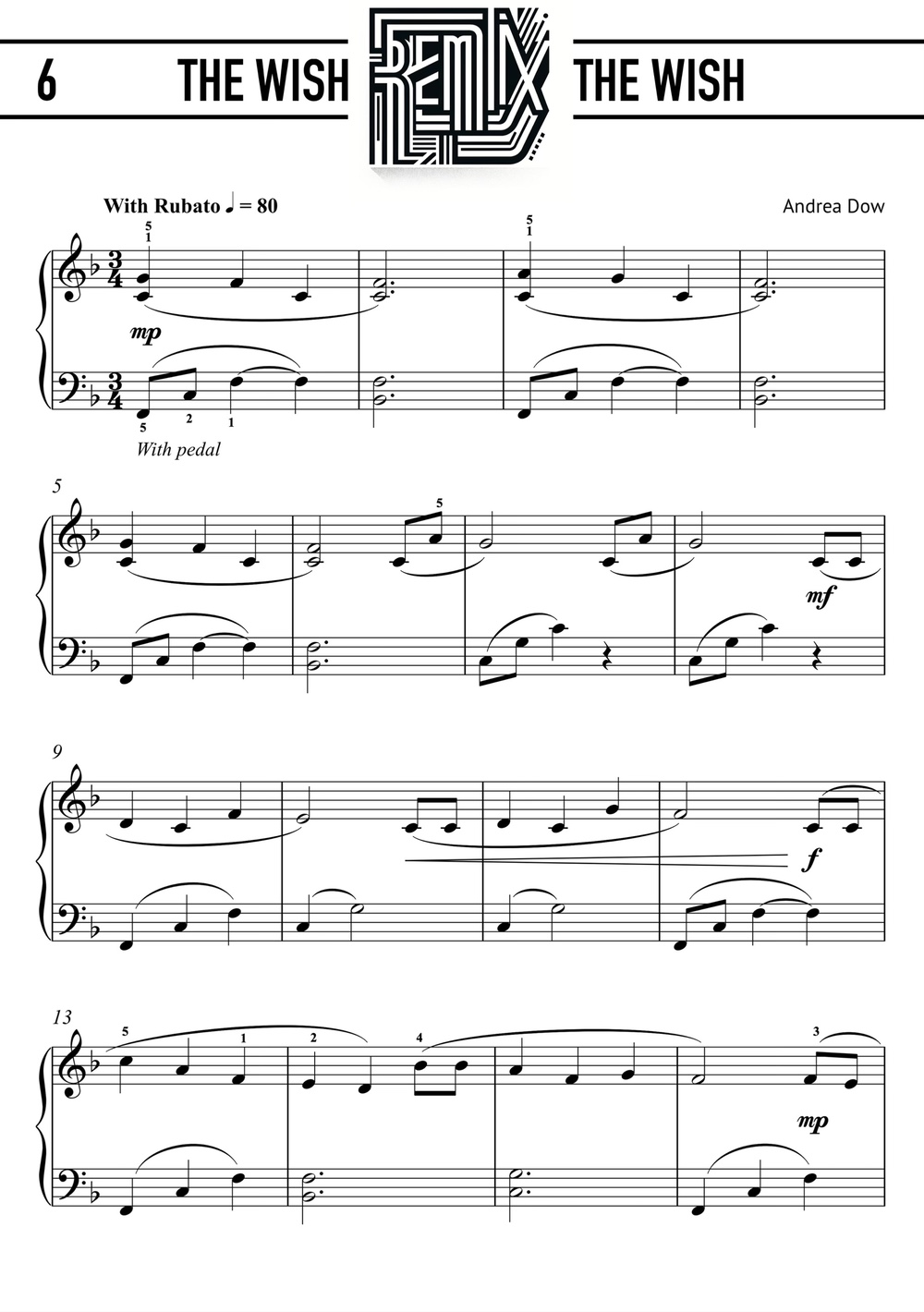
Students in Wunderkeys may play this version from Remix: Teen Hits from Kids Tunes

One of my all-time versions of Happy Birthday, in duet form – and I have the music if you want to tackle it.

April 6: Today’s Music History

.


. 1660 ~ Johann Kuhnau, German composer and writer

. 1895 ~ Waltzing Matilda, one of Australia’s best-known tunes written by bush poet Banjo Paterson, was first publicly performed at a hotel in the remote northern town of Winton.

. 1913 ~ ‘Pappy’ Wade Ray, Country entertainer/musician with the Grand Ole Opry

. 1917 ~ George M. Cohan wrote Over There, which became the chief marching song for World War I

. 1924 ~ Mimi (Miriam) Benzell, Opera singer, mezzo-soprano

. 1924 ~ Dorothy Donegan, Jazz pianist

. 1925 ~ Eddie Cantor recorded the standard, If You Knew Susie, for Columbia Records. There was none classier.

. 1927 ~ Gerry Mulligan, Jazz musician, composer

. 1929 ~ Edison Denisov, Soviet composer

. 1929 ~ André Previn, German-born American pianist, composer and conductor, Known as a classical orchestral conductor, notably of Shostakovich, he also conducted and scored film music and arrangements, Oscar-winning film scores: Gigi, Porgy and Bess, Irma La Douce, My Fair Lady, Washington Honored Eastwood, Baryshnikov, Domingo, Berry, 2000
More information about Previn

. 1931 ~ Little Orphan Annie, the comic strip character developed by Harold Gray, came to life on the NBC Blue network. About 5 decades later, the comic strip inspired a Broadway play and a movie, both titled, Annie.

. 1937 ~ Merle Haggard, American country music singer, songwriter, fiddler and guitarist, CMA Entertainer and Male Vocalist of the Year (1970)

. 1944 ~ Michelle Phillips (Holly Michelle Gilliam), Singer with The Mamas and the Papas

. 1956 ~ Capitol Tower, the home of Capitol Records in Hollywood, CA, was dedicated. The building was the first circular office tower designed in America. It is 13 stories tall and 92 feet in diameter. At night, a light at the tip of the tower blinks the letters “H-O-L-L-Y-W-O-O-D” in Morse Code.

. 1971 ~ Igor Stravinsky, Russian-born composer, died in New York. One of the 20th Century’s leading musical figures and most famous for his ballets “The Rite of Spring” and “Petrushka.”

. 1971 ~ Rolling Stone Records was formed to promote the hits of The Rolling Stones. The famous Stones trademark, the lips logo, became widely used. Brown Sugar was the first hit by the Rolling Stones on the new label, followed by Wild Horses, Tumbling Dice and Start Me Up.

. 1973 ~ The Stylistics received a gold record for their ballad hit, Break Up to Make Up. The Philadelphia soul group placed 10 hits on the pop charts in the 1970s. More of their gold record winners include: You Are Everything, Betcha By Golly Wow, I’m Stone in Love With You and You Make Me Feel Brand New.

. 1974 ~ The first concert film featuring a soundtrack in quadraphonic sound opened at the Ziegfeld Theatre.

. 1974 ~ ABBA for Sweden won the 19th Eurovision Song Contest singing “Waterloo”

. 1985 ~ The country group, Alabama, went five-for-five as the album 40 Hour Week grabbed the top spot on the Billboard country chart. The group had a number one album for each of the previous five years. The popularity of the quartet (three are cousins from Fort Payne, AL) continues today.

. 1994 ~ Dick Cary passed away.  He was an American jazz pianist, trumpet and alto horn player, and prolific arranger and composer.

. 1998 ~ Tammy Wynette, known as “The First Lady of Country Music” and world-renowned for her hit Stand by Your Man, died aged 55.

. 2001 ~ Daniel J. “Danny” Gaither, the original tenor voice of the former Bill Gaither Trio, died after a five-year battle with lymphoma. He was 62. He joined the Bill Gaither trio when he turned 18. His brother, Bill, led the group, and his younger sister, Mary Ann, was the group’s original female singer. Danny Gaither traveled with the family trio for about 10 years until the early 1980s, when he started doing solo work. Problems with his vocal chords forced him to give up his solo career about 10 years later. Danny Gaither won several Grammy and Dove awards for his work. He was inducted into the Gospel Music Hall of Fame in April 1999.

. 2016 ~ Merle Ronald Haggard died.  He was an American country music singer, songwriter, guitarist, fiddler, and instrumentalist

Composers – B

Babbitt

Milton Babbitt was both a musical genius and a math whiz kid. He could identify classical music recordings and add up grocery bills when he was only 2 years old. When he was 5, he made his violin debut and composed his first concerto. Babbitt is now an electrical music pioneer and the founder of the Electronic Music Center.

Bach, Carl Phillip Emanuel

Carl Phillip Emanuel Bach was the second surviving son of Johann Sebastian Bach’s. He was born in Weimar, Germany. He lived from 1714 until 1788 and was the leading composer of the pre-Classical period.

He studied at the Thomasschule, Leipzig, where his father was cantor, and at Frankfurt University. In 1740 he became cembalist to the future Frederick II, and later became Kapellmeister at Hamburg in 1767. He was famous for his playing of the organ and clavier, for which his best pieces were composed. He published The True Art of Clavier Playing in 1753, the first methodical treatment of the subject, introduced the sonata form, and wrote numerous concertos, keyboard sonatas, church music, and chamber music. C.P.E. Bach wrote an influential “Essay on Keyboard Instruments”.

He is sometimes known as the “Berlin Bach” or the “Hamburg Bach”.

Bach, Johann Christian

Johann Christian Bach, the youngest son (the 11th!) of Johann Sebastian and Anna Magdalena Bach, lived from 1735 until 1782. He was born in Leipzig, Germany. He was taught music by his father and by one of his brothers Carl Phillip Emanuel.

After becoming a Catholic, he was appointed organist at Milan in 1760, and for a time composed only ecclesiastical music, including two Masses, a requiem, and a “Te Deum’, but later he began to compose opera.

In 1762 he went to London to spend the rest of his life and so became known as the “English Bach” or the “London Bach”. He was appointed composer to the London Italian opera in 1762, and became musician to Queen Charlotte. His influence can be seen in the early orchestral works of Mozart.

Bach, Johann Christoph Friedrich

Johann Christoph Friedrich Bach lived from 1732 until 1795. He was the ninth son of J S Bach, also a composer and was born in Leipzig, Germany. He studied there at the Thomasschule and at Leipzig University, and became in 1750 Kapellmeister at Bückeburg. He was an industrious but undistinguished church composer. Johann Christoph Friedrich Bach is known as the “Bückeburg Bach”

Bach, Johann Sebastian

Since 1580 there have been close to 100 musical Bachs in seven generations of distinguished musicians and composers.

Johann Sebastian Bach, the most famous of these, lived between 1685 and 1750. He is considered to be a baroque composer.

Bach was born in Eisenach, Germany in 1685. He was orphaned by the age of 10, and brought up by his elder brother, Johann Christoph Bach (1671 to 1721), organist at Ohrdruf, who taught him the organ and clavier.

Bach sought and got important posts through the years. He attended school in L?neburg, before becoming organist at Arnstadt. He found his duties as choirmaster irksome, and angered the authorities by his innovative chorale accompaniments. In 1707 he married a cousin, Maria Barbara Bach (1684 to 1720), and left to become organist at M?hlhausen.

By 1708 he has secured himself a position as court organist and chamber musician to the reigning Duke at Weimar, with plenty of opportunity to compose music for the organ and in 1711 became Kapellmeister to Prince Leopold of Anhalt-Köthen, where he wrote mainly instrumental music, including the “Brandenburg’ Concertos (1721) and The Well-tempered Clavier (1722).

In 1721, about a year and a half after the death of his beloved wife, Bach married again. His new bride, the 20-year old Anna Magdalena Wilcken (1701 to 1760), sang but could not play keyboard instruments, so Bach wrote The Anna Magdalena Notebook with pieces whe could learn. These pieces were charming minuets, marches and polonaises. They had 13 children, of whom six survived.

In 1723 he was appointed cantor of the Thomasschule in Leipzig, where his works included perhaps about 300 church cantatas, the St Matthew Passion (1727), and the Mass in B Minor. He later became “Kapellmeister” for the court of Prince Leopold. At age 38 he became “Cantor” of the St. Thomas School in Leipzig and stayed there until his death, almost totally blind, in 1750.

One of his main achievements was his remarkable development of polyphony. Known to his contemporaries mainly as an organist, his genius as a composer was not fully recognized until the following century. Today he is considered one of the greatest Baroque masters along with Handel, but the people of Bach’s time considered his compositions too elaborate. It was not until 100 years later that the world recognized Bach as one of its greatest composers. The very thought of a majestic old church and the music of Johann Sebastian Bach leaps gloriously to mind. Bach was one of the finest organists and ablest contrapuntists of his time and the noblest writer of fugues who ever lived. Little of his music was published during his lifetime and it was not until 1829 when Mendelssohn performed the St. Matthew Passion that the general public realized his genius and the music of Bach was “reborn”.

His home was filled with music and children: he had 20 children and five early pianos called claviers and many stringed instruments. Bach gave lessons to everyone in the family and wrote many keyboard pieces for family members. All four of Bach’s sons became successful musicians.

The period in which he lived came to be known as the baroque period not just in music, but in art and architecture, as well.

Bach’s Toccata and Fugue in d minor was featured in the Walt Disney movie Fantasia and the new Fantasia 2000.

Bach’s most famous works are the Brandenburg Concerti,the Well-Tempered Clavier (a collection of 48 preludes and fugues. A fugue is a composition in which different instruments repeat the same melodies with slight variations), The Art of Fugue, Mass in b minor, St. John Passion,and the St. Matthew Passion.

J.S. Bach also composed organ music; chamber music; orchestral concertos; and nearly 300 religious choral works called cantatas.

His timeless religious orchestral compositions are of unique purity.

Perhaps the finest exemplar of the baroque era, Bach composed major, complex works in every genre of music except opera. Both his sacred and secular compositions are among the finest ever penned and brilliantly synthesize the various national styles practiced by Bach’s contemporaries. Here are his essential recordings: Goldberg Variations; The 6 Cello Suites; Mass in B minor; The Art of Fugue, Musical Offering; Brandenburg Concertos 1-6, all of which were chosen as Best 100 Classical Pieces of the Millenium.

Barber

Samuel Barber lived from 1910 until 1981. He is most famous for his Adagio for Strings, used in the movie “Platoon”

Bartók

Béla Bartók lived from 1881 until 1945 and was one of the leading Hungarian and European composers of his time. He was also proficient as a pianist.

He collected folk-music in Hungary as did his friend, Zoltán Kodály. His compositions include Mikrokosmos, Concerto for Orchestra, Music for Strings, Percussion and Celeste, Solo Sonata for Violin, and Concerto No. 2 for Violin and Orchestra.

Basie

Count (William) Basie lived from 1904 until 1984. He was a jazz musician who was born in Red Bank, New Jersey, USA. He received his first piano lessons at age six from his mother and worked as an accompanist to silent films while still in high school. He studied organ informally with Fats Waller, whom he replaced in a New York vaudeville act called Katie Crippin and Her Kids. Between 1924 and 1927, he toured on the Keith Circuit with the Gonzelle White vaudeville show until it got stranded in Kansas City, then a bustling center of jazz and blues activity. He played piano at a silent movie theater there, then spent a year (1928 to 1929) with Walter Page’s Blue Devils. When this band broke up, he began a five~year association with Benny Moten’s orchestra, whose sidemen included blues singer Jimmy Rushing, trumpeter Hot Lips Page, and Lester Young, the highly innovative tenor saxophonist. Upon Moten’s death in 1935, these musicians formed the nucleus of Basie’s first band. Under his leadership they broadcast from the Reno Club in Kansas City, where a radio announcer dubbed him “Count”. Through these broadcasts, he attracted the attention of the well~connected talent scout John Hammond, who set up his first tour. The band played a residency at the Grand Terrace in Chicago, then opened at the Roseland in New York in December 1936. Basie began a prolific series of recordings the following year, and in 1938 he played a long residency at the Savoy Ballroom in Harlem, where his reputation as leader of one of the premier swing bands was firmly established. He led his band on a continual series of US tours throughout the 1940s, but in 1950 economic conditions compelled him to disband and front a sextet for two years. He formed a new 16~piece band in 1952 and began a long association with producer Norman Granz of Verve Records; this outfit established a new and enduring prototype for big bands and radio and television studio orchestras.

In 1954, the band undertook the first of its many European tours. During the 1960s, the Basie orchestra accompanied various singers, including Frank Sinatra, Sarah Vaughan, Tony Bennett, and Sammy Davis Jr, on recordings and concert tours. He made numerous appearances with all~star groups in the 1970s, but maintained a regular touring schedule with his band until his death. His autobiography, Good Morning Blues, written with Albert Murray, was published posthumously in 1985.

Bax

Arnold Bax, who lived from 1883 until 1853, was English by birth. He occupied an important place in English music in his own time and was knighted in 1937. At its best his music has a compelling charm and power.

Bax wrote scores for the films Oliver Twist, the war-time Malta GC and Journey into History. Orchestral Music In addition to his seven symphonies Bax wrote a series of evocative tone poems of Celtic implication, including The Garden of Fand, November Woods and Tintagel. There are concertos for cello, for viola and for violin and Symphonic Variations for piano and orchestra in addition to a Concertante for piano left hand and orchestra, written for Harriet Cohen, with whom he had a long relationship.

Bax wrote string quartets and quintets, an interesting Viola Sonata, three Violin Sonatas and works for larger instrumental groups, including a Nonet for wind and string instruments and an Octet for horn, piano and string sextet.

Bax’s choral works include settings of traditional carols, while his solo songs allow him to explore more Celtic ground in a variety of settings, ranging from A Celtic Song Cycle to settings of poems by James Joyce, J.M. Synge, and by the English writers A.E. Housman and his brother, the writer Clifford Bax.

Bax wrote seven piano sonatas, some unpublished, and a number of pieces for piano solo or duo, many with evocative titles.

Beach

Amy Marcy Cheney Beach (Mrs. H.H.A. Beach) was born on September 5, 1867 in Henniker, NH and died on December 27, 1944 in New York, NY. She was an American composer and pianist and the first significant female composer in America and one of the leading composers of the “New England School”.

By all measures, young Amy Marcy Cheney was a true prodigy. At one year she knew forty songs, always singing them at the same pitch. By age two she could improvise a countermelody to any melody her mother sang, and at age four, she could not only read four-part hymns at sight, but wrote her first pieces in her head and then sat down and played them on the piano. She began piano study at age six with her mother, and then studied with the finest pianists in Boston. She made her debut at sixteen, and in 1885 played with the Boston Symphony Orchestra.

From this point on, her career was influenced greatly by society’s views of women. It was suggested that her desire to study composition would best be served by independent study, in part in the belief that women composed based on feeling rather than intellect. When she married the physician and amateur musician Henry Harris Aubrey Beach in 1885, he asked that she limit her concertizing to a few performances a year. Because of this, she focused on composition. After his death in 1910, she resumed her concert career in Europe and in this country.

These all had an effect on her musical development, and the results can be seen as both positive and negative. Her natural abilities made self-study a viable avenue (she learned orchestration, for example, by translating the famous treatise by Hector Berlioz). At the same time, this probably accounts for the fact that much of her music borrows stylistic elements from contemporary composers. Her husband’s desire that she not make a career as a performer may have curtailed that aspect of her professional life, but it allowed her the rare luxury (rare for both men and women) of full-time compositional activity.

The body of work that Beach produced stands out for its size as well as its quality. She also stands out as the first woman to master larger forms. Her Symphony in E (the “Gaelic”) demonstrates this, and is one of the first works by an American to answer Antonin Dvor?k’s challenge to use national themes in their compositions. Beach believed that since a large percentage of Boston’s citizens were of Irish extraction, this would be the most representative source to draw upon. Many of her works have remained popular in this century, and her music is receiving a fairer re-evaluation as a result of the general interest in the music of women and the special circumstances of its creation.

Works:
Orchestral music, including Gaelic Symphony (1896) and Piano Concerto (1899)
1 opera, Cabildo (1932)

Chamber music, including a violin sonata (1896), piano quintet (1907), string quartet (1929), and piano trio (1938)

Choral music, including the Mass in E-flat (1890), Festival Jubilate (1891),
and many sacred works (anthems and hymns); secular choral works, including “The Song of Welcome” (1898) and “The Chambered Nautilus” (1907)

More than 120 songs for voice and piano, including Five Songs to Words by Robert Burns (1899) and Three Browning Songs (1900); concert aria “Eilende Wolken” (“Racing Clouds”) for voice and orchestra (1892)

Keyboard music, including character pieces (The Hermit Thrush at Morn and The Hermit Thrush at Eve, 1921); Suite for Two Pianos on Old Irish Melodies (1924); sets of variations

Numerous articles on composition and pedagogical topics

Beethoven

Ludwig van Beethoven lived between 1770 and 1824. He bridged the gap between the Classical period and the Romantic period Beethoven was born in Bonn, Germany, but lived most of his life in Vienna, Austria.

He studied in Vienna under Mozart and Haydn.

Beethoven was born and brought up in Bonn and first studied harpsichord and violin under the direction of his father, who had dreams of fame and fortune for his young prodigy. Alas, Beethoven was a talent “in waiting” – waiting for the right teacher and the right opportunity. This happened in 1783 with the appointment of Christian Gottlob Neefe to the music staff of the ruling prince, where both Beethoven’s father and grandfather were employed.

In nine years, Beethoven was ready to pursue his studies in Vienna, with Joseph Haydn. He never returned to Bonn. Beethoven had many influential patrons in Vienna and it was clear he was on the verge of becoming a major force in music. In Vienna he first made his reputation as a pianist and teacher, and he became famous quickly.

Four years later, about 1800, after arriving in Vienna, Beethoven started to become deaf. By 1820, when he was almost totally deaf, Beethoven composed his greatest works. These include the last five piano sonatas, the Missa solemnis, and the last five string quartets. He experienced the greatest of despair but accepted his fate with a sense of profound greatness: he would show the world! From this point on, he focused all his energy on his compositions. The first work was his Third Symphony, known as the “Eroica,” a work of infinite levels of expression. Some of Beethoven’s most popular works include the Violin Concerto in D Major, Mass in D Major (“Missa Solemnis”), The Nine Symphonies, including the “Eroica”, “Pastorale” and “Choral”), Egmont Overture, Fidelio, Piano Sonata in C-Sharp Minor (“Moonlight”), Sonata in F Minor “Appassionata”), Piano Concerto No. 5 in E Flat (“Emperor”). Major chamber works include 16 string quartets, 16 piano trios, 10 violin sonatas, and 35 piano sonatas. And what beginning piano student will ever forget “Fër Elise” or many sets of variations, including a set on a theme by Paisiello?

Beethoven waged a constant war with the world he lived in – with his landlords, his debtors, his students, his friends and, of course, his deafness. By the time he wrote his celebrated Fifth Symphony in 1805, he could hear virtually nothing. This symphony has become a musical symbol of victory all over the world.

Beethoven’s Pastoral Symphony was featured in the Walt Disney movie Fantasia and his Symphony number 5 in the newly released Fantasia 2000.

Beethoven surpassed himself with his Ninth Symphony, finally finished in 1823. He based his main theme of the choral movement on Friedrich von Schiller’s “Ode to Joy”. This theme also became an hymn with the words “Joyful, Joyful, We Adore Thee. When this symphony was performed in 1824, Beethoven was already deaf and was unaware of the audience applause until he turned around from the conductor’s podium to see the audience.

Beethoven composed 32 piano sonatas, 16 string quartets, 10 overtures, 10 sonatas for violin and piano, 9 symphonies, 5 piano concerti, 5 sonatas for cello and piano, 2 masses, 1 violin concerto, 1 opera and several miscellaneous works.

Beethoven developed a completely original style of music, reflecting his sufferings and joys. His work forms a peak in the development of tonal music and is one of the crucial evolutionary developments in the history of music. Before his time, composers wrote works for religious services, and to entertain people. But people listened to Beethoven’s music for its own sake. As a result, he made music more independent of social, or relgious purposes.

The story is often repeated that when Beethoven died, his last defiant act was to shake his fist at a raging thunderstorm outside. Many have seen this as symbolic of his triumph over deafness, which was a major turning point in his life.

Beiderbecke

“Bix” Beiderbecke. From the Smithsonian magazine article: Bix: The story of a young man and his horn:

Bix Beiderbecke taught himself to play the cornet when he was in his teens and died in 1931 at the age of 28. During his brief career, says author Fred Turner, he became one of the true sensations of the Jazz Age, unforgettable to anyone who ever heard him. So unforgettable, in fact, that the Bix Beiderbecke Memorial Jazz Festival held each July draws some 15,000 jazz aficionados to Davenport, Iowa, where the jazz legend was born. And the well-known composer Lalo Schifrin recently premiered a symphonic jazz work, “Rhapsody for Bix,” based on songs written or popularized by the cornetist. Bix was also the inspiration for a popular novel of the late ’30s, Young Man With a Horn, and the 1950 movie by the same title starring Kirk Douglas. He has been the subject of a steady stream of critical assessments, a full-scale biography, a 1990 feature film and a 1994 film documentary.

But what made this young musician so memorable? The qualities that strike the modern listener, says Turner, are the ones that awed his contemporaries: the round, shimmering tone; the deliberateness of the attack that still manages to flow. “The best of his solos,” said critic Chip Deffaa, “seem absolutely perfect: one cannot conceive of them being improved upon.” Guitarist Eddie Condon said Bix’s horn sounded like a girl saying yes.

Another part of Bix’s appeal, says Turner, derives from the way he lived. Here was a handsome young man who never grew old, whose frenetic pace matched that of the new music he helped create. When fans took him partying, they found he liked the things they liked, especially Prohibition alcohol, which he could consume in enormous quantities. With the aid of booze, said Eddie Condon, “he drove away all other things like food, sleep, women, ambition, vanity, desire. He played the piano and the cornet, that was all.”

But in the end, says Turner, despite his brief fame, despite the ghastly death, there remains the beautiful sound he made and left behind.

Berg

Alban Berg Lived from 1885 until 1935. He was the Viennese pupil of Arnold Schoenberg who brought to maturity the atonal style of twentieth-century music.

Berio

Luciano Berio was born in Oneglia, Italy in 1925. He is a composer and teacher of music who studied at the Music Academy in Milan, and founded an electronic studio. He moved to the USA in 1962, taught composition at the Juilliard School, New York City, and returned to Italy in 1972. In 1950 he married the US soprano Cathy Berberian (1925 to 1983), for whom he wrote several works. He is particularly interested in the combining of live and pre-recorded sound, and the use of tapes and electronic music, as in his compositions Mutazioni (Mutations) in 1955, and Omaggio a James Joyce (Homage to James Joyce) in 1958. His Sequenza series for solo instruments (1958 onwards) are striking virtuoso pieces. Other works include Passaggio (1963), Laborintus II (1965), and Opera (1969 to 1970).

Berlin

Irving Berlin lived from 1888 until 1989. He was born Israel Baline in Tyumen, Russia. Little Israel came to the United States with his family at the age of four. His father passed away several years later, so Israel took to the streets of New York, singing on street corners and in saloons, and as a singing waiter, all to earn money to help support his family. It was the beginning of a wonderful career in song, stage and movies. A printer’s error on the music sheet for his composition, Marie from Sunny Italy, accidentally changed his name. The change became permanent.

Mr. American Music, better known to us as Irving Berlin, wrote more songs than we care to count including Alexander’s Ragtime Band, Always, Doin’ What Comes Naturally, Puttin’ on the Ritz, Blue Skies, Oh! How I Hate to Get Up in the Morning and Play a Simple Melody. This man, who could neither read nor write music, also composed a song titled, Smile and Show Your Dimple. You probably never heard of that one; but seventeen years later, when produced, it became a hit as Easter Parade.

Kate Smith was the voice he chose to sing God Bless America, which he wrote in 1917. It became her signature and a major contender to replace The Star-Spangled Banner as the U.S. national anthem.

Berlin wrote the scores for many Broadway shows (Annie Get Your Gun) and films (Top Hat). Winning an Oscar for his composition, White Christmas, Irving Berlin had the unique experience of opening the envelope that contained his name. He was the presenter at this segment of the Academy Awards for 1942 and upon opening the envelope, said, “This goes to a nice guy; I’ve known him all my life. The winner is … me.”

Berlioz

Hector Berlioz (1803 until 1869), along with Felix Mendelssohn was one of the first conductors of a large orchestra. Berlioz was generally regarded as the most important French Romantic composer. He was also known as a critic and conductor. People either really loved him, or really hated him. His music could be so powerful and original, or trite and vulgar. His music is emotional and full of the drama of the Romantic life, but it also contained the Classicism of Gluck.

Louis Hector Berlioz’s father, a property owner and a doctor, wanted him to study medicine, but it was clear that the boy was destined for music. He had an aptitude for music, composing little bits as a child. But, with his father set against a career as a musician, young Hector had to piece together a musical education. He never even learned how to play the piano, the building block for almost every composer. But Berlioz gave a positive spin to his deficiency, saying that it allowed him to create music anywhere, piano or not. This freedom gave Berlioz a voice unlike any other.

But Hector’s father still insisted that the boy study medicine, so at 16, Berlioz began his medical studies. In 1821, he went to the Medical School in Paris, but the city of Paris was the wrong place for a frustrated musician stuck in medical school. Berlioz attended the opera and heard Gluck’s work, Iphigenie en Tauride. He fell in love with the music, and soon became obsessed with it. He went to the library at the Paris Conservatoire, studying all of Gluck’s opera scores. A year later, he was writing his first opera, and in 1823, he wrote an oratorio. He still managed to receive his Bachelor of Science in 1824, but this would be as far as he would go in his medical career.

He enrolled in the Paris Conservatoire, and lived the life of the starving artist. To earn extra money, he worked at the theatre, where he met Harriet Smithson. She was an Irish lass, an actress, and the 26-year-old Berlioz fell in love with her, but she rejected him. For the next three months, he poured all of his heartbreak into his Symphonie Fantastique, subtitled An Episode in the Life of an Artist. The symphony became his first success. Eventually, though, true love would conquer all and Berlioz and his beloved Harriet would marry, and then separate.

But, Berlioz wasn’t satisfied with success as a composer of orchestral works. He wanted to conquer the stage. Paris at the time of Berlioz was a difficult place for anyone who did not compose operas. Regular concert orchestras were such a rarity that an audience didn’t exist, and composers wanting to give concerts usually ended up losing money. The old patronage system that supported the likes of Mozart and Haydn was drying up, and making a living as a composer was almost impossible, unless you composed operas. But another reason for Berlioz’s enthusiasm for the stage was his own dramatic personality. One listen to his Requiem, and you get the feeling that his aim was more theatrical than religious. His Symphonie Fantastique also contains operatic elements. After writing his first opera in 1823, Berlioz tried again in 1826, and again in 1838 with Benvenuto Cellini. It failed after only 4 performances. His next opera, The Damnation of Faust (1846), premiered in Paris, did not do any better. According to Berlioz, it had only two performances, and both were before a half-empty house.

Frustrated, Berlioz left Paris and went travelling to Russia, Berlin, and London. The British and the Germans loved his music, and Berlioz regularly visited them for the next 15 years. His once beloved Paris was changing, embracing the new music of Liszt and Wagner. Liszt tried to help Berlioz’s cause, reviving Berlioz’s opera Benvenuto Cellini in 1852 and later that year having a Berlioz Week featuring performances of Berlioz works. Berlioz reciprocated by dedicating the published version of his Damnation of Faust to Liszt in 1854.

Bernstein

January 11, 1981 Leonard Bernstein began conducting the BR – Bayerischer Rundfunk Symphony Orchestra in Richard Wagner’s “Tristan und Isolde” in Munich’s Hercules Hall. Performed one act at a time, in January, April, and November of 1981, respectively, Bernstein’s “Tristan und Isolde” was telecast live and later released as an audio recording by Philips–to some controversy.

Karl Böhm remarked, with regards to Bernstein’s exaggeratedly slow tempi, “For the first time, someone dares to perform this music as Wagner wrote it.” Böhm’s own recording of the Prelude was four minutes faster.

Upon completion of the project, Bernstein declared, “My life is complete… I don’t care what happens after this. It is the finest thing I’ve ever done.”

Bizet

Georges Bizet, 1838 to 1875, was a French composer who wrote piano music, orchestral works and eight operas. Best known for his opera Carmen. He was asked to compose music for Daudet’s play L’Arlésienne when he was only 33. This play needed 27 musical pieces, which Bizet amazingly produced, even though he had little time and his health was poor. He died 3 years later.

Black

Arnold Black was a composer and violinist who started a beloved classical music program in the rural Berkshires. He died in 2000 at the age of 77, two days after the Mohawk Trails Concert series opened its 31st year.

Black moved to the Berkshires in 1970 to escape his hectic life in New York. Born in Philadelphia, he attended the Juilliard School of Music and wrote music for theater, film, television and concert halls.

Black engaged world-renowned artists for the concert series, which could satisfy the most discriminating classical music fan.

Black was composer-in-residence at The Circle in the Square in New York City in the 1950s. He wrote the score for the production of James Joyce’s “Ulysses in Nighttown,” starring Zero Mostel.

He also wrote music for the National Shakespeare Company and for films including “River Song,” “Black Harvest,” “Memorial Day,” “Empire of Reason,” and “Peace for Our Time,” which he co-composed with Eric Clapton.

In 1995, his opera “The Phantom Tollbooth,” based on the children’s classic, premiered with Opera Delaware.

Blake

Herbert “Eubie” Blake, 1883 to 1983, was an American jazz pianist, vaudevillian, songwriter and composer of 1,000 songs. Some of them are: Charleston, Chocolate Dandies, Blackbirds of 1930, Memories of You, Shuffle Along of 1932, Atrocities of 1932, Swing It, Tan Manhattan, Brownskin Models and Hit the Stride. He teamed up with Noble Sissle to write: It’s All Your Fault, Shufflin’ Along, Love Will Find a Way, I’m Just Wild About Harry.

Boccherini

Bocelli

Andrea Bocelli was born in 1958 in rural Tuscany. Music has been a lifelong passion and it was noted at an early age how enthralled Andrea was by opera. Through a growing collection of 78s, Bocelli spent his childhood attempting to emulate his heroes, great Italian tenors including Gigli and particularly Franco Corelli. As a child Andrea learned whole operas, dreaming of performing the great heroic and tragic roles on famous opera stages.

Bocelli’s musical talents were nurtured, with classical tuition for instruments including flute and piano. However, despite a clearly beautiful natural vocal talent, formal study of the voice was not to come until later in life. While harbouring deep operatic ambitions, Bocelli’s family were sceptical that music was a realistic or secure career for any young man. Respecting his parent’s wishes, Bocelli studied law at the University of Pisa. After graduation Andrea practiced law in Pisa, but having achieved future security, turned his attention to formal training for his mature voice and the ambitions of his youth.

Andrea first studied under the maestro Luciano Bettarini of Prato, known for working with some of Italy’s finest voices. Bocelli discovered that Franco Corelli was to give master classes. Performing for his childhood idol was a daunting prospect and acceptance as a pupil of Corelli vindicated Bocelli, strengthening the confidence to pursue his goals. Bocelli put his legal career on hold to devote his life to music.

“I don’t think that one really decides to be a singer. It’s decided for you, by the reaction of those around you. Perhaps one shouldn’t sway ‘listen to me, I want to sing for you’, but if people say ‘please sing for us’, well….”

Andrea Bocelli is a true phenomenon. The manner in which the voice of one man captured the hearts of music lovers across five continents, is truly unprecedented. In just five years since the Italian public were introduced to the voice of Andrea Bocelli, through his remarkable triumph at the Sanremo Festival, this amazing talent has become the biggest selling classical performer to emerge in several decades. His two classical discs, “Viaggio Italiano” and “Aria”, have achieved international success. Just one illustration of the huge scale of Bocelli’s international popularity occurred in the US in 1999, when four of his albums featured simultaneously on the official Billboard album chart. Such a feat had been achieved only twice in recent memory, in the early 1990s by Garth Brooks and before this in the mid 1980s by U2.

Following the success of his first three albums in Italy, the contemporary album “Romanza” became Andrea Bocelli’s international debut release. In just twelve months, “Romanza” transformed Bocelli into one of the globe’s most popular recording artists. Conquering Europe, “Romanza” was released throughout 1997 in North and South America, Asia, Africa and Australia & New Zealand. “Romanza” has sold over 15 million copies to date, introducing millions of the world’s music lovers to the passionate voice of Andrea Bocelli. Andrea Bocelli has since acquainted them with his passion for opera.

Boëllmann

Léon Boëllmann lived from 1862 until 1897. His name is known to all organists because of his brilliant Toccata for the instrument, the final movement of a Suite gothique. Born in Alsace in 1862, he served as organist at the church of St. Vincent-de-Paul in Paris from 1881 until his early death in 1897.

In addition to the Toccata from the Suite gothique, Op. 25, the Douze pièces (Twelve Pieces), Op. 16, and Heures mystiques, Opp. 29 & 30, are well enough known.

Borge

Victor Borge was born in 1909 in Copenhagen, Denmark. He was an entertainer and pianist – a deliciously funny performer. He studied at the Royal Danish Academy of Music, Copenhagen, and in Vienna and Berlin. He made his debut as a pianist in 1926, and as a revue actor in 1933. From 1940 until his death in 2000 he worked in the USA for radio, television, and theatre, and has performed with leading symphony orchestras on worldwide tours since 1956. He was best known for his comedy sketches combining music and narrative. He used his classical training to skew serious music and performers.

From his obituary:
Pianist Victor Borge, died in his sleep Dec 23, 2000 at his Greenwich, Connecticut home, was known as the unmelancholy Dane of international show business. He would have turned 92 on Jan. 3, 2001.

“The cause of death was heart failure,” his daughter, Sanna Feirstein, told Reuters.

“He had just returned from a wonderfully successful trip to Copenhagen … and it was really heartwarming to see the love he experienced in his home country,” she said.

Borge was one of five performers selected for the Kennedy Center Honors in 1999.

“He went to sleep, and they went to wake him up this morning, and he was gone,” said his agent, Bernard Gurtman.

“He had so much on the table, and to the day he died he was creative, and practicing piano several hours a day,” Gurtman told Reuters. “He was just a great inspiration.”

Funeral services will be private, his daughter said.

Borge made a career of falling off piano stools, missing the keys with his hands and getting tangled up in the sheet music.

One of his inspirations was a pianist who played the first notes of the Grieg A Minor Concerto and then fell on the keys dead.

He said that the only time he got nervous on stage was when he had to play seriously and adds that if it had not been for Adolf Hitler he probably would never have pursued a career as a concert-hall comedian.

Until he was forced to flee Denmark in 1940 he was a stage and screen idol in his native country.

Lampooned Hitler

But as a Jew who had lampooned Hitler, Borge — his real name was Boerge Rosenbaum — was in danger and fled first to Sweden and then to the United States, where he arrived penniless and unknown and by a fluke got booked on the Bing Crosby radio show. He was an instant success.

He became an American citizen in 1948, but thought of himself as Danish. It was obvious from the numerous affectionate tributes and standing ovations at his 80th birthday concert in Copenhagen in 1989 that Danes felt the same way.

In the concert at Copenhagen’s Tivoli gardens, Borge played variations on the theme of “Happy Birthday to You” in the styles of Mozart, Brahms, Wagner and Beethoven — all executed with such wit that the orchestra was convulsed with laughter that a woman performing a piccolo solo was unable to draw breath to play.

“Playing music and making jokes are as natural to me as breathing,” Borge told Reuters in an interview after that concert.

“That’s why I’ve never thought of retiring because I do it all the time whether on the stage or off. I found that in a precarious situation, a smile is the shortest distance between people. When one needs to reach out for sympathy or a link with people, what better way is there?

“If I have to play something straight, without deviation in any respect, I still get very nervous. It’s the fact that you want to do your best, but you are not at your best because you are nervous and knowing that makes you even more nervous.”

His varied career included acting, composing for films and plays and writing but he was best known for his comic sketches based on musical quirks and oddities.

Unpredictable Routine

His routines were unpredictable, often improvised on stage as his quick wit responded to an unplanned event — a noise, a latecomer in the audience — or fixed on an unlikely prop — a fly, a shaky piano stool.

Borge was born in Denmark on January 3, 1909, son of a violinist in the Danish Royal Orchestra.

His parents encouraged him to become a concert pianist, arranging his first public recital when he was 10. In 1927 he made his official debut at the Tivoli Gardens.

Borge’s mischievous sense of humor was manifest from an early age. Asked as a child to play for his parent’s friends he would announce “a piece by the 85-year-old Mozart” and improvise something himself.

When his mother was dying in Denmark during the occupation, Borge visited her, disguised as a sailor.

“Churchill and I were the only ones who saw what was happening,” he said in later years. “He saved Europe and I saved myself.”

From 1953 to 1956, he appeared in New York in his own production “Comedy in Music,” a prelude to world tours that often took him to his native Scandinavia.

On radio and television, Borge developed the comedy techniques of the bungling pianist that won him worldwide fame.

Many of his skits were based on real-life events. One of his classics evolved from seeing a pianist playing a Tchaikovsky concerto fall off his seat.

Borge’s dog joined the show after it wandered on stage while he was at the keyboard — an entrance nobody would believe had been unplanned.

One incident could not be repeated. A large fly flew on to Borge’s nose while he was playing. “How did you get that fly to come on at the right time?” people asked. “Well, we train them,” Borge explained.

Borge’s book, “My Favorite Intervals”, published in 1974, detailed little-known facts of the private lives of composers describing Wagner’s pink underwear and the time Borodin left home in full military regalia but forgot his trousers.

In 1975, Borge was honored in recognition of the 35th anniversary of his arrival in the United States and his work as unofficial goodwill ambassador from Denmark to the United States. He celebrated his 75th birthday in 1984 with a series of concerts at Carnegie Hall and in Copenhagen.

Borge received a host of honors from all four Scandinavian countries for his contributions to music, humor and worthy causes.

Borge, who had lived in Greenwich since 1964, is survived by five children, nine grandchildren, and one great grandchild. His wife of many years, Sanna, died.

Borodin

One of the most beautiful string quartets ever written was Borodin’s Second String Quartet in D Major, composted in the 1880’s. Two of the melodies in the 1953 production of Kismet were based on themes from this quartet.

Boulanger, Lili

Lili Boulanger lived from 1893 until 1918. Encouraged by her elder sister Nadia, the French composer Lili Boulanger was the first woman to win the Prix de Rome and was prolific, during her short life, writing music very much in the prevailing style of the period.

Lili Boulanger’s compositions for orchestra include Pie Jesu, Sicilienne and Marche gaie for small orchestra and a fuller Poeme symphonique.

Boulanger, Nadia

Nadia Boulanger (1887 – 1979) is better known as a teacher and conductor than as a composer. In the first capacity she was responsible for the musical training of a generation of distinguished composers from Europe and America. Her work as an interpreter influenced many, not least by the part she played in the revival of interest in Monteverdi.

Nadia Boulanger’s few compositions include Les heures claires, settings of poems by Verhaeren completed in 1912, after which she wrote little, although in 1908 she had won the second Prix de Rome.

Boulez

Pierre Boulez was born in 1925 in Montbrison, France. He is a conductor and composer. He studied at the Paris Conservatoire from 1943 until 195), and became musical director of Barrault’s Théâtre Marigny (1948), where he established his reputation as an interpreter of contemporary music. During the 1970s he devoted himself mainly to his work as conductor of the BBC Symphony Orchestra (1971 to 1975) and of the New York Philharmonic (1971 to 1977), and in 1977 he became director of the Institut de Recherche et de Co-ordination Acoustique Musique at the Pompidou Centre in Paris. His early work as a composer rebelled against what he saw as the conservatism of such composers as Stravinsky and Schoenberg.

Boulez died January 5, 2016.

Brahms

Johannes Brahms lived between 1833 and 1897. He is considered to be the foremost romantic composer of instrumental music in the late 19th century. As well as being a fine composer, he was also a pianist. Brahms’ father discouraged his talent for music but Robert Schumann gave him help in reaching his goal of becoming a musician and the two remained close friends until Schumann’s death.

Brahms wrote four symphonies, two piano concerti, chamber music, piano works, and over 200 songs. Some of his most famous works are Requiem, Symphony #1 in C Minor and his Symphony #4 in E Minor.

Braxton

Anthony Braxton is an American composer and woodwind improviser, one of the most prolific artists in free jazz.

Composers ~ S

Saint-Saëns

Camille Saint-Saëns’ Carnival of the Animals is featured in Disney’s Fantasia and the newly released Fantasia 2000.

Salieri

Antonio Salieri lived from 1750 until 1825. Born in Legnago, he was brought as a boy to Vienna by Florian Gassmann, his predecessor as court Kapellmeister who supervised his musical training and education. He owed much to the influence and patronage of Gluck, to whom he seemed a natural successor in the field of opera. He won similar success to the latter also in Paris with his operas for the French stage. His pupils included Beethoven and Schubert, Czerny, Hummel, Moscheles and one of Mozart’s sons. He was a prolific composer, principally in vocal music of all kinds.

Thanks to Pushkin and Rimsky-Korsakov, as well as Shaffer and the film Amadeus, Salieri has been cast as the villain in the tragedy of Mozart’s early death. Antonio Salieri occupied a position of great importance in the music of Vienna. From 1774 he was court composer and conductor of the Italian opera, serving as court Kapellmeister from 1788 until 1824.

Salieri wrote some 45 operas, ranging from Tarare, with a libretto by Beaumarchais, for Paris and settings of libretti by Lorenzo da Ponte for Vienna to the Shakespearean comedy Falstaff and the operetta Prima la musica poi le parole (First the Music then the Words), staged at the imperial palace of Sch?nbrunn in 1786 on the same evening as Mozart’s German Singspiel Der Schauspieldirektor (The Impresario).

Salieri wrote a quantity of church music, as well as oratorios. He left still more secular vocal music, ranging from cantatas and choruses to duets and solo arias.

Rather less instrumental music by Salieri survives. This includes music for the ballet, sinfonias, concertos and music for various smaller ensembles.

As well as a significant quantity of ballet music, Salieri wrote concertos, including an organ concerto and a piano concerto, a Birthday Symphony and a set of variations on La folia di Spagna, (The Folly of Spain) the dance tune used by Corelli and many other Baroque composers.

Salieri’s chamber music consists principally of serenades, cassations and marches.

Satie

Erik Satie lived from 1866 until 1925 and was a French composer whose spare, unconventional, often witty music represents a first break with 19th century French Romanticism.

Scarlatti, Alessandro

(Pietro) Alessandro (Gaspare) Scarlatti lived from 1660 until 1725 and was the father of Domenico Scarlatti. Allessandro was a leading composer of early Italian opera and one of the most important figures in developing classical harmony.

Scarlatti, Domenico

Domenico Scarlatti (1685-1757) is an important Baroque composer from Italy. He composed more than 500 keyboard sonatas, many of which are in one movement. Occasionally, he wrote them in pairs of similar or contrasting mood. Scarlatti used interesting melodies and combined them with a rhythmic vitality.

Scharwenka

Franz Xaver Scharwenka was born near Posen, Germany. He lived from 1850 until 1924 and was a pianist and composer. In 1881 he started a music school in Berlin, and spent the years from 1891 until 1898 in New York City directing the Scharwenka Music School. He composed symphonies, piano concertos, and Polish dances.

Schickele

Peter Schickele is a composer in his own right, in addition to “discovering” P.D.Q. Bach He recently arranged Elgar’s Pomp and Circumstance for the new Disney movie Fantasia 2000.

Schoenberg

Arnold Schoenberg lived from 1874 until 1951. He was a German composer whose revolutionary method of composition (based on a series of 12 tones called 12-Tone Music) influenced many later composers.

Schubert

Franz Peter Schubert lived between 1797 and 1828. He is considered to be a romantic composer. He was an Austrian composer who was one of the greatest creators of melody and foremost writer of ‘lieder’ (German songs).

Although he only lived for 31 years, Schubert composed more than 600 songs, 22 piano sonatas and many short piano pieces. This melodic output has never been equaled either in quantity of quality. He was one of the first musicians to earn a living from the sale of his music.

Schubert’s Ave Maria was featured in the Walt Disney movie Fantasia.

Schumann, Clara Wieck

Clara Wieck Schumann was a fine pianist and composer. She married Robert Schumann.

Schumann, Robert

Robert Schumann was born in Zwickau, June 8, 1810 and died in Endenich, near Bonn, July 29, 1856. He was a German composer and pianist. With Chopin and Liszt he developed much of the technique of Romantic piano music.

He was a child prodigy, but his parents wanted him to become a lawyer. He did attend law school for a while but soon left to become a musician.

His earliest compositions were piano pieces, but he also wrote a popular piano concerto, several symphonies, and chamber music.

A master of the more intimate forms of musical compositions, Schumann is unique in music history as being one of the great composers who concentrated on one musical genre at a time, with the bulk of his earliest compositions being for the piano. Schumann’s piano music (and later his songs) remain supreme examples of the Romantic style of the second quarter of the nineteenth-century. Immensely influenced by literature and poetry, it is the dreamy nature of his music which most affects the listener, as can be heard in the fifth movement from the piano suite entitled Carnaval. Aside from three piano sonatas, most of his work for the instrument is in the form of suites comprising short, poetic pieces, each expressing a different mood.

Schumann composed his 13-piece collection Scenes from Childhood in 1838, shortly after he became engaged to Clara Wieck, who also was a fine musician and the most celebrated woman pianist of her time. Clara Wieck was the daughter of his first music teacher, who had opposed their union.

In 1840, Schumann was finally able to marry Clara Wieck. Schumann’s happiness found an outlet in the great number of Lieder he wrote during that year. The first number from his song cycle Dichterliebe, Im wundersch?nen Monat mai (A Poet’s Love: “In the beautiful month of May” ) is another example of the composer’s harmonic and melodic style.

In order to publicize his own music and to stimulate and improve the musical tastes of the burgeoning concert-going public, Schumann founded Die Neue Zeitschrift f?r Musik (The New Journal for Music) in 1834, and remained active as its editor for ten years. In the pages of this publication, Schumann considerably raised the standards of music criticism and did much to promote the careers of young composers such as Fr?d?ric Chopin, Hector Berlioz, and especially Johannes Brahms, who was to become a very close friend of Schumann. Throughout his life, Schumann felt himself divided by two contrasting natures: the gentle, poetic, Apollonian side, which he called “Eusebius”; and the more forthright, dramatic and stormy side he named “Florestan”. Because of this rift in his personality, he feared insanity for much of his life, and eventually did spend his last years in an asylum.

Scott, Cyril

Cyril Meir Scott lived from 1879 until 1970. He was a composer, born in Oxton, Cheshire, NWC England, UK. As a child he studied the piano in Frankfurt, later returning there to study composition. His works won a hearing in London at the turn of the century, and in 1913 he was able to introduce his music to Vienna. His opera, The Alchemist, had its first performance in Essen in 1925. He composed three symphonies, piano, violin, and cello concertos, and numerous choral and orchestral works, but is best known for his piano pieces and songs.

Scott, James

James Scott (1886 to 1938) was a Ragtime composer along with Scott Joplin and Joseph Lamb.

Although an extremely important figure in ragtime, Scott was always viewed as second to Scott Joplin in terms of musical expertise and prowess. However, Scott developed a very unique sound within the form of ragtime. He received lessons as a boy from John Coleman, a Missouri pianist, who recognized the boy’s genius. Soon after, he gained the attention of both the respected composer Charles Dumars, and the ragtime master himself, Scott Joplin, and the rest is history.

Seals, Son

Born in Osceola, Ark., Son Seals learned guitar from his father, a former minstrel show performer and juke joint operator. He initially established himself professionally as a drummer, working with guitarist Earl Hooker and appearing behind Albert King on the 1968 Stax album “Live Wire/Blues Power.”

Seals moved to Chicago in 1971 and began fronting his own groups on the city’s South Side.

Seals helped establish Chicago-based Alligator Records as the era’s premier blues label with a run of albums featuring his tough songs, brooding vocals and spikey guitar work. Signed to Alligator, he made an immediate impression with his impassioned 1973 debut “The Son Seals Blues Band.” After the release of its 1977 sequel “Midnight Son,” the New York Times called Seals “the most exciting young blues guitarist and singer in years.”

He won three W.C. Handy Blues Awards, and received a Grammy Award nomination in 1980 for his work on the live compilation “Blues Deluxe.”

Seals had a tempestuous relationship with Alligator and its founder-owner Bruce Iglauer, who also managed him; he departed the label in the mid-’80s, but returned to the fold in the ’90s. His last album “Lettin’ Go” was cut for Telarc in 2000.

He toured widely, despite the loss of a leg to diabetes. Late in his career he opened several shows for the jam band Phish, who covered his song “Funky Bitch.”

Seals had 14 children.

Segovia

Andrés Segovia lived from 1894 until 1987. He was a guitarist who was born in Linares, Spain. Largely self-taught, he gave his first concert in 1909, and quickly gained an international reputation. Influenced by the Spanish nationalist composers, he evolved a revolutionary guitar technique permitting the performance of a wide range of music, and many modern composers wrote works for him. He was created Marquis of Salobrena by royal decree in 1981

Shaw, Artie

Artie Shaw was born Arnold Jacob Arshawsky to a seamstress mother and photographer father in New York City on May 23, 1910, Shaw was about as restless a jazz star as one could find.

He formed and reformed bands, married and divorced eight times, gave up music for more than 30 years and put down his clarinet in 1954 never to play it in public again, quitting at age 44.

Critics dismissed his work at first. But soon they hailed him as a unique voice in swing-era jazz, especially for his beautiful tone and control of his instrument’s top register.

The Down Beat critic Howard Mandel once wrote: “In Shaw’s lips and hands the clarinet bent as pliantly as a blade of grass; it thrilled him to make glissandi, fast or sad melodies, and wonderful virtuosic turns.”

Among his famous songs were a 1938 rendition of “Begin the Beguine,” which made him a national star and chief rival to legendary clarinetist Benny Goodman, “Oh, Lady Be Good,” “Stardust,” “Indian Love Call” and “Frenesi.”

He once said the success of “Begin the Beguine” was like an anchor around his neck.

As smooth as his tone was, Shaw was a man at war with himself. A crusty, self-declared perfectionist, Shaw gave up the clarinet because he said could not reach the level of artistry he desired.

In 1981, he ended a long musical intermission by reorganizing a band that bore his name and played his music — but with another clarinetist, Dick Johnson, leading the orchestra and playing the solos Shaw made famous.

Shaw traveled with the orchestra as a guest host and sometime conductor of the band’s signature opening number, “Nightmare.”

Shaw’s bands in the 1930s and 1940s featured a who’s who of jazz greats including Billie Holiday, Buddy Rich, Roy Eldridge and “Hot Lips” Page. At the height of his popularity, he earned $30,000 a week, a huge sum for the Depression Era.

He was one of the few white bandleaders who sought out black talent. Decades after Billie Holiday sang with him, Shaw still marveled at the sound of her voice.

“When she sang something, it came alive. I mean that is what jazz is all about,” he once said.

Shaw called himself a difficult man, a view his eight former wives, including novelist Kathleen Winsor and actresses Evelyn Keyes, Ava Gardner and Lana Turner might have agreed with. He recalled once almost erupting when a woman asked if he could play something with a Latin beat.

Of Shaw’s string of former wives, manager Curtis recalled, “He said he never had to pay any alimony because they were all as rich as he was.”

It was once a national joke to have as many wives as Artie Shaw had.

In a 1985 interview with Reuters, Shaw said he gave up playing when he decided he was aiming for a perfection that could kill him.

“I am compulsive. I sought perfection. I was constantly miserable. I was seeking a constantly receding horizon. So I quit,” he said.

“It was like cutting off an arm that had gangrene. I had to cut it off to live. I’d be dead if I didn’t stop. The better I got, the higher I aimed. People loved what I did, but I had grown past it. I got to the point where I was walking in my own footsteps,” he said in that interview.

Shaw spent his time as a guest on television game shows, writing an autobiography and a novel, traveling and lecturing.

But starting in the 1980s, Shaw returned to the road with his revived band as its host and sometime conductor of its opening number before turning over to Johnson.

Sibelius

Jean Sibelius (1865 until 1957) was the most famous composer in Finland. He is the best known of the Finnish composers chiefly remembered for his seven symphonies (Finlandia). In 1897, at the age of 32, Sibelius was awarded a lifelong pension by the Finnish government so that he could devote all his time to composing.

Shostakovich

Dmitri Shostakovich (1906 to 1975) was a Russian composer renowned for his brilliant symphonies. His daring and experimental style brought him often in conflict with authorities.

Shostakovich’s Piano Concerto number 2 is featured in Disney’s newly released Fantasia 2000.

Schuetz

Heinrich Schuetz (1585- 1672) was a German composer who was born in Koestritz, Germany. Schuetz travelled to Italy to study in Venice. After his return he played an important role in bringing the Italian baroque style of music to Germany.

His compositions include church music, psalms, motets, passions, a German requiem, and the first German opera, Dafne, produced in Torgau in 1627. As a German Protestant Schuetz contributed greatly to German cultural unity after the 30-year war.

Smetana

Bedřich Smetana lived from 1824 until 1884. He wrote national music based on Bohemian folk tunes. Smetana was a child prodigy, playing is a string quartet by the age of 5 and composing by the age of 8.

He had to teach to support himself, but he maintained his Like Beethoven, Smetana did not allow his loss of hearing to stop him from composing. One of his greatest works was composed after his hearing was gone.

In The Bartered Bride he produced one of the greatest of all comic operas.

Smith

Bessie Smith (1894 to 1937) was perhaps the most influential female blues singer to ever live, so much so that she was given the nickname “the Empress of the Blues”. She was born into poverty in the 1890s, and started her singing career young. She was blessed with a deep, expansive voice that was powerful yet still had a very expressive quality to it. She rose to fame in the 1920s during the Depression, after she moved to New York City and began recording with jazz greats such as Louis Armstrong and Benny Goodman. Sadly, she was killed in a tragic automobile accident in 1937, after her career was in shambles, and she had began turning to alcohol.

Sondheim

(Joshua) Stephen Sondheim was born in 1930 in New York City. Is is a composer, lyricist who received tutoring from family friend Oscar Hammerstein II and at age 17 was a production assistant for Richard Rodgers and Hammerstein. He wrote some music for television shows and for the play Girls of Summer (1956) before making his debut on Broadway by writing lyrics for Leonard Bernstein’s West Side Story (1957) and Jule Styne’s Gypsy (1959). He first wrote music as well as words for the successful farce, A Funny Thing Happened on the Way to the Forum (1962). With producer-director Harold Prince he wrote both words and music for a string of innovative works, including A Little Night Music (1973) – which contained his best-known song, “Send in the Clowns” – and Pacific Overtures (1976), which combined elements of the Broadway musical with Japanese Kabuki theater. He won the 1985 Pulitzer Prize in drama for Sunday in the Park with George (1984).

Known for their often complex wordplay, evocative music, and unconventional subject matter, his works for stage, screen, and television mark him as one of the true artists of modern musical theater, one of the few who could inspire fans to wait overnight in freezing weather for tickets to merely a revue featuring his songs. He himself remains a private person, never courting publicity, and about all the public knows of him is that he enjoys word-based puzzles and party games.

Sor

Fernando Sor lived from 1778 until 1839. He is a Catalan composer chiefly known for his many compositions for guitar, his own instrument. Although originally opposed to the Napoleonic invasion of Spain, he later accepted a position under the French government and was, in consequence, obliged to seek refuge abroad, in London, and in Paris, where he established himself as a successful performer, teacher and composer.

Sor published a quantity of music for guitar, some of it pedagogical in purpose and some of it for concert performance. His Methode pour la guitarre, published in 1830, is among the most important books on guitar technique.

Sor wrote a number of boleros and seguidillas for voices and guitar, in addition to Spanish, Italian and English songs and duets for voice and piano.

Sor’s opera Telemaco nell’isola de Calipso (Telemachus on the Island of Calypso) was staged in Barcelona in 1797. Sor’s other theatre music was principally for the ballet, including a successful Cendrillon (Cinderella), a march from which he arranged for guitar.

SPEBSQSA

The SPEBSQSA (Society for the Preservation and Encouragement of Barber Shop Quartet Singing in America) was founded April 11, 1938 by 26 singing, striped-shirted gentlemen. Now we know that’s 6 quartets worth, but that?s what it took to get the organization humming. So, let?s head for the barbershop and ask for a “shave & a haircut, two bits!” or a refrain of Sweet Adeline.

By the way, Sweet Adeline, the love song that became a favorite of barbershop quartets, was written in 1903 by Richard Gerard and Henry Armstrong and there really was a sweet Adeline. She was opera singer Adelina Patti.

Today, female barbershop quartets are called Sweet Adelines.

Stern

Isaac Stern is a violinist who was born in Kremenets, Russia in 1920. Brought in infancy to the U.S.A. by his family, he grew up in San Francisco and took up the violin at age eight, later studying at the city’s conservatory from 1928 until 1931 and debuting with the orchestra at age 11. After years of further study and growth, he achieved an outstanding success at his Carnegie Hall debut in 1943. He went on to a career in the highest rank of international violinists – the only one to have been entirely trained in America. From 1961 he often played chamber music with pianist Eugene Istomin and cellist Leonard Rose; for many years he was president of New York’s Carnegie Hall, which he helped save from demolition. An intense and individual player, he both mastered the standard repertoire and introduced many new works. As a cultural ambassador he made tours of Russia in 1956 and of China in 1979.

Still

William Grant Still lived from 1895 until 1978. He was a composer who was born in Woodville, Miss. He has been called “the dean of Afro-American composers”. Still worked with W. C. Handy and graduated from Oberlin College. His music, while classical in technique, grew out of black life; his works include the Afro-American Symphony (1931).

Stockhausen

Karlheinz Stockhausen was born in 1928 and has been among the leading avant-garde figures in German music since the 1950s. In spite of material difficulties, he studied in Cologne with Frank Martin and was subsequently strongly influenced by attendance at Darmstadt, where summer sessions contributed largely to the development of new music. He went on to study with Messiaen in Paris. Parallel to his work in electronic music, he explored the human element in performance, moving from total serialism, in which every aspect of a piece is controlled by a predetermined serial pattern, to a more flexible approach.

The numbering of Stockhausen’s works allows his earlier compositions the numbering of fractions, with his Kontre-Punkte of 1952 as the first whole number, No. 1. A varied and fascinating series of compositions includes Stimmung for electronically treated voices, Mantra, for two pianos, woodblocks and crotales, the result of a visit to the Osaka World Fair, at which his music was featured. Zyklus has an important part in modern percussion repertoire, while work continues on Licht, a project divided into seven days and involving dramatic use of instrumental performance. The size of this work, calculated to reach completion in 2002, is characteristic of the composer’s Wagnerian tendencies.

Of particular interest in the development of Stockhausen’s ideas is Gruppen, first performed in 1958, and using three orchestras surrounding the audience. Use of short-wave radio occurs in Hymnen, Spiral and his celebration of the bicentenary of Beethoven’s birth, Kurzwellen mit Beethoven (Short-Wave with Beethoven). Aus den sieben Tagen (From the Seven Days), a series of fifteen compositions, is written without notes but with verbal directions to performers, on whose particular imagination and ability he as so often relies. His continuing work Licht (Light) allows a significant dramatic element for solo trumpet in Donnerstag (Thursday), but all in all the comprehensive nature of Stockhausen’s work and its development over the last forty years defy succinct summary.

Stokowski

Leopold (b. Antoni Stanislaw Boleslawowicz) Stokowski lived from 1882 until 1977. He was a conductor who born in London, England. After musical studies in London, Paris, and Germany, Stokowski came to America in 1905 and four years later was named conductor of the Cincinnati Symphony. He left that post in 1912 for a long and celebrated tenure as conductor of the Philadelphia Orchestra, in which he cultivated a popular but later dated creaminess of sound. Stokowski became the great matinee idol of conductors – that despite his bold championing of advanced composers including Varese, Berg, and Schoenberg – and was for awhile linked with Greta Garbo. Resigning from Philadelphia in 1938, he went on to conduct for shorter periods orchestras including the NBC Symphony, Hollywood Bowl Symphony, New York Philharmonic, Houston Symphony (1955 to 1962), and American Symphony (1962 to 1973), the latter of which he founded. His popularity is reflected in the fact that he appeared in several movies, notably One Hundred Men and a Girl (1937), Fantasia (1940) and Disney’s newly released Fantasia 2000.

Strauss, Johann Jr.

Johann Strauss Jr. (1825 – 1899) was the most famous of a musical family. He formed his own orchestra in Vienna and became known as The Waltz King.

Although his father wanted him to become a bank clerk, the supremely talented and devastatingly handsome Johann Strauss, Jr, was drawn to music. At the age of 19 he started his own orchestra, eventually providing orchestras for 14 of Austria’s ballrooms.

The Blue Danube was one of the more than 500 waltzes he composed and it became his “theme song”.

When Strauss visited the United States in 1872, he conducted 20,000 musicians and singers in a huge performance of The Blue Danube at the Boston Peace Jubilee.

Strauss, Johann Sr.

Johann Strauss, Sr. was an Austrian composer, best known for his “Radetzky March.”

Strauss, Richard
richard-strauss

Richard Strauss was born June 11, 1864 in Munich, Germany. He died on September 8, 1949 in Garmisch-Partenkirchen, Germany. He was a German composer and conductor known for his intense emotionalism in his symphonic poems. He characterized himself as ‘composer of expression’ which is born out in his colorful orchestration. In his operas he employed Wagnerian principles of music drama, but in a more compact form.

Strauss was composing by the age of six, having received basic instruction from his father, a virtuoso horn player. This was, however, his only formal training. The elder Strauss instilled in his son a love of the classical composers, and his early works follow in their path. Strauss’ first symphony premiered when he was seventeen, his second (in New York) when he was twenty. By that time, Strauss had directed his energies toward conducting, and in 1885 he succeeded Hans von B?low as conductor of the orchestra in Meiningen. For the next forty years, he conducted orchestras in Munich, Weimar, Berlin and Vienna.

As a conductor, Strauss had a unique vantage point from which to study the workings of the orchestra. From this vantage point he developed a sense for orchestration that was unrivaled. He immediately put this sense to use in a series of orchestral pieces that he called “tone poems”, including MacbethDon JuanTod und VerklärungTill Eulenspeigels lustige Streiche and Don Quixote. These works are intensely programmatic, and in the last two, Strauss elevated descriptive music to a level not approached since the techniques of text painting during the Renaissance. He also used his knowledge of orchestral techniques to produce a revised version of Hector Berlioz’s important orchestration treatise; this edition remains a standard to this day.

After the turn of the century, Strauss began to shift his focus to opera. With his principal librettist Hugo von Hofmannsthal, he created two forward-looking and shocking works: Salome, based on Oscar Wilde’s controversial play, and Elektra, Hoffmannsthal’s version of the classical Greek tragedy. In these works, the intense emotions and often lurid narrative elicited a more daring and demanding musical language full of extreme chromaticism and harsh timbres. But with his next opera, Der Rosenkavalier, Strauss seems to have left this aside, turning to a more focused, almost neoclassical approach in his later works. With this, Strauss settled into a comfortable place in German musical society, perhaps too comfortable, given his willingness to acquiesce to the artistic maneuverings of the rising Nazi regime. In the end, he broke with the Nazis on moral grounds, and died virtually penniless in the aftermath of the Second World War.

Musical Examples:

  • Don Quixote
  • Suite from Le Bourgoise gentilhomme, Op.60, Prelude
  • Also Sprach Zarathustra

One of Richard Strauss’ most popular works is Also Sprach Zarathustra since it was made popular in the 1968 Stanley Kubrick science-fiction movie 2001: A Space Odyssey.

Also sprach Zarathustra, Op. 30 (Thus Spoke Zarathustra or Thus Spake Zarathustra) is a tone poem by Richard Strauss, composed in 1896 and inspired by Friedrich Nietzsche’s philosophical treatise of the same name. The composer conducted its first performance on 27 November 1896 in Frankfurt. A typical performance lasts half an hour.

The work has been part of the classical repertoire since its first performance in 1896. The initial fanfare — entitled “Sunrise” in the composer’s program notes — became particularly well known to the general public due to its use in Stanley Kubrick’s 1968 film 2001: A Space Odyssey, and as the theme music of the Apollo program. The fanfare has also been used in many other productions.

The piece starts with a sustained double low C on the double basses, contrabassoon and organ. This transforms into the brass fanfare of the Introduction and introduces the “dawn” motif (from “Zarathustra’s Prologue”, the text of which is included in the printed score) that is common throughout the work: the motif includes three notes, in intervals of a fifth and octave, as C–G–C (known also as the Nature-motif). On its first appearance, the motif is a part of the first five notes of the natural overtone series: octave, octave and fifth, two octaves, two octaves and major third (played as part of a C major chord with the third doubled). The major third is immediately changed to a minor third, which is the first note played in the work (E flat) that is not part of the overtone series.

“Of Those in Backwaters” (or “Of the Forest Dwellers”) begins with cellos, double-basses and organ pedal before changing into a lyrical passage for the entire section. The next two sections, “Of the Great Yearning” and “Of Joys and Passions”, both introduce motifs that are more chromatic in nature.

“Of Science” features an unusual fugue beginning in the double-basses and cellos, which consists of all twelve notes of the chromatic scale. It is one of the very few sections in the orchestral literature where the basses must play a contra-b (lowest b on a piano). “The Convalescent” acts as a reprise of the original motif, and ends with the entire orchestra climaxing on a massive chord. “The Dance Song” features a very prominent violin solo throughout the section. The end of the “Song of the Night Wanderer” leaves the piece half resolved, with high flutes, piccolos and violins playing a B major chord, while the lower strings pluck a C.

One of the major compositional themes of the piece is the contrast between the keys of B major, representing humanity, and C major, representing the universe. Because B and C are adjacent notes, these keys are tonally dissimilar: B major uses five sharps, while C major has none.

Works:

  • Orchestral music, including symphonic poems: Macbeth (1888), Don Juan (1888-1889), Tod und Verklärung (Death and Transfiguration, 1889), Till Eulenspiegels lustige Streiche (Till Eulenspiegel’s Merry Pranks, 1895), Also sprach Zarathustra (Thus Spake Zarathustra, 1896), Don Quixote (1897) and Ein Heldenleben (A Hero’s Life, 1898); 2 symphonies (Domestic, 1903 and Alpine, 1915); 3 concertos (2 for horn, 1 for oboe)
  • 15 operas, including Salome (1905), Elektra (1909), Der Rosenkavalier (The Cavalier of the Rose, 1911), Ariadne auf Naxos (1912) and Die schweigsame Frau (The Silent Woman, 1935)
  • Choral works (with and without orchestra), chamber works

Stravinsky

Igor Stravinsky lived between 1882 and 1971. He is considered to be a twentieth century composer. Both Stravinsky and Prokofiev were students of Rimsky-Korsakov. Stravinsky is a Russian composer renowned for his ballet scores beginning with Firebird, and Petrushka for the Ballets Russes in Paris.

Rite of Spring created a scandal because of its complex rhythms and polytonal harmonies. Despite this, Stravinsky’s music greatly influenced contemporary music. After residing in France he moved in 1939 to the U.S. where he continued writing music for the stage.

His most famous works are for the ballet. His two most popular are The Firebird (featured in Fantasia 2000), based on a legend of a prince capturing a Firebird and receiving a magic feather, and Petrushka, in which a lovable doll is brought to life.

Stravinsky’s The Rite of Spring was featured in the Walt Disney movie Fantasia.

Suk

Joseph Suk lived from 1875 until 1935. He was born in Krhaechaovice, Czech Republic and was a composer and violinist. He studied in Prague under Dvorák, whose daughter he married, and carried on the master’s Romantic tradition by his violin Fantaisie (1903), the symphonic poem Prague, and particularly by his deeply felt second symphony, Asrael (1905), in which he mourned the deaths of his master and of his wife. He was for 40 years a member of the Czech Quartet, and in 1922 became professor of composition in the Prague Conservatory.

Sullivan

Arthur (Seymour) Sullivan was an operetta composer. He teamed up with Sir William Gilbert to write H.M.S. Pinafore, The Mikado, Pirates of Penzance and others. A recent movie about Gilbert and Sullivan, Topsy-Turvey, won an Oscar in 2000.

von Suppé

Franz von Suppé was an Austrian composer of light operas, notably “Poet and Peasant”. He lived from 1819 until 1895.

Suzuki

Shin’ichi Suzuki was born in 1898 in Nagoya, Japan and is a very famous music teacher. He studied in Tokyo and Berlin, and with three of his brothers founded the Suzuki Quartet. His mass instruction methods of teaching young children to play the violin have been adopted in many countries, and adapted to other instruments.
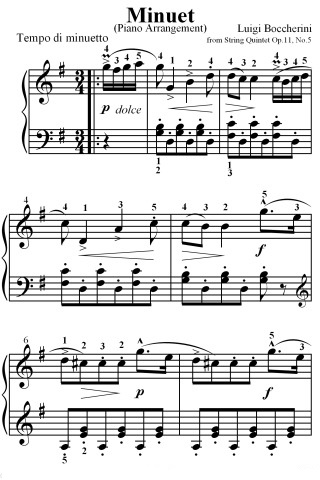
January 8 ~ On This Day in Music

today

. 1713 ~ Death of Italian composer and violinist Arcangelo Corelli in Rome age 59

. 1830 ~ Hans von Bulow, German pianist and conductor
More information about von Bulow

. 1906 ~ Arthur Rubinstein made his debut at Carnegie Hall in New York City. The concert received only a few favorable reviews.

. 1912 ~ Jose Ferrer (Cintron), Academy Award-winning actor, Rosemary Clooney’s husband

. 1922 ~ Abbey Simon, American pianist

. 1924 ~ Ron Moody, Actor, singer in Oliver Twist

. 1925 ~ Russian composer, Igor Stravinsky, appeared in his first American concert, as he conducted the New York Philharmonic Orchestra in a program of his own compositions.

. 1935 ~ Elvis Presley, American rock-and-roll singer and guitarist. He had 90 top-20 hits.

. 1937 ~ Shirley Bassey, Singer

. 1940 ~ Anthony Gourdine, Singer with Little Anthony and The Imperials

. 1940 ~ Vincent Lopez and his orchestra recorded the third version of Lopez’ theme song titled Nola. This version, recorded in Hollywood on Bluebird Records, is recognized as his best rendition of the classic song.

. 1946 ~ Robbie Krieger, Guitarist with The Doors

. 1947 ~ David Bowie, British rock singer and actor

. 1947 ~ Terry Sylvester, Musician with the groups Swinging Blue Jeans and the Hollies

. 1952 ~ Vladimir Feltsman, Pianist

. 1961 ~ Robert Goulet made his national TV debut this night on “The Ed Sullivan Show” on CBS.

. 1965 ~ The TV dance show, “Hullabaloo”, debuted on NBC~TV. The show, a weekly trip into the world of rock and roll, featured plenty of mini-skirted go~go girls; which didn’t hurt ratings any. ABC countered with “Shindig”, a similar show, similar concept, similar everything.

. 1966 ~ The Beatles LP, “Rubber Soul”, began a 6-week reign at the top of the album chart. This was the seventh Beatles LP to reach the #1 position since February, 1964. “Rubber Soul” stayed on the charts for 56 weeks. The other #1 albums for the Fab Four to that date were: “Meet The Beatles“, “The Beatles Second Album”, “A Hard Day’s Night”,“Beatles ’65”, “Beatles VI” and “Help!”.

. 1973 ~ Carly Simon received a gold record for the single, You’re So Vain.

. 1997 ~ George Handy died. Handy was a jazz music arranger, composer and pianist whose musical beginnings were fostered under the tutelage of pianist Aaron Copland.

. 1998 ~ Sir Michael Tippett, British Composer and librettist, died
More information about Tippett

. 2000 ~ Pianist Jeffrey Biegel appeared on Good Morning America. He discussed his performance of the New York Premiere with Maestro Vakhtang Jordania and the American Symphony Orchestra and performed selections from the manuscript edition of Rhapsody in Blue, with more than 50 bars restored that hadn’t been heard in New York since the famous 1924 premiere concert at Aeolian Hall.

The concert that evening was at Lincoln Center’s Avery Fisher Hall. The Rhapsody was the feature piece in an evening of premieres by American composers and Russian orchestral masterpieces. Works on the program included Variations on The Wayfaring Stranger (New York Premiere) by James Cohn; Peanuts Gallery for Piano and Orchestra by Ellen Taaffe Zwilich; the Rhapsody in Blue by Gershwin; Islamey by Balakirev (World Premiere-transcription for piano and orchestra by Jeffrey Biegel), and Mussorgsky’s Pictures at an Exhibition.