Presidents’ Day (celebrated on the third Monday in February), was originally established in 1885 in recognition of George Washington. The holiday became popularly known as Presidents’ Day after it was moved as part of the 1971 Uniform Monday Holiday Act, an attempt to create more three-day weekends for the nation’s workers. Presidents’ Day is now popularly viewed as a day to celebrate all U.S. presidents past and present.
Wondering how many U.S. Presidents played musical instruments?
Thomas Jefferson (1743 – 1826) Third president of the United States, drafted the Declaration of Independence, and played the violin and cello.
John Quincy Adams (1767 – 1848) The sixth president of the United States formulated the Monroe Doctrine, and played the flute.
John Tyler (1790-1862) The tenth president of the United States was the first Vice President to become President by the death of his predecessor. He played the violin.
Abraham Lincoln (1809-1865) The sixteenth president of the United States issued the Emancipation Proclamation and played the violin.
Ulysses S. Grant (1822- 1884) The eighteenth president of the United States certainly scrapes the bottom of the list. He was tone deaf and famously commented, “I only know two tunes. One of them is Yankee Doodle and the other isn’t.”
Chester Alan Arthur (1829 – 1886) Became the 21st president of the United States following the assassination of President James A. Garfield. He played the banjo.
Franklin Roosevelt (1882-1945) The 32nd President of the United States and the fifth cousin to President Theodore Roosevelt, played the piano and sang soprano in his school choir.
Woodrow Wilson (1856 – 1924) The 28th president of the United States and creator of the League of Nations, played the violin and sang tenor in his college glee club.
Warren Harding (1865-1923) The 29th president of the United States organized the Citizen’s Cornet Band, available for both Republican and Democratic rallies. He once remarked that, “I played every instrument but the slide trombone and the E-flat cornet.”
Calvin Coolidge (1872-1933) The 30th president of the United States was determined to preserve old moral and economic precepts amid American prosperity. He played the harmonica.
Harry Truman (1884 – 1972) The 33rd president of the United States who served during the conclusion of World War II, played the piano.
Richard Nixon (1913 – 1994) The 37th president of the United States, who ended American fighting in Vietnam and later resigned from office in the aftermath of the Watergate Scandal, was a classically-trained pianist and also played the accordion. He composed and played this piece, set to concerto form with “15 Democratic violinists.” Nixon takes a dig at Harry Truman just before playing.:
Ronald Reagan (1911-2004) The 40th president of the United States implemented the Reagan Revolution, which aimed to reinvigorate the American people and reduce their reliance upon Government. He played the harmonica.
Bill Clinton (born 1946) The 42nd president of the United States and the first Democratic president since Franklin D. Roosevelt to win a second term, plays the saxophone.
Barack Obama (born 1961) The 44th president of the United States and first African American president has broken into song on several recent occasions. President Obama sang Amazing Grace at the funeral for South Carolina State Senator Clementa Pinckney:
Beethoven’s first published works—his Opus No.1—were three trios for piano, violin and cello and already they show a marked advance on Haydn’s trios in the comparative interdependence of the three parts. Their freedom from Haydn’s oppressive formality looks forward to the first mature trios, the pair that comprises Opus 70, displaying all sorts of harmonic twists, thematic innovations and structural idiosyncrasies, these trios make much of the piano part and contain plenty of dramatic outbursts that are typical of Beethoven’s middle period.
Even more arresting is the first of the Opus 70 trios (1808) nicknamed ”The Ghost” because of its mysterious and haunting Largo. Its sibling boasts a cheerful bombastic finale that is the most entertaining music that Beethoven composed for this combination of instruments.
The “Archduke” Trio Opus 97 (1811) was Beethoven’s last full-scale work for piano trio and is typically conclusive. The third movement is its center of gravity, a highly moving set of variations with the cello dominating the thematic content. It opens with a hymn-like theme and progresses to a coda which magnificently sums up the movements ideas. The finale might be less powerful than that of Opus 70 No. 2, but it nevertheless has a sweeping rhythmic power. Again, it is beyond the shadow of a doubt that Beethoven defined the piano trio form that it retained throughout the 19th century by allowing the string instruments the status of genuinely equal partners in this superlative performance.
Humoresques Op. 101 (B. 187), is a piano cycle by the Czech composer Antonín Dvořák, written during the summer of 1894. One writer says “the seventh Humoresque is probably the most famous small piano work ever written after Beethoven’s Für Elise.
Orchestra:
Ragtime:
Jazz with Wynton Marsalis on trumpet
Zez Confrey gave this a makeover and included Way Down Upon the Swanee River:
Find the original Humoresque on IMSLP. The O’Connor Music Studio Lending Library has versions of Humoresque available at several levels and Confey’s Humorestless played in the video above.
Today’s piece is one of those that piano students often try to learn on their own – or a friend will teach them the first 9 notes. It’s usually played too fast and, often in the wrong octave, or the first couple notes are repeated too many times.
This is one of two pieces that are so often played incorrectly that they have the distinction of being banned from competition in Northern Virginia Piano Teacher competitions.
Stay tuned for the other one!
Für Elise was not published during Beethoven’s lifetime, having been discovered by Ludwig Nohl 40 years after the composer’s death. The identity of “Elise” is unknown.
The very basic melody:
From Wunderkeys – The Elise Session
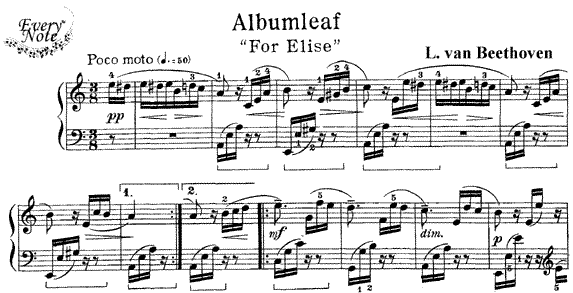
The actual beginning is a little more involved.
And, there’s more!
If you’d like to learn to play this piece correctly, find the sheet music at IMSLP, Beethoven: Exploring His Life and Music, and countless compilations of classical music available at the O’Connor Music Studio.
Follow along:
By Valentina Lisitsa:
Ragtime!
The Big Piano at FAO Schwartz in NYC:
Glass harp:
The Mystery Behind Für Elise:
Youtube has many, many more versions. Beethoven would probably go nuts!
Joseph Lamb (1887 to 1960) was an extraordinarily gifted ragtime pianist and composer along with Scott Joplin and James Scott. He differed from them, though, because the art of improvisation completely baffled him. In response to this, Lamb viewed ragtime as an art form written on paper, instead of a spontaneous one. Though his style and approach were markedly different from his peers, he still left behind a rich legacy and remained one of the most influential ragtime composers.
Lehar
Franz Lehar, 1870 to 1948 was the son of a bandmaster serving principally in Hungary. He followed his father’s profession, before winning, in 1902, success in the theatre in Vienna, where he succeeded in the following years in reviving the operetta, providing music of greater distinction, with tenor arias written specifically for Richard Tauber.
The reputation of Franz Lehar as a composer of operetta is assured as he wrote nearly forty of them. Of these by the far the best known is Die lustige Witwe (The Merry Widow), first staged in Vienna in 1905, the favourite operetta of Adolf Hitler.
Lennon
John Lennon, 1940 to 1980,was a pop star, composer, songwriter, and recording artist. He was born in Liverpool, Merseyside, NW England, UK. and was The Beatles rhythm guitarist, keyboard player, and vocalist, and a partner in the Lennon–McCartney song-writing team. He married Japanese artist Yoko Ono in 1969. On the birth of his son, Sean (born in 1975), he retired from music to become a house-husband. Five years later he recorded (Just Like) Starting Over, but he was shot and killed by a deranged fan just before its release. His death affected millions of people, record sales soared, and he continues to be admired by new generations of fans.
Lerner and Lowe
Alan Jay Lerner,
Playwright, born August 31, 1918, New York, New York; died June 14, 1986
Frederick Loewe,
Composer, born June 10, 1904, Vienna, Austria; died February 14, 1988
Frederick Loewe, an unheralded Vienna-born composer, and Alan Jay Lerner, the lyricist-playwright son of the proprietors of an American chain of women’s clothing shops, with sketches and lyrics for two Harvard Hasty Pudding shows among his major credits, met by chance at New York’s Lambs Club in 1942. Had they not, Brigadoon would never have emerged from the mists of the Scottish Highlands to make the world feel “Almost Like Being in Love” . . . no one would have been there to “Paint Your Wagon” . . . My Fair Lady would still be a less than lyrical English girl from George Bernard Shaw’s Pygmalion who couldn’t sing a note. . . we might never have thought to “Thank Heaven for Little Girls” like “Gigi” . . . and Camelot would most likely have stayed within the pages of Arthurian legend.
When the two, who were destined to enrich the American musical theater with some of its most poignant, rousing, and memorable lyrics, engaging books and powerful musical scores, had that chance meeting more than 50 years ago, neither was widely known. Loewe’s Great Lady had had a brief run on Broadway in 1938. Lerner had added radio scripts to his Hasty Pudding Club show credits. But later collaborations after one brief failure, What’s Up? (1943), and the moderately successful The Day Before Spring (1945), which ran five months on Broadway, made musical history.
Alan Jay Lerner was one of three sons of Joseph J. Lerner, who founded Lerner Stores, Inc. He was educated in England and at the Choate School in Wallingford, Connecticut, before entering Harvard. He studied at the Juilliard School of Music during vacations from Harvard. After graduating in 1940 with a B.S. degree, he wrote advertising copy and radio scripts for such programs as the “Philco Hall of Fame.”
Frederick “Fritz” Loewe was the son of Edmund Loewe, an eminent operetta tenor. When he was two, Frederick accompanied his father on a tour of the United States. The youngster played piano at four and, at nine, composed the tunes for a music hall sketch in which his father toured Europe. At 15, he wrote “Katrina,” a popular song that sold 3,000,000 copies in Europe. He had begun his own concert career as soloist with some of Europe’s leading symphony orchestras at the age of 13 after having studied with the noted European musician Ferruccio Busoni and Eugene d’Albert. In 1923, young Loewe was awarded the Hollander Medal in Berlin and studied composition and orchestration with Nickolaus von Reznicek.
The following year, the younger Loewe accompanied his father to America. Since neither a concert he gave at New York’s Town Hall, nor a subsequent week’s engagement at the Rivoli Theater led to further concert engagements, he tried teaching music and playing at Greenwich Village night clubs. When music failed to earn him a living, he worked as a busboy in a cafeteria and as a riding instructor at a New Hampshire resort. He took up flyweight boxing and failed, then went West, cowpunching, gold mining, and carrying mail on horseback over the Montana mountains before returning to New York where he found work as a piano player. In 1935, Loewe’s song “Love tiptoes Through My Heart” was accepted for the musical Petticoat Fever. His own musical, Salute to Spring, was presented in St. Louis in 1937. The next year, his Great Lady reached Broadway, but ran for only 20 performances.
The first Lerner-Loewe collaboration was a musical adaptation of Barry Connor’s farce The Patsy for a Detroit stock company in 1942. They called it Life of the Party and it enjoyed a nine-week hit that encouraged them to continue with the musical comedy What’s Up? which opened on Broadway in 1943. Lerner wrote the book and lyrics with Arthur Pierson, and Loewe composed the music. It ran for 63 performances and was followed in 1945 by their The Day Before Spring.
It was when the curtain went up to the haunted strains of bagpipes on the night of March 13, 1947, and the mist-shrouded Scottish Highland village of Brigadoon first appeared, that the team of Lerner and Loewe also emerged as potentially legendary. The musical, which after its original 581 performances on Broadway, toured extensively and has been revived frequently, won the “best musical”award from the New York Drama Critics Circle the year it opened and was hailed as having “evoked magic on Broadway.”
Between Brigadoon and Paint Your Wagon, the next team effort by Lerner and Loewe, Lerner wrote Love Life, with music by Kurt Weill, which was selected as one of the best plays of the 1948-49 Broadway season, plus the story, screenplay and lyrics for the films Royal Wedding and Brigadoon and the story and screenplay for An American in Paris, for which he won an Oscar in 1951.
Paint Your Wagon rolled in in 1951, and then, five years later, on March 15, 1956, My Fair Lady opened and became one of the most spectacular successes–artistic and financial–in the history of the American theater. Playing a record 2,717 performances on Broadway alone, it went on to break all other existing world records. This musicalization of Shaw’s classic Pygmalion was named “outstanding musical of the year” by the New York Drama Critics Circle–and by millions of theater goers.
Lerner and Loewe’s next collaboration was on the film adaptation of the Colette novel Gigi, another success filled with songs destined to become standard.
There was more collaborating to come–the film version of the Antoine de Saint-Exupery fable The Little Prince in 1972, but the 1960 Broadway hit Camelot which brought Arthurian England to life for its most shining hour, rang the curtain down on the phenomenon of Lerner and Loewe. Loewe, who had suffered a heart attack in 1958, went into retirement.
In tribute to his long time former partner, Lerner wrote, “There will never be another Fritz. . . . Writing will never again be as much fun . A collaboration as intense as ours inescapably had to be complex. But I loved him more than I understood or misunderstood him, and I know he loved me more than he understood or misunderstood me.”
Lewis
Jerry Lee Lewis (September 29, 1935 – October 28, 2022) was an American pianist, singer and songwriter. Nicknamed “The Killer”, he was described as “rock ‘n’ roll’s first great wild man”.
Liadov
Anatol Konstantinovich Liadov lived from 1855 until 1914. He was the son of a conductor at the Mariinsky Theatre in St Petersburg, and was trained at the Conservatory, where he was briefly a pupil of Rimsky-Korsakov and later a member of the teaching staff. He was associated with Balakirev and subsequently became a member of Belyayev’s circle, helping, in particular, in the establishment of the publishing-house that Belyayev established for Russian composers.
He was a thoroughly competent musician, conductor and composer, but did not apply himself constantly to work. His failure to supply music for the Dyagilev ballet in Paris in 1910 allowed Stravinsky his first chance with the Ballets russes. His compositions are characteristic of the period in Russian nationalism, when nationalism was joined with technical competence inculcated at the Conservatories.
The best known orchestral compositions by Liadov are the descriptive Russian fairy-tale pieces Kikimora, Baba-Yaga and Volshebnoye ozero (The Enchanted Lake). His last orchestral work was the symphonic poem Skorbnaya pesn. All are very much in the nationalist tradition exemplified by Rimsky-Korsakov.
Liadov wrote a number of shorter piano pieces, including Fugues and a set of Canons, testimony to his contrapuntal ability. Other pieces have characteristic titles, examples of pleasing and well crafted compositions for which there was a ready market.
Liadov wrote a setting of the final scene of Schiller’s Die Braut von Messina (The Bride from Messina) for his Conservatory graduation. Of some 26 songs, eighteen are Children’s Songs.
Liberace
(Walter) (Wladziu Valentino) Liberace, American pianist and showman. Lee, as he was known, was the master of Las Vegas. Hundreds of thousands flock to his museum there (operated by his brother, George) to see Liberace’s garish suits, trademark candelabra, and learn of the myths behind this hugely successful star of television, stage and concerts the world over.
Ligeti
György Ligeti, a composer, was born in 1923 in Transylvania. He studied and later taught at the Budapest Academy of Music. After leaving Hungary in 1956, he worked at the electronics studio in Cologne, then settled in Vienna, where he developed an experimental approach to composition. His first large orchestral work, Apparitions (1958–9), made his name widely known. In Aventures (1962) he uses his own invented language of speech sounds. He has also written a choral requiem, a cello concerto, and music for harpsichord, organ, and wind and string ensembles.
Lipatti
Dinu Lipatti was born in Bucharest and lived from 1917 until 1950. He was a pianist and composer who studied in Paris with Cortot and Boulanger, and after World War 2 established an international reputation as a gifted pianist, especially in the works of Chopin. His compositions include a Symphonie concertante for two pianos and strings, and a concertino for piano and orchestra. His career was cut short when he died of a rare form of cancer.
Liszt
Franz Liszt was born in Raiding, near Doborján, October 22, 1811 and died in Bayreuth, July 31, 1886. He was a Hungarian composer and pianist who was a major influence during the romantic period. Liszt was an outstanding pianist at seven, composed at eight and made concert appearances at nine. In addition to being a piano virtuoso, he was also a critic, conductor, city music director, literary writer and transcriber of the works of other composers. He transcribed Beethoven’s Symphonies for the piano.
Franz Liszt began his career as the outstanding concert pianist of the century, who, along with the prodigious violinist Niccolò Paganini (1782-1840), created the cult of the modern instrumental virtuoso. To show off his phenomenal and unprecedented technique, Liszt composed a great deal of music designed specifically for this purpose, resulting in a vast amount of piano literature laden with dazzling scales, trills, arpeggios, leaps, and other technical marvels. In this vein, Liszt composed a series of virtuosic rhapsodies on Hungarian gypsy melodies, the best-known being the all too familiar Hungarian Rhapsody no. 2. Liszt developed the rhapsody as a form of serious music. This kind of music is worlds apart from the generally more introspective, poetic music of pianist-composer Frédéric Chopin.
Liszt was wildly handsome and hugely talented. He was extremely popular in Paris during the 1830’s. It is said that women actually fainted at his piano recitals. He was the first to position the piano so that its lid reflected the sound and the audience could see his profile as he performed.
Liszt was the first to write a tone poem, which is an extended, single-movement work for orchestra, inspired by paintings, plays, poems or other literary or visual works, and attempting to convey the ideas expressed in those media through music. Such a work is Les Pruludes, based on a poem in which life is expressed as a series of struggles, passions, and mysteries, all serving as a mere prelude to . . .what? The Romantic genre of the symphonic poem, as well as its cousin the concert overture, became very attractive to many later composers, including Saint-Saëns, Tchaikovsky, Dvořák, Sibelius, and Richard Strauss.
Lloyd Webber
British composer Andrew Lloyd Webber is one of the most successful composers of this era with hugely successful commercial hits such as Jesus Christ Superstar, Sunset Boulevard, Cats, Phantom of the Opera and Evita. Cats, the longest-running production in Broadway history, closed after 7,397 performances on June 25, 2000.
Locatelli
Pietro Antonio Locatelli lived from 1695 until 1764. He was born in Bergamo, later moving to Rome, where he might have studied with Corelli, but more probably was a pupil of Valentini. He was an Italian composer of sonatas and concerti, but he was best known as a virtuoso violinist playing mostly in Amsterdam where he settled in 1721. He won a reputation as a virtuoso, performing in Italy, in Bavaria and in Berlin. In 1729 he settled in Amsterdam, where he taught and conducted an amateur orchestra and was able to pursue his wider cultural interests.
Locatelli wrote a number of concerti grossi, following the example of Corelli. The first set, published in Amsterdam in 1720, include twelve fugues. L’arte del violino (The Art of the Violin), published in 1733, contains twelve violin concertos and 24 Caprices, precursors of Paganini’s famous set for unaccompanied violin. A further set of six concertos was published two years later and a set of six, published in 1744, is scored for four violins, two violas and basso continuo. Locatelli combines the Roman style of Corelli with, in his solo concertos, the virtuosity of Vivaldi in Venice.
In his Concerti grossi, works for string orchestra with a smaller group of soloists, Locatelli at first follows the pattern of Corelli, with one or two violas added to Corelli’s solo group of two violins, cello and harpsichord. There is also a Concerto grosso that includes a group of solo wind instruments, in addition to solo violin concertos. Some of these works have programmatic titles. His L’arte del violino (The Art of the Violin) includes 24 Caprices for unaccompanied violin, challenging works that have been regarded by some as foreshadowing the Caprices of Paganini in the following century. Locatelli also published sets of trio sonatas and solo sonatas, including a set of the latter for flute and basso continuo.
Loewe
Frederick “Fritz” Loewe lived from 1904 until 1988. He was a composer, born in Vienna, Austria and at age 13 he was the youngest pianist to solo with the Berlin Symphony. At age 15 he composed Katrina (1919), which sold two million copies of sheet music in Europe. Although he had studied with great European masters of the piano, when he came to the U.S.A. in 1924 he failed as a piano virtuoso. He took up a series of odd jobs–prospecting for gold, professional boxing–but by the mid-1930s he had launched his career as a composer for the musical theater. Not until he teamed up with lyricist Alan Jay Lerner in 1942, however, did he find his true talent; their first big success was Brigadoon (1947) and this was followed by such classic stage and film musical scores as My Fair Lady (1956), Gigi (1958), and Camelot (1960). This last led to their falling-out and they did not collaborate again until in 1973 when they made a stage version of their film musical, Gigi. Their last collaboration was The Little Prince (1974), after which Loewe retired.
If ever I would leave you from Camelot won him a Grammy Award.
Lully
Jean Baptiste Lully lived from about 1632 until 1687 and was considered to be a baroque composer. He was an Italian-born French court composer who molded Italian opera music to suit the French text. He was the first to compose French overtures, which served as model for subsequent composers, especially J. S. Bach. He changed his name from the Italian Giovanni Battista Lulli when he became a French citizen.
Lully was conducting a Te Deum to celebrate Louis XIV’s recovery from illness. He was banging loudly on the floor with a staff when he struck his foot with such force that it developed an abscess, from which the unfortunate Lully died shortly after.
Lunceford
James Melvin Lunceford was born. June 6, 1902, Fulton, Miss., U.S. and died on July 12, 1947, Seaside, Ore. He was an American jazz dance-band leader whose rhythmically appealing, well-disciplined orchestra performed arrangements by trumpeter Sy Oliver and others to popular acclaim from 1934 to 1945 and influenced both swing and post-World War II dance bands.
Lunceford, during his youth, acquired proficiency on all reed instruments, but he seldom played with his band because he preferred to conduct. He taught and organized a student orchestra in a Memphis, Tenn., high school before beginning his professional career as a bandleader in 1929. Practiced showmanship, precise ensembles, and a medium two-beat swing tempo rather than exciting soloists were the Lunceford band’s trademarks. The band’s most popular songs included Organ Grinder’s Swing (1936) and For Dancers Only (1937). The Lunceford band was considered to be on a par with bands led by Duke Ellington, Count Basie, and Benny Goodman during the 1930s, and in 1940 the ensemble won a celebrated “battle of the bands” from a field of 28 groups, among them Basie’s, Goodman’s, and Glenn Miller‘s. Arranger Oliver left Lunceford in 1939, and by 1942 the band’s popularity had declined. Following Lunceford’s death while on tour, pianist Edwin Wilcox and saxophonist Joe Thomas led the band for several years.
Lutoslawski
Witold Lutoslawski lived from 1913 until 1994. He was born and studied in Warsaw, winning a distinguished international reputation particularly from the 1950s onwards, a leading composer among a group of creative artists of outstanding ability, remarkable in his handling of forms and textures of great originality.
The genius of Lutoslawski was early evident in his 1938 Symphonic Variations. The years after the war brought a return to more conventional national modes of composition, heard in his Little Suite and Concerto for Orchestra. Later works have allowed a more experimental approach on a broader palette, to be heard in his Funeral Music of 1958, his Second Symphony and the Prelude and Fugue for thirteen string instruments.
Characteristic works for voice and orchestra include Paroles tissées for tenor and chamber orchestra, and Three Poems by Henri Michaux for twenty voices and orchestra.
Today’s piece is one of those that piano students often try to learn on their own – or a friend will teach them the first 9 notes. It’s usually played too fast and, often in the wrong octave, or the first couple notes are repeated too many times.
This is one of two pieces that are so often played incorrectly that they have the distinction of being banned from competition in Northern Virginia Piano Teacher competitions.
Stay tuned for the other one!
Für Elise was not published during Beethoven’s lifetime, having been discovered by Ludwig Nohl 40 years after the composer’s death. The identity of “Elise” is unknown.
The very basic melody:
The actual beginning is a little more involved.
And, there’s more!
If you’d like to learn to play this piece correctly, find the sheet music at IMSLP, Beethoven: Exploring His Life and Music, and countless compilations of classical music available at the O’Connor Music Studio.
Follow along:
By Valentina Lisitsa:
Ragtime!
The Big Piano at FAO Schwartz in NYC:
Glass harp:
The Mystery Behind Für Elise:
Youtube has many, many more versions. Beethoven would probably go nuts!
Presidents’ Day (celebrated on the third Monday in February), was originally established in 1885 in recognition of George Washington. The holiday became popularly known as Presidents’ Day after it was moved as part of the 1971 Uniform Monday Holiday Act, an attempt to create more three-day weekends for the nation’s workers. Presidents’ Day is now popularly viewed as a day to celebrate all U.S. presidents past and present.
Wondering how many U.S. Presidents played musical instruments?
Thomas Jefferson (1743 – 1826) Third president of the United States, drafted the Declaration of Independence, and played the violin and cello.
John Quincy Adams (1767 – 1848) The sixth president of the United States formulated the Monroe Doctrine, and played the flute.
John Tyler (1790-1862) The tenth president of the United States was the first Vice President to become President by the death of his predecessor. He played the violin.
Abraham Lincoln (1809-1865) The sixteenth president of the United States issued the Emancipation Proclamation and played the violin.
Ulysses S. Grant (1822- 1884) The eighteenth president of the United States certainly scrapes the bottom of the list. He was tone deaf and famously commented, “I only know two tunes. One of them is Yankee Doodle and the other isn’t.”
Chester Alan Arthur (1829 – 1886) Became the 21st president of the United States following the assassination of President James A. Garfield. He played the banjo.
Franklin Roosevelt (1882-1945) The 32nd President of the United States and the fifth cousin to President Theodore Roosevelt, played the piano and sang soprano in his school choir.
Woodrow Wilson (1856 – 1924) The 28th president of the United States and creator of the League of Nations, played the violin and sang tenor in his college glee club.
Warren Harding (1865-1923) The 29th president of the United States organized the Citizen’s Cornet Band, available for both Republican and Democratic rallies. He once remarked that, “I played every instrument but the slide trombone and the E-flat cornet.”
Calvin Coolidge (1872-1933) The 30th president of the United States was determined to preserve old moral and economic precepts amid American prosperity. He played the harmonica.
Harry Truman (1884 – 1972) The 33rd president of the United States who served during the conclusion of World War II, played the piano.
Richard Nixon (1913 – 1994) The 37th president of the United States, who ended American fighting in Vietnam and later resigned from office in the aftermath of the Watergate Scandal, was a classically-trained pianist and also played the accordion. He composed and played this piece, set to concerto form with “15 Democratic violinists.” Nixon takes a dig at Harry Truman just before playing.:
Ronald Reagan (1911-2004) The 40th president of the United States implemented the Reagan Revolution, which aimed to reinvigorate the American people and reduce their reliance upon Government. He played the harmonica.
Bill Clinton (born 1946) The 42nd president of the United States and the first Democratic president since Franklin D. Roosevelt to win a second term, plays the saxophone.
Barack Obama (born 1961) The 44th president of the United States and first African American president has broken into song on several recent occasions. President Obama sang Amazing Grace at the funeral for South Carolina State Senator Clementa Pinckney:
Beethoven’s first published works—his Opus No.1—were three trios for piano, violin and cello and already they show a marked advance on Haydn’s trios in the comparative interdependence of the three parts. Their freedom from Haydn’s oppressive formality looks forward to the first mature trios, the pair that comprises Opus 70, displaying all sorts of harmonic twists, thematic innovations and structural idiosyncrasies, these trios make much of the piano part and contain plenty of dramatic outbursts that are typical of Beethoven’s middle period.
Even more arresting is the first of the Opus 70 trios (1808) nicknamed ”The Ghost” because of its mysterious and haunting Largo. Its sibling boasts a cheerful bombastic finale that is the most entertaining music that Beethoven composed for this combination of instruments.
The “Archduke” Trio Opus 97 (1811) was Beethoven’s last full-scale work for piano trio and is typically conclusive. The third movement is its center of gravity, a highly moving set of variations with the cello dominating the thematic content. It opens with a hymn-like theme and progresses to a coda which magnificently sums up the movements ideas. The finale might be less powerful than that of Opus 70 No. 2, but it nevertheless has a sweeping rhythmic power. Again, it is beyond the shadow of a doubt that Beethoven defined the piano trio form that it retained throughout the 19th century by allowing the string instruments the status of genuinely equal partners in this superlative performance.
Humoresques Op. 101 (B. 187), is a piano cycle by the Czech composer Antonín Dvořák, written during the summer of 1894. One writer says “the seventh Humoresque is probably the most famous small piano work ever written after Beethoven’s Für Elise.
Yo Yo Ma (cello) and Itzhak Perlman (violin)
Orchestra:
Ragtime:
Jazz with Wynton Marsalis on trumpet
Zez Confrey gave this a makeover and included Way Down Upon the Swanee River:
Find the original Humoresque on IMSLP. The O’Connor Music Studio Lending Library has versions of Humoresque available at several levels and Confey’s Humorestless played in the video above.
Today’s piece is one of those that piano students often try to learn on their own – or a friend will teach them the first 9 notes. It’s usually played too fast and, often in the wrong octave, or the first couple notes are repeated too many times.
This is one of two pieces that are so often played incorrectly that they have the distinction of being banned from competition in Northern Virginia Piano Teacher competitions.
Stay tuned for the other one!
Fur Elise was not published during Beethoven’s lifetime, having been discovered by Ludwig Nohl 40 years after the composer’s death. The identity of “Elise” is unknown.
The very basic melody:
The actual beginning is a little more involved.
And, there’s more!
If you’d like to learn to play this piece correctly, find the sheet music at IMSLP, Beethoven: Exploring His Life and Music, and countless compilations of classical music available at the O’Connor Music Studio.
Follow along:
By Valentina Lisitsa:
Ragtime!
The Big Piano at FAO Schwartz in NYC:
Glass harp:
The Mystery Behind Für Elise:
Youtube has many, many more versions. Beethoven would probably go nuts!




 MaryO'Studio