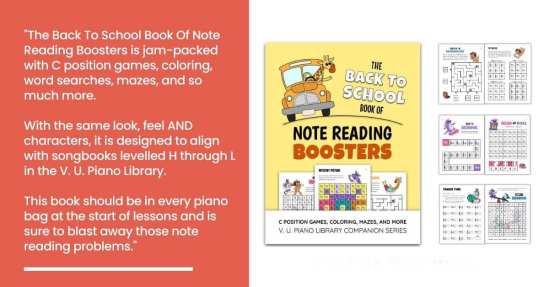
Some students will be getting this new book the first lesson this fall. With The Back To School Book Of Note Reading Boosters, you and your students have a jam-packed resource that can be used at home for extra practice or during lessons for off-the-bench activities.
Inside your students will discover back-to-school-themed mazes, color-it mystery pictures, word searches, pattern play, dot-to-dot journeys, tic tac toe, and board games; all designed to reinforce note reading in C position.
In addition, the book includes a build-your-own note printing solo, a mix and match sight reading solo, and a make-a-motive composing solo.
This year, show students just how fun note reading can be with The Back To School Book Of Note Reading Boosters.
• 1854 ~ Moritz Moszkowski, Polish-born German pianist and composer More information about Moszkowski
• 1900 ~ Ernst Krenek, Austrian-born American composer, conductor and pianist
• 1905 ~ Constant Lambert, British composer, conductor and writer
• 1912 ~ Gene (Eugene Curran) Kelly, Dancer, actor: Singin’ in the Rain, An American in Paris, Anchors Aweigh, The Three Musketeers, Marjorie Morningstar, Inherit the Wind, North and South Book I; director: Singin’ in the Rain, Hello, Dolly!, A Guide for the Married Man, The Cheyenne Social Club
• 1917 ~ Tex (Sol) Williams, American country-western singer
• 1923 ~ Billy Jones and Ernie Hare, The Happiness Boys, were heard on radio for the first time. The two were billed as radio’s first comedians and were also credited with creating and performing the first singing commercial.
• 1936 ~ Rudy Lewis, Singer with Drifters
• 1942 ~ Patricia McBride, Ballerina: New York City Ballet. For many years she was Mikhail Baryshnikov’s only partner
• 1943 ~ LIFE magazine spotlighted a dance craze that was sweeping the U.S.A., the Lindy Hop
• 1947 ~ Keith Moon, Singer, drummer with The Who
• 1947 ~ Margaret Truman, daughter of U.S. President Harry S Truman, presented her first public concert. Margaret sang before 15,000 people at the Hollywood Bowl. The concert did not get great reviews. In fact, the critics didn’t like Margaret’s singing at all. And Margaret’s dad didn’t like the critics, and said so, from the White House.
• 1949 ~ Rick Springfield, Singer
• 1951 ~ Mark Hudson, Singer with The Hudson Brothers
• 1966 ~ The U.S. premiere of the motion picture Help!, starring The Beatles, was held for thousands of moviegoers wanting to see the group’s first, color, motion picture. Their first film, A Hard Day’s Night, had been produced in black and white.
• 1990 ~ David Rose passed away
• 2001 ~ Kathleen Freeman, a veteran character actress whose face if not her name was known to audiences from television sitcoms, the film classic “Singin’ in the Rain” and Broadway’s “The Full Monty,” died of lung cancer at the age of 82. Freeman gave her final performance in “The Full Monty”. She played a sassy piano player in the hit musical and earned a Tony nomination in May 2001.
Big, brash and funny were Freeman’s trademarks in playing recalcitrant maids, demented nuns, mouthy housekeepers, battle-ax mothers, irate landladies and nosy neighbors.
Starting in the Golden Age of television, Freeman appeared in such shows as “Topper,” “The Donna Reed Show,” “The Beverly Hillbillies,” “The Dick Van Dyke Show,” “Hogan’s Heroes,” “The Lucy Show,” “The Golden Girls,” “Murphy Brown” and “Married … With Children.”
“This will sound very corny and I’m sorry,” Freeman said last year in an Associated Press interview, “but I have always had the sense I was put here to do this: I am somebody who is around to help the world laugh. I have always had that sense. Corny but absolutely true.”
In “Singin’ in the Rain,” considered by many to be the best movie musical ever made, she played Jean Hagen’s frustrated voice teacher. Among Freeman’s other films were the sci-fi thriller “The Fly,” “The Rounders” with Henry Fonda, “Far Country” with Jimmy Stewart, and “North to Alaska” starring John Wayne. More recently she appeared in “Dragnet,” “Gremlins II,” “Nutty Professor II: The Klumps” and both “Blues Brothers” comedies.
Freeman was born in Chicago and was propelled into show business at age 2. Her parents had a vaudeville act, Dixon and Freeman, in which their daughter did a little dance.
Freeman attended the University of California at Los Angeles, where she majored in music and was going to be a classical pianist. Then, she said, “A terrible thing happened. I got in a play and got a laugh. I just said a line and, `boom.”‘
Freeman then worked in many small theater groups, including the Circle Players, acting for such eminent directors – and actors – as Charles Laughton, Charlie Chaplin and Robert Morley.
At the same time, the early 1950s, the television explosion took over Los Angeles. From her first regular sitcom role, as the maid in “Topper,” Freeman went on to do just about every sitcom of the last 50 years.
For all her voluminous credits, Freeman’s stage credits were mostly on the road – touring as Miss Hannigan in “Annie” for 18 months, then in “Deathtrap” and later with Lauren Bacall in “Woman of the Year.”
Her only other Broadway appearance was for five months in the 1978 production of “13 Rue de l’Amore” starring Louis Jordan.
• 2001 ~ Frank Emilio Flynn, a blind pianist and Latin jazz pioneer who performed with many great American jazz artists, died at the age of 80.
Flynn lost his sight at age 13 but continued to study and perform classical works, transcribed into Braille, with the Symphonic Orchestra of Havana.
Flynn’s great passion was jazz, and in the 1950s he developed his own jazz-influenced ballad style, known in Cuba as “feeling.”
Performing with the Quinteto Cubana de Musica Moderno, or Cuban Quintet of Modern Music, he developed into one of the most important Cuban jazz musicians of his era.
• 1862 ~ Claude Debussy, French composer. Along with Maurice Ravel, he was one of the most prominent figures associated with Impressionist music, though he himself disliked the term when applied to his compositions.
• 1906 ~ The Victor Talking Machine Company of Camden, New Jersey began to manufacture the Victrola (record player). The hand-cranked unit, with horn cabinet, sold for $200. Records sold separately.
• 1917 ~ John Lee Hooker, American blues guitarist and singer, born in Clarksdale, Miss. He began his career in Detroit in 1948 with the release of Boogie Chillun, the biggest of his several hit records and a staple of both the blues and rock repertoires. He toured continually, and among “deep blues” artists, enjoyed an unusually successful career, appearing in concerts and on recordings with many of the leading figures in rock. He was inducted into the Rock ‘n’ Roll Hall of Fame in 1991.
• 1928 ~ Karlheinz Stockhausen, German composer
More information about Stockhausen
Read quotes by and about Stockhausen
• 1926 ~ Bob Flanigan, Singer with The Four Freshmen
• 1932 ~ The British Broadcasting Corporation (BBC) began its first experimental TV broadcast in England.
• 1938 ~ Fred Astaire and Ginger Rogers appeared, dancing, on the cover of LIFE magazine, published on this day.
• 1938 ~ Count Basie recorded the classic swing tune, Jumpin’ at the Woodside, for Decca Records.
• 1942 ~ Joe Chambers, Musician: guitar, singer with The Chambers Brothers
• 1950 ~ Sam Neely, Singer
• 1960 ~ Debbi Peterson, Drummer, singer with Bangles
• 1961 ~ Roland Orzabal, Singer, guitarist
• 2002 ~ Frederick Selch, an advertising executive and magazine publisher who collected hundreds of antique musical instruments, died at the age of 72.
Selch began collecting almost 50 years ago and owned more than 300 musical instruments by 1977.
In that year, he founded the Federal Music Society, an organization dedicated to performing music from the Colonial-Federal period. The group’s 26 players used instruments in Selch’s collection to perform in more than 70 concerts.
Selch was also the owner, editor and publisher of Ovation, a monthly magazine about classical music, from 1983 to 1989. He produced the Broadway musical “Play Me a Country Song” in 1982, and in the past 10 years was involved in a series of American Music Festivals at Illinois Wesleyan University.
Selch, who received a master’s degree in radio-television production from Syracuse University, worked at the J. Walter Thompson advertising agency from 1955 to 1974.
He is to be awarded a posthumous doctorate from the American Studies program at New York University.
• 2002 ~ Richard Lippold, a sculptor whose abstract works are featured at New York’s Avery Fisher Hall and at Harvard University, died. He was 87. Lippold created giant metal abstractions, many of which are suspended by wires so they appear to be hovering or moving through space.
His piece World Tree, a 27-foot structure of straight and circular metal tubes that resembles a radio antenna, stands on the Harvard University campus.
He is also known for Ad Astra, a double spire that rises 115 feet in front of the National Air and Space Museum in Washington, and Orpheous and Apollo, a constellation of bronze bars connected by wires in the lobby of Avery Fisher Hall in Lincoln Center.
Lippold studied industrial design, piano and dance at the Art Institute of Chicago and the University of Chicago. He worked as a freelance industrial designer for several years before teaching art at the University of Michigan.
He later taught at Goddard College in Plainfield, Vt., and Hunter College in New York.
• 2018 ~ Ed King, former guitarist for Lynyrd Skynyrd who co-wrote ‘Sweet Home Alabama,’ died at the age of 68
• 1904 ~ (William Allen) Count Basie, Bandleader, pianist
More information about Count Basie
• 1928 ~ Art Farmer, Trumpeter, flugelhorn, worked with Horace Henderson, Johnny Otis, Lionel Hampton Band; recorded be-bop classic Farmer’s Market; developed musical instrument called ‘flumpet’
• 1933 ~ Dame Janet Baker, British mezzo-soprano Read quotes by and about Baker
More information about Baker
• 1938 ~ Kenny (Kenneth Donald) Rogers, Grammy and CMA Award-winning singer; groups: The Kirby Stone Four, The New Christy Minstrels, The First Edition
Let’s face it. Most kids don’t want to practice the piano. And if they do find the time to practice, it’s usually because their parent kept nagging them. How frustrating!
Piano teachers are frustrated too. It’s nearly impossible to teach students new concepts when they don’t understand the old ones–all because of a lack of practice.
If you’re a parent in this situation, I have just the solution you’re looking for.
In this upbeat book, I share all the tips I’ve discovered in my 14 years of teaching piano. You’ll learn fun, practical ways to get your kids to the keyboard.
But this easy-to-read guide goes one step further. I’ll show you simple ways to encourage better quality practice. Even if you’ve never had a music lesson in your life!
I wrote this book for kids of all ages. There are creative ideas for elementary students and also a section for teens.
There’s even a section for what to do if your child wants to stop taking piano lessons. That’s right, there is hope and my book will show you exactly how to get them interested in piano again.
Don’t be the kind of parent who sits on the sidelines waiting until their child wants to practice. Piano lessons are too expensive for you to let another “no-practice” day go by.
This book is your answer to get your child to the keyboard, have good quality practice and develop a life-long love of music.
• 1952 ~ Doug Fieger, Musician, guitar, singer with The Knack
• 1952 ~ Rudy Gatlin, Singer with The Gatlin Brothers
• 1969 ~ Andy Williams received a gold record for the album Happy Heart on Columbia Records.
• 1977 ~ Best of My Love, by the Emotions, topped the pop charts. It had a number one run of four weeks.
• 2001 ~ Frank C. “Papa” Mangione, father of jazz musicians Chuck and Gap Mangione, died at age 91.
Mangione worked at Eastman Kodak Co., ran a grocery store for about two decades and returned to the photography company until his retirement in 1975. For the next 15 years, he sold music and merchandise on worldwide tours with his more famous son, Chuck, a flugelhorn ace.
A son of Italian immigrants, Mangione’s childhood was chronicled by his brother, Jerry, in a best-selling 1942 memoir called “Mount Allegro: A Memoir of Italian American Life.”
Three of Chuck Mangione’s songs, 60 Miles Young, 70 Miles Young and Papa Mangione, were dedicated to his father.
• 2013 ~ Marian McPartland, British jazz pianist (Marian McPartland’s Piano Jazz), died at the age of 95
• 2016 ~ Irving Fields, American composer and pianist (Miami Beach Rhumba), died at the age of 101
1. When choosing a location for your piano, select a space that is lived-in, welcoming, and well-lit. Keep it close to “the action” but not in the action. Your children will gravitate to the piano more often if it is in a central place in your home. Avoid bedrooms, basements and other “put away” places. Feeling shut-off from the family while practicing will inevitably lead to a reluctance to spend time on the piano.
While choosing an appropriate space, also consider the noise factor; not only from the piano, but also from your family’s day-to-day activities. Your children want to be close by, but not competing with noise from TV’s, dishwashers and washing machines.
2. Make the space warm and welcoming. Your children will be encouraged to spend upwards of 30 minutes every day in this space. Is it a happy place to be for this amount of time? Small adjustments to lighting and heating can make a world of difference. Seek out places with natural light and ensure it is a cheerful and welcoming space that will encourage your child to visit the piano often for their own enjoyment.
3. Ensure your children have all required materials at hand. Help your children put together a small basket or bin of everything they may need for home practice. Pens, pencils, highlighters, and post-it notes will give your children a sense of organization that will then spill over into their practice habits. Your children will also need adequate lighting to see their music, and a comfortable bench at the correct height to practice comfortably and correctly.
4. Make the “Practice Nest” a communal space. Children of any age appreciate company while they practice. Having a chair, couch, beanbag chair or pillows nearby where family members will be inclined to sit, listen and enjoy the music immediately sets the tone for happy time on the piano. Encourage siblings to stop by and listen quietly, and allow yourself even just 10 minutes to sit and listen with undivided attention each time your children practice. A setup that is conducive to including the family in home practice will encourage everyone involved to make piano practice an activity the entire family can be a part of.
5. Set the stage for organization. Ensure your children’s practice space is uncluttered and organized. Clear out old sheet music and books from the piano bench, use a magazine organizer to hold current and favorite materials, and minimize knickknacks and other distractions from the top of the piano. If you can, avoid having the piano room do “double-duty” for laundry, toys and other clutter. Having the books your children need at their fingertips reliably ensures that no time is spent searching for lost or crumpled music. Get into the habit of placing the piano books in their appropriate space immediately after each piano lesson so they are ready and waiting.
Plus one more! Adding small surprises to your children’s practice nest (fresh flowers, a hand-written note of encouragement, a small treat, a new sticker pad, a special pen etc.) helps to show that you value the time they are spending on the piano and that you appreciate their efforts and dedication. Preserving the “specialness” of their practice space encourages positive feelings towards their home music time.
• 1881 ~ Georges Enesco, Rumanian composer, violinist and conductor
• 1918 ~ Sgt. Irving Berlin’s musical about army life in World War I opened at the Century Theatre in New York City. Yip Yip Yaphank included songs, such as Mandy and Oh, How I Hate to Get Up in the Morning.
• 1939 ~ Ginger (Peter) Baker, Trumpeter, drummer with Cream
• 1939 ~ The Dick Jurgens Orchestra recorded Day Dreams Come True at Night on Okeh Records. Eddy Howard was the vocalist on the piece. It became Jurgens’ theme song.
• 1940 ~ Johnny Nash, American pop-reggae singer, songwriter and guitarist
• 1943 ~ Billy J. Kramer (William Ashton), Singer with The Dakotas
• 1945 ~ Ian Gillan, Singer with Deep Purple
• 1947 ~ Gerard Schwarz, American trumpeter and conductor
• 1951 ~ John Deacon, Bass with Queen, score of Flash Gordon
• 1964 ~ The Beatles began their first North American concert tour. They would visit 26 cities.
• 1972 ~ NBC-TV presented The Midnight Special for the first time. John Denver was the host for the first show. Wolfman Jack was the show’s announcer. The Midnight Special proved to be a ratings success.
• 1991 ~ Richard Maltby passed away. He was an American musician, conductor, arranger and bandleader.
• 2001 ~ Singer Betty Everett, whose recording of The Shoop Shoop Song (It’s In His Kiss) made Billboard’s Top 10 in 1964, died Sunday. She was 61.
Everett is remembered primarily for one huge hit song in the 1960s, but she also recorded many other songs and was recognized as one of the top soul singers of her time.
Starting at age 9, Everett played the piano and sang in church. She continued to sing in gospel choirs before moving to Chicago in 1957, where she recorded a string of hits on local record labels such as C.J. Cobra and OneDerful that included I’ll Be There and I’ve Got a Claim On You.
Everett signed a contract in the early 1960s with VeeJay, a record label that was then issuing recordings by The Beatles.
Everett recorded The Shoop Shoop Song in the spring of 1964, and it soared to Billboard’s Top 10.
The song was later recorded by Cher in the soundtrack for the 1990 movie Mermaids and more recently by Vonda Shepard of the Fox television show Ally McBeal.
• 2017 ~ Bea Wain, American singer and radio host (Deep Purple, Heart and Soul), died at the age of 100



 MaryO'Studio