Piano Maestro is Available at the O’Connor Music Studio

Piano Mania

The O’Connor Music Studio has a copy of this app if you (or your student) would like to try it during a lesson.

I see great potential with this app and think it could be useful for you at home.

It’s a fun game that can be used with a piano, the iPad or it can be hooked up to an electric keyboard.

Piano Maestro is free for all OCMS students to use on their own iPads at home.  Your student’s piano lesson books are most likely included to help the student learn the pieces – accompanied by a full backing track!


Read a review at Piano Mania Review » 148Apps » iPhone, iPad, and iPod touch App Reviews and News.

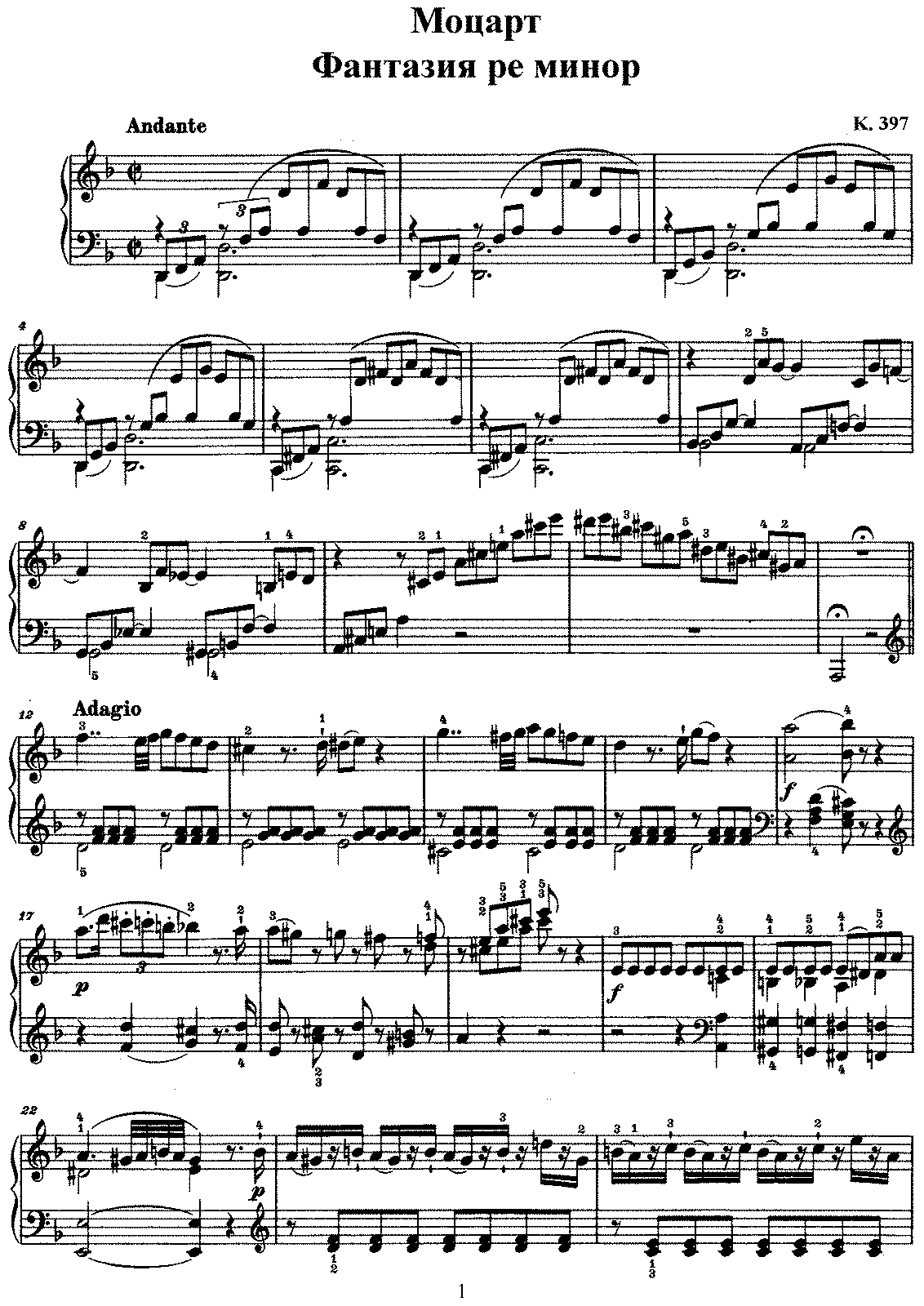
Mozart’s Fantasia in d minor, K. 397

mozart-fantasia

I have always really enjoyed playing Mozart’s Fantasia in d minor and when I was asked to play for the new piano dedication service at my church a couple years ago I knew what I would “dust off” to perform.

The Grove’s Dictionary of Music and Musicians defines the genre of musical fantasia as “a piece of instrumental music owning no restriction of formal construction, but the direct product of the composer’s impulse.”

The Fantasia in d minor has somewhat unusual rhythm, constantly changing tempo (seven different tempi occur throughout the piece), three cadenzas and its apparent lack of any recognizable musical form (as indicated by the “Fantasy” title). Although it begins in d minor, the final section is in D Major.

Mozart composed this, his third and final, Fantasia in 1782 and it was unfinished at the time of his death in 1791.  Even Mozart’s sister, “Nannerl”, who came across the work in 1807, was astounded to have discovered a previously unknown composition of such quality.

In its original form this Fantasia was probability only a fragment of what was to be a larger work. The closing bars which are most frequently performed today originated from an unauthorized print believed to have been composed in 1806 by August Eberhard Müller, one of Mozart’s admirers.

Because it was unfinished, many of the dynamic and pedal markings are nonexistant and left for the performer to choose.

As you can see from these videos, there is a wide range of tempi and interpretation from Frederich Gulda’s 4 minute, 36 second rendition 

to Glenn Gould’s version which lasts for 8 minutes, 22 seconds

Both these composers have added their own ornamentation to Mozart’s original work.

I will be playing from a G. Henley Verlag urtext edition instead of one of the many edited versions available.  I prefer to make my own musical decisions wherever possible.

The version above is originally from http://imslp.org/wiki/Fantasia_in_D_minor,_K.397/385g_(Mozart,_Wolfgang_Amadeus)  I had printed it out as another source to compare with mine, since this one has different dynamic and other interpretive markings.  This version also has 3 notes which differ from the urtext edition.

I also used 3 other sources before I finally decided how I would shape my performance and choose my fingerings.

Some sites that I consulted as part of the learning process: 

I’ve played this for just about everyone I know and on 4 different pianos and it was ready on time!


Piano Lessons Not Just For Kids

~~~

By Diana Greenburg 

When Paula Fay started taking piano lessons for the first time in her late fifties, it fulfilled a lifelong dream.

“I always wanted to learn how to play as a child, but my parents couldn’t afford it,” she said.

Today, four years later, Paula can play some of her favorite tunes. And she’s loving every minute of it.

Some adults may groan at childhood memories of lesson after lesson, practice after practice and a lot of teacher nagging, but many wish those days were back.

And more and more, these adults are turning wishful thinking into reality. According to the National Piano Foundation, adults ages 25-55 are the fastest-growing segment of people learning piano.

When Ruth Ann Laye started teaching an adult piano class at Mandarin’s Keyboard Connection, there was only one weekday class. Now, she’s up to seven classes. And of her own private practice of 28, 11 are adults.

One of her students is Belinda May from St. Augustine, who is in her 60s and in her second year of piano lessons.

Though her brothers played piano, she was more athletically inclined than musical. Then after years of “picking” at the pianos in her house, she recently resolved to start taking lessons. A beginner when she started, “now I’m playing Christmas carols,” she said.

“It tells me that you’re never too old to learn something new.”

Maureen Rhodes, a piano teacher on the Southside, would likely agree. She has more adults in her practice than she did 20 years ago.

“I think baby boomers are looking for ways to stay active,” she said. “Sometimes, kids come to me for lessons and then when they grow up and leave, their mother starts to take lessons,” says Rhodes. “Other adults have a specific goal in mind, like they want to play in church or accompany their grandson.”

Sandra Stewart, outgoing president of the Jacksonville Music Teachers Association and adjunct professor teaching a non-degree adult piano course at Florida State College, believes technology is a big part of the reason for the greater interest in piano among adults.

“Keyboards are more affordable, and that’s made all the difference,” she says.

But the piano is not always a succession of high notes for the adult student. Says Stewart: “Adults can have problems with finger dexterity. If they never played before, this can be frustrating. People who use computer a lot have an advantage. But if they don’t have this experience, they have to get over that hurdle.”

And some adults expect to transform into Mozart overnight.

“They may be symphony patrons or just love classical music and want to play instantly and do it like the pros,” Rhodes says. “But they have to develop the skills first, and it takes a lot of patience.”

But for adults committed to learning, it can be very satisfying for student and teacher alike.

“Adults are there for their own pleasure,” said Marc Hebda, president of the Florida State Music Teachers Association. “They have wonderful enthusiasm; it’s fun to see them get excited. It’s also interesting that with the economic downturn, they are not cutting back on lessons or buying instruments. Piano is a constant source of entertainment and personal development.”

The key to any student learning well, whether that student is an adult or child, is finding the right teacher. Hebda stresses the importance of taking lessons from a teacher with a music degree.

“Some people who took piano figure it’s easy to teach. But credentials are very important. You wouldn’t go to a doctor without certification or a lawyer who didn’t pass the bar. All our teachers have a music degree or demonstrate teaching ability.”

Hebda also notes that rapport between teacher and student is important.

“The student should interview the teacher, because not all students and teachers are a good match.”

For those who want to fast-track the learning process, there are alternatives. “The Piano Guy,” Scott Houston, has been teaching piano using a non-traditional method through his shows on public station WJCT.

“It seemed like there was a single path to the world of piano: this long process of taking lessons,” he said. “But people want to play the tunes they know.”

So Houston came up with a simple way for adults to learn quickly, based on the concept behind “lead sheets,” which are used by professional musicians. Houston’s technique is to teach adults a single line of notes on the treble clef with their right hand and chords with their left.

“My goal is not to teach adults to be the greatest players but to be able to play the tunes they want to play,” Houston says.

His approach has clearly struck a chord, as his book has sold 300,000 copies and he has taught many adults through his workshops in Indiana and master class “piano camp” from his beach home in Fort Myers.

There’s also a new trend gaining traction called “recreational music making” — RMM — which like Houston’s approach focuses on a simplified method to teaching music. The goal is not for a student to become accomplished at the piano and perform, but rather to just have fun making music. It is often taught to adults in group settings, such as music stores, churches and senior centers.

“Research has found that RMM is very helpful for seniors, promotes hand/eye coordination and keeps the brain working,” said Erin Bennett, assistant professor of piano and pedagogy at the University of North Florida. “Its asset is the ability to reach more people; it’s more inclusive and easier for the non-experienced.”

Whether learning piano through traditional or nontraditional means, its many benefits include boosting self-confidence.

“When I first started, I didn’t think I could do it,” Fay said. “And my friends and family were in disbelief that I was taking lessons. Then they wanted to hear a concert. In another year, I might just do it.”

She gets some measure of satisfaction in surprising those around her.

“Society puts restrictions on us as we get older that we stop learning,” she says. “But we are wiser, more patience and accept our limitations.”

Read more at Jacksonville.com: http://jacksonville.com/entertainment/music/2011-10-27/story/piano-lessons-not-just-kids#ixzz1l14hSFaV

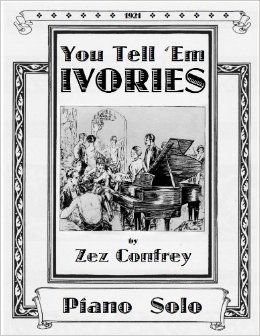
Zez Confrey (1895-1971)

confrey-you

I just love Zez Confrey’s music.  It’s not overplayed like some of Scott Joplin’s works but it’s just as much fun.

This is a piece I have often played in recitals and just for fun.

If any of my students are interested in tackling this piece, just let me know and we’ll start learning!

More about Zez Confrey

One of the books in my studio is Zez Confrey at the Piano: Piano Solos.

confrey-book“This collection represents a cross-section of Confrey’s works and encompasses the broad range of his styles. Besides his famous 1920s novelty works (including Kitten on the Keys), there are many wonderful, lesser-known gems of remarkable quality included here from later in his career. Appearing for the first time in print are transcriptions of one of his disc recordings (Poor Buttermilk) and two of his player piano roll arrangements (My Pet and Humorestless). Many of Confrey’s later works have long been out of print and are included here for the first time in decades.”

FREE Piano Practice Book Through Tuesday!

101


From the author:

Let’s face it. Most kids don’t want to practice the piano. And if they do find the time to practice, it’s usually because their parent kept nagging them. How frustrating!

Piano teachers are frustrated too. It’s nearly impossible to teach students new concepts when they don’t understand the old ones–all because of a lack of practice.

If you’re a parent in this situation, I have just the solution you’re looking for.

In this upbeat book, I share all the tips I’ve discovered in my 14 years of teaching piano. You’ll learn fun, practical ways to get your kids to the keyboard.

But this book goes one step further. I’ll show you easy ways to encourage better quality practice. Even if you’ve never had a music lesson in your life!

I wrote this book for kids of all ages. There are creative ideas for elementary students and also a section for teens.

There’s even a section for what to do if your child wants to stop taking piano lessons. That’s right, there is hope and my book will show you exactly how to get them interested in piano again.

Don’t be the kind of parent who sits on the sidelines waiting until their child wants to practice. Piano lessons are too expensive for you to let another “no-practice” day go by.

This book is your answer to get your child to the keyboard, have good quality practice and develop a life-long love of music.

Download for free here.

Coming Soon for Younger Students!

RT_Front-cover

This new method book is at the publishers right now.  I’ve already downloaded the Teacher’s Guide and I’m liking what I see.

From the Piano Pronto website

Roadtrip! is a primer level method book for very early beginners ages 4 and up. Students master basic music fundamentals while creating a musical memory book that becomes a keepsake item to commemorate their maiden voyage into piano lessons.

18 songs: Non-position based; black key pieces; R.H. & L.H. only pieces; on-staff reading only
Also features: improvisation activities; ear training; composition; teacher duets

What this means for the O’Connor Music Studio – younger beginners will be able to get a great start to their musical lives.  Previously, I’ve only accepted students starting at age 6.

Starting with the new school year, interested parents can enroll their students from the age of 4.

Register for lessons here: http://ocms.mymusicstaff.com/Register-for-Lessons


Local Event August 1, 7:00 PM

Barbershop


The Harmony Heritage Singers will present a Barbershop Harmony Concert on Saturday, August 1 at 7:00 pm at the Greenbriar Commons Park (next to the pool).

Free sodas and pretzels

Bring your chair or blanket

Rain Date: Sunday, August 2 at 7:00 pm

Barbershop harmony is music in a very pure form created with nothing but human voices coming together to create a rich and satisfying texture that is pleasing to the ears and invigorating to the soul. The barbershop style is unaccompanied vocal music characterized by four-part chords. The melody is sung by the lead, with the tenor harmonizing above the melody, the bass singing the lowest notes, and the baritone completing the chord.

For more about the barbershop style, please click here.

About the Harmony Heritage Singers:

We are the Harmony Heritage Singers, a group of retired gentlemen who enjoy singing together in the distinctive barbershop style. Under our director, Bob Wachter, we rehearse twice a month during the day at Sherwood Regional Library in the Mount Vernon neighborhood. We also present about 25 performances a year, mostly at retirement communities and seniors groups in Northern Virginia, Maryland, and the District of Columbia.

Free Children’s Music Program

music-camp2015-header


At Pender’s Music Camp, rising second through sixth graders sing in choir, play Orff instruments, ring handbells, experiment with rhythm in a percussion class, learn to read music, and make crafts.

Friday afternoon traditionally concludes with musical performances which our campers perform for friends and family!

The Music Camp Final Program will be Friday, July 10 at 3:00 pm.

Directions to Pender

12401 Alder Woods Drive
Fairfax, VA 22033
Tel: 703.278.8023

Summer Camp is Back. New Pop Song Released Each Week!

PM-SummerCamp

Summer is upon us which means BBQ cook outs, poolside hangouts and lots of ice cream! It also means less time by the piano, which means getting back into the groove of playing can be difficult come September.

We at JoyTunes want to keep you playing all summer long! To do so we are bringing back Summer Camp in Piano Maestro!

Each week, starting July 1st, we will release a new fun song for you to learn and play. Songs from artists such as

Colbie Caillat

Michael Buble

Florida Georgia Line and more!

Summer Camp songs can be found in the “summer camp” category in the Library.

Prizes will be rewarded to top players, we want to recognize your awesome playing!

Summer Camp is the perfect way to keep your piano practice up during this summer, as to not miss a beat.

The first song of Summer Camp will be Andy Grammer “Honey, I’m good”. Check out the (very cute!) video for the song to get a taste of what to look forward to!

via Summer Camp is Back. New Pop Song Released Each Week! | JoyTunes.