Albert Lavignac / Galop-Marche
For 4 pianists
or for 12 pianists
I have downloaded this music if anyone wants to try any of the parts!

Albert Lavignac / Galop-Marche
For 4 pianists
or for 12 pianists
I have downloaded this music if anyone wants to try any of the parts!

Student recitals can be lots of fun and create valuable experiences for pianists. Unfortunately, they can also be a source of anxiety or stress if students aren’t ready and/or guidelines aren’t followed.
There are guidelines and rules of behavior all performers and audience members should follow during recitals, concerts or other performances.
Audience members must remember the reason for their visit to the recital hall – to listen quietly, actively and appreciatively to the music being offered by the performers.
For the performer:
1. Dress appropriately. Performers being nicely dressed (or following the recital theme) shows respect for the audience, the teacher and themselves!
Girls in knee-length or longer skirts/dresses or slacks. No spaghetti straps, no platform shoes, flip-flops, bedroom slippers or athletic footwear.
Do not wear dangling, jingling jewelry – especially bracelets. You may need to remove rings if they twist around easily.
Boys in dress pants and buttoned dress shirts with ties preferred, or suits.
IMPORTANT: Remember to practice several times in your outfit, shoes included. You don’t want to get to the recital and find that you can’t use the pedal properly because of your shoes.
2. Clean hands! Dirty, sticky, or oily fingers can hurt your performance and bother the next pianist. If you complete a long piece and notice some keys are slippery with sweat (a very common issue), notify your instructor so they can clean the keyboard before the next performer.
2. When it is your turn, stand quickly and walk up to the stage. Do not run!
Bow before you perform to acknowledge the applause. Audiences used to know that it was appropriate to clap for the musician who was entering the stage to perform. This now isn’t always the case (I will start clapping if it doesn’t happen automatically). Students should bow to their applauding audience before they sit down at the bench (not acknowledging applause is generally considered to be rude).
2. Enter the bench from the side furthest from your audience. This was a biggie for my former piano teacher and I’m reminded of it every time I see a student slink in from the “front side”… or climb over the top. I used to think this was awfully stuffy – but when you see a student do it, it just looks right.
3. Hands in your lap before you begin. I use this with my students to give them a moment to hear the first few measures in their mind before they begin. Once fingers are on the keys it means you’re ready to play. If the bench needs adjusting it should be done first… and then hands should be placed in your lap before beginning to play.
Play the scale of the piece in your head and think over tempo, markings, etc. Then arch your hands onto the piano and position feet on the pedals or flat on the floor–NEVER under the stool. Proceed to play!
3. Should you make a mistake while performing, you should try to continue playing without starting over or repeating. This makes sufficient practice before the recital very Very VERY important!
If playing more than one piece, you should acknowledge applause in between with a nod or smile.
4. Hands in lap after you finish. So many piano students are already lifting themselves off the bench as they play the final note (perhaps really eager to return to their seat in the audience!?) Learning to place your hands in your lap after finishing gives the audience a moment to truly relish what they just heard.
5. Rise and stand at the edge of the piano (with left hand on the wood). Bow from the hips, don’t curtsey. Bowing nicely takes practice! In handbells, we bow towards the table and say silently “I love handbells”. The same can be said in piano recitals – “I LOVE Piano”.
6. Walk calmly off the stage or away from the piano. No running… no matter how badly you want to get back to your seat!
For the audience:
Recitals are a special occasion and so it is customary to dress nicely.
• Please arrive a little early in order to find a comfortable place to sit.
• Make sure all your invited guests understand the importance of arriving on time. If they arrive late, it makes it difficult for those performing.
• Please invite as many friends and family members as you’d like. Our recital hall has lots of room, and can accomodate likely as many as you’d like to invite. And if not, then a standing room only crowd would be a fantastic crowd to have, and a wonderful problem to deal with!
• Turn off all cell phones and any electrical devices that may produce sound.
• Once the recital begins, please listen and be quiet. Crying babies should be taken out. They are not happy, and neither is the audience or the performer!
• If you arrive late, please wait to enter between pieces when you hear applause. Do not enter the recital hall or switch seats while someone is performing.
• The soloist will bow and your response is to applaud politely!
• No whistling, yelling, or other loud methods of congratulation. While boisterous congratulations are meant to show support for the performer, it may actually cause unintended problems instead. The best way to show appreciation for the performance is with thunderous applause, and an occasional “bravo” at the end of an especially great performance.
• Compositions that have movements or suites are, in general, performed without applause in the middle.
• Respect the performers. Unnecessary noise from whispering, talking, candy wrappers, etc. during a program is not acceptable. Reading, studying, and writing letters during a program are also inappropriate.
• Please stay until the performance or event is completely over. Attending a recital so that other families will serve as audience to your student, and then leaving before the other performers have finished is rude, inconsiderate and unacceptable. If you have other obligations or matters to attend to before the recital is over, please do not attend.
• Flash photography is not appropriate during a performance. The flash can disrupt the performer’s concentration.
• Enjoy! Your presence is the greatest affirmation!
For Everyone:
No Perfume! Your perfume or cologne will linger around the piano after you leave the stage (especially under hot lights), and it might give the next pianist some sinus or eye irritation; or, at the very least, create a distraction that can prevent them from getting “in the zone.”
Parts of this article adapted from It’s The Little Things That Count… Piano Etiquette and Your Piano Students | Teach Piano Today

Imagine sixty kids singing and playing music to the Lord. What a glorious sound it would be, right? This is the ministry of Music Camp… to give children a chance to see how fun using music to praise the Lord can be! Like Vacation Bible School, which is held the same week in the mornings, this venue encourages the participation of children in a week-long camp format.
Music Ministry staff and volunteers work together each year to organize and orchestrate a summer music camp. It’s an opportunity for students and parents alike to experience the joy of praising God through music. Musical experience is not necessary to participate!
At Pender’s Music Camp, rising second through sixth graders sing in choir, play Orff instruments, ring handbells, experiment with rhythm in a percussion class, learn to read music, and make crafts. Older youth are always welcome to help out as teaching assistants.
Friday afternoon traditionally concludes with a musical performance, complete with costumes and choreography, which our campers perform for friends and family!
Please Read:
Payment Options:
Register here: http://www.penderumc.org/musiccamp

Prepare to embark on an adventure like no other, scouring the mysterious fathoms of the deep sea. Thrilling discoveries await just beyond the portholes of your submarine. Things look very different once you get below the surface – and that’s true for life above the surface, too.
As kids submerge themselves in God’s Word, they will discover that Jesus saw people differently. He didn’t just see what’s on the outside; He saw who people were down deep.
As kids learn to see themselves and others as Jesus sees them, they can realize that everyone needs a Savior – even those who look like they have it all together. A relationship with Jesus Christ changes everything! All you have to do is dive in!
Kids will rotate through music, recreation, snack, crafts and storytelling!
Basics:
.Please contact Jami Flemmons or Ann Hines if you have questions or want to volunteer.
Register at http://www.penderumc.org/vbs

Found on Pinterest
So often transfer students will come to me and play a piece they’ve been working on. When they make a mistake, they’ll stop and start the piece all over again instead of correcting the mistake on the spot and moving on.
If they do this at home in practice, they’ll have played the beginning part many times more than the ending – or they may have never gotten to the ending at all!
The infographic above shows a way to get around this problem. It’s also great for memorizing pieces during recital preparation.
Similar to this are some pieces in the early pages of beginning method books. Lines 1, 2 and 4 will be identical with only line 3 being changed.
If a student plays this over and over all the way through, he’s learned line 1 three times better than line 3. I always suggest practicing line 3 by itself several times to help counter this problem.

WRONG – this post, and others in this category, isn’t about ornaments at Christmas but about those funny looking marks over your music and how to play them.
The trill (or shake, as it was known from the 16th until the 19th century) is a musical ornament consisting of a rapid alternation between two adjacent notes, usually a semitone or tone apart, which can be identified with the context of the trill.
A trill provides rhythmic interest, melodic interest, and harmonic interest. Sometimes it is expected that the trill will end with a turn or some other variation. Such variations are often marked in the music.
A trill in your music can look like this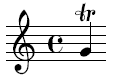
Or like this tr~~~~~~~~~~~~~
Trills can be played differently, depending on the period in which the composer was living so it is important to know the time period of your piece.
Baroque trills (aka shakes in this time period) have several ways to be played as shown in this chart:
![A table depicting how to perform different types of trills when playing music from the Baroque period (1600-1750).[4] Note the similarity between the symbol for trill and that of the mordent.](https://oconnormusicstudio.com/wp-content/uploads/2015/03/baroque_trill_instructions.png)
A table depicting how to perform different types of trills (or shakes) when playing music from the Baroque period (1600-1750).
The Baroque trill continuing through Mozart’s time usually begins on the note above the main note.
In music after the time of Mozart, the trill usually begins on the principal note.
Often, your music will have suggestions about how they should be played written above the music. If not, ASK!
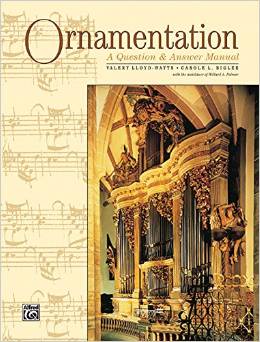
A really good book which explains about the trill and other ornaments is this one, available as a reference book in the O’Connor Music Studio:
Some trill exercises:
Questions? Write them down and don’t forget to ask at your next lesson!


JoyTunes Piano Gloves
I thought this would surely interest all piano teachers and lovers out there – JoyTunes’ just came out with new piano teaching GLOVES!
Take a look in the clip and share it to all piano lovers everywhere.
The JoyTunes gloves, still in beta version, will turn you into Mozart in the blink of an eye! Don’t know how to play piano? These gloves will take you from 1 note to Beethoven in a flash. Our gloves allow your hands to auto magically bend and move to play any song your heart desires! Check out the video for more info.
Want to get your own pair of gloves? Purchase them here: http://www.joytunes.com/gloves

I have a copy of this music (Faerie’s Aire and Death Waltz) if anyone is interested in playing it!
Actually, this has been attempted!


Four students.
The Model Student and the Bored Teenage Student:
The Can’t-Stop-Playing-Even-When-the-Teacher-Is-Talking Student and the Whiny Student:

