Local Music Camp – Pender!

music-camp-2016b-feature

Imagine sixty kids singing and playing music to the Lord. What a glorious sound it would be, right? This is the ministry of Music Camp… to give children a chance to see how fun using music to praise the Lord can be! Like Vacation Bible School, which is held the same week in the mornings, this venue encourages the participation of children in a week-long camp format.

Music Ministry staff and volunteers work together each year to organize and orchestrate a summer music camp.  It’s an opportunity for students and parents alike to experience the joy of praising God through music. Musical experience is not necessary to participate! 

At Pender’s Music Camp, rising second through sixth graders sing in choir, play Orff instruments, ring handbells, experiment with rhythm in a percussion class, learn to read music, and make crafts. Older youth are always welcome to help out as teaching assistants.

Friday afternoon traditionally concludes with a musical performance, complete with costumes and choreography, which our campers perform for friends and family!

Please Read: 

  • Online registration is open
  • Please fill out a separate form for each child.
  • There is a total limit of 60 children.
  • Be sure to register your child, not yourself.  Click “Register Additional Individuals/Family”
  • The charge will be $30 per child and $60 max per family.  NOTE:  Be sure to check the box that asks if you are registering 3 or more siblings to get a refund (Are you registering 3 or more siblings (brothers or sisters))
  • The Closing Program will be at 4:00PM.  This is a change from previous years.

Payment Options:

  • Fees must be paid online during registration by check or debit/credit card

Register here: http://www.penderumc.org/musiccamp

Summer Camp Opportunity


Prepare to embark on an adventure like no other, scouring the mysterious fathoms of the deep sea. Thrilling discoveries await just beyond the portholes of your submarine. Things look very different once you get below the surface – and that’s true for life above the surface, too.

As kids submerge themselves in God’s Word, they will discover that Jesus saw people differently. He didn’t just see what’s on the outside; He saw who people were down deep.

As kids learn to see themselves and others as Jesus sees them, they can realize that everyone needs a Savior – even those who look like they have it all together. A relationship with Jesus Christ changes everything! All you have to do is dive in!

Kids will rotate through music, recreation, snack, crafts and storytelling!

  • Registration is open online now! 
  • Please fill out a separate form for each child.
  • There is a total limit of 250 children.
  • The charge will be $30 per child and $60 max per family.
    NOTE:  Be sure to check the box that asks if you are registering 3 or more siblings to get a refund (Are you registering 3 or more siblings (brothers or sisters)?)


Basics:

  • July 11-15, 9:00 to 12:00 each day at Pender UMC, 12401 Alder Woods Drive, Fairfax, VA 22033
  • Music Camp will be from 12:30-3:30 the same dates.  Registration information coming soon.
  • Kids age 3 through 6th grade are welcome – note all children must be potty trained, teachers will NOT change diapers

.Please contact Jami Flemmons or Ann Hines if you have questions or want to volunteer.

Register at http://www.penderumc.org/vbs

Backwards Practice?

Found on Pinterest

Found on Pinterest

So often transfer students will come to me and play a piece they’ve been working on.  When they make a mistake, they’ll stop and start the piece all over again instead of correcting the mistake on the spot and moving on.

If they do this at home in practice, they’ll have played the beginning part many times more than the ending – or they may have never gotten to the ending at all!

The infographic above shows a way to get around this problem.  It’s also great for memorizing pieces during recital preparation.

Similar to this are some pieces in the early pages of beginning method books.  Lines 1, 2 and 4 will be identical with only line 3 being changed.

If a student plays this over and over all the way through, he’s learned line 1 three times better than line 3.  I always suggest practicing line 3 by itself several times to help counter this problem.

Ornaments Aren’t Just for the Holidays

OLYMPUS DIGITAL CAMERA

WRONG – this post, and others in this category, isn’t about ornaments at Christmas but about those funny looking marks over your music and how to play them.

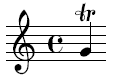
The trill (or shake, as it was known from the 16th until the 19th century) is a musical ornament consisting of a rapid alternation between two adjacent notes, usually a semitone or tone apart, which can be identified with the context of the trill.

A trill provides rhythmic interest, melodic interest, and harmonic interest. Sometimes it is expected that the trill will end with a turn or some other variation. Such variations are often marked in the music.

A trill in your music can look like thistrill

Or like this tr~~~~~~~~~~~~~

Trills can be played differently, depending on the period in which the composer was living so it is important to know the time period of your piece.

Baroque trills (aka shakes in this time period) have several ways to be played as shown in this chart:

A table depicting how to perform different types of trills when playing music from the Baroque period (1600-1750).[4] Note the similarity between the symbol for trill and that of the mordent.

A table depicting how to perform different types of trills (or shakes) when playing music from the Baroque period (1600-1750).

The Baroque trill continuing through Mozart’s time usually begins on the note above the main note.

In music after the time of Mozart, the trill usually begins on the principal note.

Often, your music will have suggestions about how they should be played written above the music.  If not, ASK!

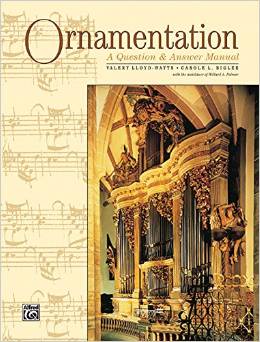
A really good book which explains about the trill and other ornaments is this one, available as a reference book in the O’Connor Music Studio:

ornamentation

Some trill exercises:

Questions?  Write them down and don’t forget to ask at your next lesson!

A New Way to Learn: Piano Gloves!

JoyTunes Piano Gloves

JoyTunes Piano Gloves

I thought this would surely interest all piano teachers and lovers out there – JoyTunes’ just came out with new piano teaching GLOVES!

Take a look in the clip and share it to all piano lovers everywhere.

The JoyTunes gloves, still in beta version, will turn you into Mozart in the blink of an eye! Don’t know how to play piano? These gloves will take you from 1 note to Beethoven in a flash. Our gloves allow your hands to auto magically bend and move to play any song your heart desires! Check out the video for more info.

Want to get your own pair of gloves? Purchase them here: http://www.joytunes.com/gloves

From TED-Ed: How Playing An Instrument Benefits Your Brain

When you listen to music, multiple areas of your brain become engaged and active. But when you actually play an instrument, that activity becomes more like a full-body brain workout.

What’s going on? Anita Collins explains the fireworks that go off in musicians’ brains when they play, and examines some of the long-term positive effects of this mental workout.

via How playing an instrument benefits your brain – Anita Collins | TED-Ed.

Bi-weekly Lessons – Why they won’t work – The Piano Studio

7 reasons why bi-weekly lessons do not work…


Now and then, our studio gets asked if we offer bi-weekly lessons. I mean, doesn’t it make sense that if you take lessons every other week, you have half the number of trips into the studio, you have double the amount of time to practice, and you can save some money, right?

WRONG.

Aside from the fact that it is a scheduling nightmare for the teacher and studio, I want to outline a few reasons why (in most cases) bi-weekly lessons do not work.

Source: Bi-weekly Lessons – Why they won’t work – The Piano Studio