Thank you for your interest in the O’Connor Music Studio!
Available times are on Mondays, Wednesdays and Fridays during the day and after school for all ages and levels. There may be other times available if requested.
After you register, you will get a confirmation email with the information you need to access the Student Portal. After logging in you may choose from the available lesson times or request something different.
Your $20.00 interview deposit will be credited towards the second month of lessons.
If you are a transfer student, please bring your most recent method book(s) and notebook to the interview.
Prospective students must have a piano, organ or electric keyboard to use for daily practice.
Roadtrip! students (ages 4-5) are scheduled for half-hour lessons with their parents present.
Beginning children (ages 6 to 9) are scheduled for half-hour lessons.
Youth (ages 10 and up) may be scheduled for half-hour lessons or forty-five minute lessons.
Adults are highly encouraged to take hour-long lessons, but are always welcome to schedule half-hour lessons at first.
The Piano Puzzlers book is available in the O’Connor Music Studio library if you’d like to give any a try. Piano Puzzlers as heard on American Public Media’s “Performance Today.” Includes 32 tunes with songs by Gershwin, Berlin, Arlen, Porter, Rodgers, Fats Waller, Lennon & McCartney, and others disguised in the styles of Bach, Handel, Haydn, Mozart, Beethoven, Brahms, Schubert, Schumann, Chopin, Janacek, Debussy, Ravel, Rachmaninoff, Stravinsky, Prokofiev, Bartok, and Copland.
Includes an introduction by Fred Child, host of “Performance Today” as well as background info by Bruce Adolphe. “Bruce Adolphe has taken a common musician’s party game and elevated it to high art and truly funny musical slapsticks. The Piano Puzzlers are a unique combination of extraordinary insight into the styles of many composers subtle, expert workmanship and great, great fun!”
If you’re a music geek (like me), I have a program for you. Now, let me be clear, to fully qualify as a music geek…you must have a fond appreciation for classical music (no, Poison, Quiet Riot, and Zepplin do not count as classical music). So, if you’re a “music geek” without an appreciation for classical music…well, I hate to burst your bubble…but, you’re not truly a music geek. Instead, you’re a music appreciator, but not a geek. So, if you just listen to indie music and scowl at anything on a label larger than Matador…don’t bother following the link I’ll provide…the fun will be lost on you…And, you probably won’t have a chance.
Every Wednesday night, on my way home from WNL, I turn on my local NPR station to listen to Piano Puzzlers on Performance Today. It’s absolutely incredible. A pianist/composer (Bruce Adolphe) takes a familiar folk or pop tune and sets it inside a classical masterpiece (or in the style of a particular composer). Sometimes it’s easy…sometimes it’s ridiculously difficult. There are days when I say, “got it” on the first pass. Then there are days when I say, “what the heck?” And, more often than not, I’m able to get either the popular/folk tune or the composer.
This is sad to admit, but there are nights when I’ll slow down on the drive home or sit in the car in the driveway to finish an episode. In fact, I get a little worked up if someone stops me after WNL…as I might miss the beginning of Piano Puzzlers (it usually hits around 8:20pm on our local station).
Take a listen to some of the archives and see if you can figure it out! It’s really cool…but probably only appreciated by music geeks (the kind of people that listen to NPR for their musical programs and not just the snipets of cool indie rock between segments on All Things Considered…which is a great show too).
Let’s face it. Most kids don’t want to practice the piano. And if they do find the time to practice, it’s usually because their parent kept nagging them. How frustrating!
Piano teachers are frustrated too. It’s nearly impossible to teach students new concepts when they don’t understand the old ones–all because of a lack of practice.
If you’re a parent in this situation, I have just the solution you’re looking for.
In this upbeat book, I share all the tips I’ve discovered in my 14 years of teaching piano. You’ll learn fun, practical ways to get your kids to the keyboard.
But this easy-to-read guide goes one step further. I’ll show you simple ways to encourage better quality practice. Even if you’ve never had a music lesson in your life!
I wrote this book for kids of all ages. There are creative ideas for elementary students and also a section for teens.
There’s even a section for what to do if your child wants to stop taking piano lessons. That’s right, there is hope and my book will show you exactly how to get them interested in piano again.
Don’t be the kind of parent who sits on the sidelines waiting until their child wants to practice. Piano lessons are too expensive for you to let another “no-practice” day go by.
This book is your answer to get your child to the keyboard, have good quality practice and develop a life-long love of music.
When my students are first working with the Grand Staff, they are often confused about the placement of the various clefs.
In piano music, we generally use only the G-clef (Treble clef – not “trouble clef” as some think!) and the F-clef (Bass clef) I try to show students how the curvy part of the G-clef wraps around the G above middle C and the F-clef looks sort of like an F marking the F below middle C. I draw out G and F on the staff to show how these could have looked.
Originally, instead of a special clef symbol, the reference line of the staff was simply labeled with the name of the note it was intended to bear: F and C and, more rarely, G. These were the most often-used ‘clefs’ in Gregorian chant notation. Gregorian chant developed mainly in western and central Europe during the 9th and 10th centuries, with later additions and redactions.
Over time the shapes of these letters became stylized, leading to their current versions.
The following ornament table is a transcription of the one appearing in the Clavier-Büchlein vor Wilhelm Friedemann Bach, written by Johann Sebastian Bach for the keyboard instruction of his eldest son.
A scan of the original manuscript appears at Dave’s J.S. Bach Page.
The German title translates as “Explanation of various signs, showing how to play certain ornaments correctly.”{1} Bach gives the sign for each ornament on the upper of the paired staves, while the lower shows its execution directly beneath.
(This blog has) simply modernized the clefs in my transcription, since Bach’s manuscript uses soprano clefs, as several composers continued to do throughout the 18th century in place of the treble clef now used in all keyboard music.
After the transcription graphic showing the table, there appear clickable buttons which are keyed to AU sound files; you can click on any of the ornaments and hear a sound file play its execution.
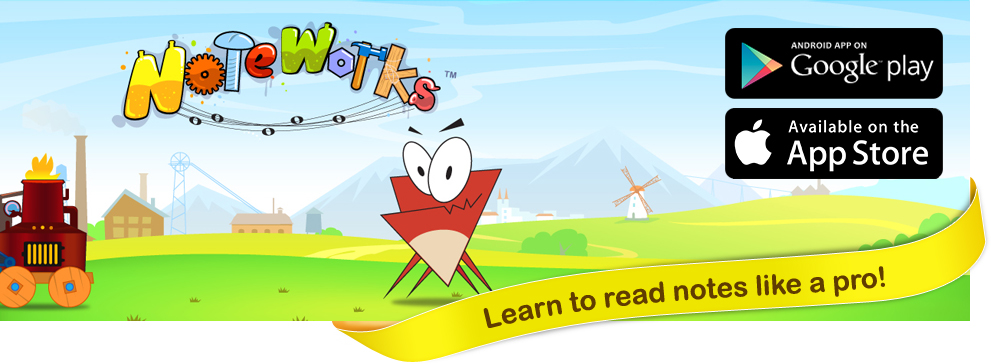
There’s a new app in the studio! It’s called NoteWorks and it looks like it will be fun for the students. NoteWorks is an engaging, fun game, designed to teach note reading.
Beginners use NoteWorks as a terrific alternative to flash cards. More advanced students use the full version to practice key signatures with up to seven sharps and flats in multiple clefs.
Kids love the app because it’s fun and addictive. Teachers and parents love how the game improves students’ note recognition and sight reading skills.
If you want this for home use, it’s available for iPhone, iPad and Android. The cost for the full version for home use is a one time fee $4.99, directly in the app. More info at https://doremiworld.com/Games/NoteWorks
I already have my students set up so we can use this during lessons, but let me know if you plan to use this at home and I’ll give you the code to connect to the studio account.
The objective of this game is to teach note recognition and improve sight reading skills. Game options include treble and bass clefs (with the grand staff option) as well as tenor and alto clefs.
Students may identify notes using the piano keyboard and practice using the Do, Re, Mi or the A, B, C note naming. The game starts by teaching a limited range of notes, with the range gradually increasing. As the players acquire basic note reading skills, the game becomes more challenging, with the introduction of accidentals, and subsequently key signatures.
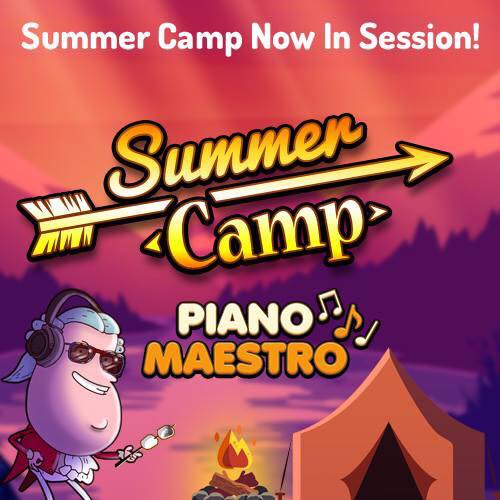
A NEW version of Piano Maestro has arrived with Summer Camp (YAY!), new engine for improved note recognition and multiple bug fixes! Make sure to update your app to get:
***Summer Camp!
– Tune in each week to see which free song will be released for your students to learn and play
– “Johnny B Goode” by Chuck Berry is this week’s first song
– Available in three versions (easy, melody line and 2 hand version), songs can be accessed from the main menu or the new Summer Camp category in the Library
– Each week, a top student with 3 stars will be awarded a gift card!
***NEW next-generation MusicSense engine for improved sound recognition for those of you that have been experiencing a few issues.
***We also made multiple bug fixes thanks to your feedback, such as better looking clefs and song audio snippets now play properly. And, of course the icon got a summer makeover 😎