Piano Pedals – History of Piano Pedals

piano-pedal-diagram piano-pedal

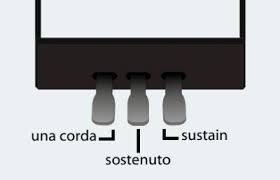
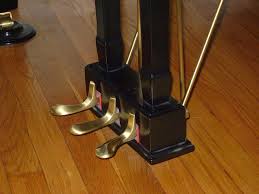
Piano pedals have existed for almost as long as the modern piano itself, but they had a rocky start. While the modern piano accepted most of its final touches, the evolution of the piano pedal continued.

In 1722, the piano’s first tone-modifying mechanism came in the form of a hand stop, and was created by Father Piano himself: Bartolomeo Cristifori. The device positioned the hammers to strike only one piano string per key, which created a soft, relaxed timbre. But it was far from ideal; a spare hand was required to use it, meaning the pianist either repeatedly removed one hand from the keys, or practiced alongside a hand-stop operator. Thankfully, the mechanism was later modified to be operated by the knee, and became the predecessor to today’s una corda, or “soft,” pedal.

The next modification arrived soon after. Gottfried Silbermann — renowned European constructor of keyboard instruments — created a mechanism that lifted the dampers off of the strings, causing a reverb effect. This early sustain pedal had an advantage over most modern sustains: treble and bass notes could be controlled separately from one another; however, like the una corda, the sustain did not start off as a foot pedal; an impracticality which may have justified its early unpopularity. Today, the sustain is the most frequently used, and possibly the most favored, piano pedal.

Which brings us to the underdog: the sostenuto pedal. Created in the mid 1800s by Boisselot & Sons, it is by far the most misunderstood piano pedal. The sostenuto is constantly being replaced — or removed entirely — from its position as the middle pedal, and is only standard on an American grand. It allows certain notes to be “sustained” while other notes are left unaffected, and even piano leader Steinway saw potential in the pedal, opting to patent the idea three years after its début in 1844. But, surprisingly, the impressive effects of the sostenuto never caught on.

Alternative middle pedals have included practice rails, which muffle the notes for quiet practice; and the faux-sostenuto, which allows only the bass notes to resonate. Most modern pianos now have only two pedals, leaving the sostenuto –- one of the most unique and inspiring pedals –- to fade into antiquity.

via Piano Pedals – History of Piano Pedals.


From the Web: The Piano Guys rock in a multi-century mash-up : The Ticket

What’s the difference between music of the 1770s and music of the 1970s? According to The Piano Guys, just enough to create a really fantastic mash-up. And so they did.

The group’s latest music video, released on YouTube Tuesday, is the most psychedelic throwback yet to grace the interweb.

Titled “What if the 1770s collided with the 1970s? – ‘I Want You Bach,’” the four-minute video features the alter-egos of musicians Jon Schmidt (“Duke Johann van Keymeister” and “Phil”) and Steven Sharp Nelson (“Sir Reginald von Sharp” and “Scooby”) in a Bach and Jackson 5 mash-up that will make you wonder why the two centuries never met before.

Here’s what The Piano Guys had to say about their inspiration:

“What if the harpsichord from the 1770s hit headlong into the talk box from 1970s? What if J.S. Bach and Jackson 5 met up and just jammed? Would they jive? Can you dig it? These are the kind of far out questions we asked ourselves as we laid down these licks and cut this film. We decided to put together a gig with two wigs in dandy attire and two hep-cats in some funkadelic threads to see if it would fly. … Presenting … ‘I Want You Bach’ – Jackson 5’s funky ‘I Want You Back’ mashed-up with 5 illustrious themes written by J.S. Bach.”

via From the Web: The Piano Guys rock in a multi-century mash-up : The Ticket.

What’s better than one piano? Eight of them at University of Akron MonsterPianos! concert – Local – Ohio

monster

One piano is grand.

Eight being played in unison?

Well, that’s much, much grander.

The University of Akron School of Music hosted its sixth MonsterPianos! concert Sunday at E.J. Thomas Hall.

The special show featured eight grand pianos arranged in a semicircle, 39 pianists dressed in tuxedos and black gowns — not all playing at the same time, mind you — a conductor, and a giant video screen broadcasting all the action.

“It’s an adventure,” admitted conductor Galen Karriker, UA director of bands and associate professor of music.

It’s also immensely popular in the community, as evidenced by the audience of nearly 1,300 people.

UA music professor Philip Thomson founded MonsterPianos! in 2006, borrowing the concept from the late pianist Eugene List.

The concert, organized by Thomson and fellow faculty member Mayumi Kikuchi, is a treat for the musicians as well as the audience, because it’s rare to have so many pianists playing together at the same time.

The piano is typically a solo instrument, after all, and pianists aren’t used to watching a conductor for direction.

The concert poses several challenges for the musicians.

One of the biggest is just the fact that they aren’t used to playing together as a group. They had practiced only six times before the final dress rehearsal Sunday.

Another challenge is that pianists are familiar with hearing themselves play. With so many other pianos, the sound blends together — of course, it’d be weird if it didn’t.

“You have to trust your eyes and not your ears,” said Ann Usher, UA professor of music and director of the School of Music, who performed at the event.

The concert, which lasted about an hour and a half, included Valse Brilliante by Moritz Moszkowski, Rondo a capriccio by Ludwig van Beethoven and the Battle Hymn of the Republic.

There also were some moments of levity such as when Zippy, the UA kangaroo mascot, led a piano-arrangement of the school fight song Win For Akron.

The concert featured faculty, students, alumni and invited guests. Some of those folks traveled from as far away as Massachusetts, Pennsylvania, New York and Texas just to perform.

One of the guests was Juliette Streeter, 14, of Akron, a student at the Miller South School for the Visual and Performing Arts.

She was excited to be chosen to participate.

“It’s not what I’m used to,” Streeter said. “It’s very fun getting used to all the different people and different styles and the ways they play.”

Karriker, who has conducted all six of the MonsterPianos!, said the concert sets UA apart.

“It truly makes us distinctive as far as a School of Music to have this kind of event,” he said. “There’s a lot of folks who love piano music in this community and they are fascinated by seeing that many pianos on stage and hearing what it sounds like.”

via What’s better than one piano? Eight of them at University of Akron MonsterPianos! concert – Local – Ohio.

It takes dedication to master piano keys | The Andalusia Star-News

keys

My piano teacher friend, Michelle, posted pictures of her students the other day. Apparently, they participated in some type of competition/recital, and with pride their teacher shared the results.

They stood smiling into the camera each holding a certificate that announced his or her status in the competition. Seeing them brought back my own memories of piano lessons and recitals. I smiled as I looked into the bright faces of those talented young people.

When I was a kid I wanted nothing more than to learn to play the piano. I had a favorite aunt who played so well and my daddy played by ear better than some folks who read music.

Oh yes, I imagined myself sitting at the keyboard, fingers flying while the family sang along to some favorite hymn or Christmas carol. Daddy would grin with pride and maybe join in playing his harmonica.

It was lovely dream. There was only one little glitch in this plan. I needed lessons in order to make it come true.

So, my parents signed me up with Mrs. Simmons who lived across the street. She was one of the best piano teachers in town and lucky me, all I had to do was cross the street for my lessons.

I’m not sure what I expected, but it was with great disappointment I realized I was not going to produce a beautiful song after only one lesson. Heck, I wasn’t going to produce much more than a repetitive playing of the scales after several lessons.

I recited, Every — Good — Boy — Does — Fine, All — Cars — Eat — Gas, FACE, GBDFA to help me remember the treble and clef lines and spaces. And I played the notes over and over until the sand in the hourglass timer told me it was time to stop. (I’m pretty sure Mother was overjoyed when that last piece of sand fell through the hole.)

When I finally got to the point of making a noise that sounded like something musical, it was, if I remember correctly, a little ditty about a frog — not exactly the moving hymn I imagined playing.

Eventually, I progressed to playing an entire piece of music. That meant I was ready to take part in the annual piano recital. I’d love to say I was excited at the prospect of publicly showing the great strides I’d made in piano playing. In truth, I was more excited about getting to wear an evening gown and lipstick.

For three years, I stuck with the lessons and with the practicing. For three years, I showed up for the recital and played the piece my teacher assigned. I have a picture of myself seated at the piano in my parents’ living room on the night of one of those recitals.

My hair is a perfect flip and I’m wearing a white gown that I imagined made me look like a cross between an angel and a fairy. I have my hands resting on the keys and I’m smiling into the camera like some diva about to launch into a classical masterpiece.

At some point, (probably had something to do with being a teenager and boys) I let go of my dreams of tickling the ivories. I did learn one Christmas carol, which my family heard until they were pretty much sick of it.

As I looked at Michelle’s students holding their certificates, I thought about the dedication it took for them to play so well. I also thought about all those teachers, like my friend and like Mrs. Simmons, who have the calling and the incredible patience it takes to try to teach another human to play a piano, especially when the student is not realistic about what it takes to master the instrument and more interested in evening gowns.

via It takes dedication to master piano keys | The Andalusia Star-News.

‘Seymour’: Ethan Hawke Makes an Introduction

sbernstein

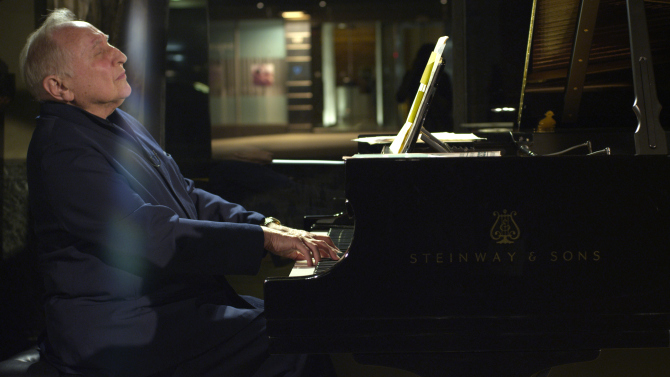
Seymour Bernstein might have ranked alongside such classical pianists as Alfred Brendel and Van Cliburn. His recitals were glowingly reviewed and he had a highly supportive patron. Yet, at the significant age of 50, he voluntarily withdrew from the world of public performance to concentrate on teaching.

When it comes to piano technique and music theory, he clearly has much to offer. But he also has insight into how one best pursues an artistic career in general, or at least that is what one future Oscar nominee thought when he happened to meet Bernstein at a dinner party. The music teacher gets a low-key but satisfying ovation in Ethan Hawke’s documentary profile, “Seymour: An Introduction.”

Evidently, Hawke found in Bernstein an empathetic counselor-guru who could well understand his bouts of stage fright and the general career uncertainty that was plaguing him. Perhaps he was also frustrated about that film he had spent over 10 years on, but had yet to come out. Regardless, Bernstein had a knack for saying reassuring things.

In a variety of master classes and private lessons, we observe Bernstein at work. He is indeed a calm and constructive instructor, but also firm and specific. If you have the talent, he will refine it. Should you doubt it, several of his former students, including pianists Joseph Smith and Kimball Gallagher, offer their reminiscences and insights into Bernstein’s lasting influence on their careers.

For his documentary directorial debut, Hawke was not out to rake any muck. While not exactly hagiography, his “Introduction” is unflaggingly nice and polite. Fortunately, Bernstein is a New Yorker (albeit a really pleasant one), whose experienced, down-to-earth personality keeps it all real and grounded.

Anyone who knows pianos will not be surprised to see the prime placement for American Steinway in “Seymour.” As always, their concert models look and sound lovely. It is also cool to see that they still consider Bernstein a Steinway artist 30-some years after his last public performance. Fittingly, Hawke coaxes Bernstein into a return performance in the Steinway Rotunda on 57th Street, which naturally serves as the closing sequence for the film. Obviously, he still has his touch.

“Seymour: An Introduction” has surely received considerably more attention because of Hawke’s involvement than it otherwise would have, but that is a fine way for him to spend some of his accrued “Boyhood” and “Before Midnight” capital in a way that will generate further good will. It is a very refined and civilized film that will probably have a number of viewers checking out YouTube for Bernstein’s original compositions. (He has a number of them posted, including “The Hawke.”)

Respectfully recommended for classical connoisseurs, Hawke fans, and Steinway admirers, the Salingerishly titled “Seymour: An Introduction” opens this Friday, March 13, in New York at the IFC Center.

From ‘Seymour’: Ethan Hawke Makes an Introduction.

What George Gershwin’s Piano Teaches Us About Technology

gershwinpiano

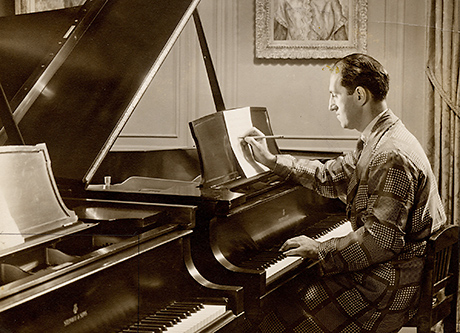
The Gershwin family donated the Steinway to the University as part of the George and Ira Gershwin initiative that is focused on research and study of the brothers’ music.

According to Marc Gershwin, George and Ira’s nephew, “I wanted the instrument to be accessible to the students and faculty who would be preserving the legacy of George and Ira Gershwin’s music… I’m delighted that the piano will once again be in regular use [by students and faculty], and am thrilled that it has been restored to performance condition.” [Two other Gershwin Steinways are in museums.]

From what I know of George he would have wanted it this way. Unlike some composers George was a gifted pianist. He had a rich social life and enjoyed playing his music for anyone who would listen.

There’s a lesson in that thought. If you have something valuable, sometimes it becomes more valuable – or at least more appreciated – when people can see it and use it. If you look at the piano as an instrument of technology that is it, then it makes sense that organizations give people access to technology – as well as resources – to do their work.

Adapted from  What George Gershwin’s Piano Teaches Us About Technology.

The Piano: A 300 Year Old Legaley [sic] Still Going Strong | Free Press Journal

steinway-old


The piano market is booming in India. Experts in the music instrument retail business say that the piano market is expected to see further growth over the next decade says NERITA D’CRUZ.

The lobby of a popular luxury hotel in South Mumbai resonates to the sound of melodious piano music, post 7.00 pm every evening. A Steinway boudoir grand piano stands in the middle of the lobby adding a classy look to the place. The pianist plays popular tunes which instantly lights up the ambience of the hotel, while guests at the hotel sit back in the lobby a few minutes longer to enjoy the music. Afterall, the piano is a classy music instrument known for its soothing and relaxing sound.

The hype associated with the piano is such that dealers in the piano retail business say that there has been a huge growth in the piano market in India over the last decade. “Over the last ten years there has been 300 to 400 percent growth in the piano market. The market share for pianos is high and there is expected to be a healthy growth for the next ten years,” says Anthony Gomes, Partner at B.X Furtados and Sons, which operates music instrument retail stores across India.

Read the entire article at  The Piano: A 300 Year Old Legaley Still Going Strong | Free Press Journal.

NYC’s Last Classical Sheet Music Store to Close

music-store

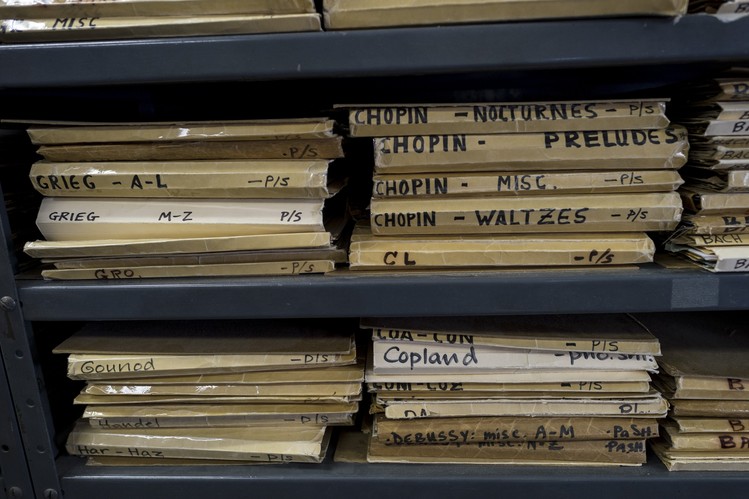
The store, on West 54th Street between Broadway and Eighth Avenue, opened in 1937 and provided the city’s musicians scores from the standard— Bach, Beethoven —to the arcane. Ms. Rogers bought it in 1978.

Frank Music is the last store in the city dedicated to selling classical sheet music, Ms. Rogers said, although other places such as the Juilliard School’s bookstore at Lincoln Center have it on their shelves.

Frank Music’s stock, which Ms. Rogers counts as hundreds of thousands of scores, was purchased by an anonymous donor as a gift for the Colburn School, a music conservatory in Los Angeles.

The school and Ms. Rogers declined to comment on financial details.

Colburn School’s president and chief executive, Sel Kardan, called Frank Music’s scores “an invaluable resource for our students and faculty for years to come.”

To the 63-year-old Ms. Rogers, nothing is more important than the arts.

“The idea that classical music is irrelevant is ridiculous,” she said, bemoaning the comparative salaries of tubists and stockbrokers. “People should be paid in terms of what they contribute to people’s well being.”

The store’s celebrity clients over the years have included pianists Emanuel Ax and Jeremy Denk, violinist Pamela Frank and cellist David Finckel.

One of Ms. Rogers’s favorite memories is a telephone call from the violinist Itzhak Perlman, asking for Kreisler scores.

The composer Bruce Adolphe, who is resident lecturer at the Chamber Music Society of Lincoln Center, described the store as a musical meeting ground.

“Frank’s Music was not just a store but a crucible,” he said, “a nexus where musicians from Suzuki beginners and their parents, to Joshua Bell, or the Brentano’s Mark Steinberg, would meet by chance.”

Read the entire article at NYC’s Last Classical Sheet Music Store to Close – WSJ.

Love for piano remains many decades later – Community – The News

piano-old

At 90 years of age, she has recently cut back a bit on her musical engagements, but she is still the official pianist for Club 55+ and happily plays hymns and old favourites for residents in her seniors’ complex in New Glasgow.

“My parents were both great singers and we had a piano at home, so I was anxious to play. I was sent for eight lessons and that is the full extent of my musical education.”

She was nine or ten when she travelled by horse and sleigh from Iron Ore to Stellarton with an uncle who brought butter, eggs and vegetables to town to sell on Saturday mornings.

“He dropped me at Langston Miller’s on Rundle Street and that’s where I learned all the notes. After that, it was just practice. I still play a lot by ear.”

Read the entire article at Love for piano remains many decades later – Community – The News.