Piano lore can be summarised thus: there are good and bad pianos. This is the basic fact in a pianist’s life. Both kinds are to be found in all sizes, from all manufacturers, at any price point. A concert grand costing more than £100,000 can be bad. Smaller can be better than larger, but between two good pianos, the sound of the larger will be richer and more present.
One can get used to any piano, even when the instrument is terrible, but the better the piano, the less time is required, and vice versa. Spending time with a good piano is rewarding: there is always something more to discover in its tone. A bad piano functions in what-you-see-is-what-you-get mode, producing the same sound even after hours of practice. And each piano is unique. Manufacturing involves hundreds of processes and adjustments, most done by hand, all affecting the final tone. As a result two pianos of the same model, made in the same year, will sound different to the untrained ear, despite their outward sameness. The contrast in sound between different models, or between pianos made in different years or from different companies will be even more apparent.
Audiences bade adieu to long-running CBS sitcom Two and a Half Men after 12 seemingly eternal seasons. Creator Chuck Lorre (also the mind behind other network staple The Big Bang Theory) got the last laugh by killing off his sworn enemy, Charlie Sheen, once and for all … by a falling piano, no less!
The thought-provoking talk on February 10th was given by Keith Pascoe, second violinist of the Vanbrugh Quartet, in connection with tomorrow night’s violin and piano recital by Ray Chen and Julien Quentin. Pascoe came up with a great title, David and Goliath, The Ballet of Unequals: A Stradivari and Model D Steinway Recital. Using videos from YouTube as illustrations (which unfortunately allowed in snippets of a couple of unwanted advertisements), Pascoe began at the beginning, with the emergence of the piano and violin as instruments in their own right, and traced some of the changes they have both undergone in the centuries since.
The piano has become bigger, stronger and louder. Not only were extra notes added to the keyboard, but the early wooden frames were replaced with cast iron. The violin may not have grown externally, but the shape of the body was remoulded, the neck and fingerboard realigned, and internal buttressing extended, all with the intention of producing greater sound.
What composers did with the combination of violin and piano – and before that, violin and harpsichord – changed too. In the typical baroque violin sonata, the violin was to the fore. In the classical era, the roles were reversed, although this reversal has long been dishonoured by performers. And in the 19th century, the balance as we know it today began to take hold. That balance usually presents the two performers in a master-servant relationship, the violinist usually the boss whose bidding is carried out by the pianist.
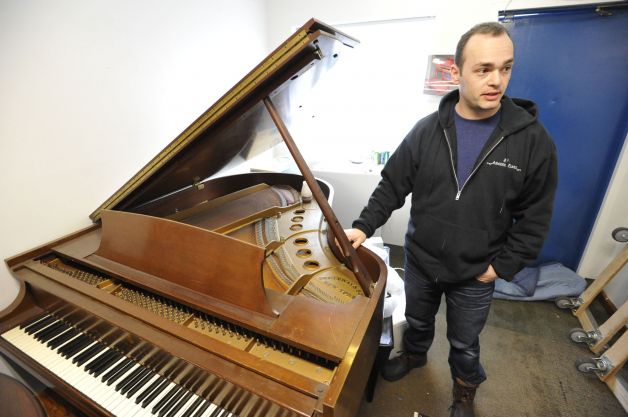
Yury Feygin, owner of Amadeus Piano, shows off a Steinway piano on display at his business in Stamford, Conn., on Wednesday, Feb. 4, 2015. The piano company mainly deals with tuning, repairs, moving, storage, restoration and antique piano sales with locations in Westport and Long Island, NY.Photo: Jason Rearick
Yury Feygin likes playing with pianos — so much, in fact, that he occasionally forgets to eat and sleep.
Like his father, Mikhail, and grandfather, Semyon, Feygin is an expert at restoring, tuning and repairing antique pianos.
Feygin and his workers have built a first-of-its-kind double-decker storage system at their Lenox Avenue warehouse. They have stashed dozens of pianos in the racks, legs removed, filed side-by-side like massive dominos as they await restoration.
“Getting pianos off the ground isn’t a comfortable thing — you’ve got to worry about it falling when you’re handling it, but we have it down to a science,” said Feygin. “People were saying, my dad was saying, `Don’t do this, let me store your stuff.'”
. 1571 ~ Michael Praetorius, German organist, composer and theorist
More information about Praetorius
. 1797 ~ Heinrich Engelhard Steinway, German piano manufacturer
More information about Steinway
. 1847 ~ Robert Fuchs, Austrian composer and music teacher
. 1905 ~ Harold Arlen, (Hyman Arluck) American composer of musicals and songs
More information about Arlen
. 1918 ~ Hank Locklin (Lawrence Hankins Locklin), Country singer
. 1932 ~ George Burns and Gracie Allen debuted as regulars on The Guy Lombardo Show on CBS radio. The couple was so popular that soon, they would have their own Burns & Allen Show. George and Gracie continued on radio for 18 years before making the switch to TV. All in all, they were big hits for three decades.
. 1941 ~ Brian Holland, Songwriter
. 1941 ~ Duke Ellington and his orchestra recorded one of big band’s all time classics on this day. Take the “A” Train was recorded at Victor’s Hollywood studio and became the Duke’s signature song.
. 1944 ~ Mick Avory, Drummer with The Kinks
. 1951 ~ Melissa Manchester, Singer
. 1958 ~ Get A Job, by The Silhouettes, reached the top spot on the music Tunedex. It remained at #1 for two weeks. Talk about sudden change in American popular music! One week earlier, the number one song was Sugartime, by The McGuire Sisters, a song that definitely was not classified as rock ‘n’ roll. Get A Job was replaced by Tequila, an instrumental by a studio group known as The Champs.
. 1959 ~ Ali (Alistair) Campbell, Guitarist, lead singer with UB40
. 1965 ~ This was a sad day in music, as singer Nat ‘King’ Cole died in Santa Monica, CA. The music legend was 45.
. 1986 ~ Whitney Houston reached the #1 spot on the music charts. Her single, How Will I Know, replaced a song recorded by her first cousin, DionneWarwick (That’s What Friends Are For). Whitney is the daughter of singer Cissy Houston.
. 1992 ~ William Schuman passed away. Schuman was an American composer and arts administrator.
. 1914 ~ Gypsy Rose Lee (Rose Hovick), Actress, dancer, stripper, subject of Broadway show and film, Gypsy, sister of actress, June Havoc
. 1914 ~ Ernest Tubb, Country Music Hall of Famer, headlined 1st country music show at Carnegie Hall
. 1923 ~ Kathryn Grayson, Singer, actress in Kiss Me Kate, Show Boat, The KissingBandit, It Happened in Brooklyn, Anchors Aweigh
. 1937 ~ Hildgarde Beherns, German Soprano
. 1939 ~ Barry Mann, Songwriter, with Cynthia Weil on dozens of ’60s and ’70s ‘Brill Building’ hits, singer
. 1940 ~ Brian Bennett, Drummer with The Shadows
. 1940 ~ The old piano played for dances in the Tattersall house in High Forest for many year – as long ago as the Civil War period – will be played once more when the Olmsted County Historical association formally opens its museum in the basement of the Rochester, MN public library.
. 1941 ~ Carole King (Klein), American pop-rock singer and songwriter
. 1944 ~ Barbara Lewis, Singer
. 1963 ~ (James) Travis Tritt, Grammy Award-winnning singe
. 1964 ~ Several days after their arrival in the U.S., The Beatles made the first of three record-breaking appearances on “The Ed Sullivan Show”. The audience viewing the Fab Four was estimated at 73,700,000 people in TV land. The Beatles sang She Loves You and I Want to Hold Your Hand. One could barely hear the songs above the screams of the girls in the audience.
. 1966 ~ Liza Minnelli brought her night club act to the Big Apple. She opened in grand style at the Persian Room of the Plaza Hotel in New York.
. 1969 ~ A young lady named Roslyn Kind made her quiet TV debut this night on“The Ed Sullivan Show”. Ed said she’s “…America’s teenager who wasn’t protesting or playing a guitar.” She only appeared once. Her sister appeared many times. Roslyn Kind is the sister of Barbra Streisand.
. 1970 ~ Sly and The Family Stone received a gold record for the single, ThankYou (Falettinme Be Mice Elf Agin). Sly (Sylvester) Stewart was a DJ in Oakland, CA.
. 1981 ~ Bill Haley died on this day in Harlingen, TX. He was 55. Haley, with his Comets, recorded what became known as the anthem of rock and roll: Rock Around the Clock, from the movie, “Blackboard Jungle”. The song turned into a multimillion dollar hit and one of many hits Haley and the Comets had, including: Dim Dim the Lights, Razzle Dazzle, Crazy Man Crazy, Rock the Joint, See You Later Alligator andShake Rattle & Roll. Bill Haley was inducted into the Rock and Roll Hall of Fame in 1987.
. 1809 ~ (Jacob Ludwig) Felix Bartholdy Mendelssohn, German composer
More information about Mendelssohn
. 1900 ~ Mabel Mercer, British-born American cabaret singer
. 1904 ~ Luigi Dallapiccola, Italian composer
More information about Dallapiccola
. 1911 ~ Jehan Alain, French organist and composer
. 1928 ~ Frankie Vaughn (Abelson), Singer
. 1929 ~ Russell Arms, Singer
. 1940 ~ Angelo D’Aleo, Singer with Dion and The Belmonts
. 1941 ~ Jimmy Dorsey and his orchestra recorded the classic, Amapola, on Decca Records. Helen O’Connell and Bob Eberly joined in a vocal duet on this very famous and popular song of the Big Band era.
. 1943 ~ Eric Haydock, Bass with The Hollies
. 1947 ~ Melanie (Safka), Singer
. 1947 ~ Dave Davies, Singer, guitarist with The Kinks
. 1950 ~ Ed, Gene, Joe and Vic, The Ames Brothers, reached the #1 spot on the pop music charts for the first time, as Rag Mop became the most favorite song in the U.S. The brothers enjoyed many successes with their recording efforts.
. 1959 ~ 22-year-old Buddy Holly, 28-year-old J.P. Richardson (The Big Bopper)and 17-year-old Ritchie Valens died in an airplane crash near Mason City, Iowa. February 3rd has been remembered as ‘The Day the Music Died’ since DonMcLeanmade the line popular in his 1972 hit, “American Pie”. Buddy Holly, born Charles Hardin Holly in Lubbock, Texas, recorded That’ll Bethe Day, Peggy Sue, Oh, Boy,Maybe Baby, and others, including It Doesn’tMatter Anymore (recorded just before his death, a smash in the U.K., non top-10 in the U.S.). Buddy was inducted into the Rock and Roll Hall of Fame in 1986. A convincing portrait of the singer was portrayed by Gary Busey in The Buddy Holly Story, a made for TV movie. J.P. (Jiles Perry) Richardson was from Sabine Pass, TX. He held the record for longest, continuous broadcasting as a DJ at KTRM Radio in Beaumont, TX in
. 1956. He was on the air for 122 hours and eight minutes. In addition to his smash hit, Chantilly Lace, Richardson also penned Running Bear (a hit for Johnny Preston) plus White Lightning (a hit for country star, George Jones). Richard Valenzuela lived in Pacoima, CA (near LA) and had a role in the 1959 film, Go Johnny Go. Ritchie Valens’ two big hits were Donna and La Bamba … the last, the title of a 1987 film depiction of his life. La Bamba also represented the first fusion of Latin music and American rock. Of the three young stars who died in that plane crash, the loss of Buddy Holly reverberated the loudest over the years. But, fans of 1950s rock ‘n’ roll will agree, all three have been sorely missed.
. 1959 ~ Lol (Laurence) Tolhurst, Drummer, keyboard with The Cure
. 1964 ~ The British group, The Beatles, received its first gold record award for the single, I Want To Hold Your Hand. The group also won a gold LP award for “Meet The Beatles”. The album had been released in the United States only 14 days earlier.
. 1971 ~ Lynn Anderson received a gold record for the single, Rose Garden. The Grand Forks, ND country singer was raised in Sacramento, CA. In addition to being a singer, she was an accomplished equestrian and California Horse Show Queen in 1966.
. 2002 ~ Remo Palmier, a self-trained guitarist who was a fixture in the New York jazz scene in the 1940s, died at the age of 78, and had been suffering from leukemia and lymphoma, his wife said. Over the course of his career, Palmier played with jazz legends Charlie Parker, Billie Holiday and Dizzy Gillespie, among others. Born Remo Palmieri in the Bronx, Palmier achieved his greatest fame performing with broadcaster Arthur Godfrey on CBS, and taught Godfrey how to play the ukulele. After Godfrey retired, Palmier released his own albums, “Windflower and “Remo Palmier”. 1893 ~ Bernard Rogers, American composer
. 1912 ~ Erich Leinsdorf, Austrian-born American conductor
. 1937 ~ Glen Gray and his Casa Loma Orchestra recorded A Study in Brown, on Decca Records.
. 1941 ~ John Steel, Singer, drummer with The Animals
. 1944 ~ Florence LaRue (Gordon), Singer with The Fifth Dimension
. 1987 ~ The show-biz world was saddened when Liberace died at his Palm Springs, CA estate. He was 67. Lee, as he was known, was the master of Las Vegas. Hundreds of thousands flock to his museum there (operated by his brother, George) to see Liberace’s garish suits, trademark candelabra, and learn of the myths behind this hugely successful star of television, stage and concerts the world over.
More information about Liberace
. 2001 ~ James Louis “J.J.” Johnson, an influential jazz trombonist who later forged a career arranging and recording scores for motion pictures and television, died at the age of 77. The Indianapolis native, who began playing piano at age 11, was a perennial winner of “Down Beat” magazine’s reader’s poll as best trombonist. While he was praised by jazz aficionados, Johnson also made his mark in popular culture, writing and arranging music for such television shows as “Starsky and Hutch”, “Mayberry, R.F.D.” and “That Girl”. His film music credits included “Cleopatra Jones” and “Shaft.” During his long career, he performed with such jazz greats as Count Basie and Dizzy Gillespie. While touring with jazz bands during the heyday of those ensembles, he played with the Clarence Love and Snookum Russell bands. He got his first big break with the Benny Carter band in 1942.
. 2002 ~ Blues and jazz pianist Abie “Boogaloo” Ames died at the age of 83. Ames was born on Big Egypt Plantation in Cruger, Miss., on May 23, 1918. He began playing piano at the age of 5 and his style earned him the nickname “Boogaloo” in the 1940’s. Ames moved to Detroit as a teen-ager and started a band, touring Europe with Louis Armstrong in 1936. Ames worked at Motown Studio and befriended other great musicians like Nat King Cole and Erroll Garner. In 1980, Ames moved to Greenville, where he became a regular performer at local clubs and festivals. Cassandra Wilson’s forthcoming Blue Note CD tentatively titled “Belly of the Sun” is set to include Darkness in the Delta, a song written by Ames for the CD. Ames was named the 2001 winner of the Artist’s Achievement Award of the Governor’s Awards for Excellence in the Arts in the state of Mississippi. With his protege and 1990s musical partner Eden Brent, Ames performed at the Kennedy Center for Performing Arts in Washington, D.C., in 2000. Ames’ last public performance was in October 2001 at the E.E. Bass Cultural Center in Greenville with another former student, Mulgrew Miller.
. 2002 ~ David Stetler, a big band swing drummer who played with Benny Goodman and Spike Jones , died of pneumonia. He was 79. A Seattle native, Stetler was discovered in high school by Lunceford. With a style close to that of Gene Krupa and Jo Jones, Stetler toured the country in the 1940s but returned to Seattle after his first son was born. He backed up national acts in local performances, including many during the world’s fair in 1962.
. 2003 ~ Charlie Biddle, a leader of Montreal’s jazz scene in the 1950s and ’60s who played bass with Thelonious Monk and Charlie Parker, died after a battle with cancer. He was 76. Biddle was a native of Philadelphia who moved to Canada in 1948. Over the next five decades, the World War II veteran and former car salesman became synonymous with jazz in Montreal. Biddle opened his own club, Uncle Charlie’s Jazz Joint, in suburban Ste- Therese in 1958. He later performed in such legendary Montreal nightspots as The Black Bottom and the Penthouse, where he worked with the likes of Oscar Peterson, Art Tatum, Charlie Parker and Lionel Hampton. When there were no jobs in Montreal, Biddle played smaller Quebec cities with a group called Three Jacks and a Jill. Until recently, Biddle played four nights a week at Biddle’s Jazz and Ribs, a Montreal landmark for nearly 25 years. Coincidentally, the club closed Tuesday for planned renovations, which included erecting a wall of fame to honor Biddle and others who have played at the club. In 1979, he organized the three-day festival that some say paved the way for the renowned Montreal International Jazz Festival. News Item about Charlie Biddle
. 2003 ~ Jerome Hines, a bass vocalist who performed regularly at the Metropolitan Opera during a career that spanned more than six decades, died. He was 81. Hines spent 41 years performing at the Met, more than any other principal singer in its history. He was known for his timbral richness, as well as the research he conducted into the historical and psychological background of the roles he portrayed. During his career at the Met, he portrayed 45 characters in 39 works, including title roles in Mussorgsky’s “Boris Godunov” and Mozart’s “Don Giovanni,” and Colline in Puccini’s “La Boheme.” He gave a total of 868 performances at the Met, retiring in 1987. He went on to perform with regional opera companies and at benefits. Hines, who became a born-again Christian in the 1950s, composed his own opera, “I Am the Way,” about the life of Jesus. He sang the title role at the Met in 1968 and 93 times around the world.
. 2003 ~ Saxophonist Cornelius Bumpus, a former member of the Doobie Brothers who had performed with Steely Dan since 1993, died en route to a series of performances in California. He was 58. Bumpus began his career at age 10, playing alto saxophone in the school band in Santa Cruz, Calif. In 1966, he spent six months performing with BobbyFreeman, and joined Moby Grape in 1977, writing one tune for the “Live Grape” album. Bumpus also recorded two solo albums and toured with his own band. Since performing with The Doobie Brothers in the early 1980s, Bumpus played with a number of bands, most recently with Steely Dan, which won the “Album of the Year” Grammy for its 2000 “Two Against Nature” release. His relations with his former Doobies bandmates turned contentious in the late 1990s, when they sued him and several other musicians over their use of the Doobies name. A federal judge in 1999 ruled against Bumpus and the other musicians, ordering them not to use the name.