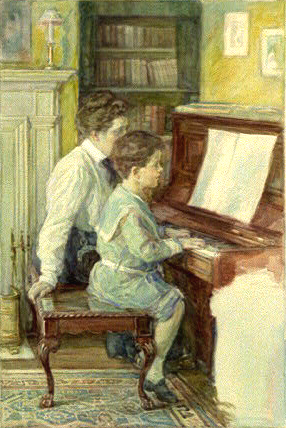
Kris Skaletski and Jennifer Eklund are happy to announce that, Roadtrip!, the first book in our new preschool method book series, is officially for sale! Student books are available now in both digital and hardcopy. The teacher guidebook, with comprehensive lesson plans and multiple teacher duets for all 18 songs, is available digitally now. Hardcopies of the guidebook will be available next Wednesday, July 29th.
Ideal for students ages 4 and up.
On the staff from the start
Music is a mix of familiar tunes and original pieces
Multi-key approach
18 songs that can be learned by note or rote
Clean easy-to-follow pages (great for special needs students!)
BONUS: The soundtrack is FREE in the introductory selling period! You can hear all the music and see the insides of the student book and teacher guidebook on the website. Full-time fun ahead!
The piano that featured on many of ABBA’s greatest hits is going under the hammer next month in London, auctioneers Sotheby’s said.
The piano is estimated to fetch between £600,000 (R12.1-million) and £800,000 when it goes on sale on September 29.
Swedish pop foursome ABBA dominated the 1970s disco scene.
“The opening piano glissando from Dancing Queen is one of the most distinctive sounds of the 1970s and we are delighted to offer the actual instrument used by the legendary ABBA in their major recordings,” said Sotheby’s expert Philip W Errington.
“The piano itself is an instrument of real importance and with the added ABBA provenance we expect it will have worldwide appeal.”
It was built by Swedish musical instrument designer Georg Bolin for the US jazz pianist Bill Evans.
The New York Times described it in 1964 as a “space-age piano”.
It was bought by Stockholm’s Metronome Studios in 1967 and appeared on nearly all of ABBA’s recordings between 1973 and 1977.
“The Bolin Grand is one of a kind and was a great source of inspiration while working in the recording studio during the ABBA sessions,” said the group’s pianist Benny Andersson.
ABBA disbanded in 1983.
Famous pianos have earned huge sums at previous auctions.
In 2000, John Lennon’s Steinway upright piano, on which he composed Imagine, was bought for £1.67-million by the singer George Michael. The upright piano which featured in Rick’s Café Americain in the 1942 film Casablanca was sold in 2014 for $3.4-million (R44.6-million).
Wanted: Temporary space for the world’s largest piano. Must have flat access, as requires forklift.
A piano handcrafted in a garage near Timaru, weighing in at 1.4 tonnes and with a length of 5.7 metres, is rolling through Wellington next month and its maker is hunting for a place to show it off.
It took Adrian Mann, 25, four years to build the piano, and he has spent the past few years giving people around New Zealand a chance to play it – he even tried, unsuccessfully, to get Elton John to give it a tinkle.
It all started when, as a curious 15-year-old, he wanted to see how long a piece of piano wire would be if it were not wrapped in copper.
The answer, according to his garden experiment, was about six metres, but it was the tone of the string that had him captivated.
“The sound I heard from that string was so clear and unique and different that I really, really had to do it. I got it in my mind that I had to build a piano.”
The following year, a neighbour offered a garage and some timber and he got stuck in – despite knowing next to nothing about piano-building.
“I had to learn everything – none of the technicians wanted to be involved because they said it wouldn’t work, so I had to learn how to do everything, from carpentry, welding, right up to the geometry of the action and the string layout.”
As the piano started to take shape, the community got on board with donations of wood, tools, books and cash, and he won a scholarship after he finished high school to allow for a final push.
As well as being the world’s largest piano, it also had the “lowest percentage of inharmonicity”, according to an Australian piano maker, Mann said.
The piano is in Auckland at present, has dates in Hamilton next month, and will be travelling through Wellington about October 22 – but it will stop only if the right venue can be found.
Positively Wellington Venues chief executive Glenys Coughlan said it would be the first time Wellington would have hosted an instrument of that size, but did not see it as an obstacle.
“We would be spoiled for choice here. We could do it on a grand scale, putting it centre court in TSB Bank Arena or inside our newly refurbished Shed 6, which would be fun.
“Or we could have a choice of stages: on stage at the Michael Fowler Centre, the St James Theatre or the Opera House. Or the lobby of the Michael Fowler Centre.”
It will be fun watching your child improve their piano skills all while having fun using Piano Maestro in lessons each week!
As your child’s teacher (or YOUR teacher!), I’m looking forward to seeing the progress they will make when they start using it at home each day. This guide will help you understand how this app will benefit your child and how to get it set up on your own iPad.
Overview What is Piano Maestro?
Piano Maestro is the ultimate piano practice tool that will have students quickly playing their favorite classical, pop, rock, TV and video game songs and themes. It is available in the App Store and works on the iPad.
What skills does it improve?
• Note reading
• Sight reading
• Rhythm
• Inner pulse
• Confidence
What makes it so fun?
• Upbeat background tracks
• Stunning graphics
• Instant rewards and feed back
• Satisfaction of playing REAL music
It works with an acoustic piano?
Yes! Your child practices on your real acoustic or digital piano. Piano Maestro listens from the iPad’s built in microphone. No wires needed.
I’m already paying for lessons and books. What value does this add?
Sometimes I wish I could be there with your child to encourage them to keep practicing daily. I’m sure it’s not always easy, as unforeseen challenges will arise.
Since our time each week is just too short, this app will give me eyes on the ground and it will keep them practicing longer and improving more quickly.
How will it be used in lessons?
I will spend a few minutes of each lesson helping your child master a couple of new songs all while having fun! I will also teach them how to use the practice options at home.
At the end of the lesson, we will choose Home Challenge assignments within the app that will show up in your account at home. I’ll get updates when progress is made.
Getting Started
Wow, this sounds awesome. Now, how do I get started?
1) Download Piano Maestro on your iPad from the AppStore
2) Create a JoyTunes account with a parent’s email, under which, you can have multiple profiles for each member of the family.
3) Create a profile for each family member (that means you too Mom and Dad!) inside the Parent/Teacher zone (top right hand corner of main screen)
4) Connect to your teacher, me! After creating a profile in the “profiles” tab of the parent/teacher zone, select the student’s profile and click “connect to teacher.” Once I approve connection to your child, they will receive full access to all content for FREE! I will then also begin receiving weekly progress reports.
5) Start Playing – I will now start assigning you homework, meanwhile get started on Journey Mode.
When you connect to the O’Connor Music Studio, Piano Maestro is free for as long as you study here.
• 1873 ~ Lee DeForest, Inventor of the triode vacuum tube, possibly the most significant invention that made radio possible.
More information about DeForest
• 1894 ~ Arthur Loesser, American pianist and writer
• 1915 ~ Humphrey Searle, British composer and writer
• 1928 ~ Peter Appleyard, British jazz vibraphonist and drummer
• 1939 ~ The radio program Arch Oboler’s Plays presented the NBC Symphony, for the first time, as the musical backdrop for the drama, This Lonely Heart.
• 1942 ~ Vic Dana, Singer
• 1949 ~ Bob Cowsill, Singer with The Cowsills
• 1957 ~ John O’Neill, Musician, guitar with That Petrol Emotion
• 1970 ~ Jimi Hendrix opened his recording studio in New York City. Because of its state-of-the-art 36-track recording capability, it attracted many top rock groups.
• 2000 ~ George Edmund Sandell, a noted violin and viola player, teacher and inventor died at the age of 88.
Sandell studied in New York under the viola virtuoso William Primrose and on scholarship at the Royal Swedish Conservatory in Stockholm.
Sandell moved to Los Angeles in 1938, where he played with the Los Angeles Philharmonic and the Pasadena and Santa Monica Symphonies.
Along with classical music, he performed pop, swing and Latin music, and played with the string sections of big band luminaries Harry James, Jimmy Dorsey and Xavier Cugat.
Sandell also played on some of Frank Sinatra’s recordings and worked for most of the big Hollywood studios on orchestral sound tracks, including the sound track for the movie Citizen Kane.
In 1947, he invented the Gee-Bee, a kitchen sponge with a plastic handle for washing dishes. He sold the company to DuPont in 1953.
• 2001 ~ Alix Williamson, the classical music publicist who suggested to Baroness Maria von Trapp that she write a book about her family’s experiences, died at the age of 85.
Williamson’s suggestion resulted in the Rodgers and Hammerstein musical “The Sound of Music.”
She represented artists such as André Watts and Frederica von Stade and helped the New York Grand Opera get a citation in the Guinness Book of World Records for its performances of a complete cycle of Verdi’s operas in Central Park. Williamson also ghostwrote books.
Life very often throws some curious coincidences my way. Just as I was preparing a presentation for architecture students at the Goa College of Architecture on ‘Architecture and Music’ and looking at the relationship of the Fibonacci sequence to music, what should appear in my newsfeed but the announcement of the famed piano firm Steinway and Sons unveiling its 600,000th piano, incorporating the iconic Fibonacci spiral in its design.
The veneer of the “Fibonacci” piano features the eponymous spiral made from six individual logs of Macassar Ebony, “creating a fluid design that represents the geometric harmony found in nature.”
In the words of designer Frank Pollaro, who spent over 6000 work-hours over four years in its creation: “Designing Steinway & Sons’ 600,000th piano was an honour and a challenge. To me, knowing that this piano would become part of history meant that it had to be more than just a beautiful design, but also needed to visually convey a deeper message…as I considered the number 600,000, the Fibonacci spiral came to mind. The way in which it continues to grow but stay true to its form is very much like Steinway and Sons over these many years. Combining the universal languages of music and mathematics suddenly made perfect sense.”
Mind you, 600,000 is not a number in the Fibonacci sequence; I checked. 600,000 is between the 29th and 30th numbers in the Fibonacci series, which are 514,229 and 832,040 respectively. But Pollaro was nevertheless highlighting an interesting relationship between music and mathematics.
Named after the Italian mathematician Leonardo Fibonacci (c. 1170- c. 1250) who brought the Indian-Arabic numeral system to Europe, the Fibonacci series appear in nature and in music, and finds application in architecture and in instrument design, much before the Fibonacci Steinway.
The basic ideas of the Fibonacci progression are contained in the writings of Indian scholar Pingala (300-200 BC) in his treatise on Sanskrit prosody.
The Fibonacci numbers have the following integer sequence: 0, 1, 1, 2, 3, 5, 8, 13, 21, 34, 55, 89, 144, 233, 377, 610, 987 and onward. Each added number is the sum of two previous numbers before it.
In nature, the Fibonacci sequence underpins phyllotaxis (arrangement of leaves on a stem), branching in trees, fruit sprouts of a pineapple among many other examples, and even the shape of the human external ear, and the cochlear apparatus of the inner ear.
It can be applied to the western musical scale as well, with the caveat that the starting note one makes the measurement from (or the ‘root’ note) is designated as 1 and not 0. By this token, there are 13 notes in a scale through its octave. There are 8 notes in a diatonic scale (hence the top note is called an ‘oct’ave). The 5th and 3rd notes create the basic foundation of musical chords. All these are Fibonacci numbers.
The very notes in the scale are based on natural harmonics created by ratios of frequencies. Ratios found in the first seven numbers of the Fibonacci series (0, 1, 1, 2, 3, 5, 8) are related to key frequencies of musical notes. Thus if we take an arbitrary frequency of 440 Hz, the root note has a ratio of 1/1, but the octave above it has a frequency of 880 Hz (2/1 of 440); a fifth above has a frequency of 660 Hz (3/2 of 440), and so on for other notes in the scale.
In last Sunday’s article, I had mentioned the ‘golden proportion’ or phi, which underpins the proportions of the Parthenon temple in the Acropolis in Athens, Greece. This ‘golden ratio’ (also called the ‘golden section’, ‘golden mean’ or the ‘divine proportion’) of 1:1618 or 0.618 has influenced composition in painting and photography, prompting the notion of dividing a canvas into thirds vertically and horizontally, and to position a subject of interest ‘about one-third’ of the way across instead of in the centre.
This ‘golden ratio’ can be obtained by dividing a Fibonacci number (in the higher reaches, not the first few) by its immediate predecessor. The quotient approximates phi (φ). Thus 987/610= 1.61803, and its inverse is 0.618.
The climax or high point of many songs and other compositions is often found at the ‘phi’ (φ) point (61.8 per cent) of the work. We have seen this to be true in the first movement of
S. Bach’s G minor sonata for solo violin.
In many compositions in sonata form, the addition of a coda causes the recapitulation (the return of the original idea that started the work) to begin at the 61.8 per cent point.
The legendary violin maker Antonio Stradivari seemed to be aware of the ‘golden section’ and used it in the placement of the f-holes on his violins. The proportions of the violin conform to the ratios of ‘phi’ (φ). The spiral of a violin scroll also obeys the Fibonacci progression.
Isn’t it amazing, how the visual and aural world, indeed nature itself can all be unified by the same mathematical sequence?[NT]
• 1879 ~ New York’s Madison Square Garden displayed a real floating ship in a gigantic water tank as Gilbert and Sullivan’s operetta, H.M.S. Pinafore, was performed.
• 1902 ~ Stefan Wolpe, German-born American composer
1918 ~ Leonard Bernstein, American conductor, composer and pianist
Read quotes by and about Bernstein
Links to more information about Bernstein Grammy winner
• 1941 ~ Skinnay Ennis and his orchestra recorded the tune Don’t Let Julia Fool Ya.
• 1942 ~ Walter Williams, Singer with The O’Jays
• 1955 ~ Elvis Costello (Declan McManus), Musician, songwriter
• 1961 ~ Billy Ray Cyrus, Singer
• 1964 ~ The Beatles received a gold record for their hit single A Hard Day’s Night. It was the third gold record for the Fab Four. They would collect 18 more through 1970.
• 1971 ~ Ted Lewis passed away. He was an American entertainer, bandleader, singer, and musician.
• 1982 ~ The group, Fleetwood Mac, received a gold record for the album Mirage.
• 2001 ~ Aaliyah died at the age of 22. She was a R&B singer and budding actress who made her film debut in “Romeo Must Die” and was killed in a plane crash in the Bahamas.
• 2001 ~ Jazz musician John Nelson, the father of pop star Prince, died at the age of 85. Nelson was the model for a character in the 1984 Prince movie “Purple Rain.” He also co-wrote songs on several of his son’s hit albums.
In the 1950s, Nelson was a pianist in the jazz group Prince Rogers Trio featuring singer Mattie Shaw. Shaw and Nelson married, and they named their son Prince Roger Nelson.
Nelson left the household when Prince was about 10 and his sister Tyka was 8. The father and son reconciled after Prince began his climb to fame.
Nelson co-wrote Computer Blue on the Purple Rain album, The Ladder on Around the World in a Day; Christopher Tracy’s Parade and Under the Cherry Moon on Parade and Scandalous on the Batman soundtrack.
It’s been more than 80 years, but Dollie McKenzie still remembers her first piano lessons.
It was about 1933, and an 8-year-old McKenzie would trek — usually by herself — each week to her piano teacher’s Ucon home, more than a mile down the road.
“We didn’t have a car, so I’d walk — winter and summer,” McKenzie said. “In the wintertime, it was pretty cold. (My teacher) would have me warm up my hands in warm water so I could play. She was very kind and loving.”
Since then, McKenzie has come a long way. Now 90, she’s conducted, accompanied, sang and performed piano and organ at hundreds — if not thousands — of local concerts, musicals, weddings, funerals, festivals and gatherings. She’s taught hundreds of students over the years and is the oldest performing member of the longstanding Idaho Falls Music Club.
In February, McKenzie chose to celebrate the start of her next decade of life fittingly — with a public music program featuring a performance from McKenzie herself along with her daughter, Rexburg-based musician Beverly Solomon, and her granddaughter, Jenny Solomon.
“There’s a song I used to sing (with local women’s chorale group Idaho Falls Choralaires) called ‘Let All My Life Be Music,’ and that’s what I’ve been,” McKenzie said. “My whole life has been music.”
Technically, music first entered McKenzie’s life at age 8. But she said age 15 was the point at which she finally “took hold” of the art form. It was also in those later teen years, she said she started teaching piano.
After high school, she bought her first upright piano with cash, for about $300. McKenzie attended Ricks College and studied music education. At Ricks, she took piano and organ lessons under a renowned local music instructor named Ruth Barrus.
McKenzie’s professional career took off after college. In 1946, she took a music teaching position in Burley public schools. She also joined the music club and served in numerous positions over the years including president, and chairs of several committees. She said she was even chosen by the club as Music Woman of the Year in the 1940s.
“She’s one of the most talented, musical people I’ve ever met,” said Bonita Higley, McKenzie’s longtime friend and fellow member of the Idaho Falls Music Club. “She could play the piano like nobody else could. We just became really good friends and I respected her so much.”
“Dollie is a very dedicated person to music,” added music club member Elaine Jensen. “She is a very, very tremendous lady in music — a very fine musician.”
McKenzie stopped teaching at age 70, though she continues playing locally. She was the driving force behind getting a sing-along started at her current residence, MorningStar Senior Living of Idaho Falls, where she lives with her husband, Dan.
“When we moved here in 2009, about the only activity for old folks was bingo,” McKenzie said. “I said, ‘There’s more to life than bingo.’ So I started the sing-along and it’s one of the most popular things here, now … it gets people involved, gets them thinking and using their faculties. Compared with doing bingo, it’s just an important thing in their life.”
McKenzie said she lives by several different mottos — among them, a quote by Jim Elliot: “When the time comes to die, make sure that’s all you have to do.” And McKenzie said she has a lot left to do. On that list is continuing to fill her life with music — McKenzie still plays every day.
“Of course there are people who don’t have a lot of music in their life, and I guess the only reason why is they’ve never been exposed to it,” McKenzie said. “Of course not everyone’s going to be a musician. But I do think it’s been very important for me. I think it’s just been an (activity that’s helped) round me out, and (given me) purpose.”
• 1854 ~ Moritz Moszkowski, Polish-born German pianist and composer
More information about Moszkowski
• 1900 ~ Ernst Krenek, Austrian-born American composer, conductor and pianist
• 1905 ~ Constant Lambert, British composer, conductor and writer
• 1912 ~ Gene (Eugene Curran) Kelly, Dancer, actor: Singin’ in the Rain, An American in Paris, Anchors Aweigh, The Three Musketeers, Marjorie Morningstar, Inherit the Wind, North and South Book I; director: Singin’ in the Rain, Hello, Dolly!, A Guide for the Married Man, The Cheyenne Social Club
• 1923 ~ Billy Jones and Ernie Hare, The Happiness Boys, were heard on radio for the first time. The two were billed as radio’s first comedians and were also credited with creating and performing the first singing commercial.
• 1936 ~ Rudy Lewis, Singer with Drifters
• 1942 ~ Patricia McBride, Ballerina: New York City Ballet. For many years she was Mikhail Baryshnikov’s only partner
• 1943 ~ LIFE magazine spotlighted a dance craze that was sweeping the U.S.A., the Lindy Hop
• 1947 ~ Keith Moon, Singer, drummer with The Who
• 1947 ~ Margaret Truman, daughter of U.S. President Harry S Truman, presented her first public concert. Margaret sang before 15,000 people at the Hollywood Bowl. The concert did not get great reviews. In fact, the critics didn’t like Margaret’s singing at all. And Margaret’s dad didn’t like the critics, and said so, from the White House.
• 1949 ~ Rick Springfield, Singer
• 1951 ~ Mark Hudson, Singer with The Hudson Brothers
• 1966 ~ The U.S. premiere of the motion picture Help!, starring The Beatles, was held for thousands of moviegoers wanting to see the group’s first, color, motion picture. Their first film, A Hard Day’s Night, had been produced in black and white.
• 2001 ~ Kathleen Freeman, a veteran character actress whose face if not her name was known to audiences from television sitcoms, the film classic “Singin’ in the Rain” and Broadway’s “The Full Monty,” died of lung cancer at the age of 82.
Freeman gave her final performance in “The Full Monty”. She played a sassy piano player in the hit musical and earned a Tony nomination in May 2001.
Big, brash and funny were Freeman’s trademarks in playing recalcitrant maids, demented nuns, mouthy housekeepers, battle-ax mothers, irate landladies and nosy neighbors.
Starting in the Golden Age of television, Freeman appeared in such shows as “Topper,” “The Donna Reed Show,” “The Beverly Hillbillies,” “The Dick Van Dyke Show,” “Hogan’s Heroes,” “The Lucy Show,” “The Golden Girls,” “Murphy Brown” and “Married … With Children.”
“This will sound very corny and I’m sorry,” Freeman said last year in an Associated Press interview, “but I have always had the sense I was put here to do this: I am somebody who is around to help the world laugh. I have always had that sense. Corny but absolutely true.”
In “Singin’ in the Rain,” considered by many to be the best movie musical ever made, she played Jean Hagen’s frustrated voice teacher. Among Freeman’s other films were the sci-fi thriller “The Fly,” “The Rounders” with Henry Fonda, “Far Country” with Jimmy Stewart, and “North to Alaska” starring John Wayne. More recently she appeared in “Dragnet,” “Gremlins II,” “Nutty Professor II: The Klumps” and both “Blues Brothers” comedies.
Freeman was born in Chicago and was propelled into show business at age 2. Her parents had a vaudeville act, Dixon and Freeman, in which their daughter did a little dance.
Freeman attended the University of California at Los Angeles, where she majored in music and was going to be a classical pianist. Then, she said, “A terrible thing happened. I got in a play and got a laugh. I just said a line and, `boom.”‘
Freeman then worked in many small theater groups, including the Circle Players, acting for such eminent directors – and actors – as Charles Laughton, Charlie Chaplin and Robert Morley.
At the same time, the early 1950s, the television explosion took over Los Angeles. From her first regular sitcom role, as the maid in “Topper,” Freeman went on to do just about every sitcom of the last 50 years.
For all her voluminous credits, Freeman’s stage credits were mostly on the road – touring as Miss Hannigan in “Annie” for 18 months, then in “Deathtrap” and later with Lauren Bacall in “Woman of the Year.”
Her only other Broadway appearance was for five months in the 1978 production of “13 Rue de l’Amore” starring Louis Jordan.
• 2001 ~ Frank Emilio Flynn, a blind pianist and Latin jazz pioneer who performed with many great American jazz artists, died at the age of 80.
Flynn lost his sight at age 13 but continued to study and perform classical works, transcribed into Braille, with the Symphonic Orchestra of Havana.
Flynn’s great passion was jazz, and in the 1950s he developed his own jazz-influenced ballad style, known in Cuba as “feeling.”
Performing with the Quinteto Cubana de Musica Moderno, or Cuban Quintet of Modern Music, he developed into one of the most important Cuban jazz musicians of his era.
More recently, he played at New York’s Lincoln Center in 1998 with trumpeters Alfredo Armenteros and Wynton Marsalis.


 1918 ~ Leonard Bernstein, American conductor, composer and pianist
 Grammy winner