Don’t Give Up Because You Miss a Note!

FaeriesAireandDeathWaltz1

I have a copy of this music (Faerie’s Aire and Death Waltz) if anyone is interested in playing it!

The music above has been played:

The drive you need to accomplish whatever you’re attempting—big or small—needs fuel. Instead of letting slip-ups set you back, psychologist and author John Norcross recommends you make them the fuel:

If you are learning to play the piano, you don’t give up because you miss a note. It’s not whether you slip, it’s how you respond to the slip.

Cut yourself some slack and remember that things take time and hard work. Listen to the sound of your “missed note” and let that push you forward. You missed that note yesterday, but that doesn’t mean you’ll miss it today.

via “If You’re Learning Piano, You Don’t Give Up Because You Miss a Note”.

Christmas Music: Adeste Fideles

“O Come, All Ye Faithful” (originally written in Latin as Adeste Fideles) is a Christmas carol which has been attributed to various authors, including John Francis Wade (1711–1786), John Reading (1645–1692) and King John IV of Portugal (1604–1656), with the earliest manuscript of the hymn bearing his name, located in the library of the Ducal Palace of Vila Viçosa.

The original four verses of the hymn were extended to a total of eight, and these have been translated into many languages. The English translation of “O Come, All Ye Faithful” by the English Catholic priest Frederick Oakeley, written in 1841, is widespread in most English speaking countries.
There are now several versions in the O’Connor Music Store if you are interested in learning this Christmas carol.


Christmas Music: Gesù Bambino


Gesù Bambino by Pietro Yon has always had a place in my childhood memories since my church choir sang it every Christmas.  Other than that, it didn’t seem to be too well known but this song has been turning up in piano books lately.  There are now several versions in the O’Connor Music Store if you are interested in learning this beautiful older Christmas carol.

Gesù bambino was written in 1917. The melody was used by Frederick H. Martens in his English language carol “When Blossoms Flowered ‘mid the Snows”. The melody and lyrics of the chorus are derived from “Adeste Fideles” (O Come All Ye Faithful).

A piano version

Piano and Organ


Sung by David Archuleta and the Mormon Tabernacle Choir

‘Intervals Roasting’ – The Most Educational Christmas Carol Ever

music-theory-song

Music theory has never sounded so catchy with this witty remake of the holiday classic The Christmas Song (with apologies to Mel Torme) Try not to laugh at the ending.

Though it is a bit humorous, this version titled ‘Intervals Roasting’, with lyrics by David Rakowski, attempts to encapsulate the fundamentals of music theory in just over two minutes.

It does a good job of explaining the intervals and harmonic structure of the song and also gives you an idea of how to use music theory to analyze or compose music.

The O’Connor Music Studio has a copy if anyone wants to learn this 🙂

Christmas Music: Carol of the Bells

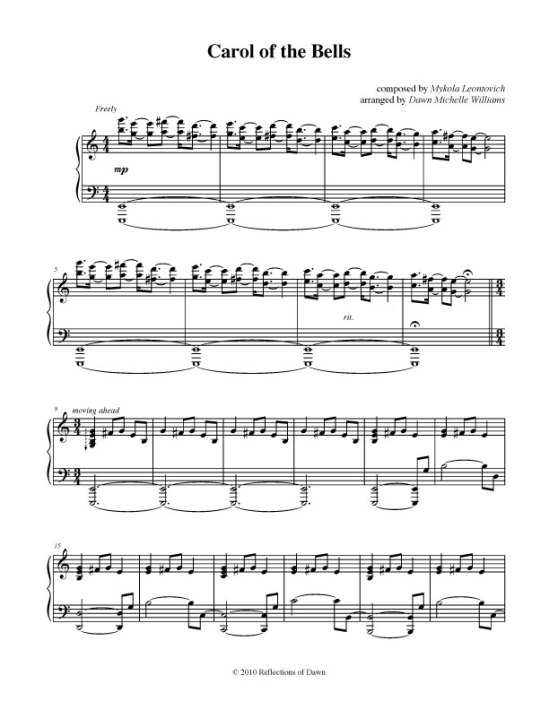
Carol of the Bells

Carol of the Bells was composed by Mykola Dmytrovych Leontovych (1877-1921) in 1916. Originally titled Shchedryk, this Ukrainian folk song is sometimes called Ukrainian Bell Carol. “Shchedryk” which was associated with the coming New Year, originally celebrated in April.

Leontovych used this tune in 1904 along with lyrics by Peter J. Wilhousky to create the version that everyone knows today. It gained popularity during the 1920s and 1930s, and was introduced to an even wider audience when it was used in the movie “Home Alone”.

It was first performed in the Ukraine on the night of January 13, 1916, on the Julian calendar this is considered New Year’s Eve. In the United States the song was first performed on October 5, 1921 at Carnegie Hall.

This video is from the Christmas special of the Mormon Tabernacle Choir, presented at the BYU channel. The orchestra and choir produce a very beautiful sound.

Not the standard version –

The O’Connor Music Studio has several versions of this Christmas Carol available for loan, including this version from the Mannheim Steamroller:


Christmas Music: Joy To The World

Joy_To_The_World-Antioch

Joy To The World

Joy to the World, the Lord is come!

Let earth receive her King.

Isaac Watts wrote the words to “Joy to the World” in 1719, based on Psalm 98 in the Bible. The hymn originally glorified Christ’s triumphant return at the end of the age, rather than a song celebrating His first coming. Only the second half of Watts’ lyrics are still used today.

The music was adapted and arranged to Watts’ lyrics by Lowell Mason in 1839 from an older melody which was then believed to have originated from Handel. The name “Antioch” is generally used for the hymn tune.

As of the late 20th century, “Joy to the World” was the most-published Christmas hymn in North America.

There are versions of Joy to the World available at the O’Connor Music Studio for any level of playing, starting with Pre-Reading, all the way up through Advanced and duets.

Christmas Music: Sleigh Ride

Sleigh Ride

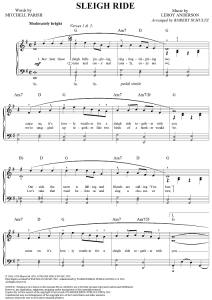
I’ve always liked Leroy Anderson’s Sleigh Ride as a secular Christmas song 🙂  It’s not technically a Christmas song since the words never mention Christmas but it’s often played now so it seems like a way to ease into the season.

Anderson had the original idea for the piece during a heat wave in July 1946;  he finished the work in February 1948.  Lyrics, about a person who would like to ride in a sleigh on a winter’s day with another person, were written by Mitchell Parish in 1950.

The orchestral version was first recorded in 1949 by Arthur Fiedler and The Boston Pops Orchestra. The song was a hit record and has become the equivalent of a signature song for the orchestra.

A fun arrangement has been made for piano duet.  I have copies here for loan and it’s available on amazon (of course! What isn’t?)

Happy Halloween: Toccata and Fugue in d minor by J.S Bach

toccata-d-minor


Johann Sebastian Bach’s towering monument of organ music, with its deep sense of foreboding, will forever be associated with Halloween.

Get a free copy of the sheet music at IMSLP or borrow a copy from the O’Connor Music Studio.  I have this arranged for organ, piano, duet, 2-piano, simplified…

If you want this in a book with other Bach transcriptions, amazon has this: Toccata and Fugue in D Minor and the Other Bach Transcriptions for Solo Piano, arranged by Ferruccio Busoni.

Here, Virgil Fox performs it on his Allen Digital Touring Organ.


Diane Bish plays the Massey Memorial Organ at the Chautauqua Institution and talks about this instrument.


And, the most fun…

Halloween Music: In the Hall of the Mountain King by Edvard Grieg

hall-mountain


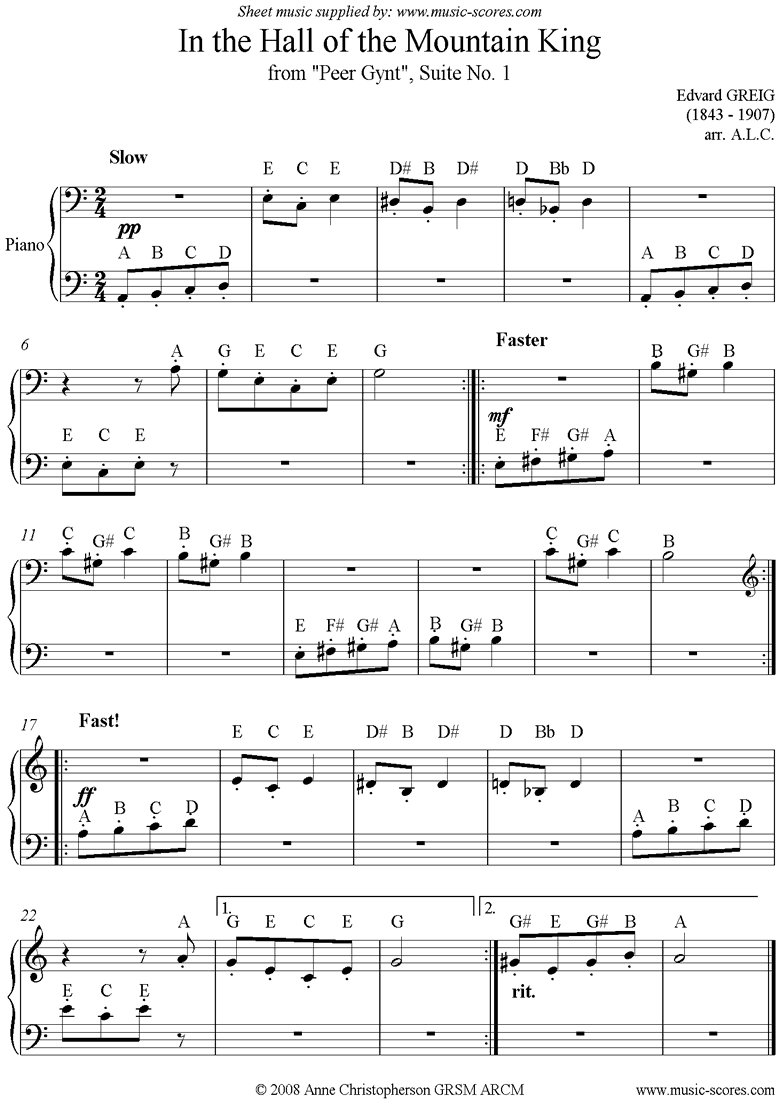
“In the Hall of the Mountain King” is a piece of orchestral music composed for the sixth scene of act 2 in Henrik Ibsen’s 1867 play Peer Gynt. It was originally part of Opus 23 but was later extracted as the final piece of Peer Gynt, Suite No. 1, Op. 46. Its easily recognizable theme has helped it attain iconic status in popular culture, where it has been arranged by many artists, including for the piano.

Borrow a copy of the sheet music from the O’Connor Music Studio.  I have this arranged for piano, duet, 2-piano, simplified…


8 part vocal orchestra (plus a tiny pair of cymbals)


Pianist Paul Barton


Solo piano sheet music – Video Score


Orchestral version

Halloween Music: Night on Bald Mountain by Modest Mussorgsky

bald-mountain

Night on Bald Mountain refers to a series of compositions by Modest Mussorgsky (1839–1881). Inspired by Russian literary works and legend, Mussorgsky composed a “musical picture”, St. John’s Eve on Bald Mountain on the theme of a witches’ sabbath occurring on St. John’s Eve, which he completed on that very night, June 23, in 1867.

Get a free copy of the sheet music at IMSLP or buy it on amazon.com.

From Disney’s Fantasia


Piano version transcribed for solo piano by Konstantin Chernov (1865-1937).


The Ludwig Symphony Orchestra, conducted by Maestro Thomas Ludwig