Vivaldi, one of the greatest baroque composers, has a very interesting story. He ran an orphanage in the 18th century in Italy that became famous all over the western world for its musically talented children. A lot of his pieces were written for specific children in his school. Vivaldi learned the violin from his father, and was trained as a priest. He was nicknamed “the red priest” for his red hair and was apparently somewhat sure of himself, having claimed once he can compose a concerto faster than it can be copied.
Vivaldi wrote over 500 pieces, most of which are lost today. He is considered one of the greatest musical landmarks in history, having inspired many composers that followed him, including J.S.Bach and others.
The manuscript of Mozart’s A major piano sonata K331 has recently been discovered in Budapest. Having spent the majority of its life in the Budapest’s National Széchényi Library for decades, the coveted manuscript was rediscovered by Haydn scholar Balazs Mikusi.
The piece was composed in 1783 and contains Mozart’s most popular jam, “Turkish March,” which has become a piano lesson staple all over the world.
Although, unfortunately, Mikusi can’t say how or when these pages found their way to Hungary; they reveal subtle differences from the published editions of the sonata. The key variances are seen in the phrasing, dynamics and occasionally the notes themselves.
“It is very rare that a Mozart manuscript pops up. Moreover the A Major Sonata had no known manuscript, so it is a really big discovery,” he said.
The library has only released teasing images of the manuscript, nothing more.
I have copies of the above sheet music in the music studio, if anyone wants to play this!
Having trouble counting various note values?
In music notation, a note value indicates the relative duration of a note, using the color or shape of the note head, the presence or absence of a stem, and the presence or absence of flags/beams/hooks/tails.
A rest indicates a silence of an equivalent duration.
The Piano Puzzlers book is available in the O’Connor Music Studio library if you’d like to give any a try. Piano Puzzlers as heard on American Public Media’s “Performance Today.” Includes 32 tunes with songs by Gershwin, Berlin, Arlen, Porter, Rodgers, Fats Waller, Lennon & McCartney, and others disguised in the styles of Bach, Handel, Haydn, Mozart, Beethoven, Brahms, Schubert, Schumann, Chopin, Janacek, Debussy, Ravel, Rachmaninoff, Stravinsky, Prokofiev, Bartok, and Copland.
Includes an introduction by Fred Child, host of “Performance Today” as well as background info by Bruce Adolphe. “Bruce Adolphe has taken a common musician’s party game and elevated it to high art and truly funny musical slapsticks. The Piano Puzzlers are a unique combination of extraordinary insight into the styles of many composers subtle, expert workmanship and great, great fun!”
If you’re a music geek (like me), I have a program for you. Now, let me be clear, to fully qualify as a music geek…you must have a fond appreciation for classical music (no, Poison, Quiet Riot, and Zepplin do not count as classical music). So, if you’re a “music geek” without an appreciation for classical music…well, I hate to burst your bubble…but, you’re not truly a music geek. Instead, you’re a music appreciator, but not a geek. So, if you just listen to indie music and scowl at anything on a label larger than Matador…don’t bother following the link I’ll provide…the fun will be lost on you…And, you probably won’t have a chance.
Every Wednesday night, on my way home from WNL, I turn on my local NPR station to listen to Piano Puzzlers on Performance Today. It’s absolutely incredible. A pianist/composer (Bruce Adolphe) takes a familiar folk or pop tune and sets it inside a classical masterpiece (or in the style of a particular composer). Sometimes it’s easy…sometimes it’s ridiculously difficult. There are days when I say, “got it” on the first pass. Then there are days when I say, “what the heck?” And, more often than not, I’m able to get either the popular/folk tune or the composer.
This is sad to admit, but there are nights when I’ll slow down on the drive home or sit in the car in the driveway to finish an episode. In fact, I get a little worked up if someone stops me after WNL…as I might miss the beginning of Piano Puzzlers (it usually hits around 8:20pm on our local station).
Take a listen to some of the archives and see if you can figure it out! It’s really cool…but probably only appreciated by music geeks (the kind of people that listen to NPR for their musical programs and not just the snipets of cool indie rock between segments on All Things Considered…which is a great show too).
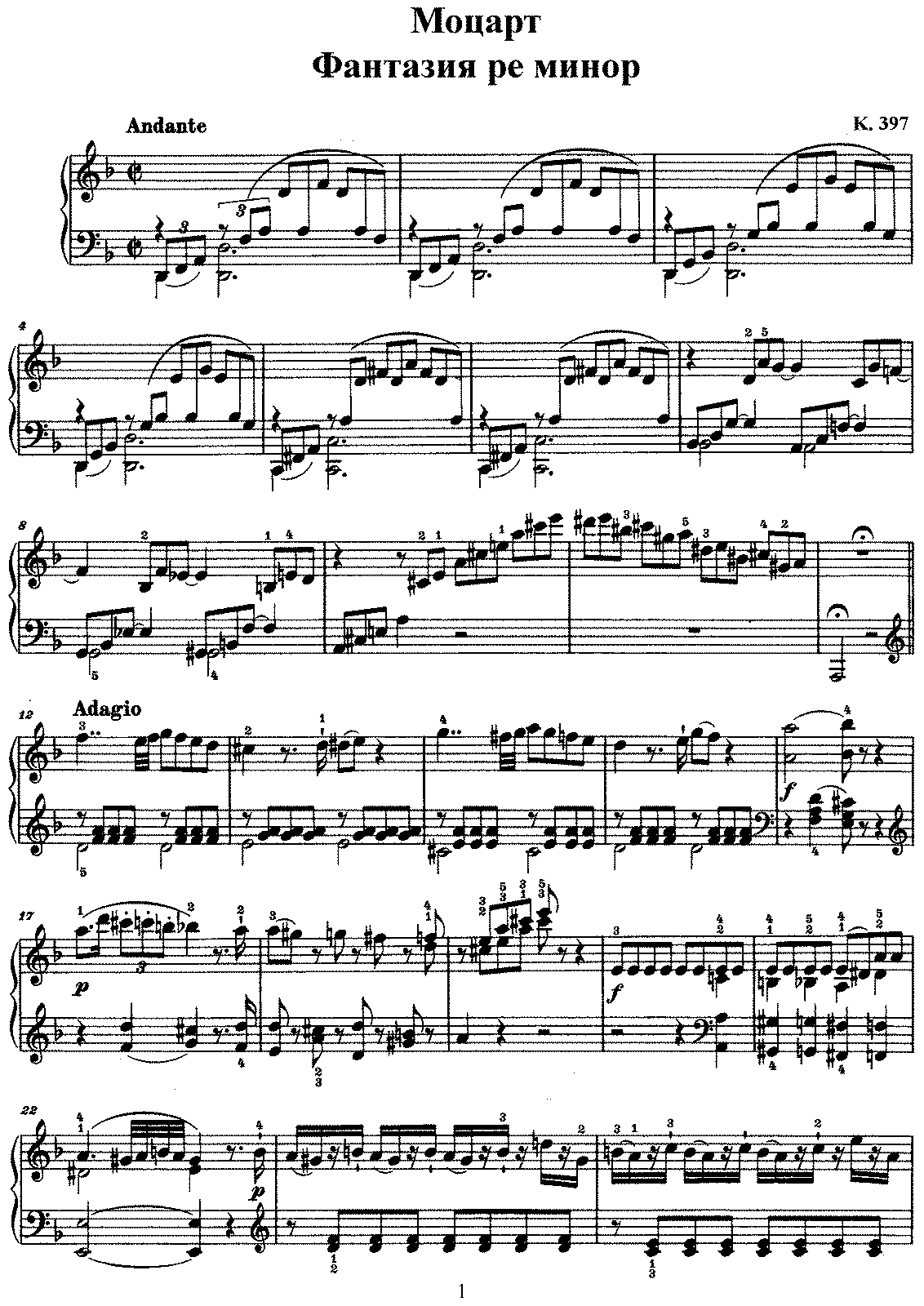
I have always really enjoyed playing Mozart’sFantasia in d minor and when I was asked to play for the new piano dedication service at my church a couple years ago I knew what I would “dust off” to perform.
The Grove’s Dictionary of Music and Musicians defines the genre of musical fantasia as “a piece of instrumental music owning no restriction of formal construction, but the direct product of the composer’s impulse.”
The Fantasia in d minor has somewhat unusual rhythm, constantly changing tempo (seven different tempi occur throughout the piece), three cadenzas and its apparent lack of any recognizable musical form (as indicated by the “Fantasy” title). Although it begins in d minor, the final section is in D Major.
Mozart composed this, his third and final, Fantasia in 1782 and it was unfinished at the time of his death in 1791. Even Mozart’s sister, “Nannerl”, who came across the work in 1807, was astounded to have discovered a previously unknown composition of such quality.
In its original form this Fantasia was probability only a fragment of what was to be a larger work. The closing bars which are most frequently performed today originated from an unauthorized print believed to have been composed in 1806 by August Eberhard Müller, one of Mozart’s admirers.
Because it was unfinished, many of the dynamic and pedal markings are nonexistant and left for the performer to choose.
As you can see from these videos, there is a wide range of tempi and interpretation from Frederich Gulda’s 4 minute, 36 second rendition
to Glenn Gould’s version which lasts for 8 minutes, 22 seconds
Both these composers have added their own ornamentation to Mozart’s original work.
I will be playing from a G. Henley Verlagurtext edition instead of one of the many edited versions available. I prefer to make my own musical decisions wherever possible.
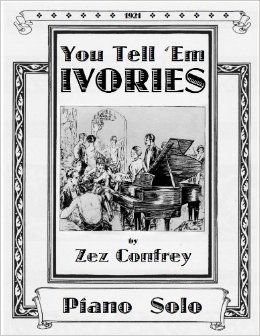
“This collection represents a cross-section of Confrey’s works and encompasses the broad range of his styles. Besides his famous 1920s novelty works (including Kitten on the Keys), there are many wonderful, lesser-known gems of remarkable quality included here from later in his career. Appearing for the first time in print are transcriptions of one of his disc recordings (Poor Buttermilk) and two of his player piano roll arrangements (My Pet and Humorestless). Many of Confrey’s later works have long been out of print and are included here for the first time in decades.”
This is one of my “bucket list” items, to go to the Old-Time Piano Playing Contest in Peoria, IL over Memorial Day weekend.
This video is “almost” as good as being there.
The Old-Time Music Preservation Association is staging their 41st World Championship Old-Time Piano Playing Contest this year to educate people about old-time piano music written prior to 1940.
When the World Championship Old-time Piano Playing Contest wraps up its 41st annual edition Memorial Day weekend in East Peoria IL, it will be for the last time.
More than 800 piano players from 38 states and five foreign countries have participated in the event through the years, collecting over $100,000 in prizes, but whoever wins the contest’s traveling trophy this year will get to keep it.
I guess this is one of my bucket list items that won’t be achieved.
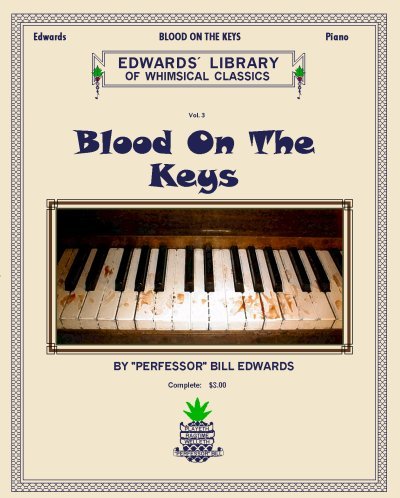
One of the “regulars”, Bill Edwards, who goes by the pseudonym “Perfessor Bill” has written a lot of ragtime music, some of which I’ve ordered. When I did, it came out that he lives relatively close so he dropped it off in person! As close as I’ll get to this event.
Bill’s website is an excellent resource for all-things ragtime. If you’re interested at all, just start digging in.
This is one of the pieces in the OCMS lending library.
The Piano Guys are an American musical group who gained popularity through YouTube, where they posted piano and cello renditions of popular songs and classical music.
They are also adding piano music books. This one from amazon.com says:
With their clever and inspiring takes on popular music and creative videos, The Piano Guys serve up an eclectic mix of classical, film score, rock and pop favorites that resonates with a wide variety of audiences.
Play 12 of their most popular songs in these arrangements for easy piano with optional cello: All of Me * Arwen’s Vigil * Begin Again * Home * Kung Fu Piano: Cello Ascends * Moonlight * Over the Rainbow * Paradise * Rolling in the Deep * A Thousand Years * Titanium * Without You.
Includes separate pull-out cello part.
I am not sure about their idea of “easy piano” but I have ordered a copy for the studio.