Today’s piece is Hungarian Dance #5 by Johannes Brahms. It’s available in Alfred Premier Piano Course Book 4 and many anthologies of classical music.
The Hungarian Dances are a set of 21 lively dance tunes based mostly on Hungarian themes, completed in 1869.
They vary from about a minute to five minutes in length. They are among Brahms’s most popular works and were the most profitable for him. Each dance has been arranged for a wide variety of instruments and ensembles. Brahms originally wrote the version for piano four hands and later arranged the first ten dances for solo piano.
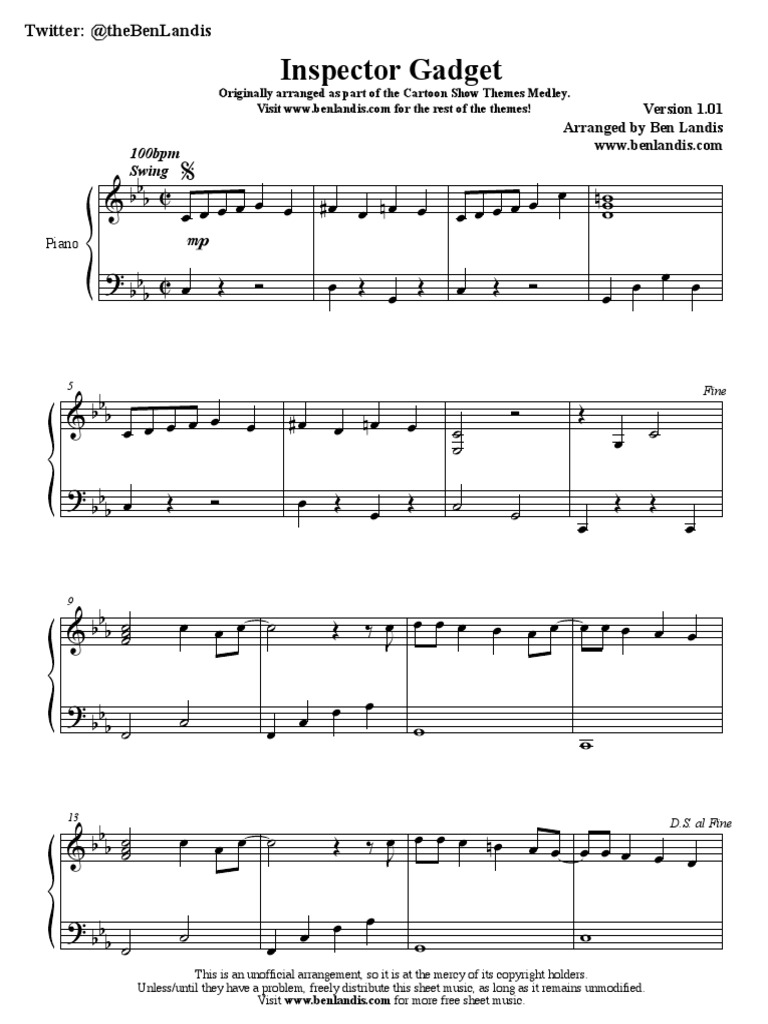
Today’s piece is from a TV show my son used to love to watch: Inspector Gadget. The show followed the adventures of a powerful but dimwitted cyborg police inspector named Gadget as he investigates the criminal schemes of Dr. Claw and his organization, MAD, as they fruitlessly attempt to stop him. However, neither side was aware that it is Gadget’s niece, Penny, and her dog, Brain, who are truly responsible for thwarting MAD.
Find the theme in Alfred Premier Pop and Movie Hits 1B as well as other books
Now, for just the theme
One of my favorite piano duet (I have the sheet music!)
Today’s piece is a fine baseball standard “Take Me Out to the Ballgame” by Jack Norworth and Albert Von Tilzer. The song’s chorus is traditionally sung during the middle of the seventh inning of a baseball game. Fans are generally encouraged to sing along, and at some ballparks, the words “home team” are replaced with the team name.
Find it in Piano Pronto Songs I love to Play 2 and Alfred Premier 2B among others.
Below are the lyrics to the chorus of the 1908 version, which is out of copyright.
Chorus
Take me out to the ball game,
Take me out with the crowd;
Buy me some peanuts and Cracker Jack,
I don’t care if I never get back.
Let me root, root, root for the home team,
If they don’t win, it’s a shame.
For it’s one, two, three strikes, you’re out,
At the old ball game.
Today’s piece is Also Sprach Zarathustra by Richard Strauss. It was made popular in the 1968 Stanley Kubrick science-fiction movie 2001: A Space Odyssey.
The organ part in this snippet looks pretty easy.
Just the main theme for piano
One-quarter speed
A piano reduction of the whole orchestral score
The orchestra playing the entire word
Just the opening of 2001: A Space Odyssey
The Blue Danube Waltz composed by Johann Strauss (no relation) was also used in this movie.
Today we will listen to Minuet in G. Several people composed a Minuet (a slow, stately ballroom dance for two in 3/4 time, popular especially in the 18th century) in the key of G including Beethoven, Mozart and Bach.
How are the same? How are they different?
JS Bach’s version
The Bach version also was “acquired” for a popular song in the 1960s
Beethoven
Rowlf from the Muppets plays the Beethoven Minuet
Mozart
So – never say to your teacher that “I already played that” – you never know which version s/he has in mind!
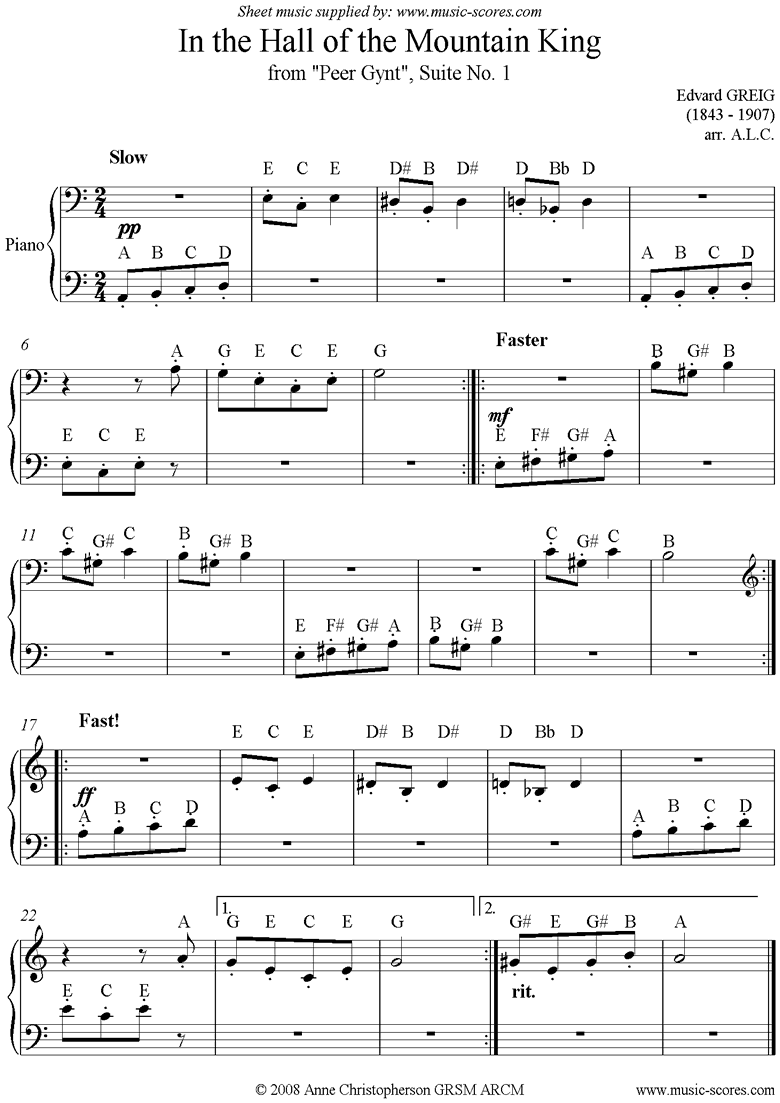
“In the Hall of the Mountain King” is a piece of orchestral music composed for the sixth scene of act 2 in Henrik Ibsen’s 1867 play Peer Gynt. It was originally part of Opus 23 but was later extracted as the final piece of Peer Gynt, Suite No. 1, Op. 46. Its easily recognizable theme has helped it attain iconic status in popular culture, where it has been arranged by many artists, including for the piano.
Borrow a copy of the sheet music from the O’Connor Music Studio. I have this arranged for piano, duet, 2-piano, simplified…
8 part vocal orchestra (plus a tiny pair of cymbals)
“The Entertainer” is a 1902 classic piano rag written by Scott Joplin. It was sold first as sheet music, and in the 1910s as piano rolls that would play on player pianos.
It was used as the theme music for the 1973 Oscar-winning film The Sting by composer and pianist Marvin Hamlisch.
The Sting was set in the 1930s, a full generation after the end of ragtime’s mainstream popularity, thus giving the inaccurate impression that ragtime music was popular at that time.
Find the sheet music in a variety of levels including Songs I Love to Play, Volume 1 and Alfred Premier Piano Course Book 4. It’s also available in Piano Maestro and to borrow from the O’Connor Music Studio
Today’s piece is the other one of two pieces that are so often played incorrectly that they have the distinction of being banned from competition in Northern Virginia Piano Teacher competitions.
The first was Fur Elise. This one is Spinning Song by Albert Ellmenreich. It’s in many, many piano method books. When I was in 5th or 6th grade, I tore it out of my book, put it in a construction paper cover and played it for some Girl Scout talent show. I have no idea why I couldn’t leave it in the book.
The left hand is supposed to sound like the foot pumping the wheel to make it move
This is part of a larger work called Musikalische Genrebilder, Op.14 which can be downloaded at IMSLP:
Spinnliedchen (Spinning Song), the best known item from the set, seems to be universally referred to as number four. The announcement of the first edition in Hofmeister’s Monatsberichte lists it as the fifth item. In Schirmer’s 1878 edition (see cover: here) of Op.14 it appears that items two and three were possibly combined into one number (entitled Sorrow and Consolation) so that Spinnliedchen became number four. Perhaps, this is the origin of the re-numbering.
To learn this sheet music, it’s available in Piano Pronto Movement 4 and Alfred Premier Piano Course Book 6
Here’s a sample:
A tutorial
With scrolling sheet music
For organ
How to conduct(?)
While this piece is not usually popular with other instruments, a trumpet quartet gave it a try
The DMS Percussion Ensemble
Singers from the Londonderry Middle School gave it a try:
The first half of this video is flute tuning. After that is a lovely flute duet.
“In the Hall of the Mountain King” is a piece of orchestral music composed for the sixth scene of act 2 in Henrik Ibsen’s 1867 play Peer Gynt. It was originally part of Opus 23 but was later extracted as the final piece of Peer Gynt, Suite No. 1, Op. 46. Its easily recognizable theme has helped it attain iconic status in popular culture, where it has been arranged by many artists, including for the piano.
Borrow a copy of the sheet music from the O’Connor Music Studio. I have this arranged for piano, duet, 2-piano, simplified…
8 part vocal orchestra (plus a tiny pair of cymbals)
“The Entertainer” is a 1902 classic piano rag written by Scott Joplin. It was sold first as sheet music, and in the 1910s as piano rolls that would play on player pianos.
It was used as the theme music for the 1973 Oscar-winning film The Sting by composer and pianist Marvin Hamlisch.
The Sting was set in the 1930s, a full generation after the end of ragtime’s mainstream popularity, thus giving the inaccurate impression that ragtime music was popular at that time.
Find the sheet music in a variety of levels including Songs I Love to Play, Volume 1 and Alfred Premier Piano Course Book 4. It’s also available in Piano Maestro and to borrow from the O’Connor Music Studio




 MaryO'Studio