
I have a copy of this music (Faerie’s Aire and Death Waltz) if anyone is interested in playing it!
Actually, this has been attempted!
but for my students…April Fools!


I have a copy of this music (Faerie’s Aire and Death Waltz) if anyone is interested in playing it!
Actually, this has been attempted!
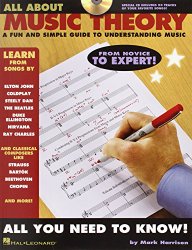
As all my students know, I teach theory with all piano and organ lessons. Sometimes, it’s from a theory book that matches a lesson book, sometimes on the fly on an “as needed” basis.
This book looks like it would be interesting to use as a review or to look ahead and see what’s coming. I have just ordered a copy for the studio if you want to check it out at the next lesson.
From amazon.com:
If you wish there was a fun and engaging way to help you understand the fundamentals of music, then this is it. Whether it’s learning to read music, understanding chords and scales, musical forms, or improvising and composing, this enjoyable guide will help you to finally start understanding the structure and design of music.
This fun-filled, easy-to-use guide includes:
* Music notation
* Scales and modes
* Melody harmonization and counterpoint
* Chord progressions
* Song form and structureListen and learn with the CD that has 90 tracks, including over 50 popular songs such as:
* Beauty and the Beast
* Candle in the Wind
* Imagine
* In the Air Tonight
* Killing Me Softly with His Song
* Let It Be
* Message in a Bottle
* Misty
* Satin Doll
* Take the ‘A’ Train
* Unchained Melody
* What’d I Say
* and more!


Since the first release of this classic Schirmer edition over 100 years ago, almost anyone who has taken piano lessons for more than two years has played from The Virtuoso Pianist.
Most anyone who has ever played piano has a love-hate relationship with the “Hanon”.
The Virtuoso Pianist (Le Pianiste virtuose) by Charles-Louis Hanon, is a compilation of sixty exercises meant to train the pianist in speed, precision, agility, and strength of all of the fingers and flexibility in the wrists.
First published in Boulogne, in 1873, The Virtuoso Pianist is Hanon’s most well-known work, and is still widely used by piano instructors and pupils although some teachers are getting away from the mechanical playing these can produce.
Personally, I’ve sometimes played these on “auto-pilot” since all one really needs is to get the first pattern going, then move up a step, up a step…

Notes by C. L. Hanon: Preparatory exercises for the Acquirement of Agility, Independence, Strength and Perfect Evenness in the Fingers. For studying the 20 exercises, begin with the metronome set at 60, gradually increasing the speed up to 108.
From Wikipedia:
The exercises are intended to address common problems which could hamper the performance abilities of a student. These include “crossing of the thumb”, strengthening of the fourth and fifth fingers, and quadruple- and triple-trills.
The exercises are meant to be individually mastered and then played consecutively in the sections they are placed in.
Apart from increasing technical abilities of the student, when played in groups at higher speeds, the exercises will also help to increase endurance. The exercises are divided in three parts:
- Exercises 1 – 20: Labeled “preparatory exercises”, these are also the most famous exercises, and are used to develop finger strength and independence. Each exercise contains a sequence of 8 semiquavers, beginning on C, which is then repeated starting on D, and so on across two octaves. The exercise is then repeated in reverse down two octaves to the starting C. The exercises are intended to be practiced in groups of three, except for the first two which are practiced together.
- Exercises 21 – 43: Labeled “further exercises for the development of a virtuoso technique.” This more difficult section is meant to be played after the pianist has fully mastered Part 1. Part 2 includes scales and arpeggios.
- Exercises 44 – 60: Labeled “virtuoso exercises for mastering the greatest technical difficulties.” Since this section is considerably more difficult, Hanon recommends the mastery of both previous parts before proceeding to this one. This part includes repeated notes,, and more.
After all three parts are mastered, Hanon recommends all exercises be played through daily to retain technique.
The O’Connor Music Studio has several editions of this work, including:
Hanon: The Virtuoso Pianist in Sixty Exercises, Complete. Since the first release of this classic Schirmer edition over 100 years ago, almost anyone who has taken piano lessons for more than two years has played from The Virtuoso Pianist . Millions of copies have been sold of these progressive exercises which guide a player’s technique, building finger independence and strength. This was the first American edition released of this music, and remains a classic at a remarkably affordable price.
Junior Hanon (Alfred Masterwork Edition). A slight condensation of Hanon’s first exercises. The simplification in layout and range make the exercises appear less difficult to a young student. Includes the complete Book 1 and excerpts from Books 2 & 3 of C. L. Hanon’s famous studies, The Virtuoso Pianist in 60 Exercises.
Hanon for Students, Bk 1: 6 Varied Exercises from The Virtuoso Pianist for Late Elementary Pianists. Hanon for Students, Book 1, contains the first six exercises from The Virtuoso Pianist, Book 1. The exercises are notated in eighth notes for one octave so that students may begin to use them effectively at the late-elementary level. Each exercise appears five times to be played with a legato touch, varied articulation, varied dynamics, varied rhythm, and transposed to F or G.
Jazz Hanon. Inspired by Charles-Louis Hanon’s The Virtuoso Pianist the essential technical method for any classical player these new volumes present a modern-day equivalent for the musician seeking to play the key piano styles of the 20th century. Each book develops basic technique and true facility in each genre through authentic, progressive exercises and etudes. The music in these books is fun to play for pianists at every level, building the necessary skills in each style while providing extensive musical and stylistic insight.
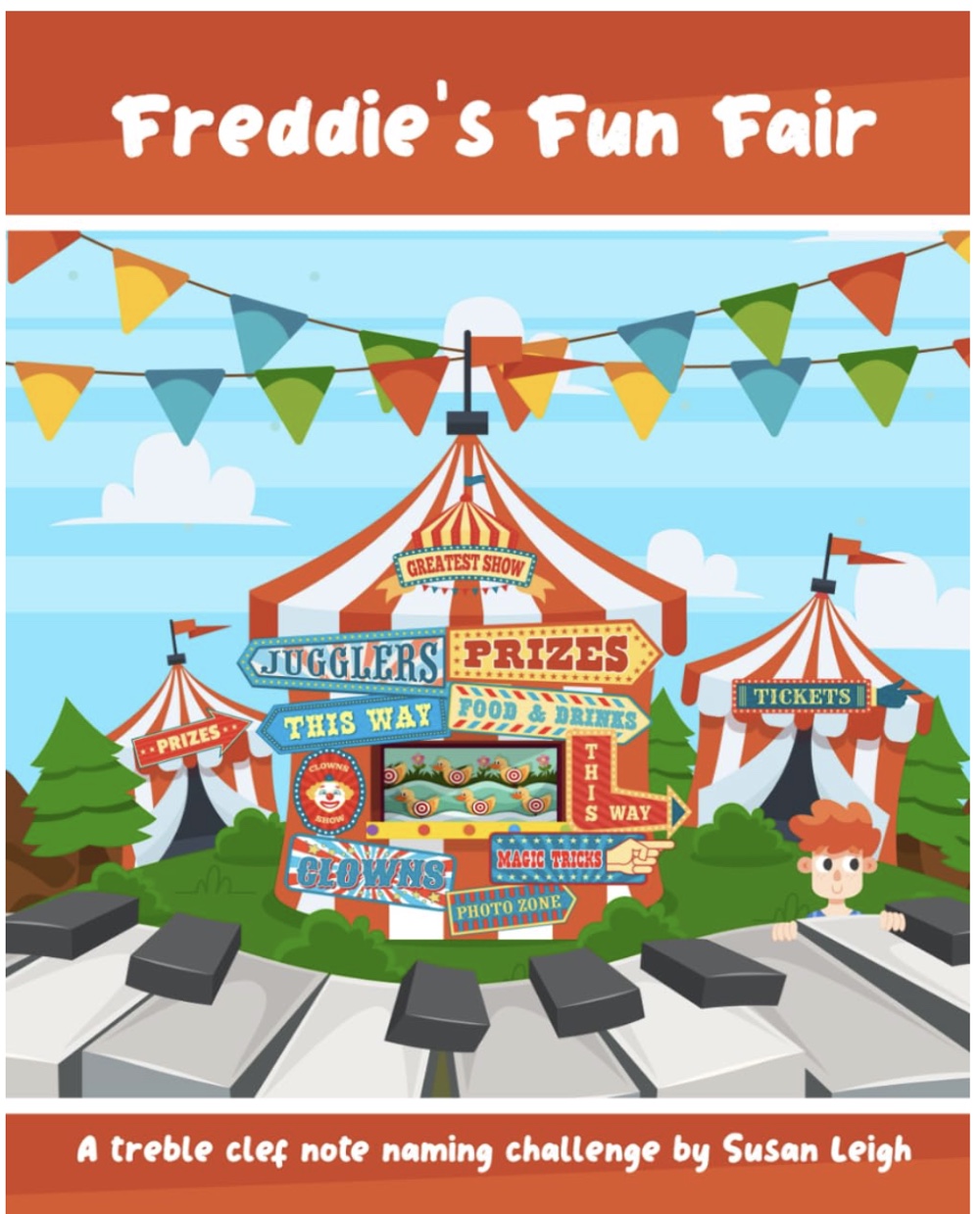
Susan Leigh’s other books have been a huge hit with students and I’m sure this one will be, too. It was just published and I’ve ordered it to arrive in time for students returning after winter break.
Freddie invites you to a treble clef challenge at the fun fair! Can you beat him in events like ‘Tin Can Alley’, ‘Hook a Duck’, ‘Balloon Darts’ and more? Improve your note reading and aim for the gold medal!
The note range includes all the lines and spaces of the treble clef stave, making it ideal for instrumentalists who play the piano, flute, saxophone and more.
Puzzles include traditional fairground games like the Coconut Shy, Bumper Cars, Hoopla, Toy Grabber, Skittles and Test Your Strength. There are match ups, scrambles, mazes, and also games against the clock like Tabletop Giraffe Racing, Splash the Shark and Whack-a-monster.
Students compete against Freddie in all events until the overall winner is crowned. There are two certificates to compete for; but who will win gold or silver and become the ultimate champion of both the treble clef and the fairground?!

Music theory has never sounded so catchy with this witty remake of the holiday classic The Christmas Song (with apologies to Mel Torme) Try not to laugh at the ending.
Though it is a bit humorous, this version titled ‘Intervals Roasting’, with lyrics by David Rakowski, attempts to encapsulate the fundamentals of music theory in just over two minutes.
It does a good job of explaining the intervals and harmonic structure of the song and also gives you an idea of how to use music theory to analyze or compose music.
The O’Connor Music Studio has a copy if anyone wants to learn this 🙂

“O Come, All Ye Faithful,” originally penned in the reverent Latin tones as “Adeste Fideles,” is a Christmas carol shrouded in mystery and rich in history. This beloved hymn, a staple of holiday celebrations, is thought to have been crafted by a medley of historical figures. Among them are John Francis Wade (1711–1786), John Reading (1645–1692), and even King John IV of Portugal (1604–1656). The hymn’s origins are further mystified by the earliest manuscript bearing King John IV’s name, found nestled in the Ducal Palace of Vila Viçosa’s library.
Initially composed with four verses, the hymn has since blossomed into an eight-verse masterpiece, transcending language barriers and cultural divides. Its verses have been translated into a multitude of languages, spreading its message of faith and joy worldwide. The English rendition by Frederick Oakeley, an English Catholic priest, penned in 1841, has particularly resonated in the hearts of English-speaking audiences globally, becoming a cherished rendition of this classic hymn.
Today, “O Come, All Ye Faithful” stands not just as a carol but as a symbol of Christmas spirit and unity. If you’re drawn to the allure of this timeless hymn and wish to bring its melody into your own celebrations, the O’Connor Music Studio offers a variety of versions for those eager to learn and share in the joy and majesty of this classic Christmas carol. Whether you’re a seasoned musician or a curious beginner, the store provides a gateway to experiencing and sharing the enduring magic of “O Come, All Ye Faithful.”

Gesù Bambino,” composed by the illustrious Pietro Yon, is a melodic treasure that resonates with the warmth and nostalgia of my childhood Christmases. Each note of this enchanting piece takes me back to those magical days when the church choir’s voices would rise in harmony, filling the air with the spirit of the festive season. This song, a staple of my yuletide memories, holds a special place in my heart, reminiscent of the joy and wonder of Christmas celebrated in the hallowed halls of my childhood church.
Though it seemed a hidden gem, known primarily within the circles of my church community, “Gesù Bambino” has recently found a renaissance, emerging in piano books and gaining recognition. Its melody, crafted in the year 1917, has an ethereal quality that transcends time and place.
The song’s enchanting tune was brilliantly adapted by Frederick H. Martens in his English carol “When Blossoms Flowered ‘mid the Snows.” Its chorus, a harmonious blend of melody and lyrics, draws inspiration from the classic carol “Adeste Fideles” (O Come All Ye Faithful), weaving a tapestry of musical heritage and tradition. This fusion of melodies creates a piece that is both familiar and fresh, evoking a sense of time-honored tradition while offering a unique auditory experience.
“Gesù Bambino” is not just a song; it’s a musical journey that captures the essence of Christmas, weaving together the threads of nostalgia, tradition, and the universal joy of the holiday season. Its rising popularity is a testament to its timeless beauty and its ability to touch hearts, just as it has touched mine since childhood.
A piano version
Piano and Organ
Sung by David Archuleta and the Mormon Tabernacle Choir

Carol of the Bells was composed by Mykola Dmytrovych Leontovych (1877-1921) in 1916. Originally titled Shchedryk, this Ukrainian folk song is sometimes called Ukrainian Bell Carol. “Shchedryk” which was associated with the coming New Year, originally celebrated in April.
Leontovych used this tune in 1904 along with lyrics by Peter J. Wilhousky to create the version that everyone knows today. It gained popularity during the 1920s and 1930s, and was introduced to an even wider audience when it was used in the movie “Home Alone”.
It was first performed in the Ukraine on the night of January 13, 1916, on the Julian calendar this is considered New Year’s Eve. In the United States the song was first performed on October 5, 1921 at Carnegie Hall.
This video is from the Christmas special of the Mormon Tabernacle Choir, presented at the BYU channel. The orchestra and choir produce a very beautiful sound.
Not the standard version –
The O’Connor Music Studio has several versions of this Christmas Carol available for loan, including this version from the Mannheim Steamroller:

Joy To The World
Joy to the World, the Lord is come!
Let earth receive her King.
Isaac Watts wrote the words to “Joy to the World” in 1719, based on Psalm 98 in the Bible. The hymn originally glorified Christ’s triumphant return at the end of the age, rather than a song celebrating His first coming. Only the second half of Watts’ lyrics are still used today.
The music was adapted and arranged to Watts’ lyrics by Lowell Mason in 1839 from an older melody which was then believed to have originated from Handel. The name “Antioch” is generally used for the hymn tune.
As of the late 20th century, “Joy to the World” was the most-published Christmas hymn in North America.
There are versions of Joy to the World available at the O’Connor Music Studio for any level of playing, starting with Pre-Reading, all the way up through Advanced and duets.

I’ve always liked Leroy Anderson’s Sleigh Ride as a secular Christmas song 🙂 It’s not technically a Christmas song since the words never mention Christmas but it’s often played now so it seems like a way to ease into the season.
Anderson had the original idea for the piece during a heatwave in July 1946; he finished the work in February 1948. Lyrics, about a person who would like to ride in a sleigh on a winter’s day with another person, were written by Mitchell Parish in 1950.
The orchestral version was first recorded in 1949 by Arthur Fiedler and The Boston Pops Orchestra. The song was a hit record and has become the equivalent of a signature song for the orchestra.
A fun arrangement has been made for piano duet. I have copies here to lend and it’s available on amazon (of course! What isn’t?)
 MaryO'Studio