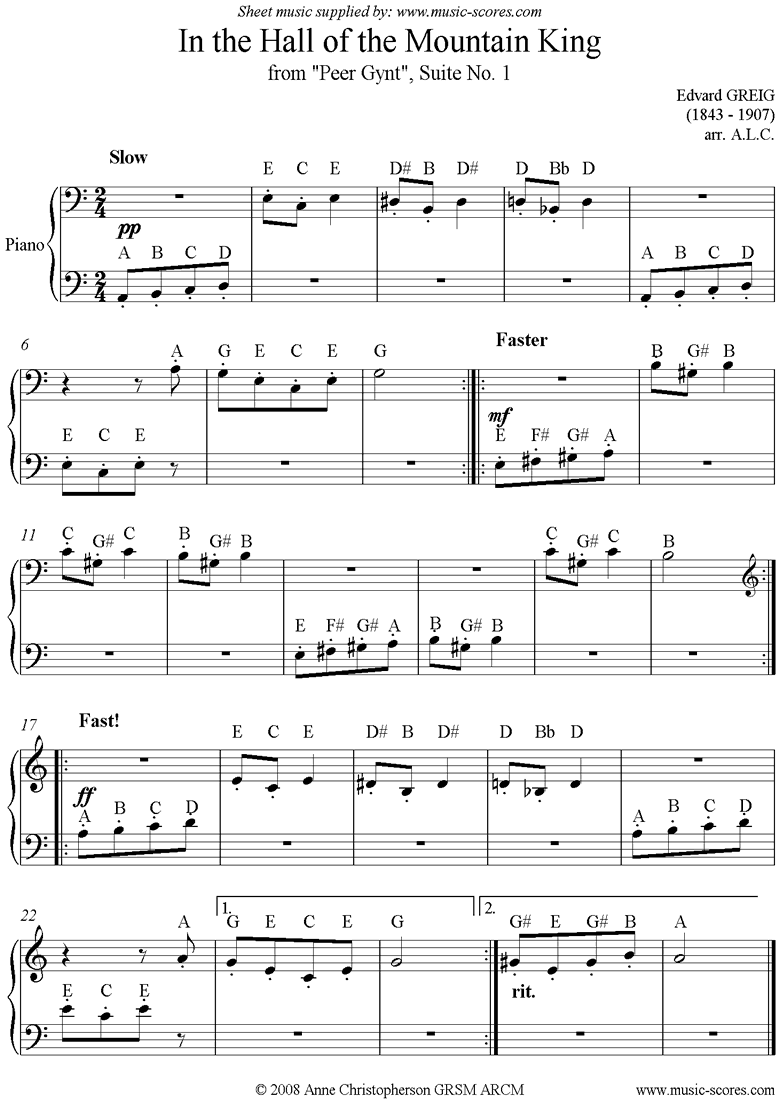
“In the Hall of the Mountain King” is a piece of orchestral music composed for the sixth scene of act 2 in Henrik Ibsen’s 1867 play Peer Gynt. It was originally part of Opus 23 but was later extracted as the final piece of Peer Gynt, Suite No. 1, Op. 46. Its easily recognizable theme has helped it attain iconic status in popular culture, where it has been arranged by many artists, including for the piano.
Borrow a copy of the sheet music from the O’Connor Music Studio. I have this arranged for piano, duet, 2-piano, simplified…
8 part vocal orchestra (plus a tiny pair of cymbals)
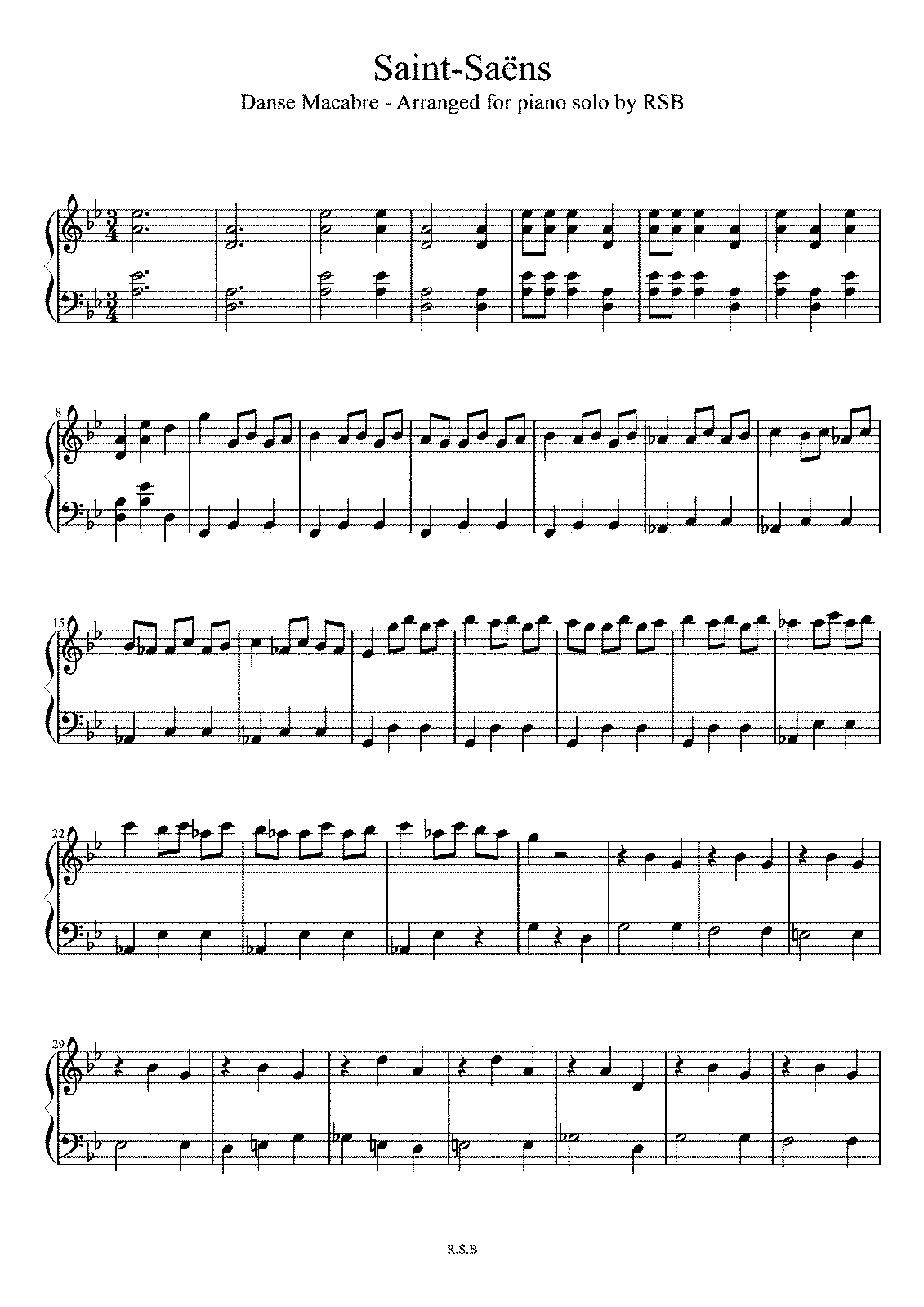
Danse macabre, Op. 40, is a tone poem for orchestra, written in 1874 by French composer Camille Saint-Saëns. It started out in 1872 as an art song for voice and piano with a French text by the poet Henri Cazalis, which is based on an old French superstition. In 1874, the composer expanded and reworked the piece into a tone poem, replacing the vocal line with a solo violin.
Get a free copy of the sheet music at IMSLP (Look for Arrangements and Transcriptions) or borrow a copy from the O’Connor Music Studio. I have this arranged for organ, piano, duet, simplified…
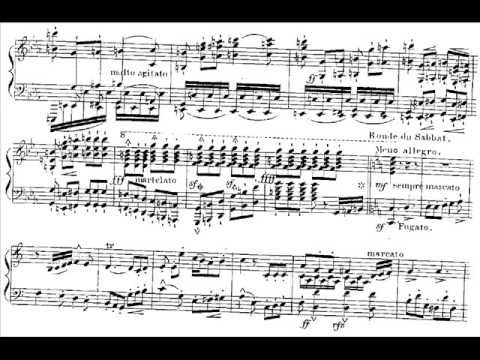
Amazon has a great Dover edition for solo piano. This splendid compilation features a variety of the composer’s best piano works, all reproduced from authoritative sources. Taking its title from the popular orchestral work “Danse Macabre” (presented here in the brilliant arrangement by Liszt), this collection also includes “Allegro appassionato,” “Album” (consisting of six pieces), “Rhapsodie d’Auvergne,” “Theme and Variations,” plus six etudes, three waltzes, and six etudes for left hand alone.
The final movement is the best known part of the symphony, thanks to its use in the Julia Roberts movie, Sleeping With The Enemy. It features a four-part structure, which Berlioz described in his own program notes from 1845 as follows:
“He sees himself at a witches’ Sabbath, in the midst of a hideous gathering of shades, sorcerers and monsters of every kind who have come together for his funeral. Strange sounds, groans, outbursts of laughter; distant shouts which seem to be answered by more shouts. The beloved melody appears once more, but has now lost its noble and shy character; it is now no more than a vulgar dance tune, trivial and grotesque: it is she who is coming to the Sabbath… Roar of delight at her arrival… She joins the diabolical orgy… The funeral knell tolls, burlesque parody of the Dies irae, the dance of the witches. The dance of the witches combined with the Dies irae.”
The Dies irae melody is one of the most-quoted in musical literature, appearing in the works of many diverse composers.
The traditional Gregorian melody has also been used as a theme or musical quotation in a number of classical compositions, notable among them:
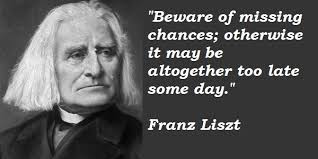
Franz Liszt was born in Raiding, near Ödenburg, October 22, 1811 and died in Bayreuth, July 31, 1886. He was a Hungarian composer and pianist who was a major influence during the romantic period. Liszt was an outstanding pianist at seven, composed at eight and made concert appearances at nine. In addition to being a piano virtuoso, he was also a critic, conductor, city music director, literary writer and transcriber of the works of other composers. He transcribed Beethoven’s Symphonies for the piano.
Franz Liszt began his career as the outstanding concert pianist of the century, who, along with the prodigious violinist Niccoló Paganini (1782-1840), created the cult of the modern instrumental virtuoso. To show off his phenomenal and unprecedented technique, Liszt composed a great deal of music designed specifically for this purpose, resulting in a vast amount of piano literature laden with dazzling, and other technical marvels. In this vein, Liszt composed a series of virtuosic rhapsodies on Hungarian gypsy melodies, the best-known being the all too familiar Hungarian Rhapsody no. 2. Liszt developed the rhapsody as a form of serious music. This kind of music is worlds apart from the generally more introspective, poetic music of pianist-composer Frédéric Chopin.
Liszt was wildly handsome and hugely talented. He was extremely popular in Paris during the 1830’s. It is said that women actually fainted at his piano recitals. He was the first to position the piano so that its lid reflected the sound and the audience could see his profile as he performed.
Liszt was the first to write a tone poem, which is an extended, single-movement work for orchestra, inspired by paintings, plays, poems or other literary or visual works, and attempting to convey the ideas expressed in those media through music. Such a work is Les Préludes, based on a poem in which life is expressed as a series of struggles, passions, and mysteries, all serving as a mere prelude to . . .what? The Romantic genre of the symphonic poem, as well as its cousin the concert overture, became very attractive to many later composers, including Saint-Saëns, Tchaikovsky, Dvorák, Sibelius, and Richard Strauss.
Listen to Liszt’s transcription of Meyerbeer’s Hellish Waltz from Robert du Diable, which probably caused more public commotion than any other piano piece in history.
I have purchased a set of Shades of Sound Listening & Coloring Book: Halloween for the studio.
Each week, I will print out some of the pages for your student and put them in his/her notebook. After listening to the music on YouTube, the student may color the pages.
After they are colored, please return them to the notebook so that there will be a complete book when finished.
If you are an adult and want to listen and color, too, just let me know and I’ll print you a set.
The Shades of Sound Listening and Coloring Books are a great way to encourage students to listen to great piano and orchestral repertoire. Students of all ages will love coloring the fun pictures while listening to and learning from the music of the great composers.
This Shades of Sound Halloween edition includes 13 spooky pieces of piano and orchestral literature, ranging from the Baroque to the Modern period. By spending just 5-10 minutes per day listening for just a few days per week, students can listen to and complete the whole book in a few weeks.
Aspiring pianists need to know the literature, hear the greats perform, and be inspired and excited by the great music that is available! Just as writers need to read, read, read, pianists need to listen! Through this fun curriculum, students will learn about the musical periods and the great composers and their works. Listening repertoire selected includes selections from the standard solo piano literature, as well as solo piano and orchestra literature and orchestral works.
My hope is that students can add just 5-10 minutes of listening per day to their normal practicing. Listening to great music will change their understanding of music and will vastly increase their music history knowledge. It will excite and inspire them, encourage further study and listening, give them new pieces to add to their own repertoire wish list, infuse more great music into their lives, homes and families, and will boost their musicianship and expression to the next level.
The Halloween Shades of Sound book includes 13 different pieces, including:
Totentanz by Liszt
Le Cimetiere, from Clairs de Lune by Abel Decaux
Graceful Ghost Rag by William Bolcom
Night on Bald Mountain by Mussorgsky/Rimsky-Korsakov
Tarantelle, from Music for Children Op. 65 No. 4 by Prokofiev
Tarantella by Albert Pieczonka
In the Hall of the Mountain King by Grieg
Toccata and Fugue in D minor, BWV 565 by Bach
Funeral March, from Piano Sonata No. 2 in B-flat minor by Chopin
Danse Macabre by Saint-Saens
The Banshee by Henry Cowell
Scarbo, from Gaspard de la nuit by Ravel
The Sorcerer’s Apprentice by Paul Dukas
Students may use The Playful Piano – Halloween Listening YouTube playlist to listen along with their book using quality recordings. The playlist is ordered to go right along with the book, and also includes 5 extra pieces (some pages include optional “Further Listening” examples students may listen to).
Jelly Roll Morton, born Ferdinand Joseph La Menthe in 1885, was one of the most influential composers of the jazz era, bridging an important gap between ragtime, blues, and jazz. In a sense, he was the first great jazz composer.
His career began in New Orleans, where he began to experiment with a unique blend of blues, ragtime, Creole, and Spanish music in bordellos as a piano player. Along with being a musician, he also worked as a gambler, pool shark, vaudeville comedian, and was known for his flamboyant personality and diamond front tooth.
Morton became successful when he started making what would be some of the first jazz recordings in 1923 with “the New Orleans Rhythm Kings”. Whether he played on the West Coast, New Orleans, or in Chicago, his recordings were always very popular. He joined the group “the Red Hot Peppers” in 1924 and made several classic albums with the Victor label.
Nothing but success came to him until 1930, when “Hot Jazz” began to die out, and big bands began to take over. Morton died in 1941, claiming that a voodoo spell was the cause of his demise.
• 1895 ~ The Berliner Gramophone Company was founded in Philadelphia. Record players were not too far off in the future.
• 1904 ~ “Little Johnny Jones” opened in Hartford, CT. The show became a hit several times, due in part to a little ditty which became quite popular. Give MyRegards to Broadway was penned, as was the entire musical, by the ‘Yankee Doodle Dandy’ himself, George M. Cohan.
• 1935 ~ Wedding bells pealed for a singer and a bandleader who tied the knot, making radio history together. The bandleader was Ozzie Nelson and the singer was Harriet Hilliard. They would make the history pages again on this very day in 1944.
• 1941 ~ The Benny Goodman Orchestra recorded Buckle Down Winsocki, with Tom Dix as featured vocalist, on the Columbia label.
• 1941 ~ George Bellamy, Guitarist with The Tornados
• 1942 ~ Buzz (Reese) Clifford, Singer
• 1944 ~ Susan Raye, Singer
• 1944 ~ The first broadcast of The Adventures of Ozzie & Harriet was heard on the CBS radio network. The show would continue on radio until 1953 and on ABC~TV from 1952 to 1966. “Hi Mom, Hi Dad, Hi Dave, Hi Ricky.”
• 1947 ~ Tony Wilson, Bass, singer with Hot Chocolate
• 1948 ~ Johnny Ramone (Cummings), Guitarist with The Ramones
• 1949 ~ Hamish Stuart, Guitarist, singer with Average White Band
• 1950 ~ Robert ‘Kool’ Bell, Bass guitar, singer with Kool and the Gang
• 1956 ~ Lawrence “a-one and a-two” Welk was doing so well with “da boys inta bant” on ABC-TV, that, after being on the tube for just one year with The Lawrence Welk Show, Welk originated another popular show called Lawrence Welk’s Top Tunes and New Talent.
• 1961 ~ Ted Kooshian, American jazz pianist
• 1974 ~ Then Came You, by Dionne Warwicke and The Spinners, went solid gold this day. While the editors are poring over the proper spelling of her name, might we add that due to some superstitious feeling having to do with astrology, the former Ms. Warwick changed her name for good luck to Warwicke. It apparently worked. That is, until she went solo again upon meeting Barry Manilow in the early 1980s. Tunes likeI’ll Never Love This Way Again, Deja Vu and hits with Johnny Mathis, Luther Vandross and some friends made it OK to be just Dionne Warwick again.
• 1979 ~ “Sugar Babies”, opened at the Mark Hellinger Theatre on Broadway. The star of the hit show was also making his debut on the Great White Way. Mickey Rooney, who had been acting since the 1930s, once again delighted one and all with his performance.
• 1984 ~ Anne Murray won the Country Music Association’s Album of the Year Award this day for A Little Good News. Murray was the first woman to win this award.
Destined to become one of the world’s greatest pianists, Vladimir Horowitz was born in 1903 in Kiev, Russia. While most young children were playing games, Vladimir was playing with the ivories. His time was well spent as he was fully capable of performing publicly by the time he was sixteen.
Within four years, the young piano virtuoso was entertaining audiences at recitals throughout Leningrad – 23 performances in one year, where he played over 200 different works of music, never repeating a composition. After Leningrad, Horowitz played in concerts in Berlin, Hamburg and Paris.
In 1928, the Russian pianist traveled to the United States to play with the New York Philharmonic Orchestra at Carnegie Hall. Arturo Toscanini chose Horowitz to perform his first solo with the New York Philharmonic. It was there that Horowitz met his bride-to-be, Toscanini’s daughter, Wanda. The two were wed in Milan in 1933. New York became Horowitz’ permanent home in 1940. He became a U.S. citizen a few years later, devoting the rest of his career to benefit performances, and helping young, aspiring artists.
His return to the concert stage in May of 1965 was a triumphant success, as was his television recital, Vladimir Horowitz at Carnegie Hall.
Just three years before his death, Vladimir Horowitz returned to his homeland to perform once again for the Russian people on April 20, 1986. They felt he had been away far too long … close to sixty years.
Johann Sebastian Bach (1685-1750) was also apparently a coffee enthusiast. So much so that he wrote a composition about the beverage. Although known mostly for his liturgical music, his Coffee Cantata (AKA Schweigt stille, plaudert nicht, BWV 211) is a rare example of a secular work by the composer. The short comic opera was written (circa 1735) for a musical ensemble called The Collegium Musicum based in a storied Zimmerman’s coffee house in Leipzig, Germany. The whole cantata seems very much to have been written with the local audience in mind.
Coffee Cantata is about a young vivacious woman named Aria who loves coffee. Her killjoy father is, of course, dead set against his daughter having any kind of caffeinated fun. So he tries to ban her from the drink. Aria bitterly complains:
Father sir, but do not be so harsh!
If I couldn’t, three times a day,
be allowed to drink my little cup of coffee,
in my anguish I will turn into
a shriveled-up roast goat.
Ah! How sweet coffee tastes,
more delicious than a thousand kisses,
milder than muscatel wine.
Coffee, I have to have coffee,
and, if someone wants to pamper me,
ah, then bring me coffee as a gift!
The copywriters at Starbucks marketing department couldn’t have written it any better. Eventually, daughter and father reconcile when he agrees to have a guaranteed three cups of coffee a day written into her marriage contract.






 MaryO'Studio