Isaac Watts wrote the words to “Joy to the World” in 1719, based on Psalm 98 in the Bible. The hymn originally glorified Christ’s triumphant return at the end of the age, rather than a song celebrating His first coming. Only the second half of Watts’ lyrics are still used today.
The music was adapted and arranged to Watts’ lyrics by Lowell Mason in 1839 from an older melody which was then believed to have originated from Handel. The name “Antioch” is generally used for the hymn tune.
As of the late 20th century, “Joy to the World” was the most-published Christmas hymn in North America.
There are versions of Joy to the World available at the O’Connor Music Studio for any level of playing, starting with Pre-Reading, all the way up through Advanced and duets.
• 1918 ~ Milton DeLugg, Bandleader on The Tonight Show Starring Johnny Carson; Milton DeLugg and His Orchestra: Abe Burrows’ Almanac, The Chuck Barris Rah Rah Show, Dagmar’s Canteen, Doodles Weaver, The Gong Show, Judge for Yourself, Your Hit Parade; played accordion in The Milton DeLugg Quartet and songwriter
• 1928 ~ Jörg Demus, Austrian pianist
• 1934 ~ Billy Paul (Paul Williams), Singer
• 1941 ~ Tom McGuinness, Bass, guitar with Manfred Mann; McGuinness Flint; and Blues Band
• 1942 ~ Ted Bluechel, Jr., Singer, drummer with The Association
• 1944 ~ Eric Bloom, Singer, guitarist
• 1945 ~ John Densmore, Musician with The Doors
• 1950 ~ Dino Lipatti, classical pianist and composer whose career was cut short from causes related to Hodgkin’s disease, died at the age of 33
• 1952 ~ Michael McDonald, Singer, songwriter, keyboard with The Doobie Brothers
• 1960 ~ Rick Savage, Bass with Def Leppard
• 1972 ~ Motown’s Temptations reached the #1 spot on the top 40 charts with Papa Was a Rollin’ Stone. It was the fourth #1 hit for the Temptations, joining My Girl, I Can’t Get Next to You and Just My Imagination.
• 1981 Hershy Kay, composer, died at the age of 62. Union Jack is a ballet made by New York City Ballet co-founder and founding choreographer George Balanchine to traditional British tunes, hornpipe melodies and music-hall songs, ca. 1890–1914, adapted by Hershy Kay. The premiere took place on 13 May 1976, at the New York State Theater, Lincoln Center, to honor British heritage in the United States its bicentennial with costumes by Rouben Ter-Arutunian, original lighting by Ronald Bates and current lighting by Mark Stanley. At the finale, the ensemble spells out “God Save the Queen” in semaphore code and the Union Jack unfurls. Principal dancer Jock Soto included an excerpt from Union Jack in his farewell performance in June 2005.
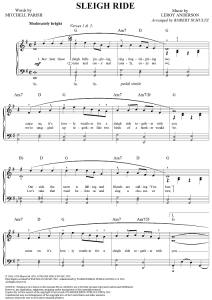
I’ve always liked Leroy Anderson’s Sleigh Ride as a secular Christmas song 🙂 It’s not technically a Christmas song since the words never mention Christmas but it’s often played now so it seems like a way to ease into the season.
Anderson had the original idea for the piece during a heat wave in July 1946; he finished the work in February 1948. Lyrics, about a person who would like to ride in a sleigh on a winter’s day with another person, were written by Mitchell Parish in 1950.
The orchestral version was first recorded in 1949 by Arthur Fiedler and The Boston Pops Orchestra. The song was a hit record and has become the equivalent of a signature song for the orchestra.
A fun arrangement has been made for piano duet. I have copies here for loan and it’s available on amazon (of course! What isn’t?)
• 1709 ~ Franz Xaver Richter, Austro-Moravian singer, violinist, composer, conductor and music theoretician
• 1879 ~ Gilbert and Sullivan’s operetta, H.M.S. Pinafore, opened. Arthur Sullivan conducted the orchestra while William Gilbert played the role of a sailor in the chorus and in the Queen’s Nay-vee.
• 1912 ~ Terence Beckles, pianist/teacher
• 1913 ~ Mary Martin, American singer and actress, primarily for the musical theater, Tony and Emmy Award-winning actress, mother of actor Larry Hagman
• 1924 ~ Lady Be Good opened in New York City. George Gershwin wrote the music while Fred and Adele Astaire were well-received by the show’s audience for their dancing talents.
• 1936 ~ Lou Rawls (Louis Allen), American Grammy Award-winning singer of popular music, TV regular on Dean Martin Presents
• 1938 ~ Sandy Nelson, Drummer
• 1939 ~ Diane Lennon, Singer with The Lennon Sisters on Lawrence Welk Show, Jimmy Durante Presents the Lennon Sisters
• 1940 ~ Glenn Miller got a call from ASCAP (American Society of Composers and Publishers). He was informed that he couldn’t use his Moonlight Serenade as his band’s theme song. He had to use Slumber Song instead because of an ASCAP ban.
• 1945 ~ Bette Midler, American Grammy Award-winning pop-rock singer and actress
• 1945 ~ Burl Ives made his concert debut. He appeared at New York’s Town Hall. We lovingly listen every year for the voice of this old-time radio personality as the narrator and banjo-pickin’ snowman in TV’s Rudolph the Red-Nosed Reindeer.
• 1946 ~ Gilbert (Raymond) O’Sullivan, Singer
• 1950 ~ John Wesley Ryles, Singer
• 1950 ~ Ernest John Moeran passed away
• 1968 ~ Promises, Promises opened on Broadway. The play ran for 1,281 performances, earning $35,000 in profits each week of 1969. Dionne Warwick had a hit version of the title song.
• 1986 ~ Horace Heidt, orchestra leader (Swift Show Wagon), died at the age of 85
• 1989 ~ Alvin Ailey, US choreographer (Blues Suite, Revelations), died at the age of 58
• 1997 ~ Stéphane Grappelli, French jazz violinist who founded the Quintette du Hot Club de France, died at the age of 89
. 1954 ~ George McArdle, Bass guitarist with Little River Band
. 1954 ~ June Pointer, Singer with The Pointer Sisters
. 1955 ~ Billy Idol (Broad), Guitarist, singer, songwriter
. 1957 ~ John Aston, Guitarist with these groups: Photons, Psychedelic Furs
. 1957 ~ Richard Barbieri, Drummer with Japan, composer
. 1968 ~ Diana Ross and The Supremes hit the #1 spot on the music charts with Love Child. The somewhat controversial tune (for the times) stayed at the top for two weeks.
. 1971 ~ ABC-TV presented Brian’s Song as the ABC Movie of the Week. The touching story was about Chicago Bears running back Brian Piccolo and his friendship with Gayle Sayers, who watched Brian die a tragic death. The theme song, Brian’s Song, was performed by Michel Legrand.
. 1974 ~ The Eagles hit, Best of My Love, was released. It would take until March 1, 1975 for it to reach the #1 spot on the top 40 charts.
. 1970 ~ Des’ree, Singer
. 1996 ~ Tiny Tim died performing Tiptoe Through the Tulips to an audience at a benefit in Minneapolis, Minnesota. He cut the song short, commenting to his wife, Miss Sue, that he felt ill. As he was making his way with Sue to her table, amidst the applause of his loyal fans, he collapsed, was taken to a Minneapolis hospital and died without regaining consciousness.
. 2017 ~ Jim Nabors, American comedian, actor and singer (Gomer Pyle, Back Home Again in Indiana), died from health complications at the age of 87
In Scotland, and many countries with Scottish connections, St Andrew’s Day is marked with a celebration of Scottish culture with traditional Scottish food, music and dance. Schools across Scotland hold special St Andrew’s Day events and activities including art shows, Scottish country dancing, lunchtime Ceilidhs, dance festivals, storytelling, reciting and writing poems, writing tall tales, cooking traditional Scottish meals, and bagpipe-playing.
The day is also seen as the start of a season of Scottish winter festivals encompassing St Andrew’s Day, Hogmanay and Burns Night.
In Edinburgh, there is a week of celebrations, concentrating on musical entertainment and traditional ceilidh dancing. A ceilidh is a social event with couples dancing in circles or sets (groups of eight people).
In Glasgow city centre, a large shindig, or party, with traditional music and a ceilidh are held. In Dumfries, songs are performed in the Burn’s night tradition.
In Barbados Saint Andrew’s Day is celebrated as the national day of Independence in Barbados. As the patron saint of Barbados, Saint Andrew is celebrated in a number of Barbadian symbols including the cross formation of the Barbadian Coat of Arms, and the country’s national honours system which styles persons as Knights or Dames of St. Andrew.
You’re invited to a musical celebration of God’s gift of eternal light! The Pender UMC music ministry presents “The Promise of Light”, a cantata (narrative piece of music) composed by Joel Raney. The piece includes Christmas carols and original choral music blended with narration, piano, handbell, and percussion, to tell the timeless story of the birth of Jesus Christ, the Light of the World.
The production will take place during Pender’s only Sunday worship service on December 9, at 10 a.m. Stay for a delicious brunch after worship!
No RSVP required; all are welcome. Childcare will be available during worship for ages birth through 6th grade.
I have just purchased a set of Christmas Shades of Sound Listening & Coloring Book for the studio.
Please let me know if you do not want your student to participate in Christmas activities and I will assign alternate activities.
Each week, I will print out some of the pages for your student and put them in his/her notebook. After listening to the music on YouTube, the student may color the pages.
After they are colored, please return them to the notebook so that there will be a complete book when finished.
If you are an adult and want to listen and color, too, just let me know and I’ll print you a set.
Get your piano students listening to great classical music!
The Shades of Sound Listening and Coloring Books are a great way to encourage students to listen to great piano and orchestral repertoire. Students of all ages will love coloring the fun pictures while listening to and learning from the music of the great composers.
This Shades of Sound Christmas edition includes 20 pieces of piano and orchestral literature for the Christmas season, from the Baroque to the Modern period. Includes background and historical information on the pieces and the composers, and a beautiful coloring page for each piece.
The Christmas Shades of Sound book includes 20 different pieces, including:
In Dulci Jubilo from the Christmas Tree Suite by Liszt
. 1710 ~ Wilhelm Friedemann Bach, composer, son of J.S. Bach
. 1880 ~ Lillian Russell made her vaudeville debut, in New York City.
. 1899 ~ Hoagy (Hoagland Howard) Carmichael, American jazz pianist and songwriter, singer, bandleader, attorney
. 1909 ~ Helen Hayes appeared for the first time on the New York stage. She was a member of the cast of In Old Dutch, which opened at the Herald Square Theatre.
1913 ~ Lord Benjamin Britten, British composer
Read quotes by and about Britten
More information about Britten Grammy winner
. 1925 ~ Gunther Schuller, American composer, conductor, French-horn player and educator
. 1938 ~ Bunny Berigan and his orchestra recorded Jelly Roll Blues on Victor Records. The tune became a standard for the band.
. 1943 ~ Floyd Sneed, Drummer with Three Dog Night
. 1946 ~ Aston Barrett, Musician with ‘Family Man’, bass with Bob Marley & The Wailers
. 1949 ~ Steve ‘Miami’ Van Zandt, Singer, songwriter, guitar
. 1950 ~ Tina (Martina) Weymouth, Bass with Talking Heads
. 1953 ~ Craig Hundley, Pianist with the Craig Hundley Trio
. 1955 ~ RCA paid the unheard of sum of $25,000 to Sam Phillips of Memphis, TN for the rights to the music of a truck driver from Tupelo, Mississippi: Elvis Presley. Thanks to negotiations with Elvis’ manager, Colonel Tom Parker, RCA tossed in a $5,000 bonus as well, for a pink Cadillac for Elvis’ mother.
. 1957 ~ The Miles Davis Quintet debuted with a jazz concert at Carnegie Hall in New York.
. 1965 ~ The production of Man of LaMancha, including the classic The Impossible Dream, opened in New York City for the first of 2,328 performances.
. 1975 ~ Dr. Zhivago appeared on TV for the first time. The production, including Somewhere My Love, had earned $93 million from theater tickets over ten years. NBC paid $4 million for the broadcast rights.
. 1977 ~ Tony Orlando returned to the concert stage after a self-imposed, three-month retirement following the suicide death of his good friend, Freddie Prinze. Orlando appeared in concert in San Carlos, California.
. 2001 ~ Norman Granz, the impresario who helped make jazz more accessible to the public while making the music business fairer to black performers, died in Geneva, Switzerland, of complications from cancer. He was 83. Granz owned four labels – Clef, Norgran, Verve and Pablo – and at one time or another recorded most of the major names in jazz, including Louis Armstrong, Count Basie, Duke Ellington, Ella Fitzgerald, Dizzy Gillespie, Billie Holiday, Charlie Parker and Oscar Peterson. Many historians credit him with bringing top jazz performers in integrated bands into venues across the country through a series called Jazz at the Philharmonic. Granz’s efforts also helped end a system in which white performers generally earned far more than blacks. He insisted on equality in pay, dining and accommodations for his musicians. In 1947, he told Down Beat magazine that he lost $100,000, then a sizable sum, by turning down bookings in segregated concert halls.