On November 7 ~ in Music History


Happy Diwali!

Diwali is the Hindu festival of lights celebrated every year in autumn in the northern hemisphere (spring in southern hemisphere).  One of the most popular festivals of Hinduism, it spiritually signifies the victory of light over darkness, good over evil, knowledge over ignorance, and hope over despair.

As per India’s official holiday calendar, Diwali in 2017 will be on October 19, coinciding with the 15th day of Kartik, the holiest month in the Hindu lunar calendar.


.1916 ~ Joe Bushkin, American jazz pianist (A Couple of Joes)

.1922 ~ Al Hirt, Trumpeter, Flight of the Bumble Bee as theme song for TV’s The Green Hornet, played in singer Don Gibson’s band, regular on Make Your Own Kind of Music

.1926 ~ Dame Joan Sutherland, Australian coloratura soprano

.1930 ~ The Waltz You Save for Me, by ‘The Waltz King’ himself, Wayne King, was recorded on Victor. It became King’s theme.

.1937 ~ Mary Travers, American folk singer, Mary of Peter, Paul and Mary

.1938 ~ Dee (Delectus) Clark, Singer

.1942 ~ Johnny Rivers (John Ramistella), Singer

.1943 ~ Joni Mitchell, Canadian folk-rock singer, songwriter and guitarist, 1970 UK No.11 single ‘Big Yellow Taxi’, 1974 US No.7 single ‘Help Me’. She wrote ‘Both Sides Now’ a hit for Judy Collins and ‘Woodstock’ a hit for Crosby Stills Nash and Young and Matthews Southern Comfort. Mitchell’s work is highly respected by critics, and she has deeply influenced fellow musicians in a diverse range of genres.

.1947 ~ Billboard magazine began listing the top 15 popular records. Only 10 songs had been featured previously.

.1956 ~ Elvis Presley hit the charts with Love Me. The song was the first million-seller to make the charts without being released as a single. It was, instead, an EP (extended play) 45 rpm, with three other songs on it: Rip It Up, Paralyzed and When My Blue Moon Turns to Gold Again on RCA Victor.

.1970 ~ Does Anybody Really Know What Time It Is? was released by Columbia. It became the third tune by Chicago to hit the pop music charts. Make Me Smile and 25 or 6 to 4 were previous hits. Does Anybody Really Know What Time It Is? made it to #7 on the charts, January 7, 1971.

.1976 ~ Gone With the Wind was aired (over two nights) on NBC-TV. The showing was the highest-rated TV show in history. 65 percent of all viewers turned on their sets to watch Scarlet O’Hara and Rhett Butler.

.1978 ~ Nick Gilder, Singer

.1979 ~ The Rose, starring Bette Midler, got star treatment with a world premiere in Los Angeles. The movie was modeled after the life of Janis Joplin.

.2000 ~ Doug Nelson, bassist in teen blues star Jonny Lang’s band, was killed when he was hit by a pickup truck on a rural highway in northern Minnesota. He was 46. Nelson began playing professionally at age 15. He worked in Los Angeles for a time and toured with Olivia Newton-John, before returning in the late 1980s to the Twin Cities, where he played with local bands. He joined Lang’s group about three years ago.

.2000 ~ Columbia Legacy and Verve released a five-CD box set companion titled “Ken Burns Jazz: The Story of American Music” in addition to 22 individual artist discs.
Read the news item

.2001 ~ Gene Wooten, a dobro player who backed Patty Loveless, the Osborne Brothers, Wilma Lee Cooper and other country stars, died from complications of lung cancer. He was 49. “He was like a teacher for everyone,” said mandolinist Roland White. “He was like our guru. He just helped everybody in music. … There was no ego ever – ever – and that’s hard to find.” Wooten, a native of Franklinton, N.C., attended Appalachian State University in Boone, N.C., where he began his career in music. He moved to Nashville in 1977 and was hired by Cooper. Wooten played on the Mountain Soul album by Loveless this year. He was voted best dobro player three times by the Society for the Preservation of Bluegrass in America.

.2004 ~ Howard Keel, American actor, singer and president of the Screen Actors Guild (7 Brides for 7 Brothers, Kiss Me Kate), died at the age of 87

.2016 ~ Leonard Cohen, Canadian writer and singer-songwriter (Death of Ladies Man), died at the age of 82

.2018 ~ Francis Lai, the French composer best known for his themes for the movies “Love Story” and “A Man and a Woman,” died at the age of 86.
On October 31 ~ in Music History

Happy Halloween

Halloween (All Hallow’s Eve) is an ancient celebration dating back to the sixth or seventh centuries. This holiday combines the Druid autumn festival and the Christian celebration of Hallowtide, long associated with witches, ghosts, devils, spirits, magic … and all scary things that go bump in the night.

• 1896 ~ Ethel Waters, American blues and jazz singer

• 1906 ~ Louise Talma, American composer

• 1912 ~ Dale Evans (Frances Butts), Singer, songwriter of Happy Trails to You, actress, wife of ‘King of the Cowboys’ Roy Rogers

• 1922 ~ Illinois (Battiste) Jacquet, Tenor saxophone, played with Lionel Hampton, Cab Calloway, Count Basie

• 1927 ~ Anita Kerr, Pianist, singer, record producer, The Anita Kerr Singers, composer

• 1930 ~ In a rare recording, William ‘Count’ Basie sang with Bennie Moten’s orchestra, Somebody Stole My Gal, on Victor.

• 1934 ~ Tom Paxton, American folk singer, guitarist and songwriter

• 1947 ~ Russ Ballard, Singer, songwriter, guitar with Argent

• 1952 ~ Bernard Edwards, Bass with Chic

• 1953 ~ NBC televised “Carmen” on Opera Theatre in living color. It was the first major opera televised in anything other than black and white.

• 1956 ~ Tony Bowers, Bass with Simply Red

• 1961 ~ Larry Mullen, Grammy Award-winning drummer, with U2

• 1963 ~ Johnny Marr, Guitarist with The Smiths

• 1972 ~ Curtis Mayfield received a gold record for Freddie’s Dead from the movie, Superfly.

• 1984 ~ Caribbean Queen became a gold record for Billy Ocean. It was Ocean’s second hit song and the only one of his 11 hits to become a million-seller. He would have two other #1 songs and a pair of #2 hits, but none as big as Caribbean Queen (No More Love on the Run). Billy’s from Trinidad, and his real name is Leslie Sebastian Charles.


maryorednpurplewitch

It’s Halloween: Toccata and Fugue in d minor by J.S Bach

toccata-d-minor


Johann Sebastian Bach’s towering monument of organ music, with its deep sense of foreboding, will forever be associated with Halloween.

Get a free copy of the sheet music at IMSLP or borrow a copy from the O’Connor Music Studio.  I have this arranged for organ, piano, duet, 2-piano, simplified…

If you want this in a book with other Bach transcriptions, amazon has this: Toccata and Fugue in D Minor and the Other Bach Transcriptions for Solo Piano, arranged by Ferruccio Busoni.

Here, Virgil Fox performs it on his Allen Digital Touring Organ.


Diane Bish plays the Massey Memorial Organ at the Chautauqua Institution and talks about this instrument.


Halloween Themes Changed to a Major Key

Classic horror themes are ominous and generally dread-inspiring for a reason: They are written in minor keys. Find a nifty melody, go minor, and watch the goosebumps pile up. For composers, sometimes it’s almost too easy.

To prove that it’s the minor key and not the melody that is eerily accenting the work of cinema’s most murderous villains, musician/writer/filmmaker Ian Gordon re-recorded five iconic themes in major keys. What comes next will definitely not frighten you.

A quick rundown:

The X-Files theme sounds like the beginning of an inspirational journey across side-scrolling Nintendo worlds. (One where you’re searching for a magic flute.)

Halloween sounds like the side A, track one of an indie-pop outfit’s meadow-frolicking breakout record.

Saw recalls the music that scores when the football game is getting out of hand and only the underdog protagonist can bring you back.

The Exorcist sounds like a Styx breakdown.

Nightmare on Elm Street sounds like you’re at Sea World, and Shamu is doing a night show. (The ones with lasers.)

via Horror themes re-recorded in a major key will make you feel all warm and fuzzy.

Halloween Music: Night on Bald Mountain by Modest Mussorgsky

bald-mountain

Night on Bald Mountain refers to a series of compositions by Modest Mussorgsky (1839–1881). Inspired by Russian literary works and legend, Mussorgsky composed a “musical picture”, St. John’s Eve on Bald Mountain on the theme of a witches’ sabbath occurring on St. John’s Eve, which he completed on that very night, June 23, in 1867.

Get a free copy of the sheet music at IMSLP or buy it on amazon.com.

From Disney’s Fantasia


Piano version transcribed for solo piano by Konstantin Chernov (1865-1937).


The Ludwig Symphony Orchestra, conducted by Maestro Thomas Ludwig

Halloween Music: Funeral March of a Marionette by Charles Gounod

funeral

The Funeral March of a Marionette (Marche funèbre d’une marionnette) is a short piece by Charles Gounod. It was written in 1872 for solo piano and orchestrated in 1879. It is perhaps best known as the theme music for the television program Alfred Hitchcock Presents, which originally aired from 1955 to 1965.

In 1871-72, while residing in London, Gounod started to write a suite for piano called “Suite Burlesque”. After completing one movement, the Funeral March of a Marionette, he abandoned the suite and had the single movement published by Goddard & Co. In 1879 he orchestrated the piece. The instrumentation is: piccolo, flute, 2 oboes, 2 clarinets in A, 2 bassoons, 2 horns in D, 2 trumpets in A, 3 trombones, ophicleide, timpani, bass drum, triangle, strings. The work is in the key of D minor, with a central section in D major. Various arrangements by other hands exist.

There is a program underlying the Funeral March of a Marionette: The Marionette has died in a duel. The funeral procession commences (D minor). A central section (D major) depicts the mourners taking refreshments, before returning to the funeral march (D minor).
The score contains the following inscriptions in appropriate places:

La Marionnette est cassée!!! (The Marionette is broken!!!)
Murmure de regrets de la troupe (Murmurs of regret from the troupe)
Le Cortège (The Procession)
Ici plusieurs des principaux personnages de la troupe s’arrêtent pour sa rafrâichir (Here many of the principal personages stop for refreshments)
Retour a la maison (Return to the house). (Wikipedia)

Download this music in several versions from IMSLP.  Click on Arrangements and Transcriptions.  There are also some arrangements for piano at the O’Connor Music Studio.

On Alfred Hitchcock:

From Faber Piano Adventures Performance Book Level 3B No.7 (Also available in the OCMS Library):

Piano 4-hands:

With animation:

On organ:

Mannheim Steamroller:

And, finally, a light show!

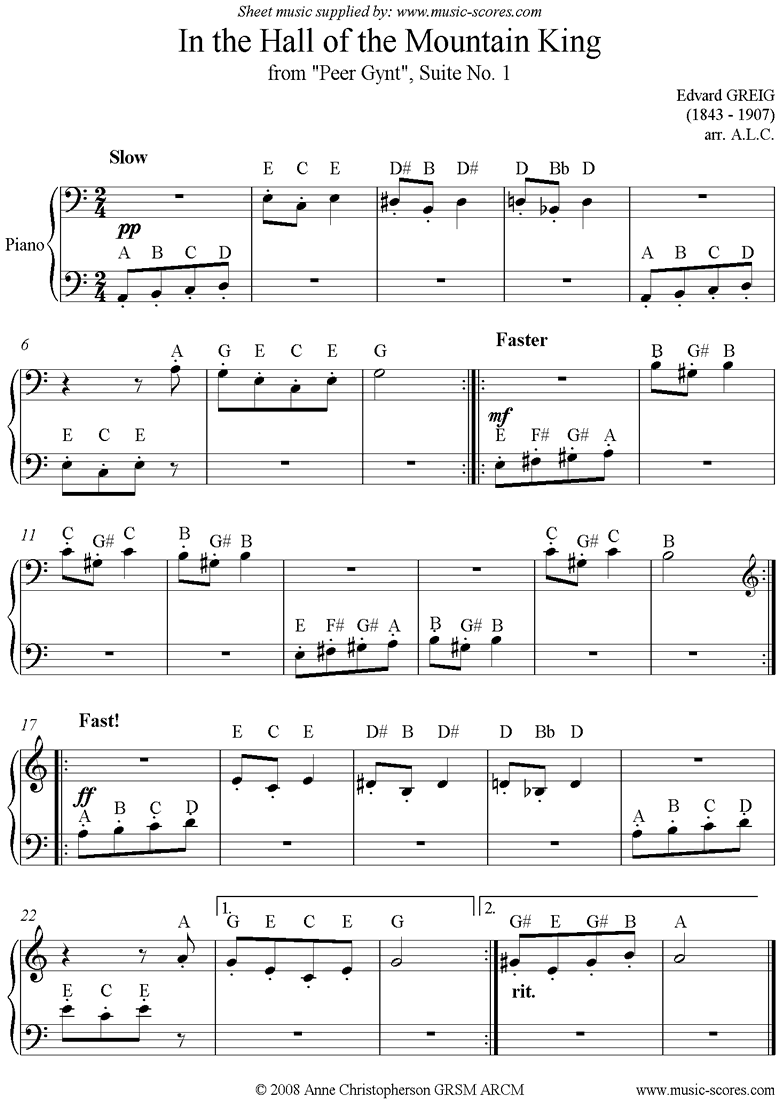
Halloween Music In the Hall of the Mountain King by Edvard Grieg

hall-mountain


“In the Hall of the Mountain King” is a piece of orchestral music composed for the sixth scene of act 2 in Henrik Ibsen’s 1867 play Peer Gynt. It was originally part of Opus 23 but was later extracted as the final piece of Peer Gynt, Suite No. 1, Op. 46. Its easily recognizable theme has helped it attain iconic status in popular culture, where it has been arranged by many artists, including for the piano.

Borrow a copy of the sheet music from the O’Connor Music Studio.  I have this arranged for piano, duet, 2-piano, simplified…


8 part vocal orchestra (plus a tiny pair of cymbals)


Pianist Paul Barton


Solo piano sheet music – Video Score


Orchestral version

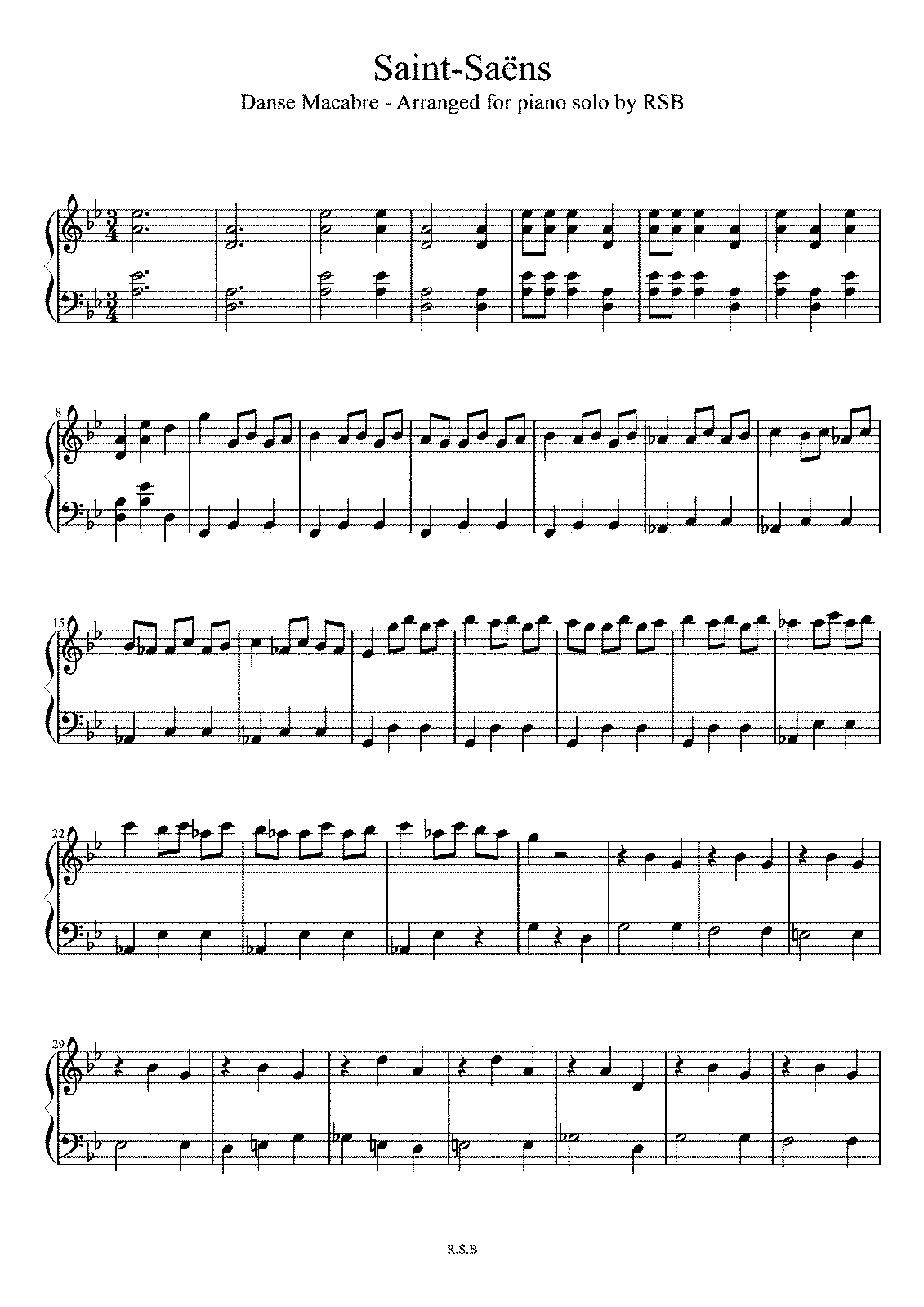
Halloween Music: Danse Macabre by Camille Saint-Saëns

danse-macabre

Danse macabre, Op. 40, is a tone poem for orchestra, written in 1874 by French composer Camille Saint-Saëns. It started out in 1872 as an art song for voice and piano with a French text by the poet Henri Cazalis, which is based on an old French superstition. In 1874, the composer expanded and reworked the piece into a tone poem, replacing the vocal line with a solo violin.

Get a free copy of the sheet music at IMSLP (Look for Arrangements and Transcriptions) or borrow a copy from the O’Connor Music Studio.  I have this arranged for organ, piano, duet, simplified…

Amazon has a great Dover edition for solo piano.  This splendid compilation features a variety of the composer’s best piano works, all reproduced from authoritative sources. Taking its title from the popular orchestral work “Danse Macabre” (presented here in the brilliant arrangement by Liszt), this collection also includes “Allegro appassionato,” “Album” (consisting of six pieces), “Rhapsodie d’Auvergne,” “Theme and Variations,” plus six etudes, three waltzes, and six etudes for left hand alone.

This video originally aired on PBS in the 1980s:


For two pianos:


Piano Tutorial:


Orchestra:

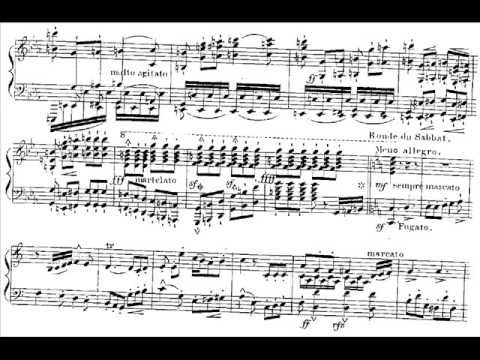
Halloween Music: Dreams of a Witches’ Sabbath from Symphonie fantastique by Hector Berlioz

berlioz-symphony-fantastique
The final movement is the best known part of the symphony, thanks to its use in the Julia Roberts movie, Sleeping With The Enemy. It features a four-part structure, which Berlioz described in his own program notes from 1845 as follows:

“He sees himself at a witches’ Sabbath, in the midst of a hideous gathering of shades, sorcerers and monsters of every kind who have come together for his funeral. Strange sounds, groans, outbursts of laughter; distant shouts which seem to be answered by more shouts. The beloved melody appears once more, but has now lost its noble and shy character; it is now no more than a vulgar dance tune, trivial and grotesque: it is she who is coming to the Sabbath… Roar of delight at her arrival… She joins the diabolical orgy… The funeral knell tolls, burlesque parody of the Dies irae, the dance of the witches. The dance of the witches combined with the Dies irae.”

The Dies irae melody is one of the most-quoted in musical literature, appearing in the works of many diverse composers.

The traditional Gregorian melody has also been used as a theme or musical quotation in a number of  classical compositions, notable among them:

Free sheet music from IMSLP for the basic Dies irae

Free sheet music from IMSLP for the basic Symphonie fantastique (look under Arrangements and Transcriptions)

The basic Gregorian Chant

An animated version of the  Dreams of a Witches’ Sabbath from Symphonie fantastique.  Can you hear the Dies irae in this?  It starts around 3:18.

Leonard Bernstein conducts the “Orchestre National de France” in Berlioz’s Symphonie Fantastique
5th Movement

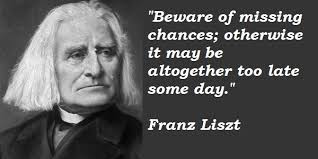
It’s Franz Liszt’s Birthday!

liszt-quote

Franz Liszt was born in Raiding, near Ödenburg, October 22, 1811 and died in Bayreuth, July 31, 1886. He was a Hungarian composer and pianist who was a major influence during the romantic period. Liszt was an outstanding pianist at seven, composed at eight and made concert appearances at nine. In addition to being a piano virtuoso, he was also a critic, conductor, city music director, literary writer and transcriber of the works of other composers. He transcribed Beethoven’s Symphonies for the piano.

Franz Liszt began his career as the outstanding concert pianist of the century, who, along with the prodigious violinist Niccoló Paganini (1782-1840), created the cult of the modern instrumental virtuoso. To show off his phenomenal and unprecedented technique, Liszt composed a great deal of music designed specifically for this purpose, resulting in a vast amount of piano literature laden with dazzling, and other technical marvels. In this vein, Liszt composed a series of virtuosic rhapsodies on Hungarian gypsy melodies, the best-known being the all too familiar Hungarian Rhapsody no. 2. Liszt developed the rhapsody as a form of serious music. This kind of music is worlds apart from the generally more introspective, poetic music of pianist-composer Frédéric Chopin.

Liszt was wildly handsome and hugely talented. He was extremely popular in Paris during the 1830’s. It is said that women actually fainted at his piano recitals. He was the first to position the piano so that its lid reflected the sound and the audience could see his profile as he performed.

Liszt was the first to write a tone poem, which is an extended, single-movement work for orchestra, inspired by paintings, plays, poems or other literary or visual works, and attempting to convey the ideas expressed in those media through music. Such a work is Les Préludes, based on a poem in which life is expressed as a series of struggles, passions, and mysteries, all serving as a mere prelude to . . .what? The Romantic genre of the symphonic poem, as well as its cousin the concert overture, became very attractive to many later composers, including Saint-Saëns, TchaikovskyDvorák, Sibelius, and Richard Strauss.


     Liszt’s birthday

     anniversary of Liszt’s death

    Listen to Liszt’s transcription of Meyerbeer’s Hellish Waltz from Robert du Diable, which probably caused more public commotion than any other piano piece in history.


     Read quotes by and about Liszt

     Liszt was the first recitalist

     In Praise of Pianos and the Artists Who Play Them

     History of the Piano

     Franz Liszt