• 1397? ~ Guillaume Du Fay, French composer. Considered the leading composer of the early Renaissance.
More information about Du Fay
• 1694 ~ Leonardo Leo, Italian composer and organist
• 1811 ~ Ambrose Thomas, French composer, primarily of operas
• 1890 ~ Erich Kleiber, Austrian conductor
• 1891 ~ Henry Charles Litolff, French pianist/composer, died at the age of 73
• 1924 ~ The comic strip Little Orphan Annie debuted in the New York Daily News. Annie and her little dog, Sandy, were creations of cartoonist Harold Gray. His work would come to life in the Broadway and film adaptations of Annie a half-century later, with great success.
• 1926 ~ Jeri Southern (Genevieve Hering), Singer
• 1940 ~ Damita Jo (DuBlanc), Singer
• 1942 ~ Rick Huxley, Bass with Dave Clark Five
• 1943 ~ Sammi Smith, Singer
• 1947 ~ Rick Derringer (Zehringer), Singer, songwriter with The McCoys, record producer
• 1953 ~ Samantha Sang, Singer
• 1957 ~ Dick Clark’s American Bandstand caught the attention of network executives at ABC-TV in New York, who decided to put the show on its afternoon schedule. Many artists, acts and groups of the rock ’n’ roll era debuted on American Bandstand – Simon and Garfunkel, Frankie Avalon, Fabian, Bobby Rydell, Chubby Checker – catapulting Clark into the spotlight as one of TV’s most prolific producers and hosts.
• 1958 ~ Joseph Holbrooke, English pianist, conductor and composer (3 Blind Mice), died at the age of 80
• 1975 ~ Singer Stevie Wonder signed the recording industry’s largest contract: $13 million over a seven-year period. Wonder stayed with his original label, Tamla/Motown, while other major Motown artists, including Diana Ross, Gladys Knight and The Four Tops had left the label over creative differences and financial accounting disputes.
• 2018 ~ Charlotte Rae, American character actress, comedian, singer and dancer (Edna-Facts of Life), died at the age of 92
Just because. This is a favorite Piano Guys piece that combines Amazing Grace, Scotland the Brave and Fight Song. I had loved it since the first time I heard it.
A couple years ago, we were on the train to New York to visit our son. He asked if we could go see the Piano Guys and, of course, I said YES! He got us first row seats and I was amazed.
I could see that they were going to play this last on the program and I was concerned that there were no bagpipers. I was wrong – they had several pipers and I was blown away.
• 1921 ~ Herb (Mitchell) Ellis, Guitarist, singer with Soft Winds
• 1927 ~ Radio station 2XAG, later named WGY, the General Electric station in Schenectady, NY, began experimental operations from a 100,000-watt transmitter. Later, the FCC regulated the power of AM radio stations to not exceed 50,000 watts on ‘clear channels’ (where few, if any, stations would cause interference with each other).
• 1927 ~ Singer Jimmie Rodgers recorded his first sides for Victor Records in Bristol, TN. He sang Sleep Baby Sleep and Soldier’s Sweetheart.
• 1929 ~ Gabriella Tucci, Italian soprano
• 1938 ~ Simon Preston, British organist
• 1939 ~ Frankie Ford (Guzzo), Singer
• 1940 ~ Timi (Rosemarie) Yuro, Singer
• 1943 ~ David Carr, Keyboards with The Fortunes
• 1978 ~ Frank Fontaine passed away. He was an American stage, radio, film and television comedian and singer.
• 2000 ~ Jerome Smith, founding guitarist of KC & The Sunshine Band, died after being crushed in a construction accident. He was 47. KC & The Sunshine Band reached the top of Billboard Magazine’s charts in 1975 with Get Down Tonight. Before Smith left the group, it had five No. 1 songs, including Boogie Shoes and That’s the Way (I Like It), and three Grammys.
Today’s piece is Beethoven’s Rage Over a Lost Penny found in Piano Pronto Movement 4, Songs I Love to Play 2 and Beethoven: Exploring His Life and Music. The official title is The “Rondo alla ingharese quasi un capriccio” in G major, Op. 129 (Italian for “Rondo in the Hungarian [i.e. gypsy] style, almost a caprice”).
The story goes –
At one point Beethoven was composing this piece, a booming and boisterous piece that exuded energy and vitality.
One night a neighbor heard a loud dispute.
Beethoven was in a rage, accusing a maid of stealing a gold penny. The maid ran out and was never heard from again.
The neighbor then heard furniture crashing, and he could only conclude that the great Maestro was tipping over furniture, madly looking for the lost gold penny.
The story spread through the neighborhood and became part of the legend of Beethoven’s bad moods and curmudgeonly behavior.
• 1778 ~ La Scala, one of the world’s great opera houses, opened on this day. They premiered William Tell by Gioachino Rossini
• 1823 ~ Francisco Asenjo Babieri, Spanish composer
• 1884 ~ Louis Gruenberg, Polish-born American composer
• 1902 ~ Ray Bloch, Conductor and orchestra leader
• 1917 ~ Charlie Shavers, Trumpeter with the John Kirby Sextet and composer of Undecided
• 1918 ~ Les Elgart, Lead trumpet, bandleader for Les and (brother) Larry Elgart
• 1921 ~ Richard Adler, Broadway Composer, lyricist
• 1926 ~ Tony Bennett (Benedetto), Grammy Award-winning American singer of popular music
• 1941 ~ Beverly Lee, Singer with The Shirelles
• 1949 ~ B.B. (Morris) Dickerson, Bass and singer with War
• 1951 ~ Johnny Graham, Guitarist with Earth, Wind and Fire
• 1963 ~ The Beatles made their final appearance at the Cavern Club in Liverpool, England. The group was about to leave its hometown behind for unprecedented worldwide fame and fortune.
• 1963 ~ The Beach Boys’ Surfer Girl, was released on Capitol Records. It became one of their biggest hits. Surfer Girl made it to number seven on the hit music charts on September 14, 1963
• 1963 ~ Comedian Allan Sherman’s summer camp parody, Hello Mudduh, Hello Fadduh! (A Letter from Camp) was released on Warner Brothers Records. The melody was based on the Dance of the Hours from Ponchielli’s opera La Giaconda. This dance was also performed in the original Disney movie Fantasia.
• 1971 ~ Paul McCartney formed a new band called Wings. Joining McCartney in the group were Denny Laine, formerly of The Moody Blues, Denny Seilwell and McCartney’s wife, Linda.
• 1998 ~ Alfred Schnittke, one of the most original and influential composers to emerge from the Soviet Union, died. He was 63.
• 2001 ~ Jeanne Loriod, the leading performer of an electronic instrument used in film scores and symphonic works to produce mysterious glassy tones, died in southern France. She was 73. Loriod, who played the ondes martenot – invented by the French musician Maurice Martenot – died of a stroke in Juan-les-Pins, Le Monde newspaper reported.
She was the younger sister of pianist Yvonne Loriod, who was married to composer Olivier Messiaen. The three musicians often collaborated.
The ondes martenot – which translates as “Martenot waves” – produces electronic waves from a system of transistors, a keyboard and a ribbon attached to a ring on the performer’s forefinger.
Loriod’s career took her all over the world. She performed with the Boston Symphony Orchestra and the Berlin Philharmonic, among others.
Composers such as Tristan Murail, Jacques Charpentier and Michael Levinas wrote works for her, according to Le Monde. Loriod had also been planning to collaborate with the pop group Radiohead, the paper wrote.
• 2008 ~ Louis Teicher died at 83. He was half of the piano duo Ferrante & Teicher, which toured for four decades and released 150 albums, some as suitable for elevators as for concert halls.
• 2016 ~ Ricci Martin, an entertainer/musician son of Dean Martin, died at the age of 62.
• 1925 ~ John Dexter, Opera director, Mid-America Chorale
• 1921 ~ Enrico Caruso, Italian operatic tenor, died in Naples.
• 1926 ~ The first demonstration of the Vitaphone system, that combined picture and sound for movies, was held at the Warner Theatre in New York City. John Barrymore and Mary Astor starred in the demonstration film for the new moving picture projector.
• 1935 ~ Hank Cochran, Pop Singer and songwriter
• 1937 ~ Garth Hudson, Musician, keyboard with The Band
• 1937 ~ Benny Goodman and his quartet recorded Smiles for Victor Records. Playing with Goodman’s clarinet on the famous song were Lionel Hampton, Teddy Wilson and Gene Krupa.
• 1939 ~ Edwin Patten, Singer with Gladys Knight & The Pips
• 1941 ~ Doris Kenner-Jackson (Coley), Singer with The Shirelles
• 1943 ~ Kathy Lennon, Singer with The Lennon Sisters
• 1951 ~ Andrew Gold, Singer, son of composer Ernest Gold
• 1991 ~ Jeri Southern passed away
• 1997 – Nigeria’s musician Fela Anikulapo-Kuti, who popularized the Afro-music beat globally, died of AIDS aged 58.
• 2000 ~ Helen Quinn, who for more than 30 years presided over the Metropolitan Opera patrons who lined up to buy standing-room tickets, died at the age of 76. Often called the Queen of Standees by those who allowed her to take charge of the ticket queue, Quinn was herself a veteran of standing-room lines at the Met, and attended five or six performances a week, almost always as a standee. In 1966, on her own initiative, she imposed a system on the standee process that the throng of regulars was apparently happy to abide by, and to which the Met gave tacit approval.
• 2001 ~ Ron Townson, the portly centerpiece singer for the Grammy-winning pop group The 5th Dimension, died of renal failure after a four-year battle with kidney disease. He was 68. Other members of the reconstituted group – known for such 1960s hits as Aquarius/Let the Sun Shine In, Wedding Bell Blues and Stoned Soul Picnic – performed at the Capitol Fourth music and fireworks show on July 4 in Washington, D.C. Declining health had forced Townson to retire from The 5th Dimension in 1997, bringing to an end a career that saw him tour with such music legends as Nat King’ Cole and Dorothy Dandridge, appear in operas and direct choirs. He helped front The 5th Dimension when the group’s smooth mixture of pop, jazz, gospel, and rhythm and blues won it four Grammys in 1968 for the Jimmy Webb song Up Up and Away. Other hits included One Less Bell to Answer and Sweet Blindness. As various members left The 5th Dimension in the 1970s to pursue solo projects, Townson formed the group Ron Townson and Wild Honey. Later, he reunited with McLemore and LaRue in a new version of The 5th Dimension that included Phyllis Battle and Greg Walker. He also appeared on television and in films, including the 1992 movie The Mambo Kings.
• 2002 ~ Freidann Parker, co-founder of the Colorado Ballet, died at the age of 77. Colorado Ballet co-founder Lillian Covillo met Parker in the late 1940s in a dance class taught by Martha Wilcox. The two began the Covillo-Parker School of Dance, and then a fledgling ballet company. After an ambitious double bill in 1961, they created Colorado Concert Ballet, which presented Denver’s first Nutcracker the following season. Every performance sold out. By 1978, the board of directors more than doubled its budget to $100,000, and Colorado Ballet was born. Today its budget has grown to $7 million with a roster of 40 dancers. Parker’s first dance lessons were with Iris Potter. She later trained with modern-dance pioneer Hanya Holm.
• 2020 ~ Leon Fleisher, American pianist and conductor, died at the age of 92. He was one of the most renowned pianists and pedagogues in the world. Music correspondent Elijah Ho has called him “one of the most refined and transcendent musicians the United States has ever produced”.
In 1964, Fleisher lost the use of his right hand, due to a condition that was eventually diagnosed as focal dystonia. Fleisher commenced performing and recording the left-handed repertoire while searching for a cure for his condition. In addition, he undertook conducting during this time, serving at one time as Music Director of the Annapolis Symphony Orchestra in Maryland. In the 1990s, Fleisher was able to ameliorate his focal dystonia symptoms after experimental botox injections to the point where he could play with both hands again.
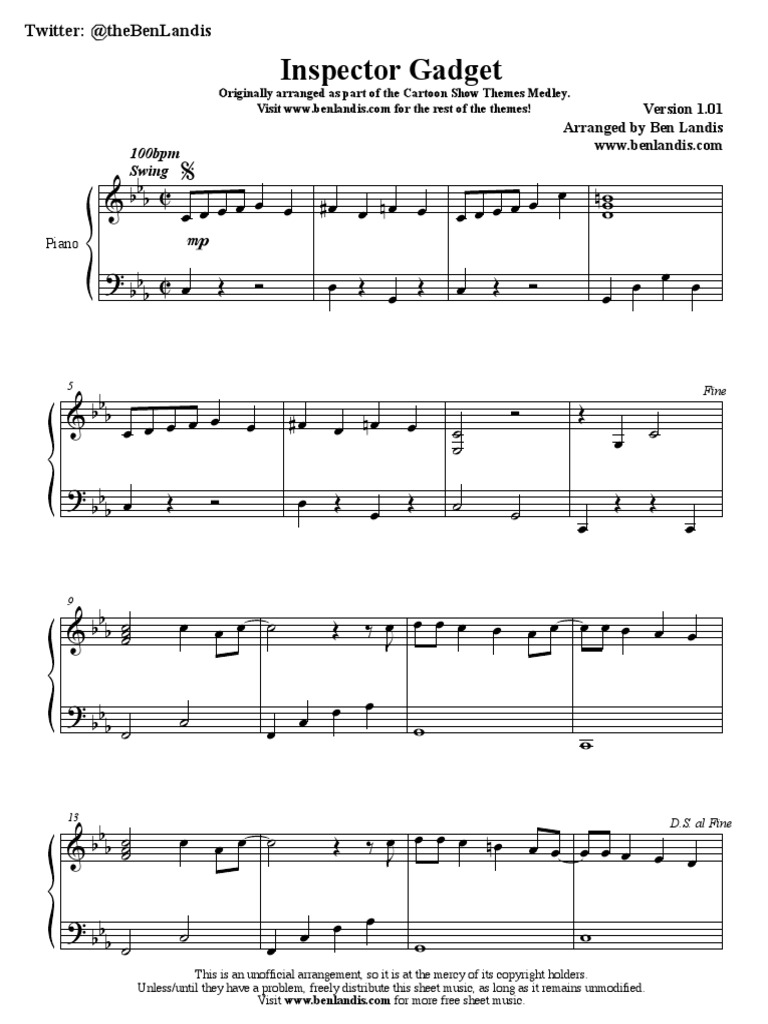
Today’s piece is from a TV show my son used to love to watch: Inspector Gadget. The show followed the adventures of a powerful but dimwitted cyborg police inspector named Gadget as he investigates the criminal schemes of Dr. Claw and his organization, MAD, as they fruitlessly attempt to stop him. However, neither side was aware that it is Gadget’s niece, Penny, and her dog, Brain, who are truly responsible for thwarting MAD.
Find the theme in Alfred Premier Pop and Movie Hits 1B as well as other books
Now, for just the theme
One of my favorite piano duet (I have the sheet music!)
• 1877 ~ Angela Diller, American pianist and educator
• 1919 ~ Oscar Hammerstein I passed away
• 1930 ~ Lionel Bart, Broadway Composer
• 1930 ~ Geoffrey Holder, Dancer
• 1939 – American bandleader Glenn Miller recorded In the Mood which later became his theme tune.
• 1942 ~ Jerry Garcia, American rock guitarist, banjo, lyricist and singer with The Grateful Dead
• 1942 ~ Jimmy Dorsey and his orchestra recorded Charleston Alley, on Decca Records.
• 1942 ~ The American Federation of Musicians went on strike. Union president James C. Petrillo told musicians that phonograph records were “a threat to members’ jobs.” As a result, musicians refused to perform in recording sessions over the next several months. Live, musical radio broadcasts continued, however.
• 1947 ~ Rick Anderson, Musician, bass with The Tubes
• 1947 ~ Rick Coonce, Singer, drummer with The Grassroots
• 1953 ~ Robert Cray, Guitar
• 1960 ~ Chubby Checker’s The Twist was released. The song inspired the dance craze of the 1960s.
• 1971 ~ The Concert for Bangladesh was held at Madison Square Garden in New York City. George Harrison, Ringo Starr, Eric Clapton, Bob Dylan, Leon Russell, Ravi Shankar and Billy Preston performed. A multi-record set commemorating the event was a super sales success. Together, the concert and the album raised over $11 million to help the starving minions of Bangladesh.
• 1981 ~ MTV (Music Television) made its debut at 12:01 a.m.
• 1984 ~ Singer Jermaine Jackson made a guest appearance on the TV soap opera, As the World Turns.
• 1997 ~ Russian pianist Sviatoslav Richter died of a heart attack in a Moscow hospital. He was 82.
• 2007 ~ Tommy Makem, Irish folk singer died
• 2017 ~ Goldy McJohn, Canadian musician (Steppenwolf), died at the age of 72
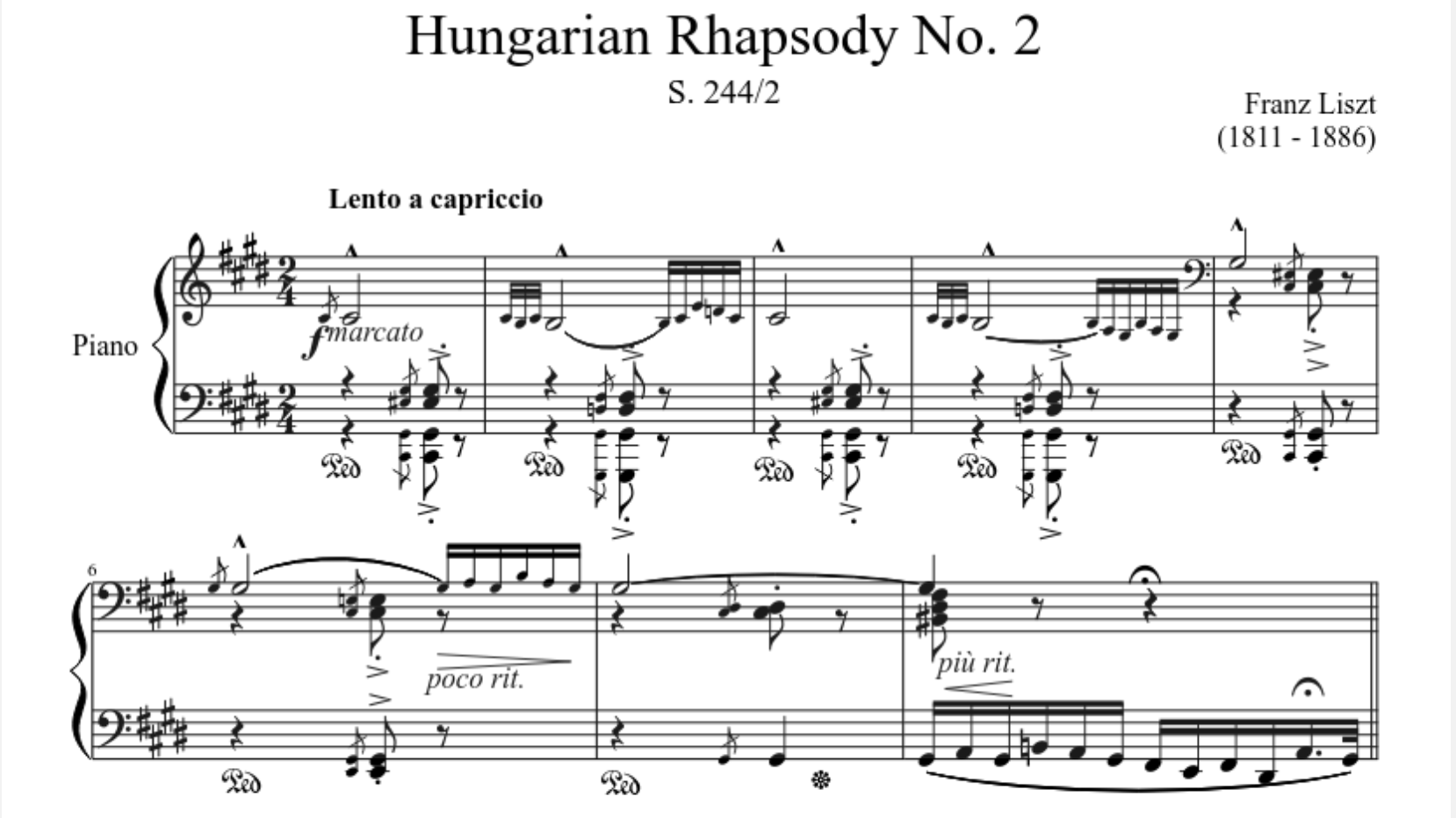
Today’s piece is a favorite in cartoons as you’ll see below. Hungarian Rhapsody number 2 by Franz Liszt is the second in a set of 19 Hungarian Rhapsodies and is by far the most famous of the set. They are all based on Hungarian folk tunes, or what Liszt assumed were Hungarian folk tunes. Even though Liszt’s nationality was Hungarian, he wasn’t familiar with the language.
So he ended up making some assumptions. Some of these Hungarian Rhapsodies were not actually gypsy folk tunes at all, but tunes composed by middle-and-upper-class folk, which the gypsies integrated into their own music.
These Rhapsodies are very difficult for pianists since Liszt was a virtuoso musician and liked to compose pieces only he could play.


 Be sure your student reads and listens to Today’s Daily Listening Assignment

 Be sure your student reads and listens to





 MaryO'Studio