January 19 ~ On This Day in Music

Join us on January 19 as we celebrate National Popcorn Day! Buttered, salted, kettled, drizzled with caramel, popcorn is one of those snacks perfect anytime, anywhere. It’s great on the go, in the theater, or in your living room! Just be prepared to dig some of it out of your teeth.

Read more

. 1853 ~ Verdi’s opera “Il Trovatore” premiered in Rome

. 1884 ~ Jules Massenet’s opera “Manon” premiered in Paris

. 1908 ~ Merwyn Bogue, Comic singer, sang and played trumpet with Kay Kyser’s Kollege of Musical Knowledge, big bandleader

. 1939 ~ Phil Everly, American rock-and-roll singer and guitarist, The Everly Brothers with his brother Don

. 1942 ~ Michael Crawford, singer. Some of his best-known roles have been in The Phantom of the Opera, Condorman, Hello, Dolly!, A Funny Thing Happened on the Way to the Forum, The Knack

. 1943 ~ Janis Joplin, American blues-rock singer and songwriter with Big Brother and The Holding Company and formed Kozmic Blues Band

. 1944 ~ Shelley Fabares, Singer, Nanette Fabray’s niece

. 1946 ~ Dolly Parton, American country music singer and songwriter, ACM Entertainer of the Year in 1977 and CMA Entertainer of the year, 1978

. 1949 ~ Robert Palmer, Singer, guitarist

. 1952 ~ Dewey Bunnell, Singer, guitarist with America

. 1953 ~ Sixty-eight percent of all TV sets in the U.S. were tuned to CBS-TV this day, as Lucy Ricardo of I Love Lucy gave birth to a baby boy, just as she actually did in real life, following the script to the letter! The audience for the program was greater than that watching the inauguration of President Dwight D. Eisenhower the following day. The baby was Desi Arnaz, Jr., entertainer and singer with Dino, Desi and Billy

. 1970 ~ The soundtrack of the film, “Easy Rider”, the movie that made a star of Peter Fonda, became a gold record. It was the first pop-culture, film soundtrack to earn the gold award.

. 1971 ~ Ruby Keeler made her comeback in the play, “No, No Nanette”, which opened at the 46th Street Theatre in New York City. Keeler played the role of Sue Smith in the revival of the 1925 hit musical. The show played for 861 performances.

. 1976 ~ The Beatles turned down an offer of $30 million to play together again on the same stage. Rock promoter Bill Sargent still doesn’t understand why the group turned down his generous offer.

. 1980 ~ Richard Franko Goldman, composer, died at the age of 69

. 1993 ~ Fleetwood Mac reunited to play “Don’t Stop” at Bill Clinton’s first inaugural ball

. 1998 ~ Carl Perkins, singer/songwriter, died at the age of 65

. 2014 ~ Udo Kasemets (November 16, 1919 – January 19, 2014) was an Estonian-born Canadian composer of orchestral, chamber, vocal, piano and electroacoustic works. He was one of the first composers to adopt the methods of John Cage and was also a conductor, lecturer, pianist, organist, teacher and writer.

Composers ~ H

Halle

Adam de la Halle, also known as Adam le Bossu (“Adam the Hunchback’) lived from around 1237 to around 1286. He was a poet and composer, born in Arras, France. He was court poet and musician to Robert II of Artois, and followed him to Naples in 1283. He was the originator of French comic opera, with Le Jeu de Robin et de Marion, and the partly autobiographical composition Jeu de la fuelle (Play of the Greensward). He also wrote poems in mediaeval verse forms.

Hamlisch

Marvin Hamlisch, American pianist, composer and arranger of popular music. He helped revitalize Ragtime with his musical arrangements in the movie, The Sting.

Hammerstein

1895 – Oscar (Greeley Clendenning) Hammerstein II lived from 1895 until 1960. He was a lyricist and songwriter with Richard Rodgers. Some of their best known musicals are Oklahoma!, Carousel, South Pacific, The King and I, Flower Drum Song and Sound of Music.

Handel

George Frederick Handel lived between 1685 and 1759. He is considered to be an important baroque composer. Handel had a lot in common with Bach. They were both born in Germany, the same year and both were organists and composers. Handel moved to England and spent 40 years there. While he was there he began writing music for the British royal family and he directed and composed operas as director of the Academy of Music.

“Largo” is a musical term for “very slow” and it is also the title of Handel’s most famous single melody. Largo is from an opera called Xerxes about a Persian king with that name and had it’s premiere in London in 1738.

Handel’s nickname was “The Thunderbolt”, given to him by Mozart because he composed so much music.

One of Handel’s most popular works is The Sarabande from Suite Number 11 since it was made popular in the 1975 Stanley Kubrick movie Barry Lyndon, based on the novel by Thackery. This sarabande is part of a dance suite. Suites such as this were very popular with amateur players during Handel’s day.

He is most famous for the Messiah. This oratorio, composed in 1742, brought the entire baroque tradition to its climax. Handel’s enormous work included over 40 operas, about 20 oratorios, cantatas, sacred music, and orchestral, instrumental, and vocal works.

Handy

W. C. Handy was known as the Father of the Blues. His compositions “Memphis Blues” (1912) and “St. Louis Blues” (1914) made the blues popular in the United States.

Hanson, Howard

Howard Hanson lived from 1896 until 1981. He was a composer, conductor, educator; born in Wahoo, Nebraska. He studied and taught in the U.S.A. before winning the Rome Prize in 1921. He returned from Italy in 1924 to become director of the Eastman School of Music in Rochester, N.Y., remaining there until retirement in 1964. His compositions, including seven symphonies and the opera Merry Mount (1934), typically reflect both his Swedish family background and a conservative, Romantic spirit. He was also an important conductor and promoter of American composers, both conservative and innovative.

Hanson, Raymond

Raymond Hanson lived from 1913 until 1976. He was a composer and teacher, born in Sydney, New South Wales, Australia. He studied at the New South Wales Conservatory, to which he returned to lecture from 1948 until his death. His Trumpet Concerto is well known, and was one of the first Australian recordings to be released internationally. Other works include operas, a ballet, a symphony, four concertos, chamber music, and film scores.

Hanson-Dyer, Louise Berta Mosson

Louise Berta Mosson Hanson-Dyer lived from 1884 until 1962. She was a music publisher and patron, born in Melbourne, Victoria, Australia. She studied in Edinburgh and at the Royal College of Music, London, and became the centre of Melbourne’s musical life, helping establish the British Music Society there in 1921. She established Editions du Oiseau-Lyre, a music-publishing business in Paris in 1927, which set a new standard of music printing, and she became a leader in the revival of early music. Later resident in France, she maintained her links with Australia, and published the works of leading Australian composers. Her considerable Australian estate was left to Melbourne University for music research.

Hart

Lorenz Hart was born in New York City and lived from 1895 until 1943. He was a lyricist;. He studied journalism and wrote poetry at Columbia University and translated plays for the Shuberts before meeting composer Richard Rodgers in 1918. They collaborated on four songs for Poor Little Ritz Girl (1920) and did their first complete score for The Garrick Gaities (1925).

During the next 18 years they collaborated on a string of successful Broadway and Hollywood musicals–among them On Your Toes (1936), The Boys from Syracuse (1938), and Pal Joey (1940). Although they created many popular songs, including “With a Song in My Heart” (1929), “Blue Moon” (1934), and “My Funny Valentine” (1937), Hart’s show lyrics were distinguished by their clever wordplay, intricate internal rhymes, and often sardonic attitude.

Haydn

Joseph Haydn lived between 1732 and 1809 and was born in Austria. He is considered to be a classical composer. Haydn was born in Rohrau, Austria and is often called the father of the modern symphony. Most of his career was spent conducting an orchestra and composing music for a rich Hungarian family, the Esterházys, who not only maintained a magnificent palace in Eisenstadt, but kept a string quartet and an entire opera company in residence.

Haydn created the form of the classical symphony and string quartet as we know them today. He became one of the most important figures in the development of Classical music during the eighteenth century.

Haydn wrote 104 symphonies, more than 40 piano sonatas, over 20 operas, many string quartets, trios, masses and songs.

The Creation is one of his oratorios and has been compared to Handel’s Messiah.

Henderson

Roy Henderson was a baritone famed for his performances of Frederick Delius’ works and a teacher of Kathleen Ferrier. When he died Thursday March 11, 2000, he was 100.

Henderson learned to sing while serving with the Artists Rifles during World War I.

He studied at the Royal Academy of Music, and got his first major break in 1925 in a performance of Delius’ “Mass of Life,” which he sang at short notice at a Royal Philharmonic concert.

From then on, Henderson was regarded as the ideal Delius baritone. He sang on the first recording of Delius’ “Sea Drift” and in the premiere of “Idyll.”

He also performed all the Elgar oratorios and choral works, and sang Count Almaviva in “The Marriage of Figaro” at the 1934 opening night of the Glyndebourne summer opera festival.

Henderson’s last singing performance was on March 29, 1952 in the role of Christus in Bach’s “St. Matthew Passion” at Southwark Cathedral, the Anglican cathedral on the south bank of the Thames in London.

Henderson met Ferrier in 1942,and she later asked Henderson to teach her. She went on to become one of Britain’s renowned voices of the century.

Hill

Mildred Hill, born in 1859, American organist and pianist, composer of “Happy Birthday”. When it was granted a copywrite in 1893, it’s original title was “Goodmorning to All”.

Hindemith

Paul Hindemith lived from 1895 until 1963. He was a German composer who used many techniques of composition from the 1700’s therefore, bringing a neoclassical element to contemporary music.

Holst

Gustav Theodore Holst, English Composer, was born in Cheltenham, England in 1874 and died in London in 1934. He was of the same era as Elgar, but, like Pachelbel, is really only famous for one piece, his Planets’ Suite. This is a series of seven “movements”, one for each of the non~Earth planets known in Holst’s day (i.e., all of the planets but Earth and Pluto). The music reflects the character of the Greco-Roman divinity associated with each planet, with the opening Mars, Bringer of War, being a ferocious, menacing portrait indeed.

One of the themes to Jupiter was subsequently used as the basis for rather a patriotic hymn (I vow to thee my country), in much the same way as one of Elgar’s Pomp and Circumstance marches was turned into Land of Hope and Glory.

Horowitz

Destined to become one of the world’s greatest pianists, Vladimir Horowitz was born in 1903 in Kiev, Russia. While most young children were playing games, Vladimir was playing with the ivories. His time was well spent as he was fully capable of performing publicly by the time he was sixteen.

Within four years, the young piano virtuoso was entertaining audiences at recitals throughout Leningrad – 23 performances in one year, where he played over 200 different works of music, never repeating a composition. After Leningrad, Horowitz played in concerts in Berlin, Hamburg and Paris.

In 1928, the Russian pianist traveled to the United States to play with the New York Philharmonic Orchestra at Carnegie Hall. Arturo Toscanini chose Horowitz to perform his first solo with the New York Philharmonic. It was there that Horowitz met his bride-to-be, Toscanini?s daughter, Wanda. The two were wed in Milan in 1933. New York became Horowitz? permanent home in 1940. He became a U.S. citizen a few years later, devoting the rest of his career to benefit performances, and helping young, aspiring artists.

His return to the concert stage in May of 1965 was a triumphant success, as was his television recital, Vladimir Horowitz at Carnegie Hall.

Just three years before his death, Vladimir Horowitz returned to his homeland to perform once again for the Russian people on April 20, 1986. They felt he had been away far too long … close to sixty years.

Horn

Paul Horn was born in 1930. He is a composer, jazz musician, playing reeds. SOme of his most famous works are: Green Jelly Beans, Dancing Children, Inside [recorded in Taj Mahal]. His TV documentary was The Story of a Jazz Musician.

Hovhaness

Alan Hovhaness, (1911 until 2000) was a a prolific composer who melded Western and Asian musical styles.

Hovhaness wrote more than 400 pieces, including at least nine operas, two ballets, more than 60 symphonies, and more than 100 chamber pieces.

His works include “Lousadzak” (1944), for piano and orchestra; “Wind Drum” (1962), a music-dance drama; “And God Created the Great Whales” (1970); and “The Way of Jesus” (1974), a folk mass.

His early compositions were thoroughly Western. But the influences of Eastern musical styles became more evident after he attended Bohuslav Martinu’s master class in composition in 1942 at the Berkshire Music Center at Tanglewood.

Hovhaness was the first Western composer asked to write music for an orchestra comprised entirely of Indian instruments. He served for six months as composer-in-residence at the University of Hawaii and became a composer-in-residence with the Seattle Symphony in 1966.

Howe

Julia Ward Howe was a U.S. author and lecturer best known for her “Battle Hymn of the Republic.” In 1843 she married Samuel Gridley Howe of Boston, reformer and teacher of the blind. The “Battle Hymn”, composed to the rhythm of the folksong “John Brown’s Body”, was first published in The Atlantic Monthly in February 1862.

Huang

Dr. Hao Huang was a Leonard Bernstein Music scholarship recipient at Harvard University (AB cum laude), a piano scholarship Master’s student at the Juilliard School (MM in piano performance), and a Graduate Council Fellow at the State University of New York at Stony Brook (DMA). He has studied with Seymour Bernstein, Leon Fleisher, Claude Frank, Beveridge Webster and Gilbert Kalish. He is currently a piano professor at Scripps College and the Claremont Graduate School, and has taught at the Hochschule fur Musik “Franz Liszt” in Weimar and the School of Music at Converse College.

January 18 ~ On This Day in Music

today

. 1835 ~ César Cui, Russian composer and music critic
More information about Cui

1841 ~ Alexis-Emmanuel Chabrier, French composer
More information about Chabrier

. 1913 ~ Danny Kaye (David Daniel Kaminski), Comedian, dancer, singer, actor, entertainer

. 1939 ~ Louis Armstrong and his orchestra recorded Jeepers Creepers on Decca Records. Satchmo lent his vocal talents to this classic jump tune.

. 1941 ~ Bobby Goldsboro, Singer

. 1941 ~ David Ruffin (Davis Eli Ruffin), Lead singer with The Temptations

. 1944 ~ ‘Legs’ Larry Smith, Drummer with The Bonzo Dog Doo-Dah Band and Bob Kerr’s Whoopee Band

. 1944 ~ The first jazz concert was held at the Metropolitan Opera House in New York City. The stars of the concert were Louis Armstrong, Benny Goodman, Lionel Hampton, Artie Shaw, Roy Eldridge and Jack Teagarden. What a ticket!

. 1948 ~ Ted Mack came to television as “The Original Amateur Hour” debuted on the DuMont network. The program continued on different networks for a 22-year run on the tube. Teresa Brewer and Pat Boone got their start on this program.

. 1953 ~ Brett Hudson, Singer, comedian with Hudson Brothers

. 1958 ~ Leonard Bernstein began presenting his television series What does music mean? The series ran for 53 programs.

. 1968 ~ Singer Eartha Kitt made headlines, as she got into a now-famous confrontation with Mrs. Lyndon B. Johnson, wife of the President of the United States, at a White House luncheon to discuss urban crime. Ms. Kitt told Lady Bird (the First Lady) that American youth were rebelling against the war in Vietnam, linking the crime rate with the war escalation. She had a lot to say and it definitely was not “C’est Si Bon”.

. 1986 ~ Dionne Warwick’s single for AID’s research, That’s What Friends are For, became her second #1 song on the music charts. Although Dionne had many hits in the 1960s, singing Burt Bacharach tunes like I Say a Little Prayer and Do You Know the Way to San Jose.

. 2017 ~ Roberta Peters, American operatic soprano (NY Met), died at the age of 86

Composers – F

Field

John Field lived from 1782 until 1837 and was an Irish pianist and composer. He has been credited the invention of the Nocturne, a form later adopted and developed by Chopin. Field was born in Dublin in 1782, the son of a violinist, but moved with his family to London in 1793, perhaps taking violin lessons from Haydn’s friend Salomon.

He became an apprentice of Muzio Clementi, appearing in a series of important London concerts, and later touring widely. After concerts in Russia, he remained in St. Petersburg, where he became a fashionable teacher and performer, moving to Moscow in 1821. Illness brought him, in 1831, to London again, a visit followed by a continental tour and a final return to Moscow, where he died in 1837.

Flowtow

Friedrich Adolf Ferdinand, Freiherr von Flotow was a German composer. He is chiefly remembered for his opera Martha, which was popular in the 19th century and the early part of the 20th.

January 17 ~ On This Day in Music

today

. 1712 ~ John Stanley, English composer and organist

. 1728 ~ Johann Gottfried Muthel, German composer and noted keyboard virtuoso

. 1734 ~ François-Joseph Gossec, Belgian composer
More information about Gossec

. 1750 ~ Tomaso Albinoni, Italian composer (Adagio in G Minor), died at the age of 78

. 1876 ~ The saxophone was played by Etta Morgan at New York City’s Olympic Theatre. The instrument was little known at the time in the United States.

. 1913 ~ Vido Musso, Reed instruments, played with Benny Goodman, bandleader: Stan Kenton was his pianist

. 1917 ~ Ulysses Simpson Kay, US composer, born in Tucson, Arizona (d. 1995)

. 1920 ~ George Handy (George Joseph Hendleman), Pianist, composer, arranger for the Boyd Raeburn band, Alvino Rey band, Paramount Studios

. 1922 ~ Betty White, Emmy Award-winning actress on The Mary Tyler Moore Show, singer

. 1926 ~ Moira Shearer, Ballerina

. 1927 ~ Eartha Kitt, Singer. Kitt’s birth certificate listing her actual birthdate as 1/17/27 was found in 1997. She has celebrated her birthday as Jan. 26 (1928) all of her life and says, “It’s been the 26th of January since the beginning of time and I’m not going to change it and confuse my fans.”

. 1938 ~The first jazz concert is performed at Carnegie Hall. Benny Goodman and his orchestra performed at this iconic New York City venue and the event included guests like Count Basie and other popular names of the day. It gave the genre credibility as a legitimate musical preference.

. 1941 ~ Gene Krupa and his band recorded the standard, Drum Boogie, on Okeh Records. The lady singing with the boys in the band during the song’s chorus was Irene Daye.

. 1944 ~ Chris Montez, Singer

. 1948 ~ Mick Taylor, Singer, rhythm guitar with The Rolling Stones

. 1955 ~ Steve Earle, Songwriter, singer, guitar

. 1956 ~ Paul Young, Singer

. 1959 ~ Susanna Hoffs, Singer, guitar with The Bangles

. 1960 ~ John Crawford, Singer, bass with Berlin

. 1969 ~ Lady Samantha, one of the very first recordings by Reginald Kenneth Dwight (aka Elton John), was released in England on Philips records. The song floundered, then bombed. The rock group, Three Dog Night, however, recorded it for an album.

. 2001 ~ Pianist and singer Emma Kelly, the “Lady of 6,000 Songs” made famous by the book “Midnight in the Garden of Good and Evil,” died from a liver ailment at the age of 82. Kelly’s nightclub act, in which she tapped her vast repertoire of American popular standards five nights a week until she became ill a month ago, was a must-see for Savannah tourists itching to meet a real-life character from author John Berendt’s Southern Gothic best seller. Though the book helped her book performances from New York to Switzerland, Kelly continued to crisscross south Georgia to play church socials and high school graduations, Kiwanis luncheons and wedding receptions. Berendt devoted an entire chapter to Kelly in the 1994 book, describing her as a teetotaling Baptist who would play smoky cocktail lounges Saturday nights and Sunday school classes the next morning. Kelly performed at her own nightclub, Emma’s, in Savannah, for five years in the late 1980s. She then bounced between lounges near the downtown riverfront. She also independently recorded three albums, the last of which were released posthumously, her son said.

. 2001 ~ Jazz musician, composer and conductor Norris Turney, who played alto sax and flute with the Duke Ellington Orchestra and led the Norris Turney Quartet, died of kidney failure at the age of 79. Turney recorded with a number of bands over the years, and toured with Billy Eckstine, Ray Charles and others. He was an original member of the Lincoln Center Jazz Orchestra directed by Wynton Marsalis. Turney’s lone CD as a bandleader, “Big, Sweet ‘N Blue,” was warmly received by jazz critics.

. 2002 ~ Edouard Nies-Berger, the veteran organist and protege of Albert Schweitzer, died at the age of 98. Nies-Berger, who played with the New York Philharmonic, was a native of Strasbourg in Alsace. His father, a church organist, was an associate of Schweitzer. The doctor, philosopher and Nobel laureate was pastor of a nearby church where the teenage Nies-Berger played occasionally. Nies-Berger moved to New York in 1922 and for the next 15 years played the organ in houses of worship across the country. By the mid-’30s he settled in Los Angeles and performed in the soundtracks of several films, including “The Bride of Frankenstein” and “San Francisco.” He returned to Europe in 1937 to study conducting with Bruno Walter in Salzburg, Austria. After conducting for two years in Latvia and Belgium he returned to the United States. He was named organist of the New York Philharmonic, where he played under the direction of such conductors as Walter, George Szell and Leonard Bernstein. Nies-Berger was reunited with Schweitzer in 1949, when the humanitarian visited the United States. For six years they collaborated on the completion of Schweitzer’s edition of the organ music of Johann Sebastian Bach. After serving at St. Paul’s in Richmond, Nies-Berger returned to Europe for several years to perform as a recitalist and write several books, including a memoir of Schweitzer. In 1991 he was awarded the gold medal of the Art Institute of Alsace, and in 1993 was named a knight of the arts and letters by the French Ministry of Education and Culture.

. 2013 ~ Lizbeth Webb, English soprano, died at the age of 86

Composers – C

Cahn

Sammy Cahn (Samuel Cohen) lived from 1913 until 1993. If you care about anything at all, there’s a song written by Sammy Cahn for you to relate to. Sammy Cahn, the Tin Pan Alley legend, was born Samuel Cohen in New York City.

As a youngster, little Sammy wanted to grow up to be a famous vaudeville fiddler. How lucky we are that he stopped thinking about this in his teenage years. That’s when he met pianist, Saul Chaplin. Sammy wrote the words and Saul wrote the music to their first hit, Rhythm is Our Business for bandleader, Jimmie Lunceford. Then Until the Real Thing Comes Along for Andy Kirk and the jazz classic, Shoe Shine Boy, performed by Count Basie, Louis Armstrong, the Mills Brothers, even Bing Crosby. The Andrews Sisters were lucky to know Sammy, too. It was his adaptation of the Yiddish song, Bei Mir Bist Du Schön that became their signature.

Frank Sinatra’s many signature titles were Sammy Cahn’s words, too (with Jimmy Van Heusen’s music): All the Way (won an Oscar in 1957), My Kind of Town, and Grammy Award-winning September of My Years. As part of the personal song-writing team for Mr. Sinatra, Sammy also wrote Love and Marriage, The Second Time Around, High Hopes (another Oscar winner in 1959) and The Tender Trap.

If you still haven’t found a song that makes you care, try these additional Oscar winners by Sammy Cahn: Three Coins in the Fountain (1954) and Call Me Irresponsible (1963). He composed 22 other songs that were nominated but didn’t win the gold statue!

Want to know more? Pick up the autobiography of the talented Sammy Cahn, written in 1974, I Should Care.

Cage

John (Milton) Cage lived from 1912 until 1992. He was an American composer who was born in Los Angeles, California, USA. He studied with a number of teachers including Henry Cowell and Arnold Schoenberg, who helped provoke his avant-garde proclivities. He began writing all-percussion pieces in the 1930s and proclaimed the use of noise as the next musical horizon; in 1938 he introduced the “prepared piano,” an instrument whose sound is radically modified by various objects placed on the strings. While writing much for prepared piano in the 1940s, notably the Sonatas and Interludes, he also produced some pioneering electronic music. Among the most widely influential elements of his thought was the idea of indeterminacy, music that is not strictly controlled, as seen in his 1951 Landscape No. 4 for twelve radios – the sound of which depends on what happens to be on the air. Later works, especially the notorious 4’33” (1954), involve complete silence. He continued to develop such concepts and he also produced several quirky, engaging books beginning with the 1961 Silence. In his later years he was widely acclaimed as one of the more original of American artists.

Caruso

Enrico Caruso was a tenor opera singer who lived from 1873 until 1921. His best known roles are Canio in Pagliacci, Rodolfo in La Bohème. He made his Metropolitan Opera debut in Rigoletto. He sang nearly 70 roles and appeared in nearly every country of Europe and North and South America. His final performance was La Juive at the Met in 1920.

Carissimi

Giacomo Carissimi lived from 1604 until 1674. He is considered to be one of the greatest Italian composers of the 17th century, notable for his oratorios and secular cantatas.

Cash

John R. Cash was born Feb. 26, 1932, in Kingsland, Ark., one of seven children. When he was 12, his 14-year-old brother and hero, Jack, died after an accident while sawing oak trees into fence posts. The tragedy had a lasting impact on Cash, and he later pointed to it as a possible reason his music was frequently melancholy.

He worked as a custodian and enlisted in the Air Force, learning guitar while stationed in Germany, before launching his music career after his 1954 discharge.

“All through the Air Force, I was so lonely for those three years,” Cash told The Associated Press during a 1996 interview. “If I couldn’t have sung all those old country songs, I don’t think I could have made it.”

Cash launched his career in Memphis, performing on radio station KWEM. He auditioned with Sun Records, ultimately recording the single Hey Porter, which became a hit.

Sun Records also launched the careers of Elvis Presley, Roy Orbison, Jerry Lee Lewis and others.

Folsom Prison Blues, went to No. 4 on the country charts in 1956, and featured Cash’s most famous couplet: “I shot a man in Reno/ just to watch him die.”

Cash recorded theme albums celebrating the railroads and the Old West, and decrying the mistreatment of American Indians. Two of his most popular albums were recorded live at prisons. Along the way he notched 14 No. 1 country music hits.

Because of Cash’s frequent performances in prisons and his rowdy lifestyle early in his career, many people wrongly thought he had served prison time. He never did, though he battled addictions to pills on and off throughout his life.

He blamed fame for his vulnerability to drug addiction.

“When I was a kid, I always knew I’d sing on the radio someday. I never thought about fame until it started happening to me,” he said in 1988. “Then it was hard to handle. That’s why I turned to pills.”

He credited June Carter Cash, whom he married in 1968, with helping him stay off drugs, though he had several relapses over the years and was treated at the Betty Ford Center in California in 1984.

June Carter Cash was the daughter of country music great Mother Maybelle Carter, and the mother of singer Carlene Carter, whose father was country singer Carl Smith. Together, June Carter and Cash had one child, John Carter Cash. He is a musician and producer.

Singer Roseanne Cash is Johnny Cash’s daughter from his first marriage, to Vivian Liberto. Their other three children were Kathleen, Cindy and Tara. They divorced in 1966.

In March 1998, Cash made headlines when his California-based record company, American Recordings, took out an advertisement in the music trade magazine Billboard. The full-page ad celebrated Cash’s 1998 Grammy award for best country album for “Unchained.” The ad showed an enraged-looking Cash in his younger years making an obscene gesture to sarcastically illustrate his thanks to country radio stations and “the country music establishment in Nashville,” which he felt had unfairly cast him aside.

Jennings, a close friend, once said of Cash: “He’s been like a brother to me. He’s one of the greatest people in the world.”

Cash once credited his mother, Carrie Rivers Cash, with encouraging him to pursue a singing career.

“My mother told me to keep on singing, and that kept me working through the cotton fields. She said God has his hand on you. You’ll be singing for the world someday.”

Dozens of hit records like Folsom Prison Blues, I Walk the Line, and Sunday Morning Coming Down defined Cash’s persona: a haunted, dignified, resilient spokesman for the working man and downtrodden.

Cash’s deeply lined face fit well with his unsteady voice, which was limited in range but used to great effect to sing about prisoners, heartaches, and tales of everyday life. He wrote much of his own material, and was among the first to record the songs of Bob Dylan and Kris Kristofferson.

One Piece at a Time was about an assembly line worker who built a car out of parts stolen from his factory. A Boy Named Sue was a comical story of a father who gives his son a girl’s name to make him tough. The Ballad of Ira Hayes told of the drunken death of an American Indian soldier who helped raise the American flag at Iwo Jima during World War II, but returned to harsh racism in America.

Cash said in his 1997 autobiography “Cash” that he tried to speak for “voices that were ignored or even suppressed in the entertainment media, not to mention the political and educational establishments.”

Cash’s career spanned generations, with each finding something of value in his simple records, many of which used his trademark rockabilly rhythm.

Cash was a peer of Elvis Presley when rock ‘n’ roll was born in Memphis in the 1950s, and he scored hits like Cry! Cry! Cry! during that era. He had a longtime friendship and recorded with Dylan, who has cited Cash as a major influence.

He won 11 Grammys – most recently in 2003, when Give My Love To Rose earned him honors as best male country vocal performance – and numerous Country Music Association awards. He was elected to the Country Music Hall of Fame in 1980 and inducted into the Rock and Roll Hall of Fame in 1992.

His second wife, June Carter Cash, and daughter Roseanne Cash also were successful singers. June Carter Cash, who co-wrote Cash’s hit Ring of Fire and partnered with her husband in hits such as Jackson, died in May 2003.

The late 1960s and ’70s were Cash’s peak commercial years, and he was host of his own ABC variety show from 1969-71. In later years, he was part of the Highwayman supergroup with Waylon Jennings, Willie Nelson and Kris Kristofferson.

In the 1990s, he found a new artistic life recording with rap and hard rock producer Rick Rubin on the label American Recordings. And he was back on the charts with the 2002 album “American IV: The Man Comes Around.”

Most recently, Cash was recognized for his cover of the Nine Inch Nails song Hurt with seven nominations at the August 2003 MTV Video Music Awards. He had hoped to attend the event but couldn’t because of his hospital stay. The video won for best cinematography.

He also wrote books including two autobiographies, and acted in films and television shows.

In his 1971 hit Man in Black, Cash said his black clothing symbolized the downtrodden people in the world. Cash had been “The Man in Black” since he joined the Grand Ole Opry at age 25.

“Everybody was wearing rhinestones, all those sparkle clothes and cowboy boots,” he said in 1986. “I decided to wear a black shirt and pants and see if I could get by with it. I did and I’ve worn black clothes ever since.”

Johnny Cash, ‘”The Man in Black” who became a towering figure in American music with such hits as Folsom Prison Blues, I Walk the Line, and A Boy Named Sue, died Friday, September 12, 2003. He was 71.

“Johnny died due to complications from diabetes, which resulted in respiratory failure,” Cash’s manager, Lou Robin, said in a statement issued by Baptist Hospital in Nashville.”

Cash had battled a disease of the nervous system, autonomic neuropathy, and pneumonia in recent years. Cash lived in Hendersonville, Tenn., just outside of Nashville. He also had a home in Jamaica.

Cesti

Marc Antonio Cesti, 1623 to 1669, was an Italian composer working in Venice, Rome and Vienna. He reputedly wrote over one hundred operas of which 15 are extant.

Charles

Ray Charles (Robinson) is a singer, pianist, composer who was born in Albany, Ga in 1930. He lost his sight (from glaucoma) when he was six and attended a school for the blind where he learned to read and write music in braille and play piano and organ. Orphaned at age 15, he left school and began playing music to earn a living, moving to Seattle, Wash., in 1947. Dropping his last name, he performed at clubs in the smooth lounge-swing style of Nat “King” Cole. After some hits on Swing Time Records, he switched to Atlantic Records in 1952 and began to develop a rougher blues and gospel style. For New Orleans bluesman, Guitar Slim, he arranged and played piano on “The Things I Used To Do” (1953); the record sold a million copies. He went on to record his own “I’ve Got a Woman” in 1955 with an arrangement of horns, gospel-style piano, and impassioned vocals that led to the gospel-pop and soul music of the 1960s and to his hit “What’d I Say” (1959). Possessing a multifaceted talent, he recorded with jazz vibist Milt Jackson, made a country and western album that sold 3 million copies (1962), and continued to release a variety of pop hits, Broadway standards, and blues, gospel, and jazz albums. A major influence on popular black music during his early years, he gradually reached out to influence both white musicians and audiences. And although he had been convicted of using drugs in the 1950s, he lived to see the day when he was so acceptable to mainstream Americans that he became virtually the chief image for promoting Pepsi-Cola and he was asked to perform at many national patriotic and political events.

Charpentier

Marc Antoine Charpentier, 1636 to 1704, was a French composer who studied in Italy. When he returned to France he became the most outstanding French composer of oratorios.

Cherubini

Luigi Cherubini lived from 1760 until 1842. The Italian composer Cherubini came to occupy a dominant position in French musical life. He was employed at the Conservatoire in Paris on its foundation and from 1822 was director of the institution, retaining this position until the year of his death. His works include compositions for the stage, the church and for political purposes, a requirement of the turbulent revolutionary years.

Cherubini wrote some 30 operas and of these Les deux journées, now seldom heard, had influence on Beethoven’s only opera, Fidelio. The opera Médée, first staged in Paris in 1797, remains in occasional repertoire, with the aria Ah, nos peines, providing a popular soprano operatic recital item.

Chopin

Step into the melodious world of Frédéric François Chopin (1 March 1810 – 17 October 1849), the Polish maestro who danced his fingers across the piano keys, creating ripples in the Romantic era. Renowned globally as a virtuoso pianist and composer, Chopin dedicated his life to the ivory keys, weaving compositions that spoke a poetic language, unmatched in technique and emotional depth.

Born in the quaint village of Żelazowa Wola, in what was then the Duchy of Warsaw, Chopin grew up under the artistic skyline of Warsaw. As Congress Poland unfolded its wings, so did Chopin’s prodigious talent. By the tender age of 20, having already mastered his art in Warsaw, he embarked on a journey just before the November 1830 Uprising broke out, a journey that would take him to the heart of Paris at 21.

Parisian life saw Chopin shine not in grand concert halls, but in the intimate embrace of salons, where his music found a home. In these salons, he enchanted a select few with 30 public performances, sustaining his life through the sale of his compositions and highly sought-after piano lessons. Among his admirers and friends was the legendary Franz Liszt, alongside other contemporaries like Robert Schumann, who were spellbound by his musical prowess.

Chopin’s life, however, was a nocturne shadowed by the relentless pursuit of tuberculosis, which ultimately claimed him on October 17, 1849. For 11 years, he battled the disease, pouring his soul into his music.

The essence of Chopin’s music is a beautiful paradox – it’s an intricate blend of lyrical romanticism, the rustic charm of Polish folk tunes, and awe-inspiring technical virtuosity. His legacy lives on in the dreamy realms of his nocturnes, the precision of his études, and the rhythmic grace of his waltzes. Transcending the barriers of piano, his compositions have found new life in various instruments and have gracefully waltzed into films, television shows, and commercials.

Chopin’s melodies are not just notes strung together; they are a testament to his undying love for Poland and his genius, resonating through time and continuing to stir the hearts of audiences worldwide. In Chopin’s music, we find an eternal resonance that speaks of passion, homeland, and the unquenchable spirit of creativity.

Christoff

Boris Christoff lived from 1914 until 1993. He was a bass-baritone who was born in Plovdiv, Bulgaria. He studied law in Sofia, then studied singing in Rome and Salzburg. His debut recital was in Rome in 1946. He sang at La Scala in Milan in 1947, at Covent Garden in 1949, and from 1956 in the USA.

Clementi

Muzio Clementi lived from 1752 until 1832. He was a composer and pianist who born in Rome. In 1766 he was brought to England, where he conducted the Italian Opera in London (1777–80), toured as a virtuoso pianist (1781), and went into the piano-manufacturing business. He wrote the Gradus ad Parnassum from 1817 to 1826, a piano method on which subsequent piano methods have been based. He composed mainly piano and chamber music.

Coates

Eric Coates lived from 1886 until 1957 and was the greatest British composer of light music in the 20th century, though his education never looked to be leading him in that direction. He was born in the midlands of England, in the county of Nottinghamshire, in 1886. He studied at the Royal Academy of Music in London, taking viola with the legendary Lionel Tertis, and composition with Frederick Corder. But it was as a violist that he earned his living, joining the famous Queen’s Hall Orchestra under Sir Henry Wood. From 1913 to 1919 he was principal viola, and a list of first British performances by that orchestra would indicate that he came into contact with all the most avant garde music of his day. Yet it was to be in the field of light music that he was to become famous.

It was the time of the radio, the BBC Light Programme with its demands for new music, and the need to brighten the country after the First World War, and above all it was the day of the ‘bright young thing’. It was the perfect scene for a composer who could produce a seemingly endless stream of easily memorable melodies. A publishing house commissioned him to write a major light music work for orchestra each year, while they were happy to take anything from him including his large output of songs.

Orchestras demanded that he conduct his own music with them, and he started a second career as a conductor of light music including many appearances with the BBC Theatre Orchestra. His music spoke to all generations, from those looking for nostalgia, to the very young, with his phantasies, ‘Cinderella’ and ‘The Three Bears’. He produced one major success after another, his music in the war years valuable to the morale of the nation, and included the stirring march for the Eighth Army to mark their Alamein victory in 1942 under General Montgomery.

Though he continued conducting his own music after the war, including definitive recordings of much of his output, his compositional career seemingly burned out. Then in a sudden flurry of activity he produced a number of fine works in his last years. That period included the Dambusters March for the film on that theme, the first time he succumbed to the many film music offers made to him.

He had so many successes, and his music became known to just about everyone in the UK, that it was thought he had a considerable output, but apart from his songs, it numbered less than fifty. Without doubt it was his training in classical music, and the years in the orchestra, that enabled him to write so fluently and so colourfully.

Sleepy Lagoon dates from 1930, but was not a huge success until an American dance orchestra turned it into a slow foxtrot. That led to the work being chosen for the opening music to the longest running radio show, Desert Island Discs, which started in 1948 and is still broadcast 50 years later. It remains probably the best known melody in the UK.

Two years later, among a number of short pieces written at this time, comes the very relaxed, Lazy Nights. Springtime Suite dates from 1937, and though its three movements never quite achieved the success of his other suites, it is one of his most skilfully constructed works. The previous year Coates met a commission from a virtuoso saxophonist for a new work. The brilliant Saxo-Rhapsody was the result. Composed in less than a month, its jaunty and jolly atmosphere so perfectly captured the nature of the instrument, while providing the soloist with a piece of unabashed showmanship.

The waltz was still the ballroom favourite, and Coates provided a number of such works, though truth to tell, they were more often played as an orchestral work than for dancing. Footlights dates from 1939, the same year that saw the little orchestral romance, Last Love.

Four Ways Suite dates from 1925, Coates looking in four directions, north, south, east and west. The north is represented by Scotland; the second movement has a distinct Italian flavour; China is the east, and flying in the face of the mood among British musicians at that time, it is jazz for the West. The disc ends with Coates’ last composition, High Flight, intended for a Warwick film of 1957.

Cohan

George M. (Michael) Cohan was an actor, singer, composer os songs such as Over There, The Yankee Doodle Boy, Give My Regards to Broadway, Mary’s a Grand Old Name, You’re a Grand Old Flag and Harrigan. He was the subject of movie called Yankee Doodle Dandy, as well as a Broadway show named George M!

There is a statue of George M. Cohan in New York.

Cole

Nat King Cole lived from 1917 until 1965. He was born Nathaniel Adams Coles in Birmingham, Alabama and raised in Chicago. Cole was a jazz pianist, singer, bandleader,for the King Cole Trio, a songwriter who wrote Straighten Up and Fly Right, an actor in St. Louis Blues, the first black entertainer to host a national TV show and the father of singer Natalie Cole.

His daughter, Natalie, became a pop music star with many hits in the 1990s – including an album of standards made popular by her father: “Mona Lisa”, “For Sentimental Reasons”, “Nature Boy”, “Too Young” and “Unforgettable”. With modern recording technology, she was able to record a duet with her father’s voice.

His first recording was in 1936. Although Cole’s commercial success as a pop artist was phenomenal, it unfortunately came with the sacrifice of his exemplary and extremely influential talents as a jazz pianist. Before he turned full-time to singing, he had already influenced the likes of Oscar Peterson, Ahmad Jamal, and Ray Charles with his intricate and innovative piano style and piano/guitar/bass lineup.

Cole’s songs included: Mona Lisa, Too Young, Unforgettable, Pretend, Ballerina, Ramblin’ Rose and The Christmas Song Cole passed away Feb 15, 1965 and was posthumously awarded a Lifetime Achievement Grammy in 1990.

Coleman, Cy

Born Seymour Kaufman of immigrant East European Jewish parents in the Bronx, Coleman’s first major hit was Wildcat, the 1960 musical about wildcat oil drilling that starred Lucille Ball (news) and featured the classic Hey Look Me Over. His later hits included City of Angels and Barnum.

Coleman was a self-taught jazz pianist whose career started at the age of 7 when he played a recital at Carnegie Hall.

Songs such as Witchcraft and The Best is Yet to Come were made popular by Sinatra, while another longtime collaborator was screenwriter and lyricist Adolph Green, best known for 1950s classic Singin’ in the Rain.

Coleman also worked closely with Shirley MacLaine, conceiving and co-writing her television special If My Friends Could See Me Now and creating the musical Gypsy in My Soul in 1976 that won Emmy awards for both Coleman and MacLaine.

He won three Tony Awards (news – web sites) as well as several Grammys and Emmys and an Oscar nomination for the music for the 1969 film Sweet Charity. which also starred MacLaine.

Coleman, Ornette

Ornette Coleman is a jazz musician, saxophonist and composer. He was born in 1930 in Fort Worth, Texas. His experiments in free-form improvisation sharply divided the jazz establishment upon his emergence in 1959. Largely self-taught, he played in rhythm-and-blues bands before settling in Los Angeles in 1951, where he gradually formed a quartet of musicians who were receptive to his unorthodox ideas. He first recorded in 1958 and made his New York debut the following year. He made a series of important recordings between 1959 and 1961 that shaped the direction of jazz for the next twenty years. A sporadic performing artist after the early 1960s, he occasionally led both a conventional jazz quartet and the rock band Prime Time, but turned increasingly to composition, producing several works for symphony orchestra in accordance with his “harmolodic theory.”

Copland

Aaron Copland lived between 1900 and 1990. He is considered to be a twentieth century composer.

Copland often used American folk music in his ballets, such as “Appalachian Spring”, which won a Pulitzer Prize.

Copland also wrote background music for movies and a ballet based on the story of Billy the Kid. He often used American themes in an expressive modern style, sometimes employing jazz rhythms.

Corelli

Arcangelo Corelli lived from 1653 until 1713. His contributions to the development of European music are the foundations of violin technique and creating the basic style for concerti grossi.

He spent most of his life in Rome, under the patronage of Cardinal Pietro Ottobani.

Couperin

François Couperin lived from 1668 until 1733. He was part of a famous French musical family and is most well-known for his harpsichord music.

Cowell

Henry Dixon Cowell lived from 1897 until 1965. He was a composer who was born in Menlo Park, California. Cowell was largely self-taught as pianist and composer. In his teens he gravitated to radical musical experiments including his trademark use of tone-cluster harmony. From the 1920s he pursued an international career as composer, concert promoter, and pianist, specializing in his own and others’ “ultra-modern” music; he also taught and wrote books including the 1919 New Musical Resources, and in 1927 founded the historic New Music Quarterly. In his own music, progressive ideas appear alongside traditional material; his works include 20 symphonies.

Cristofori

Bartolommeo Cristofori (1655) Italian instrument maker, credited with designing the first pianoforte, which he called “the harpsichord that plays soft and loud”.

Cruger

Johann Cruger lived from 1598 until 1662. His Now Thank We All our God was harmonized by Felix Mendelssohn.

Cugat

Xavier Cugat lived from 1900 until 1990. He was a violinist and bandleader who was born in Barcelona, Spain and raised in Cuba. He first became popular in the United States in the 1920s with his tango orchestra; in the 1930s he introduced other Latin dance rhythms including the Cuban rumba. In the 1940s he appeared in many musical films, such as You Were Never Lovelier (1942). He promoted the popularity of Latin music in the United States.

Czerny

Carl Czerny was an Austrian composer, teacher, and pianist of Czech origin whose vast musical production amounted to over a thousand works. His books of studies for the piano are still widely used in piano teaching.

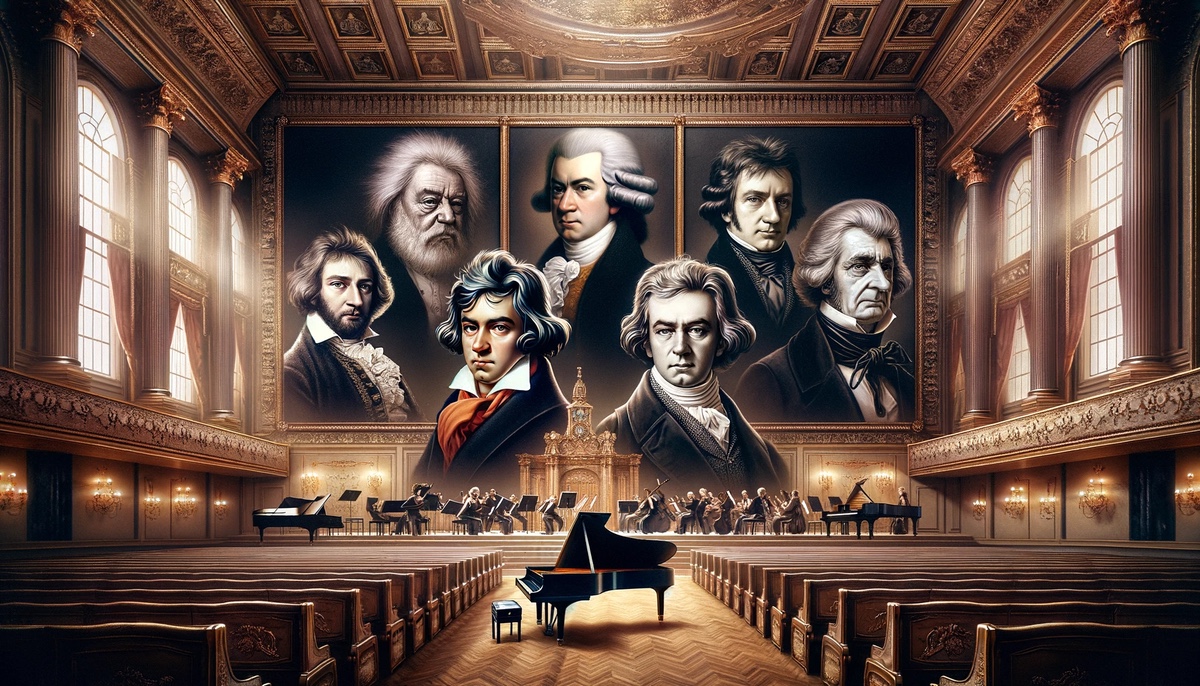
Czerny is in the center top of this image. He influenced many!

January 16 ~ On This Day in Music

. 1864 ~ Anton Schindler, German violinist and Beethoven’s biographer, died at the age of 68

. 1875 ~ First American performance of Johannes Brahms’ “Hungarian Dances”

.

1886 ~ Death of Italian opera composer Amilcare Ponchielli, in Milan. He was 51.

. 1891 ~ French Composer Leo Delibes died at the age of 54

. 1905 ~ Ernesto Halffter, Spanish composer and conductor

. 1908 ~ Ethel Merman (Zimmerman), American singer of popular music, Tony Award-winning actress (musical), Musical Theater Hall of Fame. She is most famous for Call Me Madam in 1951, It’s a Mad, Mad, Mad, Mad World, There’s No Business Like Show Business and Alexander’s Ragtime Band

. 1929 ~ Marilyn Horne, American mezzo-soprano

. 1929 ~ G.T. (Granville) Hogan, Jazz drummer who played with Elmo Hope, Earl Bostic

. 1934 ~ Bob Bogle (Robert Lenard Bogle), Guitarist, bass with The Ventures

. 1938 ~ Béla Bartók and his wife, Ditta performed their first public concert featuring his Sonata for Two Pianos and Percussion

. 1938 ~ Benny Goodman and his band, plus a quartet, brought the sound of jazz to Carnegie Hall in New York City. When asked how long an intermission he wanted, he quipped, “I don’t know. How much does Toscanini get?”

. 1942 ~ Bill Francis, Keyboard, singer with Dr. Hook and the Medicine Show

. 1942 ~ Kay Kyser and the band recorded A Zoot Suit for Columbia Records. The tune is about the problems associated with wearing this garish, exaggerated ‘hep’ fashion.

. 1946 ~ Katia Ricciarelli, Italian soprano

. 1946 ~ Ronnie Milsap, Grammy Award-winning singer in 1976, CMA Male Vocalist of the Year (1974, 1976, 1977), CMA Entertainer of the Year (1977), blind since birth, he learned to play several instruments by age 12

. 1950 ~ Debbie Allen, Dancer, actress, choreographer, sister of actress Phylicia Rashad

. 1957 ~ Conductor Arturo Toscanini died in New York at the age of 89.

. 1957 ~ The Cavern Club opened for business in Liverpool, England. The rock club was just a hangout for commoners. Then, things changed — big time. It all started in the early 1960s when four kids from the neighborhood popped in to jam. They, of course, turned out to be The Beatles.

. 1962 ~ Paul Webb, Bass with Talk Talk

. 1964 ~ “Hello Dolly!” opened at the St. James Theatre in New York City. Carol Channing starred in the role of Mrs. Dolly Levi. The musical was an adaptation of Thornton Wilder’s play, “The Matchmaker”. The show, with an unforgettable title song, was hailed by critics as the “…possible hit of the season.” It was possible, all right. “Hello Dolly!” played for 2,844 performances. And, it returned to Broadway in the 1990s, again starring Carol Channing.

. 1972 ~ David Seville died on this day in Beverly Hills, CA. Born Ross Bagdasarian, the musician was the force, and artist, behind the Alvin and the Chipmunks novelty songs of the 1950s, ’60s and ’70s.

. 1973 ~ Clara Ward passed away. Ward was an American gospel artist who achieved great artistic and commercial success in the 1940s and 1950s.

. 1975 ~ “Mandy” is Barry Manilow’s first #1 pop hit

. 1976 ~ The album, “Frampton Comes Alive”, was released by Herb Alpert’s A&M Records. The double LP soon reached the top spot of the album charts and stayed perched there for 17 weeks. It sold 19 million copies in its first year.

. 1980 ~ Lin Manuel Miranda, American actor, composer, lyricist (Hamilton)

. 1984 ~ Michael Jackson received eight awards at the 11th annual American Music Awards this night.

. 2001 ~ Eleanor Lawrence, a flutist who played often in chamber music performances and with several orchestras in New York City, died of brain cancer at the age of 64. She is credited with transforming a simple newsletter into an important source for flutists. Lawrence studied the flute at the New England Conservatory with the principal flutist of the Boston Symphony Orchestra, James Pappoutsakis. She later studied with flutists from the Philadelphia Orchestra and the Metropolitan Opera orchestra. She joined the American Symphony Orchestra and the Brooklyn Philharmonic after moving to New York in the 1960s. She played periodically with the New York Philharmonic and the Metropolitan Opera. Besides performing, Lawrence taught at the Manhattan School of Music. She served three times as the president of the New York Flute Club. She edited The National Flute Association Newsletter, now The Flutist Quarterly, from the mid-1970s to the early 1980s, expanding it from a brief information sheet to a publication with regular interviews.

Leonard Bernstein: What Does Music Mean?

On January 18, 1958 Leonard Bernstein began presenting his television series What does music mean?  The series ran for 53 programs.  Some of the episodes can be found below:

Part 1 What is Classical Music?

Plot: Bernstein conducts Handel’s Water Music and cites it as an indisputable example of classical music. “Exact” is the word that best defines classical music, Bernstein says and he demonstrates with musical illustrations from Bach’s Fourth Brandenburg Concerto, Mozart’s Concerto No. 21 in C Major and The Marriage of Figaro, and Haydn’s Symphony No. 102.

The decline of classical music at the end of the eighteenth century is tied to Beethoven’s innovations and the Romantic movement, and Bernstein conducts Beethoven’s Egmont Overture.


Part 2 What is Melody?

Plot: Bernstein discusses the different forms melody can take, including tune, theme, motive, melodic line and musical phrase. He illustrates by conducting the orchestra in excerpts from Tchaikovsky, Wagner, Hindemith, and Brahms.


Part 3 What is a Mode?

Plot: Bernstein discusses scales, intervals, and tones, and analyzes several pieces, including Debussy’s Fêtes, Rimsky-Korsakov’s Scheherazade, and music from the Kinks and the Beatles, to illustrate different modes.

An excerpt from Bernstein’s ballet Fancy Free is also performed.

January 15 ~ On This Day in Music

. 1775 ~ Giovanni Battista Sammartini, composer, died

. 1890 ~ Premiere of The Sleeping Beauty, ballet by Pyotr Il’yich Tchaikovsky. After the less-than-promising 1877 debut of Swan Lake, marred by a largely amateur production, over a decade elapsed before the composer was commissioned by the Director of the Imperial Theatres in St. Petersburg to supply music for a ballet on the Perrault fairy tale, The Sleeping Beauty. Tchaikovsky threw himself arms-deep into the project. Not only was the composer again on happy turf, but he was also currently in a state of delight by the occasional presence of a three-year-old little girl; children seemed to tap a joyful vein in Tchaikovsky. The little girl’s proximity fed a spirit of fantasy that transmitted to this most lighthearted of the composer’s scores. Most musicologists and historians concede that Sleeping Beauty is the most perfectly wrought of Tchaikovsky’s three ballet scores, classic in its restraint, yet possessing the right amount of color and panache to render it pure Tchaikovsky; its waltz remains a Pops favorite.

. 1896 ~ Alexander Scriabin made his European debut as a pianist at the Salle Erard in Paris

. 1904 ~ Ellie Sigmeister, Classical composer

. 1905 ~ Weldon Leo ‘Jack’ Teagarden, died of pneumonia
More information about Teagarden

. 1909 ~ Gene Krupa, American Jazz bandleader and drummer

. 1919 ~ Pianist and statesman Ignace Paderewski became the first premier of Poland

. 1925 ~ Ruth Slenczynska, pianist, born in Sacramento, California

. 1941 ~ Captain Beefheart (Don Van Vliet), Singer with Captain Beefheart & His Magic Band, artist

. 1942 ~ Kenny Sargent vocalized with the Glen Gray Orchestra on Decca Records’ It’s the Talk of the Town.

. 1944 ~ Duke Ellington and His Famous Orchestra took the song “Do Nothin’ Till You Hear From Me” to the top of the charts. It was there for eight weeks before being knocked out off the top.

. 1948 ~ Ronnie Van Zandt, Singer, songwriter with Lynyrd Skynyrd

. 1951 ~ Charo (Maria Rosario Pilar Martinez Molina Baeza), ‘The Hootchy Cootchy Girl’, actress, singer, wife of Xavier Cugat

. 1951 ~ Martha Davis, Singer with The Motels

. 1959 ~ Peter Trewavas, Bass with Marillion

. 1964 ~ The soundtrack album of the musical, “The King and I”, starring Yul Brynner, earned a gold record.

. 1967 ~ Ed Sullivan told the Rolling Stones to change the lyrics and the title to the song, Let’s Spend the Night Together, so it became Let’s Spend Some Time Together.

. 1972 ~ Elvis Presley, who was also censored from the waist down by Ed Sullivan, reportedly drew the largest audience for a single TV show to that time. Elvis presented a live, worldwide concert from Honolulu on this day.

. 1972 ~ “American Pie” by Don McLean hit #1 on the pop charts

. 1987 ~ Ray Bolger died.  He was an American entertainer of vaudeville, stage and actor, singer and dancer best known for his portrayal of the Scarecrow in The Wizard of Oz.

. 1993 ~ Sammy Cahn passed away.  He was an American lyricist, songwriter and musician.

. 2018 ~ Edwin Hawkins, American gospel musician, choirmaster and composer (Oh Happy Day), died of pancreatic cancer at the age of 74

. 2019 ~ Carol Elaine Channing died at the age of 98. She was an American actress, singer, dancer and comedian. Notable for starring in Broadway and film musicals, her characters typically radiate a fervent expressiveness and an easily identifiable voice, whether singing or for comedic effect.

Gene Krupa, Born January 15, 1909

krupa


Eugene Bertram “Gene” Krupa lived from January 15, 1909 to October 16, 1973.  He was an American jazz and big band drummer, actor and composer, known for his highly energetic and flamboyant style.

One of my all-time favorite non-piano songs is Sing Sing Sing. Krupa joinedBenny Goodman’s band in 1934, where his featured drum work made him a national celebrity. His tom-tom interludes on their hit “Sing, Sing, Sing” were the first extended drum solos to be recorded commercially.

The Benny Goodman big band playing Sing Sing Sing, featuring Gene Krupa at the end. We get the added benefit of hearing Mr. Harry James play a trumpet solo.

~~~

Gene Krupa and Buddy Rich: Famous Drum Battle