When they make a mistake they hack away at it until it finally yields, and simply move on. What they have actually practised is getting it wrong three or four times in a row and right on the fifth attempt. What, then, are the chances of getting it right the first time in the context of the flow of the piece?
• 1856 ~ Robert Schumann passed away. Schumann was a German composer and influential music critic. He is widely regarded as one of the greatest composers of the Romantic era. Schumann left the study of law, intending to pursue a career as a virtuoso pianist.
More information about Schumann
• 1887 ~ Sigmund Romberg, Hungarian-born American operetta composer, founding member of ASCAP. He was famous for his operettas “Desert Song”, “Maytime” and “Student Prince”
• 1916 ~ Charlie Christian, American guitarist and blues singer
• 1930 ~ Paul Taylor, Dancer with the Martha Graham Dance Company, New York City Ballet, Paul Taylor Dance Company, Emmy Award-winning choreographer, Kennedy Center Honors in 1992 “…for enhancing the lives of people around the world and enriching the culture of our nation.”
• 1933 ~ Randy Sparks, Folk singer, songwriter with the New Christy Minstrels
• 1935 ~ Peter Schreier, German tenor
• 1946 ~ Neal Doughty, Keyboards with REO Speedwagon
• 1953 ~ Geddy Lee, Bass, singer with Rush
• 1965 ~ The Queen of England attended the premiere of the motion picture, Help!, starring The Beatles. The command performance was held at the London Pavilion. The film later earned first prize at the Rio De Janeiro Film Festival in Brazil. The Beatles later said the film was shot in a “haze of marijuana”. According to Starr’s interviews in The Beatles Anthology, during the Austrian Alps film shooting, he and McCartney ran off over the hill from the “curling” scene set to smoke a joint.
• 1966 ~ Martina McBride, Country singer
• 1970 ~ Sir John Barbirolli died. He was the British conductor of the Halle Orchestra, and was a famous interpreter of English music, Mahler and Italian opera.
The O’Connor Music Studio has a copy of this app if you (or your student) would like to try it during a lesson.
I see great potential with this app and think it could be useful for you at home.
It’s a fun game that can be used with a piano, the iPad or it can be hooked up to an electric keyboard.
Piano Maestro is free for all OCMS students to use on their own iPads at home. Your student’s piano lesson books are most likely included to help the student learn the pieces – accompanied by a full backing track!
• 1750 ~ Johann Sebastian Bach, German composer and organist, died. Composer of “St Matthew Passion” and “Brandenburg Concertos”, his output covered every musical genre with innovations in format, quality and technical demands.
More information about Bach
• 1796 ~ Ignace Bösendorfer, Italian Pianomaker
More information about Bösendorfer
• 1901 ~ Rudy (Hubert Prior) Valee, Bandleader and singer. Valee was one of the first, before Bing Crosby, to popularise the singing style known as “crooning”.
• 1914 ~ Carmen Dragon, Classical music conductor, bandleader and father of singer, ‘Captain’ Daryl Dragon
• 1933 ~ The singing telegram was introduced on this day. The first person to receive a singing telegram was singer Rudy Vallee, in honor of his 32nd birthday.
• 1934 ~ Jacques d’Amboise, Ballet dancer with the New York City Ballet
• 1937 ~ Peter Duchin, American bandleader, pianist, son of musician, Eddy Duchin
• 1939 ~ Judy Garland sang one of the most famous songs of the century with the Victor Young Orchestra. The tune became her signature song and will forever be associated with the singer-actress. Garland recorded Over the Rainbow for Decca Records. It was the musical highlight of the film, The Wizard of Oz.
• 1941 ~ Riccardo Muti, Italian conductor
• 1945 ~ Rick Wright, Keyboards with Pink Floyd
• 1949 ~ Peter Doyle, Singer with The New Seekers
• 1949 ~ Simon Kirke, Drummer with Free
• 1958 ~ Three years after his Cherry Pink and Apple Blossom White reached number one, Cuban-born bandleader Perez Prado captured the top spot again, with Patricia. Prado was known as the Mambo King for his popular, Latin-flavored instrumentals.
• 2001 ~ Bass guitarist Leon Wilkeson, one of the founding members of legendary rock band Lynyrd Skynyrd, died at the age of 49. The band, best known for songsWhat’s your Name?, Sweet Home Alabama and Freebird, debuted in 1973 and was named after the members’ high school gym teacher, Leonard Skinner. Wilkeson was involved in a 1977 plane crash in Mississippi that killed band members Ronnie Van Zant, Steve Gaines and Cassie Gaines. The group disbanded after the crash, but re-formed with others in 1987 for a reunion tour. The band toured for most of the 1990s and had a concert scheduled for Aug. 23 in Jacksonville.
• 2002~ Thomas Calvin “Tommy” Floyd, whose twangy voice sold Luck’s beans in the 1950s, died. He was 89 and suffered from Alzheimer’s disease. Floyd was one of Asheboro’s best known voices, between his music career and his jobs announcing at radio stations. Floyd organized the Blue Grass Buddy’s in 1942. The group played for radio shows and performed around the Southeast, appearing in concert with bluegrass legends Lester Flatt and Earl Scruggs. In 1950, Luck’s sponsored the band, provided that Floyd plug the product at shows. His jingle went: “Luck’s pinto beans, Luck’s pinto beans. Eat ’em and you’ll never go wrong. Luck’s pinto beans.” Luck’s sponsored him as a host for 15-minute country music spots on television stations in the Southeast. Luck’s discontinued the sponsorship in 1953.
• 2002 ~ Eddy Marouani, who managed the careers of some of the most famous figures in French music, including Edith Piaf and Jacques Brel, died. He was 81. He also steered the careers of singers Michel Sardou, Serge Lama and comedian Michel Boujenah. Marouani headed the agency “Office Parisien du Spectacle” and presided over one the biggest families of French impresarios. Marouani published his memoirs in 1989, entitled “Fishing for Stars, Impresario Profession.”
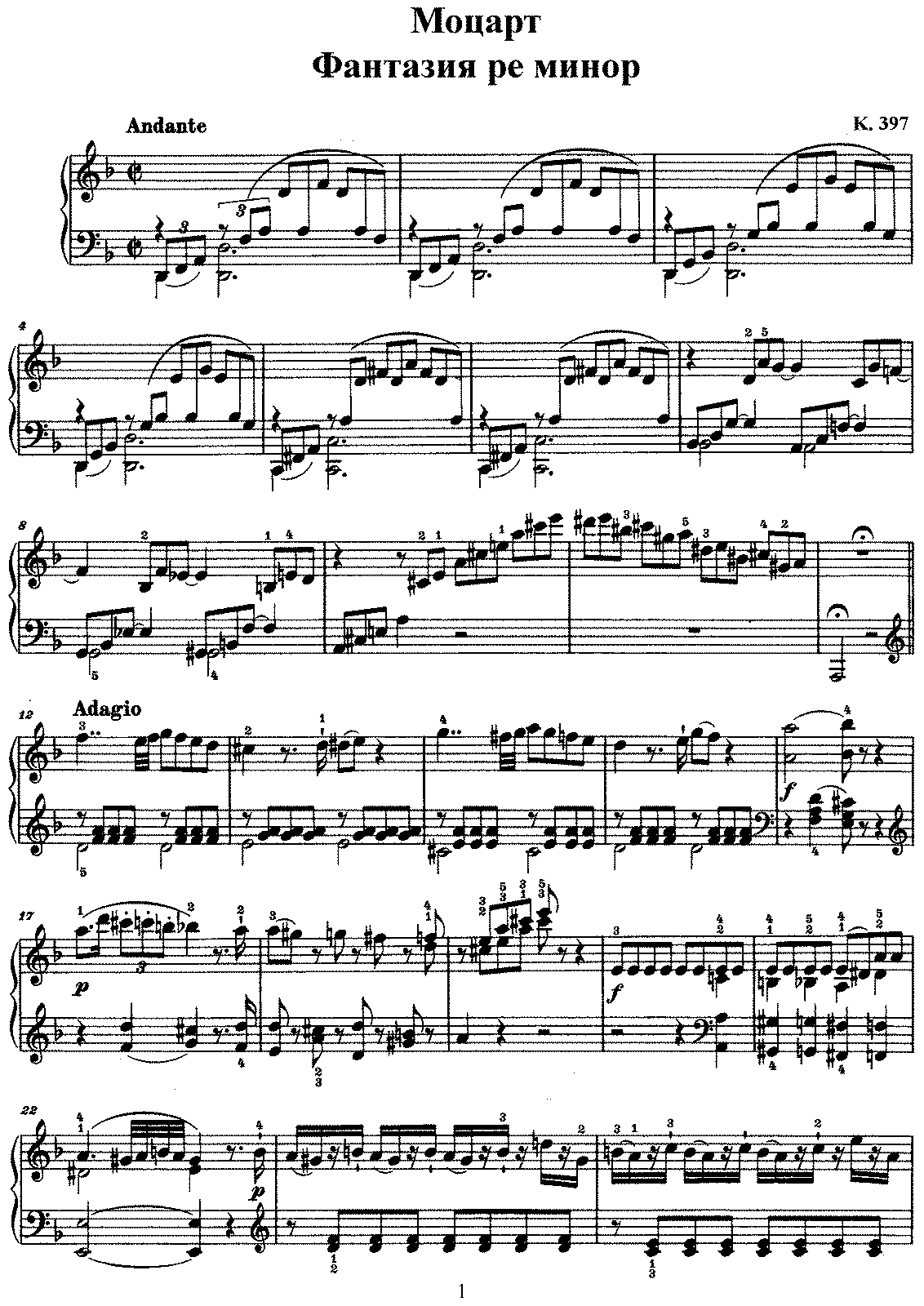
I have always really enjoyed playing Mozart’sFantasia in d minor and when I was asked to play for the new piano dedication service at my church a couple years ago I knew what I would “dust off” to perform.
The Grove’s Dictionary of Music and Musicians defines the genre of musical fantasia as “a piece of instrumental music owning no restriction of formal construction, but the direct product of the composer’s impulse.”
The Fantasia in d minor has somewhat unusual rhythm, constantly changing tempo (seven different tempi occur throughout the piece), three cadenzas and its apparent lack of any recognizable musical form (as indicated by the “Fantasy” title). Although it begins in d minor, the final section is in D Major.
Mozart composed this, his third and final, Fantasia in 1782 and it was unfinished at the time of his death in 1791. Even Mozart’s sister, “Nannerl”, who came across the work in 1807, was astounded to have discovered a previously unknown composition of such quality.
In its original form this Fantasia was probability only a fragment of what was to be a larger work. The closing bars which are most frequently performed today originated from an unauthorized print believed to have been composed in 1806 by August Eberhard Müller, one of Mozart’s admirers.
Because it was unfinished, many of the dynamic and pedal markings are nonexistant and left for the performer to choose.
As you can see from these videos, there is a wide range of tempi and interpretation from Frederich Gulda’s 4 minute, 36 second rendition
to Glenn Gould’s version which lasts for 8 minutes, 22 seconds
Both these composers have added their own ornamentation to Mozart’s original work.
I will be playing from a G. Henley Verlagurtext edition instead of one of the many edited versions available. I prefer to make my own musical decisions wherever possible.
1867 ~ Enrique Granados, Spanish composer and conductor
More information about Granados
• 1877 ~ Ernö Dohnányi, Hungarian pianist, composer and conductor. He wrote the popular “Variations on a Nursery Song” and became an eminent concert pianist. One of the leading lights of 20th-century Hungarian music, he championed the music of Bartok and Kodaly.
• 1918 ~ Leonard Rose, American cellist
• 1927 ~ Bob Morse, Singer with The Hi-Lo’s
• 1933 ~ Nick Reynolds, Folk singer with The Kingston Trio
• 1942 ~ Peggy Lee recorded her first hit record, in New York City. With the backing of the Benny Goodman band, Miss Lee sang Why Don’t You Do Right.
• 1943 ~ Al Ramsey, Musician: guitar with Gary Lewis & The Playboys
• 1944 ~ Bobbie Gentry, Pop Singer. She won a Grammy Award in 1967
• 1949 ~ Maureen McGovern, Singer
• 1950 ~ Michael Vaughn, Guitarist with Paperlace
• 1959 ~ Brothers, Santo and Johnny (Farina) of Brooklyn, NY saw their one and only hit record, the instrumental Sleepwalk released. Sleepwalk was number one for two weeks. Their next song, Tear Drop, only made it to number 23 on the pop charts. Such is life in the pop music biz.
• 1963 ~ Karl Mueller, Rock Musician
• 1974 ~ NBC~TV removed Dinah’s Place from its daytime programming roster. The move brought Dinah Shore’s 23~year association with the Peacock Network to a close.
• 1974 ~ John Denver’s biggest hit song reached the top of the Billboard singles chart. Annie’s Song, written for his wife, became the most popular song in the U.S. Denver had three other #1 songs: Sunshine on My Shoulders, Thank God I’m a Country Boy and I’m Sorry.
• 1976 ~ John Lennon finally had his request for permanent residency in the United States approved. Lennon’s immigration card number was A-17-597-321. The decision to allow Lennon to stay in the country ended a long struggle between the former Beatle and the U.S. Government.
• 2000 ~ Alex “Sleepy” Stein, the founder of the first all-jazz radio station, died of cancer at the age of 81. Stein started working for CBS radio in the 1940s and later moved to Chicago, where he earned the nickname “Sleepy” after replacing an all-night deejay named Wide-Awake Widoe. He moved to Southern California, where he started broadcasting from an AM station in Long Beach. In 1957, Stein bought KNOB and began all-jazz programming from the Signal Hill station. On-air personalities at the groundbreaking station included famous jazz announcers Chuck Niles, Jim Gosa and Alan Schultz. Stan Kenton helped him finance the station by contributing the profits from his band’s performances.
• 2001 ~ Harold Land, a jazz saxophonist who over five decades performed with such greats as Thelonious Monk, Billie Holiday and Tony Bennett, died at 72. Land was born on Dec. 18, 1928, in Houston and grew up in San Diego. His parents bought him a saxophone when he was 16 and he made his first record at 21. In 1954 he moved to Los Angeles, where he joined the group run by trumpeter Clifford Brown and drummer Max Roach, touring the country for two years. He went on to join bands featuring jazz notables Curtis Counce and Blue Mitchell. He co-led a band with vibraphone player Bobby Hutcherson in the late 1960s and early 1970s, and had a 30-year association with Gerald Wilson’s orchestras. Land earned a reputation as a hard-bop musician capable of incandescent improvisation. In the late 1970s and the 1980s, Land joined the Timeless All-Stars, which included Hutcherson, drummer Billy Higgins, pianist Cedar Walton and trombonist Curtis Fuller. He also was a featured soloist for Tony Bennett. He appeared on the soundtracks for the movies Carmen Jones in 1954 and They Shoot Horses, Don’t They? in 1969. He continued to be an active musician late in life. The album Promised Land, featuring Land and his quartet, was released this year.
Classical piano pieces by such composers as Beethoven, Mozart and Chopin likely sounded much different when the masters first performed those works than they do today. Pianos themselves have changed considerably — but so, too, has technique.
Over the past decade, a growing number of musicologists have begun to take a closer look at how technique shapes not just the sound of music, but also the audience’s emotional response to it.
“Music has one foot in physics and one foot in aesthetics,” said Rolf Inge Godoy, a professor of musicology at the University of Oslo. “Body motion is essential for shaping the outcome of the sound, both in terms of what you actually hear and in terms of the visual impact on an audience.”
Dr. Godoy uses optical motion capture — also employed by the animation industry — to study the physics of musical movement. Infrared cameras capture light from reflective markers placed on a cellist’s hands or a percussionist’s body, recording the performer’s motion at up to 500 frames per second and at an accuracy to one-third of a millimeter.
Computer algorithms then make associations between the motion data, what is heard and what listeners say they felt.
Recently Dr. Godoy turned the technology on a fascinating question: How were such classical pieces as Mozart’s Variation K. 500 and Hummel’s Etudes, Opus 125, originally played, and how might that have made a difference in sound and in audience reaction?
To find out, Dr. Godoy struck up a collaboration with Christina Kobb, a doctoral candidate at the Norwegian Academy of Music and head of theory at Barratt Due Institute of Music in Oslo. Ms. Kobb has developed an unusual expertise: She has learned how to play the piano according to techniques described nearly 200 years ago.
As a visiting student at Cornell University in 2010, she researched 19th-century pedagogical piano treatises — essentially, instruction manuals for piano playing. The techniques that they described, she realized, differed drastically from those she had been taught.
“I was not following even the most basic instructions given to beginners at the time,” Ms. Kobb said. “I wondered, ‘Would this make a difference in my playing?’ ”
For the next three years, she gradually replaced her modern way of playing with 19th-century technique, gleaned from around 20 treatises. Most were written in Vienna in the 1820s, while a few were published in France and England. Her primary source, however, was “A Complete Theoretical and Practical Course of Instructions on the Art of Playing the Piano Forte,” the seminal 465-page treatise published in 1827 by Johann Nepomuk Hummel, one of Mozart’s students.
“It’s hard enough learning how to play once,” she said. “I had to become conscious of every motion in my hands and fingers, things that normally I would do automatically, by habit.”
While modern players tend to hunch over the keys and hold their forearms nearly perpendicular to the keyboard, 19th-century style dictated that pianists sit bolt upright. The posture prevented players from bringing their weight to bear on the keyboard, instead forcing them to rely on smaller finger movements. The elbows were held firmly against the body, with forearms sloping down and hands askew.
As Ms. Kobb became more fluent in this approach, she found that certain movements — jumping quickly between disparate chords, for example — became swifter and more fluid. “The elbow against your body serves as a sort of GPS, so you always know where you are,” she said.
Chords and scales sound smoother and can be played faster, Ms. Kobb also found, and dramatic pauses between notes — often a matter of physical necessity rather than of style — are lessened. The old style also allows the performer to be more discriminatory and subtle in choosing which notes to stress, Ms. Kobb learned, producing a performance that is subdued by today’s standards.
“There’s a different physical feeling to playing, as well as a different outcome,” she said.
To identify the sources of those differences, Dr. Godoy and his colleagues recently attached 46 pieces of reflective material to Ms. Kobb’s fingers and arms, and then filmed her playing on an electric piano. After analyzing her movements, the researchers will be able to tell precisely which differences in technique account for each variation in the music as it is played in the old and modern styles.
“The correlation between bodily effort and sound output is really what we’re aiming to find out, but in order to do that we need to perform extensive statistical analysis, which is tremendously time-consuming,” Dr. Godoy said. He expects the results of the data analysis in three to four months.
“We are exploring those connections to get a better understanding of what music is,” Dr. Godoy added. “What is its power, and why do people respond so strongly to it?”
For her part, Ms. Kobb now plans to delve deeper into the repertoire of Romantic composers. “It’s time to restore the early techniques to try to bring us even closer to the way music sounded at the time of Beethoven,” she said.
1782 ~ John Field, Composer
More information about Field
• 1791 ~ Wolfgang Amadeus Franz Xavier Mozart, Mozart’s son. He didn’t give his first concert until he was 13 and never achieved his father’s fame
• 1874 ~ Serge Koussevitzky, Russian-born American conductor, double-bass player and music publisher, He was conductor of the Boston Symphony Orchestra and founder of the Tanglewood Music Festival.
• 1882 ~ Richard Wagner’s opera “Parsifal” was first performed, at Bayreuth, western Germany.
• 1914 ~ Erskine Hawkins, ’20th Century Gabriel’ Trumpeter bandleader, composer of Tuxedo Junction (with Julian Dash and Bill Johnson)
• 1924 ~ Louie Bellson (Balassoni), Drummer with the Duke Ellington Band, drum solo on Skin Deep, composer, music director for wife Pearl Bailey, played with Dorsey Brothers and Count Basie bands
• 1929 ~ Alexis Weissenberg, Bulgarian-born French pianist
• 1939 ~ Sixteen-year-old singer Kay Starr got a big break. She recorded Baby Me with Glenn Miller and his orchestra on Victor Records. Starr was filling in for Marion Hutton who, at the last minute, was unable to attend the recording session.
• 1941 ~ Bobby Hebb, Grammy Award-winning songwriter, singer, Grand Ole Opryat age 12
• 1943 ~ Mick Jagger, British rock singer and songwriter. 41 hits [1964 to 1989], 5 gold records, 8 number one hit, Rock and Roll Hall of Famer. In 2003 he was knighted for his services to popular music and in early 2009 he joined the electric supergroup SuperHeavy.
• 1945 ~ Rick White, Singer
• 1949 ~ Roger Taylor (Meadows-Taylor), Drummer with Queen
• 2001 ~ Cleveland Johnson, a crusader for equality through his Tampa Bay-area newspaper, the Weekly Challenger, died of lung cancer. He was 73. Johnson wrote over the years about the need for social change, warning of the devastating effects of drugs on the black community and preaching the virtues of black economic power. Johnson, whose first love was music, studied at the Juilliard School and the Boston Conservatory. He operated a jewelry and dress store in Miami before moving to St. Petersburg in the mid-1960s and taking a job at the new Weekly Challenger, where he discovered that he had a talent for selling advertising. When founder M.C. Fountain died, Johnson kept the paper. Starting in the 1980s, he urged blacks to spend their money in black-owned businesses.
• 2002 ~ Buddy Baker, musical director for nearly 200 Disney movies and TV shows including “The Mickey Mouse Club,” died. He was 84. The composer penned incidental music and special songs sung by for “The Mickey Mouse Club” child stars and was responsible for music in the 1981 cartoon feature “The Fox and the Hound.” He was nominated for an Academy Award for the score to the 1972 children’s drama “Napoleon and Samantha.” He also scored incidental music for the Disney theme park attractions “Great Moments With Mr. Lincoln,” “It’s a Small World,” and “The Haunted Mansion.” Disney Studios hired him in 1954. He worked on arrangements for the TV show “Davy Crockett” and three “Winnie the Pooh” cartoons and composed original music for the 1975 film “The Apple Dumpling Gang” and 1976’s “The Shaggy D.A.”
• 2002 ~ Kenny Gardner, a tenor who sang with Guy Lombardo and His Royal Canadians, died. He was 89. Gardner, the featured crooner, was remembered for such songs as Enjoy Yourself, It’s Later Than You Think and Frankie and Johnny. The band, one of the most popular orchestras in American dance music, sold more than 100 million recordings and became known for its New Year’s Eve broadcasts of Auld Lang Syne. Gardner started singing for radio shows in Los Angeles. He joined the band after Elaine Lombardo heard him on the air in 1940. Gardner left the group to serve in the military, where he was wounded and received a Purple Heart. He returned to perform with the band until his retirement in 1978.
When Paula Fay started taking piano lessons for the first time in her late fifties, it fulfilled a lifelong dream.
“I always wanted to learn how to play as a child, but my parents couldn’t afford it,” she said.
Today, four years later, Paula can play some of her favorite tunes. And she’s loving every minute of it.
Some adults may groan at childhood memories of lesson after lesson, practice after practice and a lot of teacher nagging, but many wish those days were back.
And more and more, these adults are turning wishful thinking into reality. According to the National Piano Foundation, adults ages 25-55 are the fastest-growing segment of people learning piano.
When Ruth Ann Laye started teaching an adult piano class at Mandarin’s Keyboard Connection, there was only one weekday class. Now, she’s up to seven classes. And of her own private practice of 28, 11 are adults.
One of her students is Belinda May from St. Augustine, who is in her 60s and in her second year of piano lessons.
Though her brothers played piano, she was more athletically inclined than musical. Then after years of “picking” at the pianos in her house, she recently resolved to start taking lessons. A beginner when she started, “now I’m playing Christmas carols,” she said.
“It tells me that you’re never too old to learn something new.”
Maureen Rhodes, a piano teacher on the Southside, would likely agree. She has more adults in her practice than she did 20 years ago.
“I think baby boomers are looking for ways to stay active,” she said. “Sometimes, kids come to me for lessons and then when they grow up and leave, their mother starts to take lessons,” says Rhodes. “Other adults have a specific goal in mind, like they want to play in church or accompany their grandson.”
Sandra Stewart, outgoing president of the Jacksonville Music Teachers Association and adjunct professor teaching a non-degree adult piano course at Florida State College, believes technology is a big part of the reason for the greater interest in piano among adults.
“Keyboards are more affordable, and that’s made all the difference,” she says.
But the piano is not always a succession of high notes for the adult student. Says Stewart: “Adults can have problems with finger dexterity. If they never played before, this can be frustrating. People who use computer a lot have an advantage. But if they don’t have this experience, they have to get over that hurdle.”
And some adults expect to transform into Mozart overnight.
“They may be symphony patrons or just love classical music and want to play instantly and do it like the pros,” Rhodes says. “But they have to develop the skills first, and it takes a lot of patience.”
But for adults committed to learning, it can be very satisfying for student and teacher alike.
“Adults are there for their own pleasure,” said Marc Hebda, president of the Florida State Music Teachers Association. “They have wonderful enthusiasm; it’s fun to see them get excited. It’s also interesting that with the economic downturn, they are not cutting back on lessons or buying instruments. Piano is a constant source of entertainment and personal development.”
The key to any student learning well, whether that student is an adult or child, is finding the right teacher. Hebda stresses the importance of taking lessons from a teacher with a music degree.
“Some people who took piano figure it’s easy to teach. But credentials are very important. You wouldn’t go to a doctor without certification or a lawyer who didn’t pass the bar. All our teachers have a music degree or demonstrate teaching ability.”
Hebda also notes that rapport between teacher and student is important.
“The student should interview the teacher, because not all students and teachers are a good match.”
For those who want to fast-track the learning process, there are alternatives. “The Piano Guy,” Scott Houston, has been teaching piano using a non-traditional method through his shows on public station WJCT.
“It seemed like there was a single path to the world of piano: this long process of taking lessons,” he said. “But people want to play the tunes they know.”
So Houston came up with a simple way for adults to learn quickly, based on the concept behind “lead sheets,” which are used by professional musicians. Houston’s technique is to teach adults a single line of notes on the treble clef with their right hand and chords with their left.
“My goal is not to teach adults to be the greatest players but to be able to play the tunes they want to play,” Houston says.
His approach has clearly struck a chord, as his book has sold 300,000 copies and he has taught many adults through his workshops in Indiana and master class “piano camp” from his beach home in Fort Myers.
There’s also a new trend gaining traction called “recreational music making” — RMM — which like Houston’s approach focuses on a simplified method to teaching music. The goal is not for a student to become accomplished at the piano and perform, but rather to just have fun making music. It is often taught to adults in group settings, such as music stores, churches and senior centers.
“Research has found that RMM is very helpful for seniors, promotes hand/eye coordination and keeps the brain working,” said Erin Bennett, assistant professor of piano and pedagogy at the University of North Florida. “Its asset is the ability to reach more people; it’s more inclusive and easier for the non-experienced.”
Whether learning piano through traditional or nontraditional means, its many benefits include boosting self-confidence.
“When I first started, I didn’t think I could do it,” Fay said. “And my friends and family were in disbelief that I was taking lessons. Then they wanted to hear a concert. In another year, I might just do it.”
She gets some measure of satisfaction in surprising those around her.
“Society puts restrictions on us as we get older that we stop learning,” she says. “But we are wiser, more patience and accept our limitations.”
• 1939 ~ W2XBS TV in New York City presented the first musical comedy seen on TV. The show was Topsy and Eva.
• 1941 ~ Manuel Charlton, Musician, guitar, singer with Nazareth
• 1942 ~ Capitol Records first number one hit made it to the top this day. It was one of their first six records released on July 1. The new company’s hit was Cow Cow Boogie, by Ella Mae Morse and Freddy Slack.
• 1943 ~ Jim McCarty, Drummer with the Yardbirds and songwriter
• 1945 ~ Donna Theodore, Singer on Art Linkletter’s Hollywood Talent Scouts
• 1951 ~ Verdine White, Rock Musician, bass, singer with Earth, Wind and Fire
• 1952 ~ Herbert Murrill, Composer, died at the age of 43
• 1955 ~ Ilmari Hannikainen, Composer, died at the age of 62
• 1955 ~ Isaak Iosifovich Dunayevsky, Composer, died at the age of 55
• 1964 ~ “Here’s Love” closed at Shubert Theater New York City after 338 performances
• 1964 ~ The Beatles’ “Hard Day’s Night” album went #1 and stayed #1 for 14 weeks
• 1965 ~ Bob Dylan appeared on stage at the Newport Folk Festival with an electric guitar. He was not well received, even with the classic folk song, Blowin’ in the Wind. The electrified “poet laureate of a generation” was booed and hissed by the audience for being amplified. He was, in fact, booed right off the stage.
• 1983 ~ Jerome Moross, American composer of Frankie & Johnny, died at the age of 69
• 1990 ~ “Les Miserables,” opened at Princess Elizabeth Theatre in Vancouver
• 1994 ~ John M Dengler, Jazz Bass Sax/Trumpet/Trombone, died at the age of 67
• 1995 ~ Charlie Rich, Country singer, died at the age of 62. Rich began as a Rockabilly artist for Sun Records in Memphis in 1958. He scored the 1974 US No.1 & UK No.2 single ‘The Most Beautiful Girl’ and ‘Behind Closed Doors’, was a No.1 country hit.
• 1995 ~ Osvaldo Pugliese, Musician and composer, died at the age of 89


 1741 ~ Antonio Vivaldi died