So often transfer students will come to me and play a piece they’ve been working on. When they make a mistake, they’ll stop and start the piece all over again instead of correcting the mistake on the spot and moving on.
If they do this at home in practice, they’ll have played the beginning part many times more than the ending – or they may have never gotten to the ending at all!
The infographic above shows a way to get around this problem. It’s also great for memorizing pieces during recital preparation.
Similar to this are some pieces in the early pages of beginning method books. Lines 1, 2 and 4 will be identical with only line 3 being changed.
If a student plays this over and over all the way through, he’s learned line 1 three times better than line 3. I always suggest practicing line 3 by itself several times to help counter this problem.
. 1859 ~ Daniel Emmett introduced I Wish I was in Dixie’s Land (later named Dixie) in New York City. Just two years later, the song became the Civil War song of the Confederacy.
. 1875 ~ Pierre Monteux, French conductor, famed for his interpretation of early 20th century music, he conducted the first performances of Stravinsky’s “Rite of Spring” and Ravel’s “Daphnis and Chloe.”
. 1891 ~ Distinguished American actor Edwin Booth made his final stage appearance in a production of Hamlet at the Brooklyn Academy of Music.
. 1915 ~ “Muddy” Waters, American blues singer and guitarist
. 1922 ~ Elmer Bernstein, Composer of Academy Award-winning film scores: Thoroughly Modern Millie (1967); Sudden Fear, The Man with the Golden Arm, Ten Commandments, Sweet Smell of Success, To Kill a Mocking Bird, Walk on the Wild Side and The Magnificent Seven
. 1938 ~ After seven years of singing on the radio, Kate Smith began a new noontime talk show.
. 1939 ~ Glenn Miller recorded his theme song, Moonlight Serenade, for Bluebird Records. Previously, the Miller theme had been Gone with the Dawn and, before then, Now I Lay Me Down to Sleep.
. 1939 ~ Hugh Masakela, Trumpeter
. 1946 ~ Serge Leiferkus, Russian baritone
. 1954 ~ Maestro Arturo Toscanini conducted his last concert with the NBC Symphony Orchestra at Carnegie Hall in New York City. Toscanini ended a 17-year association with the orchestra.
. 1964 ~ The Beatles set an all-time record on the Top 100 chart of Billboard magazine this day. All five of the top songs were by the British rock group. In addition, The Beatles also had the number one album as Meet the Beatles continued to lead all others. The LP was the top album from February 15 through May 2, when it was replaced by The Beatles Second Album. It was estimated at the time that The Beatles accounted for 60 percent of the entire singles record business during the first three months of 1964. The top five singles by The Beatles this day were:
1) Can’t Buy Me Love
2) Twist and Shout
3) She Loves You
4) I Want to Hold Your Hand
5) Please Please Me
. 1968 ~ Bobby Goldsboro received a gold record for the single, Honey. The poignantly sad song charted for 13 weeks, spending five weeks at number one. Goldsboro produced a total of 11 hits on the pop charts in the 1960s and 1970s. Honey was his only million seller and only number one hit.
. 1994 ~ Ginny Simms passed away. She was an American popular singer and film actress.
. 2000 ~ Blues singer Mary Smith McClain, better known to fans as “Diamond Teeth Mary,” died in St. Petersburg, Fla. She was believed to have been 97 or 98. McClain was a teen-ager posing as a boy when she hopped a train in her native West Virginia to begin a new life as a traveling blues musician more than 80 years earlier. She went from singing at carnivals with the Rabbit Foot Minstrels to the Chicago Blues Festival, New York City’s Carnegie Hall and Europe. She sang with such music greats as B.B. King, Duke Ellington, Billie Holiday and Louis Armstrong. McClain, who once had diamonds set in her teeth, was considered the world’s oldest-performing true blues musician, appearing at local clubs until two weeks before her death.
WRONG – this post, and others in this category, isn’t about ornaments at Christmas but about those funny looking marks over your music and how to play them.
The trill (or shake, as it was known from the 16th until the 19th century) is a musical ornament consisting of a rapid alternation between two adjacent notes, usually a semitone or tone apart, which can be identified with the context of the trill.
A trill provides rhythmic interest, melodic interest, and harmonic interest. Sometimes it is expected that the trill will end with a turn or some other variation. Such variations are often marked in the music.
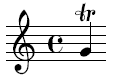
A trill in your music can look like this
Or like this tr~~~~~~~~~~~~~
Trills can be played differently, depending on the period in which the composer was living so it is important to know the time period of your piece.
Baroque trills (aka shakes in this time period) have several ways to be played as shown in this chart:
A table depicting how to perform different types of trills (or shakes) when playing music from the Baroque period (1600-1750).
The Baroque trill continuing through Mozart’s time usually begins on the note above the main note.
In music after the time of Mozart, the trill usually begins on the principal note.
Often, your music will have suggestions about how they should be played written above the music. If not, ASK!
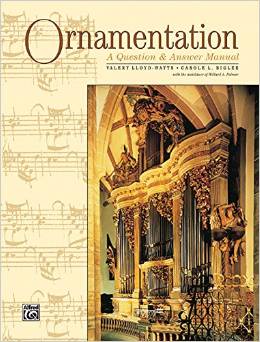
A really good book which explains about the trill and other ornaments is this one, available as a reference book in the O’Connor Music Studio:
Some trill exercises:
Questions? Write them down and don’t forget to ask at your next lesson!
. 1895 ~ Mario Castelnuovo-Tedesco, Italian-born American composer
. 1897 ~ Johannes Brahms, German composer and pianist, died. He wrote four symphonies as well as concerti for piano and violin and highly-esteemed chamber works.
. 1924 ~ Doris Day, Singer
. 1942 ~ Wayne Newton, American singer of popular music
. 1944 ~ Tony Orlando, Singer, Tony Orlando and Dawn
. 1948 ~ Garrick Ohlsson, American pianist, winner of Poland’s Frederic Chopin piano competition in 1970. More about this competition.
. 1949 ~ Dean Martin and Jerry Lewis debuted on radio in an NBC program that ran until 1952.
. 1950 ~ Kurt Weil, German composer, died, best known for his “Threepenny Opera” and for his collaboration with actress and singer Lotte Lenya whom he married in 1926.
. 1952 ~ Harry Belafonte recorded his first songs for RCA Victor at Manhattan Center in New York City.
. 1952 ~ Hugo Winterhalter backed up the singer with an 18-piece orchestra. Among the sides recorded were Dogs A-Roving and Chimney Smoke.
. 1955 ~ Fred Astaire appeared on television for the first time on The Toast of the Town, with host, Ed Sullivan. Already an established dancer in films, Astaire was quick to become a TV sensation as well.
. 1965 ~ Bob Dylan appeared on the pop music charts for the first time. Subterranean Homesick Blues entered the Top 40 at number 39. The song stayed on the charts for eight weeks. Dylan would chart a total of 12 singles on the pop charts between 1965 and 1979. He appeared in the films Don’t Look Back, Eat the Document and Pat Garrett and Billy the Kid. He made the film Renaldo and Clara in 1978. Dylan co-starred in the film Hearts of Fire in 1987. He became a member of the Traveling Wilburys and was inducted into the Rock and Roll Hall of Fame in 1988. Dylan won the Grammy’s Lifetime Achievement Award in 1991.
. 1986 ~ For the first time in six years, major record companies decided to raise prices – between three and five percent.
. 1986 ~ Peter Pears, British operatic tenor, died. He was a collaborator with composer Benjamin Britten and first interpreter of many of Britten’s works, notably “Peter Grimes.”
. 1999 ~ Lionel Bart, British composer of the musical “Oliver!,” died aged 68.
. 2001 ~ Lester “Big Daddy” Kinsey, a blues singer-guitarist known for his croaky voice, died of prostate cancer. He was 74. Kinsey and his sons, Kenneth, Donald and Ralph, became known as “Big Daddy” Kinsey and His Fabulous Sons. The sons now form the Gary-based Kinsey Report and record for Alligator Records, a Chicago blues label. The Kinsey Report has toured with the likes of the Allman Brothers Band. In the early ’90s, the elder Kinsey experienced one of his career highlights with I Am the Blues, a major-label release on Polygram. The album boasted a host of blues standouts backing up Kinsey, including Buddy Guy, James Cotton, Sugar Blue and Pinetop Perkins.
2015 ~ Andrew Porter died. He was a renowned music critic and scholar and translator of opera.
. 1826 ~ Charles-Valentin Alkan made his public performance debut at the piano, in Paris
. 1851 ~ Adolph Brodsky. He was a Russian Empire violinist
. 1905 ~ Kurt Herbert Adler, Austrian-born American conductor and opera director
. 1912 ~ Herbert Mills, Singer with The Mills Brothers
. 1939 ~ Marvin Gaye, American soul singer and songwriter, inducted into Rock and Roll Hall of Fame in 1987
. 1941 ~ Leon Russell, American rock singer songwriter and instrumentalist
. 1942 ~ Glenn Miller and his orchestra recorded American Patrol for Victor Records. The jitterbug tune became one of Miller’s most requested hits.
. 1947 ~ Emmylou Harris, Grammy Award-winning singer for Elite Hotel in 1976 and Blue Kentucky Girl in 1978.
. 1963 ~ Best Foot Forward opened in New York City. Liza Minnelli was the lead actress in this off-Broadway revival of the show which enjoyed a run of 224 performances.
. 1964 ~ The Beach Boys recorded their next single ‘I Get Around’, which became their first US No.1 in the summer of this year. The song begins with a multi-part a cappella introduction that quickly shifts into rock-style verses sung by Mike Love and a pop chorus sung in falsetto by Brian Wilson
. 1985 ~ A day after its release, the album, We are the World, was certified gold with sales in excess of 500,000 copies.
. 1987 ~ One of the greatest jazz drummers of all time, Buddy Rich died aged 69 due to complications caused by a brain tumour. Rich worked with many acts including, Frank Sinatra, Ella Fitzgerald, Louis Armstrong, Tommy Dorsey’s band, Dizzy Gillespie and Oscar Peterson. Rush’s Neil Peart organized a pair of 90s tribute albums (titled Burning for Buddy), which also featured the work of Kenny Aronoff, Dave Weckl, Steve Gadd, Max Roach, Steve Smith and Matt Sorum.
I thought this would surely interest all piano teachers and lovers out there – JoyTunes’ just came out with new piano teaching GLOVES!
Take a look in the clip and share it to all piano lovers everywhere.
The JoyTunes gloves, still in beta version, will turn you into Mozart in the blink of an eye! Don’t know how to play piano? These gloves will take you from 1 note to Beethoven in a flash. Our gloves allow your hands to auto magically bend and move to play any song your heart desires! Check out the video for more info.


![A table depicting how to perform different types of trills when playing music from the Baroque period (1600-1750).[4] Note the similarity between the symbol for trill and that of the mordent.](https://oconnormusicstudio.com/wp-content/uploads/2015/03/baroque_trill_instructions.png)