. 1669 ~ Miquel Lopez, composer, born. He died sometime in 1723
. 1671 ~ Francesco Stradivari, Italian violin maker
. 1862 ~ The Battle Hymn of the Republic was first published in “Atlantic Monthly”. The lyric was the work of Julia Ward Howe. The Battle Hymn of the Republic is still being sung and to the tune of a song titled John Brown’s Body.
. 1869 ~ Victor Herbert, Composer, cellist and conductor of the Pittsburgh Symphony. He composed operettas such as Babes in Toyland, Naughty Marietta and songs like Ah Sweet Mystery of Life (At Last I’ve Found You)
. 1877 ~ Thomas Frederick Dunhill, English composer and writer on musical subjects
. 1894 ~ James P. Johnson, American pianist and composer (Charleston), born in New Brunswick, New Jersey
. 1896 ~ Puccini’s “La Bohème” premiered in Turin, Italy. La Bohème is an opera in four acts, composed by Giacomo Puccini between 1893 and 1895 to an Italian libretto by Luigi Illica and Giuseppe Giacosa, based on Scènes de la vie de bohème (1851) by Henri Murger. The story is set in Paris around 1830, and shows the Bohemian lifestyle of a poor seamstress and her artist friends.
. 1904 ~ Enrico Caruso recorded his first sides for Victor Records. He did ten songs in the session and was paid only $4,000.
. 1937 ~ Don Everly born, Singer with his brother, Phil, in The Everly Brothers. Some of their hits were: Wake Up Little Susie, Bye Bye Love, Cathy’s Clown and All I Have To Do Is Dream
. 1937 ~ Ray Sawyer, Singer with Dr. Hook and The Medicine Show
. 1939 ~ Benny Goodman and his orchestra recorded And the Angels Sing on Victor Records. The vocalist on that number, who went on to find considerable fame at Capitol Records, was Martha Tilton.
. 1940 ~ Frank Sinatra sang Too Romantic and The Sky Fell Down in his first recording session with the Tommy Dorsey Band. The session was in Chicago, IL. Frankie replaced Jack Leonard as lead singer with the band.
. 1941 ~ “Downbeat” magazine reported this day that Glenn Miller had inked a new three-year contract with RCA Victor Records. The pact guaranteed Miller $750 a side, the fattest record contract signed to that time.
. 1949 ~ RCA Victor countered Columbia Records’ 33-1/3 long play phonograph disk with not only a smaller, 7-inch record (with a big hole in the center), but an entire phonograph playing system as well. The newfangled product, the 45- rpm, which started a revolution (especially with the new rock and roll music), soon made the 78-rpm record a blast from the past.
. 1952 ~ Rick James (James Johnson), Singer
. 1954 ~ Mike Campbell, Guitarist with Tom Petty and The Heartbreakers
. 1968 ~ Elvis Presley celebrated the birth of his daughter, Lisa Marie. Lisa Marie married and divorced the ‘Gloved One’, Michael Jackson, in the ’90s.
. 1971 ~ The soundtrack album from the movie, “Love Story”, starring Ryan O’Neal and Ali McGraw, with music by Frances Lai, was certified as a gold record on this day.
. 1995 ~ Richey Edwards, guitarist with the Manic Street Preachers, vanished leaving no clues to his whereabouts. He left The Embassy Hotel in London at 7am, leaving behind his packed suitcase. His car was found on the Severn Bridge outside Bristol, England sixteen days later. Edwards has never been found, despite constant searching, and in November 2008 he was declared officially dead.
. 2002 ~ Hildegard Knef, a smoky-voiced actress and singer who starred in Germany’s first post-World War II movie and scandalized church officials with a 1951 nude scene, died of a lung infection at a Berlin hospital. She was 76. Knef became a star for her role as a former concentration camp inmate returning home in Wolfgang Staudte’s 1946 “Murderers Are Among Us.” Knef, who sometimes went as Hildegard Neff in the United States, appeared in more than 50 films, most of them made in Europe. She reportedly turned down a Hollywood studio contract after being told she would have to change her name and say she was Austrian, not German. She scandalized Roman Catholic authorities with a brief nude scene in the 1951 German film “The Story Of A Sinner.” Her work in the United States included the role of Ninotchka in Cole Porter’s Broadway musical “Silk Stockings” in the 1950s, and a supporting role in “The Snows of Kilimanjaro.” She launched a career as a singer in the 1960s and wrote a best-selling 1970 autobiography. She continued to act and sing almost until the end of her life, appearing as herself in the 2000 documentary “Marlene Dietrich: Her Own Song” and in the 1999 German comedy, “An Almost Perfect Wedding.”
. 2003 ~ Latin jazz musician Ramon “Mongo” Santamaria, a Cuban-born percussionist and bandleader known for his conga rhythms, died in Miami at age 85. He was best known for his 1963 recording of Herbie Hancock’s song Watermelon Man, which became his first Top 10 hit. In 1959, Santamaria penned Afro Blue, which quickly became a jazz standard covered by stars such as Count Basie and Dizzy Gillespie. Born in Havana, Santamaria performed at Havana’s famed Tropicana Club before moving to New York City in the early 1950s, touring with the Mambo Kings and performing with Tito Puente and Cal Tjader. Santamaria recorded scores of albums in a career that spanned nearly 40 years, mixing rhythm and blues with jazz and hip-swaying conga. In 1977 he was awarded a Grammy for Best Latin Recording for his album “Amancer.” In recent years, he divided his time between Manhattan and Miami.
. 2018 ~ Alan Stout, American composer, died at the age of 85
. 2018 ~ Dennis Edwards, who joined the Temptations in 1968 and sang on a string of the group’s hits including “I Can’t Get Next to You,” “Ball of Confusion” and “Papa Was a Rollin’ Stone” in an initial tenure that stretched to 1977, died at the age of 74.
. 1759 ~ François Devienne, French composer and professor of flute
. 1797 ~ Franz Peter Schubert, Austrian composer Read quotes by and about Schubert More information about Schubert
. 1798 ~ Carl Gottlieb Reissiger, German Kapellmeister and composer
. 1882 ~ Anna Pavlova, Russian ballerina and choreographer
. 1892 ~ Eddie Cantor (Iskowitz), Entertainer, ‘banjo eyes’ Some of his hits were: If You Knew Susie like I Know Susie, Alabamy Bound, Dinah, Ida, Makin’ Whoopee and Ma He’s Makin’ Eyes at Me
. 1906 ~ Benjamin Frankel, British composer
. 1921 ~ Mario Lanza, Opera singer. Some of his non-operatic songs were Be My Love, The Loveliest Night of the Year and Because You’re Mine
. 1923 ~ Carol Channing, Broadway entertainer and Tony Award-winning actress in shows such as Hello, Dolly! (1964) and Thoroughly Modern Millie
. 1934 ~ Ron Weatherburn, jazz pianist
. 1936 ~ “The Green Hornet” was introduced by its famous theme song, The Flight of the Bumble Bee, originally by Rachmaninoff. The radio show was first heard on WXYZ radio in Detroit, MI on this day. The show stayed on the air for 16 years. “The Green Hornet” originated from the same radio station where “The Lone Ranger” was performed.
. 1937 ~ Phillip Glass, American composer of minimalist music More information about Glass
. 1946 ~ Terry Kath, Guitarist with Chicago
. 1951 ~ Harry Wayne Casey, Keyboards, singer with KC and the Sunshine Band
. 1951 ~ Phil Collins, British rock drummer, songwriter and singer
. 1951 ~ Phil Manzanera (Targett-Adams), Guitarist with Roxy Music
. 1955 ~ Electronics pioneer RCA demonstrated the first music synthesizer that could electronically play musical sounds.
. 1960 ~ Julie Andrews, Henry Fonda, Rex Harrison and Jackie Gleason, appeared in a two-hour TV special titled, The Fabulous ’50s. 1961 ~ Lloyd Cole, Guitarist, singer with Lloyd Cole and The Commotions Dial Records founder Ross Russell died. He released 78-rpm recordings of Charlie Parker on his small jazz label and wrote a biography of Parker in 1973 called “Bird Lives! The High Life and Hard Times of Charlie (Yardbird) Parker”.
. 1976 ~ ABBA knocked Queen from the UK No.1 position on the UK singles chart with ‘Mamma Mia.’ Queen’s single ‘Bohemian Rhapsody’ had enjoyed a nine-week run at the top of the charts, by coincidence, Queen’s single contains the famous “mamma mia, mamma mia, mamma mia let me go” line.
. 1981~ Justin Timberlake, singer with *NSYNC who had the 2000 US No.1 single ‘It’s Gonna Be Me’ and the 1999 UK No.5 single ‘I Want You Back’. As a solo artist scored the 2003 UK No.2 & US No.3 single ‘Cry Me A River’. His second solo album ‘FutureSex/LoveSounds’ was released in 2006 with the US No.1 hit singles ‘SexyBack’, ‘My Love’ and ‘What Goes Around… Comes Around.’ With his first two albums, Timberlake has sold over fourteen million albums worldwide. Timberlake has his own record label called Tennman Records. He also has an acting career, having starred in films such as The Social Network, Bad Teacher and Friends with Benefits.
. 1982 ~ Sandy Duncan of Tyler, Texas gave her final performance as Peter Pan in Los Angeles, CA. The actress completed 956 performances without missing a show. She flew a total of 261.5 miles while on stage.
. 1985 ~ John Fogerty, former leader of Creedence Clearwater Revival, returned to the A&M recording studios in Hollywood, CA to give his first ‘live’ performance in 14 years. Actually, Fogerty performed in a video called Rock and Roll Girls.
. 1987 ~ Madonna’s record, Open Your Heart, moved to the #2 spot on the pop charts (right behind At This Moment by Billy Vera and The Beaters). A week later, Open Your Heart became Madonna’s fifth #1 hit since 1983. She had 11 consecutive singles in the Top 10, the most for any female artist of the rock era.
. 1995 ~ George Abbott, Director, passed away.
. 2002 ~ Evelyn Scott, the city’s first female disc jockey who later played a tough-talking tavern keeper on the television soap opera “Peyton Place,” died at the age of 86. Born in Brockton, Mass., Scott moved to Los Angeles and landed a job as a disc jockey on radio station KMPC. She later was hired as a singing DJ on KHJ’s “Rise and Shine” morning show. She began acting in theater companies and eventually landed small roles in films such as “Wicked Woman,” “The Green-Eyed Blonde” and “I Want to Live.” She may be best remembered as saloon keeper Ada Jacks in the soap “Peyton Place,” which showed the extramarital affairs and other dark secrets of the residents of a small New England town. Scott played the role from 1965 to 1969, and then reprised the role on “Return to Peyton Place” from 1972 to 1974. She also came back for the 1985 television movie “Peyton Place: The Next Generation.” Scott appeared in episodes of other TV shows including “Bonanza,” “Gunsmoke” and “Perry Mason.” After she retired from acting, she dedicated her time to helping the homeless and served as a board member of Portals House Inc., a center for mentally ill people.
. 2004 ~ Roberto Ocasio, a versatile musician and bandleader of Latin Jazz Project, died in a car accident. He was 49. Ocasio performed more than 250 times last year, mostly in Cleveland. He has shared stages with such other Latino musicians as Eddie Palmieri and NestorTorres. His band played venues from street festivals to Cleveland’s Severance Hall. Ocasio played the piano and six other instruments. He earned a degree in composition and arranging from the Berklee College of Music in Boston. He formed Latin Jazz Project in 1997. Ocasio composed and arranged the band’s music, a repertoire ranging from original pieces to rock tunes and American standards with his own twist. He performed songs in Spanish and English.
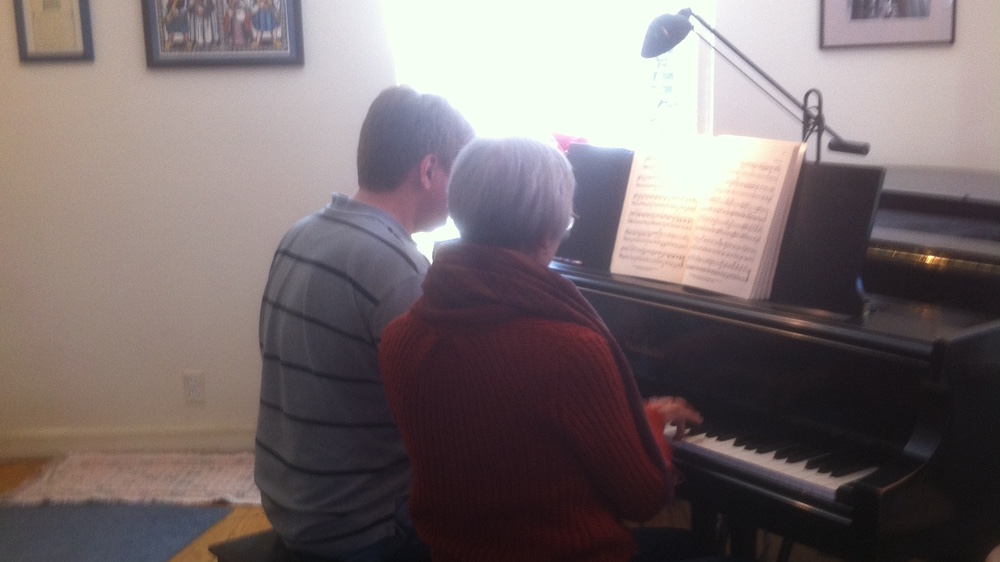
When Paula Fay started taking piano lessons for the first time in her late fifties, it fulfilled a lifelong dream.
“I always wanted to learn how to play as a child, but my parents couldn’t afford it,” she said.
Today, four years later, Paula can play some of her favorite tunes. And she’s loving every minute of it.
Some adults may groan at childhood memories of lesson after lesson, practice after practice and a lot of teacher nagging, but many wish those days were back.
And more and more, these adults are turning wishful thinking into reality. According to the National Piano Foundation, adults ages 25-55 are the fastest-growing segment of people learning piano.
When Ruth Ann Laye started teaching an adult piano class at Mandarin’s Keyboard Connection, there was only one weekday class. Now, she’s up to seven classes. And of her own private practice of 28, 11 are adults.
One of her students is Belinda May from St. Augustine, who is in her 60s and in her second year of piano lessons.
Though her brothers played piano, she was more athletically inclined than musical. Then after years of “picking” at the pianos in her house, she recently resolved to start taking lessons. A beginner when she started, “now I’m playing Christmas carols,” she said.
“It tells me that you’re never too old to learn something new.”
Maureen Rhodes, a piano teacher on the Southside, would likely agree. She has more adults in her practice than she did 20 years ago.
“I think baby boomers are looking for ways to stay active,” she said. “Sometimes, kids come to me for lessons and then when they grow up and leave, their mother starts to take lessons,” says Rhodes. “Other adults have a specific goal in mind, like they want to play in church or accompany their grandson.”
Sandra Stewart, outgoing president of the Jacksonville Music Teachers Association and adjunct professor teaching a non-degree adult piano course at Florida State College, believes technology is a big part of the reason for the greater interest in piano among adults.
“Keyboards are more affordable, and that’s made all the difference,” she says.
But the piano is not always a succession of high notes for the adult student. Says Stewart: “Adults can have problems with finger dexterity. If they never played before, this can be frustrating. People who use computer a lot have an advantage. But if they don’t have this experience, they have to get over that hurdle.”
And some adults expect to transform into Mozart overnight.
“They may be symphony patrons or just love classical music and want to play instantly and do it like the pros,” Rhodes says. “But they have to develop the skills first, and it takes a lot of patience.”
But for adults committed to learning, it can be very satisfying for student and teacher alike.
“Adults are there for their own pleasure,” said Marc Hebda, president of the Florida State Music Teachers Association. “They have wonderful enthusiasm; it’s fun to see them get excited. It’s also interesting that with the economic downturn, they are not cutting back on lessons or buying instruments. Piano is a constant source of entertainment and personal development.”
The key to any student learning well, whether that student is an adult or child, is finding the right teacher. Hebda stresses the importance of taking lessons from a teacher with a music degree.
“Some people who took piano figure it’s easy to teach. But credentials are very important. You wouldn’t go to a doctor without certification or a lawyer who didn’t pass the bar. All our teachers have a music degree or demonstrate teaching ability.”
Hebda also notes that rapport between teacher and student is important.
“The student should interview the teacher, because not all students and teachers are a good match.”
For those who want to fast-track the learning process, there are alternatives. “The Piano Guy,” Scott Houston, has been teaching piano using a non-traditional method through his shows on public station WJCT.
“It seemed like there was a single path to the world of piano: this long process of taking lessons,” he said. “But people want to play the tunes they know.”
So Houston came up with a simple way for adults to learn quickly, based on the concept behind “lead sheets,” which are used by professional musicians. Houston’s technique is to teach adults a single line of notes on the treble clef with their right hand and chords with their left.
“My goal is not to teach adults to be the greatest players but to be able to play the tunes they want to play,” Houston says.
His approach has clearly struck a chord, as his book has sold 300,000 copies and he has taught many adults through his workshops in Indiana and master class “piano camp” from his beach home in Fort Myers.
There’s also a new trend gaining traction called “recreational music making” — RMM — which like Houston’s approach focuses on a simplified method to teaching music. The goal is not for a student to become accomplished at the piano and perform, but rather to just have fun making music. It is often taught to adults in group settings, such as music stores, churches and senior centers.
“Research has found that RMM is very helpful for seniors, promotes hand/eye coordination and keeps the brain working,” said Erin Bennett, assistant professor of piano and pedagogy at the University of North Florida. “Its asset is the ability to reach more people; it’s more inclusive and easier for the non-experienced.”
Whether learning piano through traditional or nontraditional means, its many benefits include boosting self-confidence.
“When I first started, I didn’t think I could do it,” Fay said. “And my friends and family were in disbelief that I was taking lessons. Then they wanted to hear a concert. In another year, I might just do it.”
She gets some measure of satisfaction in surprising those around her.
“Society puts restrictions on us as we get older that we stop learning,” she says. “But we are wiser, more patience and accept our limitations.”
. 1566 ~ Alessandro Piccinini born. He was an Italian lutenist and composer who died sometime in 1638
. 1697 ~ Johann Joachim Quantz, German flutist, flute maker and composer
. 1861 ~ Charles Martin Tornow Loeffler, Alsatian-born American composer
. 1862 ~ Walter Johannes Damrosch, German conductor and composer
. 1911 ~ (David) Roy ‘Little Jazz’ Eldridge, Trumpeter and soloist with Gene Krupa’s Band, U.S. President Carter’s White House jazz party in 1978
. 1917 ~ The Original DixielandJazzBand recorded a classic for Columbia Records titled, The Darktown Strutters’ Ball. It was one of the first jazz compositions recorded.
. 1921 ~ Bernie Leighton, Jazz pianist
. 1928 ~ Ruth Brown, R&B and jazz singer
. 1928 ~ Harold Prince, Broadway producer and director of A Little Night Music and Sweeney Todd: The Demon Barber of Fleet Street
. 1936 ~ Horst Jankowski, Pianist, most famous work was A Walk In The Black Forest
. 1938 ~ Norma Jean (Beasler), Country singer
. 1941 ~ Joe Terranova, Singer with Danny and the Juniors
. 1943 ~ Marty Balin (Buchwald), Singer with Jefferson Airplane/Starship
. 1943 ~ The Nat King Cole Trio reached the top of the charts with the song “That Ain’t Right.” It stayed there for one week before dropping off the top spot.
. 1944 ~ Lynn Harrell, American cellist
. 1947 ~ Steve Marriott, Singer, songwriter, guitarist
. 1949 ~ William King, Trumpeter, keyboard with The Commodores
. 1951 ~ Phil Collins, English singer-songwriter, drummer, keyboard player with Genesis. As a solo performer he had a number of world wide singles to his credit including “You Can’t Hurry Love”, “Take a Look at Me Now)” “One More Night”, “A Groovy Kind of Love” and “Another Day in Paradise”. He is also remembered for his role in Live Aid 1985 when he performed at Wembley Stadium, England and JFK Stadium Philadelphia using the Concorde to fly from England to the US.
. 1969 ~ The Beatles made their last public appearance. It was at a free concert at their Apple corporate headquarters in London. The group recorded Get Back and also filmed the movie “Let It Be”.
. 2004 ~ Jazz bassist Malachi Favors, who played with such bandleaders as Dizzy Gillespie and Freddy Hubbard before beginning a 35-year association with the Art Ensemble of Chicago, died. After service in the Army during the Korean War, he studied with the bassists Wilbur Ware and Israel Crosby, and worked with the pianists Andrew Hill and King Fleming. After playing with Gillespie, Hubbard, and other members of the bebop revolution, Favors joined the band of Chicago saxophonist Roscoe Mitchell and played a major part on Mitchell’s influential free-jazz album, “Sound”, in 1966. Mitchell’s band soon evolved into the Art Ensemble of Chicago, which combined traditional elements of jazz and blues, West African music, chanting, ritual, abstract sound and silence. Although founded in Chicago, the group was based in Europe until 1971. In addition to his distinctive bass sound, Favors also added vocals and such folk instruments as banjo, zither and harmonica to group’s compositions. He also recorded a solo bass album, “Natural and the Spiritual”.
. 2011 ~ John Barry, English film score composer died at the age of 77
. 2013 ~ Patty Andrews, American singer (Andrews Sisters), died at the age of 94
Since the first release of this classic Schirmer edition over 100 years ago, almost anyone who has taken piano lessons for more than two years has played from The Virtuoso Pianist.
Most anyone who has ever played piano has a love-hate relationship with the “Hanon”.
The Virtuoso Pianist (Le Pianiste virtuose) by Charles-Louis Hanon, is a compilation of sixty exercises meant to train the pianist in speed, precision, agility, and strength of all of the fingers and flexibility in the wrists.
First published in Boulogne, in 1873, The Virtuoso Pianist is Hanon’s most well-known work, and is still widely used by piano instructors and pupils although some teachers are getting away from the mechanical playing these can produce.
Personally, I’ve sometimes played these on “auto-pilot” since all one really needs is to get the first pattern going, then move up a step, up a step…
Notes by C. L. Hanon: Preparatory exercises for the Acquirement of Agility, Independence, Strength and Perfect Evenness in the Fingers. For studying the 20 exercises, begin with the metronome set at 60, gradually increasing the speed up to 108.
The exercises are intended to address common problems which could hamper the performance abilities of a student. These include “crossing of the thumb”, strengthening of the fourth and fifth fingers, and quadruple- and triple-trills.
The exercises are meant to be individually mastered and then played consecutively in the sections they are placed in.
Apart from increasing technical abilities of the student, when played in groups at higher speeds, the exercises will also help to increase endurance. The exercises are divided in three parts:
Exercises 1 – 20: Labeled “preparatory exercises”, these are also the most famous exercises, and are used to develop finger strength and independence. Each exercise contains a sequence of 8 semiquavers, beginning on C, which is then repeated starting on D, and so on across two octaves. The exercise is then repeated in reverse down two octaves to the starting C. The exercises are intended to be practiced in groups of three, except for the first two which are practiced together.
Exercises 21 – 43: Labeled “further exercises for the development of a virtuoso technique.” This more difficult section is meant to be played after the pianist has fully mastered Part 1. Part 2 includes scales and arpeggios.
Exercises 44 – 60: Labeled “virtuoso exercises for mastering the greatest technical difficulties.” Since this section is considerably more difficult, Hanon recommends the mastery of both previous parts before proceeding to this one. This part includes repeated notes,, and more.
After all three parts are mastered, Hanon recommends all exercises be played through daily to retain technique.
The O’Connor Music Studio has several editions of this work, including:
Hanon: The Virtuoso Pianist in Sixty Exercises, Complete. Since the first release of this classic Schirmer edition over 100 years ago, almost anyone who has taken piano lessons for more than two years has played from The Virtuoso Pianist . Millions of copies have been sold of these progressive exercises which guide a player’s technique, building finger independence and strength. This was the first American edition released of this music, and remains a classic at a remarkably affordable price.
Junior Hanon (Alfred Masterwork Edition). A slight condensation of Hanon’s first exercises. The simplification in layout and range make the exercises appear less difficult to a young student. Includes the complete Book 1 and excerpts from Books 2 & 3 of C. L. Hanon’s famous studies, The Virtuoso Pianist in 60 Exercises.
Hanon for Students, Bk 1: 6 Varied Exercises from The Virtuoso Pianist for Late Elementary Pianists. Hanon for Students, Book 1, contains the first six exercises from The Virtuoso Pianist, Book 1. The exercises are notated in eighth notes for one octave so that students may begin to use them effectively at the late-elementary level. Each exercise appears five times to be played with a legato touch, varied articulation, varied dynamics, varied rhythm, and transposed to F or G.
Jazz Hanon. Inspired by Charles-Louis Hanon’s The Virtuoso Pianist the essential technical method for any classical player these new volumes present a modern-day equivalent for the musician seeking to play the key piano styles of the 20th century. Each book develops basic technique and true facility in each genre through authentic, progressive exercises and etudes. The music in these books is fun to play for pianists at every level, building the necessary skills in each style while providing extensive musical and stylistic insight.
. 1962 ~ Fritz Kreisler died. He was an Austrian-born violinist and composer
. 1966 ~ “Sweet Charity”, with Gwen Verdon, opened at the Palace Theatre in New York City. The musical, by Neil Simon, was an adaptation of the Federico Fellini film, “Notti di Cabiria”. The play ran for 608 performances. In 1969, Hollywood produced a big-budget version of the Broadway musical starring Shirley MacLaine.
. 1973 ~ Johnny Rivers received a gold record for the hit single, Rockin’ Pneumonia and the Boogie Woogie Flu. As is tradition, Rivers removed the fragile gold disk from the wooden frame and, as he was putting it on his stereo, had a ferocious sneezing fit and never did find out how his song sounded in solid gold.
. 1977 ~ From the One-Hit Wonder File, this note: Rose Royce earned the #1 spot on the music charts with Car Wash, from the movie of the same name. The song stayed at the peak of the pop charts for one week, then faded away.
. 1996 ~ The 6,138th performance of “Cats” was held in London, surpassing the record of Broadway’s longest-running musical, “A Chorus Line”
. 2001 ~ Suzanne Bloch, a concert chamber musician and teacher at the Juilliard School, died at her home. She was 94. Bloch played and taught ancient instruments, in particular the lute, a guitar-like instrument common in 18th-century Europe. Mostly self-taught, she also played the recorder and the virginal, a tiny relative of the harpsichord. Beginning in the late 1930s, she performed frequently in concert, often dressed in Renaissance costume. She taught classes at Juilliard from 1942 to 1985. After marrying Paul Smith, a mathematician who became chairman of Columbia University’s mathematics department, Bloch played chamber music with well-known scientists, including Albert Einstein. Born in Geneva, Bloch moved to New York with her family in 1916, when her musician father, Ernest Bloch, began teaching and conducting in the United States. Bloch promoted her father’s music throughout her life, collecting clippings, writing program notes and founding the Ernest Bloch Society in 1967.
. 2015 ~ Rod McKuen, American singer-songwriter (Jean) and poet, died at the age of 81
. 2019 ~ James Ingram, American R&B singer-songwriter and musician (Just Once), died at the age of 66
Michael Joe Jackson
A star was born on August 29, 1958 in Gary, Indiana. Singer, songwriter, dancer, actor Michael Joe Jackson started on the road to stardom while at Garnett Elementary School in Gary. Michael performed for his class by singing Climb Every Mountain. Within just a few years, he took his act to the stage joining his brothers as The Jackson Five. They were entertaining at Mr. Lucky’s, also in Gary, Indiana. Michael was only 8. By the time he was 11, Michael, the youngest of the five brothers, was the lead singer of the group.
And their hits were hitting the top of the charts: I Want You Back, ABC, The Love You Save, I’ll Be There. Then young Michael started recording solo hits like Ben, also #1.
And the hits just kept on coming … and the awards came with them: A Grammy for Best Male R&B Vocal in 1979 for Don’t Stop ’Til You Get Enough, 5 Grammy Awards in 1983 — Best Male Pop Vocal and Album of the Year (Thriller), Best Male R & B vocal and Best R & B song (Billie Jean), and Best Recording for Children: E.T., the Extraterrestrial; 2 in 1984 — Record of the Year and Best Male Pop Vocal (Beat It); another in 1985 with Lionel Richie for Song of the Year (We are the World); a Best Music Video/Short Form Grammy in 1989 for Leave Me Alone; and finally, The Legend Award Grammy — for the living legend in the music industry, Michael Jackson.
Whether Michael sings with his brothers, his sisters, alone or in duets with fellow performers, the results are hit, after hit, after hit … The Girl is Mine and Stay, Stay, Stay with Paul McCartney; I Just Can’t Stop Loving You with Siedah Garrett; Rock with You, Bad, Smooth Criminal … Ease on Down the Road with Diana Ross (from Broadway’s The Wiz in which Michael played the scarecrow). Michael, the actor, was also seen as a hologram, Captain Eo in Epcot Center’s multimedia show.
A celebrity for most of his life, he is both magic and tragic … the gloved one’s fame and infamy well-known throughout the world: he made $70 million from Thriller; he paid $50 million for the rights to the Beatles’ 251 songs; his Bad album was number one in 23 countries; he has an amusement park and zoo at his California estate; he married and divorced Lisa Marie Presley, the daughter of the King of Rock.
He remarried, became a father … and the rest of the story is still being written …. To date, Michael Jackson remains the King of Pop.
Janácek
Leos Janácek lived from 1854 until 1928. It was relatively late in life that the Moravian composer Janácek won more than local recognition. He made his early career in the capital of his native province, Brno, coupling an interest in regional folk music with a study of speech intonations, echoed in his instrumental as well as vocal writing. His opera Jenufa was first staged in Brno in 1904, but it was the performance in Prague in 1915 that brought the work of the composer a much wider public. The seven operas that followed have formed a very idiosyncratic part of current operatic repertoire, culminating in From the House of the Dead, completed in 1928, the year of Janácek’s death, and based on the novel by Dostoyevsky.
The best known of Janácek’s music for orchestra is the Sinfonietta, derived from an original festival piece of 1926. To this may be added the rhapsody based on the work of Gogol, Taras Bulba, and the Lachian Dances, based on folk-dances.
Joachim
Joseph Joachim lived from 1831 until 1907. He was a Hungarian violinist, conductor and composer whose exceptional talent was recognized by Mendelssohn. He was also a close friend of Brahms. His music had much in common with the music of Schumann.
John
Elton Dwight John was born in 1947 and is a rock singer and pianist. He was born in Pinner, NW Greater London, England. He played the piano by ear from age four, and studied at the Royal Academy of Music at 11. From 1967, he and Bernie Taupin began writing songs such as “Rocket Man’ (1972), “Honky Cat’ (1972), and “Goodbye Yellow Brick Road’ (1973). Their publisher pressed John to perform them, for which he obscured his short, plump, myopic physique in a clownish garb that included huge glasses, sequined and fringed jump suits, and ermine boots. The top pop star of the 1970s, he later became chairman (1976 to 1990) and then honorary life president in 1990 of the Watford Football Club and a stock-market speculator. Despite health problems in 1993 brought about by his stressful lifestyle he continues to perform live across the world.
Johnson
James Price Johnson, Ragtime composer
Jolivet
André Jolivet lived from 1905 until 1974. Versatile in the arts, André Jolivet was a pupil of Le Flem and later of Varèse and was, with Olivier Messiaen, Daniel Lesur and Yves Baudrier, a member of the composers grouped together as Jeune France. As director of music for the Comédie française he wrote a quantity of incidental music and elsewhere based his work on principles that stemmed from his interest in the magical and incantatory element fundamental to human music.
Jolivet wrote a number of concertos, all demanding considerable virtuosity from the soloist. These include a concerto for the ondes Martenot, an electronic instrument developed in France in the 1920s, and concertos for trumpet and piano, for flute, for piano, for harp, for bassoon and harp, for percussion, for cello and for violin.
In addition to his varied incidental music, whether for Molière, Claudel, Corneille or Plautus, Jolivet wrote music for the ballet and for marionette plays.
Jolivet made an early impression on Messiaen with the six piano pieces that constitute Mana. Chamber music includes music involving the flute, an instrument he particularly favoured for its primitive human associations.
Joplin
Scott Joplin (1868-1919) was the most influential and famous composer of the ragtime era, and one of the most daring pioneers in the history of American music. He was known as the Father of Ragtime. At first, the musical establishment absolutely refused to acknowledge ragtime as a worthy means of musical expression, dismissing it as catastrophic noise that had little musical meaning at all. Only within the last few decades has his work finally been truly appreciated and accepted as a truly great form of art, and as a unique and substantial contribution to music.
Ragtime, which first emerged in the 1890’s, is a style of piano playing with an up-and-down “ragged time” rhythm. Joplin made ragtime an international dance craze with “Maple Leaf Rag”. “The Maple Leaf Rag”, became the first song to sell over one million copies of sheet music.
The remarkable part of his success as a musician was the fact that he was African American. His success paved the way for all black musicians who would come after him, breaking a long-standing race barrier: acceptance as a performer.
Joplin’s music enjoyed renewed popularity with the use of “Solace” in the 1973 movie The Sting. Solace was not a typical rag, although it does have similar rhythmic elements.
Treemonisha was an opera composed by Joplin, although it was not produced until 1975, 58 years after his death.
Some other ragtime composers were Joseph Lamb and James Scott. Eventually, ragtime was replaced by jazz.
. 1904 ~ Enrico Caruso signed his first contract with Victor Records. He had debuted at the Metropolitan Opera just two months before.
. 1927 ~ Ronnie Scott (Schatt), Jazz musician: tenor sax, bandleader, jazz club owner in London
. 1927 ~ Twenty years before the famous record by Art Mooney was recorded, Jean Goldkette and his dancing orchestra recorded, I’m Looking Over a Four-Leaf Clover. Though the name of the bandleader may not be so famous, two of his sidemen on this Victor recording session certainly were: Big band fans know Bix Beiderbecke and Joe Venuti.
. 1940 ~ “Beat the Band” made its debut on NBC radio. The band was that of Ted Weems and his 14-piece orchestra, who were joined by Elmo ‘The Whistling Troubadour’ Tanner, Harry Soskind and Country Washington. One other star of the show was a barber from Pittsburgh, PA (nearby Canonsburg, actually), who would record many hits for RCA Victor from 1943 right through the dawn of the 1970s. His name was Perry Como. Beat the Band was a funky show where listeners’ questions were selected in the hopes of stumping the band. If a listener’s question was chosen, he or she received $10. The questions were posed as riddles: What song title tells you what Cinderella might have said if she awoke one morning and found that her foot had grown too large for her glass slipper? If the band played the correct musical answer, Where Oh Where Has My Little Dog Gone?, the listener lost.
. 1943 ~ Dick Taylor, Bass, guitar with The Pretty Things
. 1944 ~ John Tavener, British avant-garde composer More information about Tavener
. 1944 ~ Brian Keenan, Drummer with groups Manfred Mann and The Chambers Brothers
. 1956 ~ Elvis Presley made his first appearance on national television. No, he didn’t appear on some teenage dance show; but rather, “The Dorsey Brothers Show”, starring Tommy and Jimmy. Elvis sang Blue Suede Shoes and Heartbreak Hotel. He was backed by the instruments of the Dorsey band.
. 1968 ~ Sarah McLauchlan, Singer
. 1985 ~ 45 of the world’s top recording artists were invited to an all-night recording session at the A&M studios in Los Angeles. As each of the artists walked through the studio door, they were greeted by a hand-lettered sign — put there by Lionel Richie. It simply said, “Check your ego at the door.” The session started at 10 p.m. with producer Quincy Jones conducting. At 8 o’clock the following morning, the project, “USA for Africa”, spearheaded by promoter, Ken Kragen, was recorded and mixed. The resulting song, We Are the World, featuring Michael Jackson, Cyndi Lauper, Kenny Rogers, Dolly Parton, Sting, Harry Belafonte, Diana Ross, Paul Simon and many others became the top song in the U.S. on April 13, 1985.
. 2002 ~ Michael Hammond, who became chairman of the National Endowment for the Arts just a week earlier, died apparently of natural causes. He was 69. A native of Kenosha, Wis., the conductor and composer had been dean of the School of Music at Rice University in Houston when President Bush nominated him to lead the federal agency that decides grants for the arts. After being confirmed by the Senate on Dec. 20, 2001, Hammond had assumed the post-Jan. 22, 2002, and was still in the process of moving to Washington. A student of music and medicine, Hammond’s interests included music from Southeast Asia, the Renaissance and medieval times and the intersection between music and neuroscience. He received a Rhodes scholarship to study philosophy, psychology and physiology at Oxford University. He also studied Indian philosophy and music at Dehli University in India. In 1968, he left his post as director of the Wisconsin Conservatory of Music in Milwaukee to become the founding dean of music at the State University of New York at Purchase. He later served as president of the school, until he left for Rice’s Shepherd School of Music in 1986. All the while, he retained his interest in medicine, teaching neuroanatomy and physiology at Marquette Medical School and at the University of Wisconsin. Hammond also served as the founding rector of the Prague Mozart Academy in the Czech Republic, now the European Mozart Academy was on the board of the Houston Symphony, and was vice chairman of the board of Interlochen Center for the Arts in Michigan.
. 2002 ~ Steve Caldwell, who sang and played saxophone for the Swingin’ Medallions at the time of the band’s 1966 hit Double Shot (of My Baby’s Love), died of pancreatic cancer. He was 55. Caldwell was with the group from 1963 to 1969. After getting his master’s degree in chemistry at the University of South Carolina, he returned to his native Atlanta and ran the Norell temporary staffing agency until starting his own company in 1976. His wife, Lynn Caldwell, said he raised $1 million for charity through World Methodist Evangelism.
Giuseppe Tartini was born in Pirano, Italy and lived from 1692 until 1770. He was a violinist and composer, who also had studied law and divinity at Padua, and was an accomplished fencer. He secretly married a proteg?e of the Archbishop of Padua, for which he was arrested. He fled to Assisi but, after attracting the archbishop’s attention by his violin playing, he was invited back to his wife. Perhaps one of the greatest violinists of all time, he was also an eminent composer. His best-known work is the Trillo del Diavolo (c.1735, Devil’s Trill).
Tavener, John
John Taverner lived from about 1490 until 1545. He was employed as master of the choristers at Cardinal College (Christ Church), Oxford, in its early heyday, retiring, on Cardinal Wolsey’s fall from power, to Boston, where he was held in considerable regard until his death in 1545. The popular, if mistaken, account of his life is the subject of the opera by Peter Maxwell Davies, Taverner.
Taverner wrote Latin Mass settings, Magnificat settings and motets. Of the first of these the Western Wynde Mass, using the melody of a popular song of that name, is among the better known. From his Mass Gloria tibi Trinitas came the fragment of a theme that served later generations as the basis of an English genre of consort music, the In nomine.
Taverner himself began the tradition of the In nomine, an instrumental arrangement of part of the Benedictus of his Mass Gloria tibi Trinitas.
Taverner, John Keith
John Kenneth Tavener, born in 1944 in London, England is a composer. He studied at the Royal Academy of Music, London and has been professor of music at Trinity College of Music since 1969. He was still at college when he won the prestigious Prince Rainier of Monaco Prize in 1965 with his cantata, Cain and Abel. His music is predominantly religious, and includes the cantata The Whale (1966), Ultimos ritos (1972, Last Rites) for soloists, chorus, and orchestra, and a sacred opera Therese (1979). He was converted to the Russian Orthodox faith in 1976.
His work, Eternity’s Sunrise, won a Grammy Award. His sacred work, Song for Athene, was sung at the funeral ceremony of Princes Diana.
Tchaikovsky
Piotr Ilyich Tchaikovsky lived between 1840 and 1893. He is considered to be a romantic composer. He was a Russian composer who was a master of melancholy moods, emotional outbursts and dramatic climaxes in his music.
“Worthless, vulgar, derivative, unplayable” were a few of the adjectives that pianist and conductor Nicholas Rubinstein used to describe Tchaikovsky’s Piano Concerto in b-flat minor, when he first heard it on Christmas Eve, 1874. Ironically, Tchaikovsky had arranged the piece as a gift for Rubinstein, to whom he intended to dedicate it. Furious, Tchaikovsky re-dedicated the piece to pianist Hans von Bülow, who was the first to perform it.
Within a few yers, Rubinstein’s distaste for the concerto mellowed and he became one of its principal interpreters.
Tchaikovsky read Goethe’s novel Wilhelm Meisters Lehrjahre in the 1860’s and set its melancholy poem “None but the Lonely Heart” to music.
Tchaikovsky found one of his greatest successes with his lovely waltz from the “Serenade for Strings” which he composed in 1880. He was also composing the 1812 Overture at the same time. He conducted several early performances of the Serenade himself, but he had no formal conducting training and became so nervous that he sometimes lost the place in his own music.
Shakespeare’s Romeo and Juliet inspired the melancholy Tchaikovsky to write his own version, using musical themes to suggest various themes from the play.
On his way to New York in 1891 to participate in the opening of Carnegie Hall, Tchaikovsky stopped in Paris and discovered the celesta, The celesta is a small keyboard with tiny silver bars which sound like bells when struck. He ordered one to be sent to Moscow in strict secrecy so that he could be the first to use it. His ballet The Nutcracker included the “Dance of the Sugar Plum Fairy” which has several wonderfully shimmering phrases for the celesta.
Tchaikovsky’s Nutcracker was featured in the Walt Disney movie Fantasia.
The first performance of the Sixth Symphony was only a mild success. By the time of the next performance a few weeks later – which was a tremendous success – Tchaikovsky was dead of cholera. It’s title Pathétique – is characteristic of the composer, who always was afraid that his creativity would suddenly stop.
Teagarden
Weldon Leo ‘Jack’ Teagarden was a Jazz musician, born in Vernon, Texas and he lived from 1905 until 1964. He came from a musical family with his mother, Helen, playing piano and his father,Charles, trumpet. His two brothers, Charlie (trumpet) and Clois (drums) were also talented musicians as was his sister Norma (piano). Jack started on piano at the age of five and two years later learned to play the baritone horn, bought for him by his father. By the age of ten Jack was playing trombone.
The family moved from Vernon to Chappell, Nebraska in 1918 and Jack was soon playing in local theatres accompanied by his mother on piano. From here his travels become a little blurred but we know that he lived for a while in 1919 in Oklahoma City then with his uncle in San Angelo and started playing with local bands. He then played with a quartet at the Horn Palace Inn, San Antonio led by drummer Cotton Bailey,from late 1920 until September 1921 except for a summer season in Shreveport.
It was from Cotton Bailey that the young Weldon received his nickname, “Jack”. From then until the spring of 1923 he played with the legendary Peck Kelly’s Bad Boys. Dropped out of music in Wichita Falls in the summer of ’23 then joined Marin’s Southern Serenaders before rejoining Peck Kelly.
His recording debut came with Johnny Johnson and his Statler Pennsylvanians in early December 1927 when they cut two sides for Victor, “Thou Swell”/”My One and Only”. Jack was twenty-two years old. Two months with the Tommy Gott Orchestra then a major move to Ben Pollack where he remained from June 1928 until May 1933. This period with Pollack was extremely productive in recording terms as he led his own recording groups as well as playing as a sideman with Louis Armstrong, Benny Goodman, Red Nichols, Eddie Condon, and many other famous musicians of the day.
He took part in the first ‘mixed’ recording session with Louis which produced the majestic blues “Knockin’ a Jug”. In October 1928 Jack cut “Makin’ Friends” with Eddie Condon and made history by using a water glass as a substitute for a mute, removing the bell of the trombone and holding the glass over the open end of the tubing producing a unique sound.
In December 1933 he made his big move to join Paul Whiteman. He stayed with Whiteman’s star-studded aggregation until December 1938. His stay with Whiteman brought him financial security but we will never know if this residency was a good move or a bad one. Opinions differ strongly. It has been surmised that Benny Goodman would have offered Jack the trombone chair in his new orchestra as featured soloist.
After leaving Whiteman, Jack started up his own big band which he led until from February 1939 until November 1946. Musically the band was a success but financially a disaster. When the band was finally broken up, Jack gigged around, recorded as a freelance and played at the ‘Esquire’ jazz concert in January 1944 at the Metropolitan Opera House with Armstrong, Eldridge, Tatum, Hawkins. He led his own sextet until joining Louis Armstrong’s All Stars where he stayed from July 1947 until August 1951.
When he left Louis he formed his own All Stars and toured with them until he disbanded in 1956 when he played with Ben Pollack for a few months. He co-led another all-star group with Earl Hines which visited Britain and Europe in the fall of 1957 which was raptuorously received. Jack led another group on a State Department sponsored tour of Asia from September 1958 until January 1959.
Jack was a mainstay of late 1920s New York Jazz scene, a trombonist and singer whose relaxed, melodic instrumental style was highly influential. He was also one of the best White Jazz singers, particularly when he sang the Blues on songs like Makin’ Friends.
He continued playing and leading a group until his death on January 15, 1964. He played his last engagement at The Dream Room in New Orleans while suffering from bronchial pneumonia, returned to the Prince Conti Motor Hotel, just three blocks from Basin Street, after the gig and was found by the room-maid the next afternoon, dead on the floor clad in his dress shirt and shorts. He was 58 years old. The New Orleans “Times-Picayune” published his obituary on January 16, 1964. Jack was buried at Forest Lawn Memorial Park, Los Angeles, Plot # 7281. The headstone reads “Where there is Hatred, Let Me Sow Love”
Tebaldi
Renata Tebaldi is an Operatic soprano, born in Pesaro, Italy in 1922. She studied at Parma Conservatory, made her debut at Rovigo in 1944, and was invited by Toscanini to appear at the re~opening of La Scala, Milan, in 1946, where she sang until 1954. She then sang in many opera houses, including several seasons at the Metropolitan Opera, New York City, and made many recordings. Tebaldi had one of the most beautiful Italian voices of the century. Although her rivalry with Maria Callas attracted much attention, it was her singing that captivated her fans.
Her breakthrough came in 1946 when she auditioned in Milan for the great conductor Toscanini and from then until the late 1970s she performed across Europe and the United States.
When she made her debut at the city’s La Scala opera house in late 1946, the maestro dubbed her “The Voice of an Angel.”
Singing the soprano part in Giuseppe Verdi’s “Te Deum,” the concert marked the reopening of the theater after the end of World War II. It also branded Tebaldi in Italian minds as part of the country’s post-war renaissance.
She went on to perform at London’s Covent Garden, the San Francisco Opera and appeared regularly at the Metropolitan Opera (news – web sites) in New York taking the lead roles in “La Boheme,” “Madam Butterfly,” “Tosca” and “La Traviata.”
“I started my career at 22 and finished it at 54. 32 years of success, satisfaction and sacrifices. Singing was my life’s scope to the point that I could never have a family,” she wrote in a preface to her official Web site.
Tebaldi was born in the Italian seaside town of Pesaro on Feb. 1, 1922. Stricken with polio at the age of 3, she was unable to partake in strenuous activities and instead became interested in music.
In her early teens, she began studying music at the Conservatory of Parma.
“I started singing when I was a young girl but my family wanted me to study piano but my overwhelming need to express myself with my voice made me choose the art of singing,” she once told her fans.
Tebaldi has left a huge legacy of complete operas on disc with other famous singers including Mario del Monaco, Giulietta Simionato, and Carlo Bergonzi.
Her recordings include Verdi’s “Otello” and “Aida” and Puccini’s “La Boheme” and “Madama Butterfly.”
She last performed on the opera stage in 1973, and her last concert took place in 1976.
Tebaldi was a Knight Commander of the Order of Merit of the Italian Republic and had received a Commander, Order of Arts and Letters from France.
Te Kanawa
Dame Kiri Te Kanawa, born in 1944 in Gisborne, New Zealandin, is an Operatic soprano. After winning many awards in New Zealand and Australia she came to London, where she made her debut with the Royal Opera Company in 1970. She has since taken a wide range of leading roles, and in 1981 sang at the wedding of the Prince and Princess of Wales. She was made a dame in 1982 and has produced many non-classical recordings. In 1989 she published Land of the Long White Cloud: Maori Myths and Legends.
Teleman
Georg Philipp Telemann, born in 1681 in Magdeburg, Germany, was a very prolific late Baroque era composer, composing 600 overtures in the Italian style, 44 Passions, 40 operas, innumerable trio sonatas, suites and flute quartets. He was a self-taught composer and organist. When he died in 1767, his organist post in Leipzig went to Johann Sebastian Bach.
Tilson Thomas
Michael Tilson Thomas is the Music Director of the San Francisco Symphony, the Founder and Artistic Director of the New World Symphony, and the Principal Guest Conductor of the London Symphony Orchestra. He is currently Artistic Director of the Pacific Music Festival in Sapporo, Japan, which he and Leonard Bernstein inaugurated in 1990. Born in Los Angeles, he is the third generation of his family to follow an artistic career. At age nineteen he was named Music Director of the Young Musicians Foundation Debut Orchestra where he worked with Stravinsky, Boulez, Stockhausen and Copland on premieres of their compositions. He was also Assistant Conductor at the Bayreuth Festival. Noted for his commitment to music education, Michael Tilson Thomas founded the New World Symphony in 1988, to be a national orchestra for the most gifted graduates of America’s music conservatories. In addition to their regular season in Miami, they have toured France, Great Britain, South America, Japan, Israel and the United States, and in 1998 celebrated their 10th anniversary with concerts in New York, London, Paris, Amsterdam and Vienna.
Tilson Thomas has recently completed a very successful tour of Europe with the San Francisco Symphony and back at home in June 1999, they present a festival of Stravinsky’s music, some of which they have recently recorded together.
With the London Symphony Orchestra, Tilson Thomas has toured in Israel, Japan, the USA, as well as in Europe including an appearance at the Salzburg Festival. In London, he and the orchestra have mounted major festivals focusing on the music of Brahms, Mahler, Rimsky-Korsakov, Gershwin, Reich and Takemitsu.
Tilson Thomas’ recordings have received many awards and cover a wide range of repertoire including Bach, Beethoven, Mahler and Prokofiev as well as his pioneering work with the music of Ives, Ruggles, Reich, Cage and Gershwin. In 1994 Michael Tilson Thomas received the Ditson Award for contributions to American Music, was named Musical America’s Conductor of the Year and received five Grammy nominations and two Gramophone awards for his recordings. He has been an exclusive BMG Classics/RCA Victor Red Seal recording artist since 1995 and his most recent releases include the disc “New World Jazz” with the New World Symphony Orchestra.
Tilson Thomas has also worked extensively for television including educational broadcasts with the New York Philharmonic, a BBC series with the London Symphony Orchestra including programmes on Strauss, Sibelius and Beethoven, and other television productions celebrating works by Gershwin and Bernstein.
Von Tilzer, Albert
Albert Von Tilzer (Albert Gumm) (1878 – 1956) was born in Indianapolis, Indiana on Mar. 29, 1878. He was the younger brother of Harry Von Tilzer. He was a vaudeville performer and composer and wrote many hit tunes. Some of them were: Carrie (Carrie Marry Harry), Give Me the Moonlight, Give Me the Girl, I’ll Be with You in Apple Blossom Time, Put Your Arms Around Me Honey and Take Me Out to the Ball Game
Overview Composer Albert Von Tilzer was an important songwriter most active from the early 1900’s into the 1920’s. He was the younger brother of composer Harry Von Tilzer.
Albert went to work in his father’s Indianapolis shoe store after graduating from high school. He learned to play the piano by ear and did have some lessons in harmony before he joined a vaudeville troupe.
In 1899, he went to Chicago, and worked briefly for his older brother’s music publishing firm, Shapiro, Bernstein and Von Tilzer. Albert then traveled to New York City, and found work as a shoe salesman in a large Department store.
In 1900, he published his first song “The Absent Minded Beggar Waltz”, a piano instrumental. In 1903 he wrote “That’s What the Daisy Said”, with his own lyric. This was published by his brother’s firm.
In 1903, he formed York Music Company, his own publishing house, which would thereafter publish all of his own music.
All the while Albert was composing and publishing, he was also working as a vaudeville performer. He was a headliner on the Orpheum circuit. In 1930, he settled in Hollywood and worked in a few motion pictures. He was elected to the Songwriter’s Hall of Fame. Albert Von Tilzer died in L.A., in 1956, at age 78.
Von Tilzer, Harry
Harry Von Tilzer (Harry Gummbinsky -the family later shortened the name to “Gumm”.) lived from 1872 until 1946. He was born in Detroit, Michigan and was the older brother of Albert Von Tilzer. He was an entertainer and common laborer who turned to music composition and formed the Harry Von Tilzer Music Company in 1902. He wrote many hit tunes. Some of them are: (She was only a) Bird in a Gilded Cage; I Want a Girl (Just Like the Girl That Married Dear Old Dad); I’d Leave My Happy Home for You; Take Me Back to New York Town; Wait ‘Til the Sun Shines Nellie; When My Baby Smiles at Me and Why Do They Always Pick on Me?
Harry, one of six children, was to find a career in music as did his younger brother Albert. (Apparently, two of the children, a boy and an girl, perished in childhood.) When Harry was still a child, his family moved to Indianapolis, IN, where he father acquired a shoe store. A theatrical company gave performances in the loft above the store, and that’s where Harry learned to love show business.
His career really started in 1886 when, at age 14, he ran away from home and joined the Cole Brothers Circus. By 1887, he was playing piano, composing songs, and acting in a traveling repertory company. He changed his name at that time. His mother’s maiden name was Tilzer, and he ‘gussied’ it up by adding the ‘Von’. Thereafter he would be called Harry Von Tilzer, and later his younger brother would adopt the name also, Albert Von Tilzer.
Harry met Lottie Gilson when the burlesque troupe with which he was working reached Chicago. The popular vaudevillian took an interest, and induced him to go to New York. In 1892, Harry, working as a groom on a trainload of horses, arrived in New York, with just $1.65 in his pocket. He rented a room near the Brooklyn Bridge and became a $15.00 per week saloon pianist. He left New York briefly to work in a traveling medicine show, but returned to again work in saloons and later as a vaudevillian in a ‘Dutch’ act with George Sidney.
At this time, Harry was writing songs, literally hundreds of songs that were never published. He would sell them outright to other entertainers for $2.00 each. Even Tony Pastor sang a few of his songs in his theater. But the tide was about to turn for Harry.
One of his songs was published, “My Old New Hampshire Home”, lyric by Andrew B. Sterling. William C. Dunn, owner of a small print shop, purchased it outright for $15.00, and issued it in 1898. It was a hit that sold more than 2 million copies.
There is an interesting historical note connected with Harry Von Tilzer. In the Early 1900’s, Von Tilzer kept an upright piano in his publishing firm. Harry kept pieces of paper stuffed between the strings of the piano’s harp. It gave the piano a tinny sort of sound to which Von Tilzer was partial. One day, the lyricist and newspaper journalist Monroe Rosenfeld was in Harry’s office and heard him playing the tinny sounding piano. The sound suggested a title for a piece he was writing, – Tin Pan Alley.
Harry’s last years were spent in retirement, while living in the Hotel Woodward, in New York City. He died in 1946, at age 74.
Tippett
Sir Michael (Kemp) Tippett is a Composer, born in London, England, UK in 1905. He studied at the Royal College of Music, London, and became director of music at Morley College from 1940 until 1951. His oratorio, A Child of Our Time (1941), reflecting the problems of the 1930s and 1940s, won him wide recognition. A convinced pacifist, he was imprisoned for three months as a conscientious objector during World War 2. He scored a considerable success with his operas The Midsummer Marriage (1952) and King Priam (1961), and among his other works are four symphonies, a piano concerto, and string quartets. He was knighted in 1966, and received the Order of Merit in 1983.
Toscanini
Arturo Toscanini, 1867 to 1957, was a conductor who born in Parma, Italy. He was a cellist before the night in 1886 when he took over the baton from an indisposed conductor in Rio de Janeiro and stayed on the podium for the rest of his career. After years of journeyman work in Italian opera houses, he became conductor of Milan’s La Scala in 1898. In 1909 he came to the USA to lead the Metropolitan Opera orchestra; his subsequent career took him to positions in Europe, England, and the USA, including the podium of the New York Philharmonic from 1928 to 1936. In 1937 the NBC Symphony, primarily a broadcasting and recording orchestra, was created for Toscanini; he led it until 1954, cementing his reputation as one of the most revered conductors in the world. He helped pioneer a new performance tradition that proclaimed an end to Romantic interpretive excesses and substituted absolute fidelity to the score; in practice, that made for clean, sinewy performances, achieved partly by his legendary tantrums in rehearsals. He was equally admired for his performances of Beethoven and other 19th-century classics and of modern composers including Stravinsky, Debussy, and Richard Strauss.
Townshend
Born Peter Dennis Blandford Townshend on May 19, 1945, as a member of The Who, he wrote nearly all of the songs and sang “The Acid Queen” and “Sensation”. for the double album Tommy. Tommy is a deaf, dumb, and blind kid who becomes a Messiah and later is forsaken by his followers. Tommy is based, in part, on the spiritual teachings of Indian mystic Meher Baba, of whom Townshend had become a devotee. Read the rest of this biography at http://www.petetownshend.net
Tucker
There is a statue of Richard Tucker, an opera singer, in New York.






 MaryO'Studio