What You Need to Know about Piano Pedals

piano-pedal-diagram

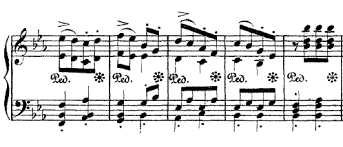
These are some examples of pedal marks in piano music:
piano-pedal-music

An older style of pedaling. The symbols can be between or below the staves.


piano-pedal-music2

This type of pedaling is more commonly used today.


piano-pedal-music3

Another type of pedaling

Pedals on a grand piano:

piano-pedal

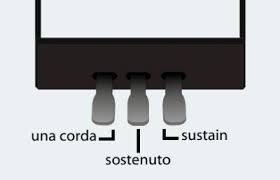
There are two standard foot pedals on the piano: on the left side is the una corda pedal and on the right side is the sustain (damper) pedal.

The middle sostenuto pedal is only standard on the American grand piano, and is very rarely used.

With pedals, the pianist can add resonance and color to the music and thereby bring out its inherent emotion. At the same time, over-pedaling or improper pedaling can drown the listener and the performer in a miasma of overlapping sounds.

Anton Rubinstein, renowned pianist of the late nineteenth century, said that the rightmost pedal is the very soul of the instrument.  His book, The Art of Piano Pedaling: Two Classic Guides, is still in print.

This pedal has various names. It is sometimes called the damper pedal (because it lifts all the dampers inside the piano), or the forte pedal (because the result of lifting all the dampers is a fuller sound), or the tre corde pedal (because it allows the three strings of each key to vibrate), or the sustaining pedal (because when you depress it the note will continue to sound even if you take your fingers off the keys).

Damper Pedaling Guidelines

Here are some guidelines pedaling. As with everything in art, they can be ignored under certain circumstances.

  1. Avoid pedaling notes that move in a stepwise or scalar pattern. Adjacent notes are dissonant, and when pedaled, they sound smudged.
  2. Do pedal notes that skip and form a nice harmony.
  3. Change your pedal (i.e., lift it up and put it down again) at each change of harmony.
  4. Avoid pedaling through rests (i.e., silence), at ends of phrases (at which point we would need to breathe and that split second of silence takes care of that), or staccato notes—although this is commonly ignored, because we actually can hear the disconnection through the pedal. This is why we do not depend on the pedal to achieve a beautiful legato.
  5. Keep your heel planted firmly on the floor, and pedal with either toes or the ball of foot, depending on your shoe size.

There are several manipulations possible with the damper pedal, each affecting the sound slightly differently.

Syncopated Pedaling

For the cleanest sound, the syncopated (or legato) pedal will give you the most control.  This is an action where the foot is put down immediately after the note is played. This may take some getting used to, but you can practice it by playing a C scale.

  1. Play C, and then lower the damper pedal.
  2. Hold the pedal down until you are just about ready to play the D.
  3. As the D’s finger goes down, the foot goes up, and then down again immediately after the D is struck.

The sound is clean. Continue up the scale the same way.

As an experiment, try putting the pedal down as you play a note, and notice the difference in the sound. Since the damper pedal lifts all the dampers, when you strike the D, not only are the three strings of that note free to vibrate but so do all the other strings vibrate sympathetically. You have a sound that is full of overtones.

There are times when you will want that effect and so will keep your foot down until the accumulated sound needs to breathe.

You can practice the syncopated pedal away from the piano by sitting on the bench or a chair and lifting your right knee at exactly the same time as your right hand goes down to tap the rising knee. This is the same action at the keyboard. The foot goes up when the hand goes down and then returns to the pedal.

Partial Pedals

There are half and quarter pedals too, which are used when you don’t want full vibrato. Rather than depressing the pedal all the way down, you lower your foot halfway so that the dampers are lifted only slightly off the strings, without allowing them to vibrate fully.

The quarter pedal gives even just a hint of pedal. It will take a while to feel these various distances on your piano. Also, you will find that each piano has its own pedal feel, which you must get used to before attempting to perform on that instrument.

Flutter Pedal

Then there are times, usually in scale passages, where touches of pedal can be very appealing and then the foot goes up and down rapidly and shallowly, and that is called the “flutter” pedal.

Choosing the Pedaling

The different types of damper pedaling techniques are for you, the pianist, to decide. But what determines which choice you will make?

Two things will control that: your very important ear, and your understanding of the music—the composer and the era in which the music was composed.

Your pedaling approach following the composer’s style depends on your knowledge of what instruments were available during the composer’s lifetime and how the pedal or lack of pedals would have made the music sound. This way, your interpretation will have authenticity.


Position of the Sustain Pedal:

Right pedal

The Sustain Pedal is Played With:

Right foot

Also Called:

Damper pedal, forte pedal, loud pedal

Effects of the Sustain Pedal:

The sustain pedal allows all of the notes on the piano to resonate after the keys have been lifted, for as long as the pedal is depressed. It creates a legato effect, forcing all of the notes to echo and overlap.

History of the Sustain Pedal:

The sustain pedal was originally operated by hand, and an assistant was required to operate it until the knee lever was created. The creators of the sustain foot pedal are unknown, but it is believed to have been invented around the mid-1700s.

Use of the sustain was uncommon until the Romantic Period, but is now the most commonly used piano pedal.

How the Sustain Pedal Works:

The sustain pedal lifts the dampers off of the strings, allowing them to vibrate until the pedal is released.

Sustain Pedal Marks:

In piano notation, use of the sustain pedal begins with Ped., and ends with a large asterisk.

Variable pedal marks, seen as __/_/__, are placed under notes, and define the precise pattern in which the sustain pedal is depressed and released.

    • Horizontal lines show when the sustain pedal is depressed.
  • Diagonal lines indicate a quick, temporary release of the sustain pedal.


Position of the Una Corda Pedal:

Left pedal

The Una Corda is Played With:

Left foot

Also Called:

Soft pedal, “piano” pedal

Effects of the Una Corda Pedal:

The una corda pedal is used to enhance the timbre of softly played notes, and exaggerate a low volume. The soft pedal should be used with notes that are already played softly, and will not produce the desired effect on louder notes.

History of the Una Corda Pedal:

The una corda was the first mechanism to modify the piano’s sound, and was originally operated by hand. It was invented in 1722 by Bartolomeo Cristofori, and quickly became a standard addition to the piano.

How the Una Corda Pedal Works:

Most treble keys are attached to two or three strings. The una corda shifts the strings so that the hammers only strike one or two of them, creating a softened sound.

Some bass keys are only attached to one string. In this case, the pedal creates a shift so that the hammer strikes on a lesser-used portion of the string.

Una Corda Pedal Marks:

In piano notation, use of the soft pedal begins with the words una corda (meaning “one string”), and is released by the words tre corde (meaning “three strings”).

Interesting Facts About the Una Corda Pedal:

  • Most upright pianos use a “piano” pedal instead of a true una corda pedal. The piano pedal moves the hammers closer to the strings, preventing them from striking with full force


Position of the Sostenuto Pedal:

Usually the middle pedal, but is often omitted.

The Sostenuto is Played With:

Right foot

Originally Called:

Tone-sustaining pedal

Effects of the Sostenuto Pedal:

The sostenuto pedal allows certain notes to be sustained while other notes on the keyboard are unaffected. It is used by hitting the desired notes, then depressing the pedal. The selected notes will resonate until the pedal is released. This way, sustained notes can be heard alongside notes played with a staccato effect.

History of the Sostenuto Pedal:

The sostenuto pedal was the last addition to the modern piano. Boisselot & Sons first showcased it in 1844, but the pedal didn’t gain popularity until Steinway patented it in 1874. Today, it’s primarily found on American grand pianos, but is not considered a standard addition since it is very rarely used.

How the Sostenuto Pedal Works:

When the sostenuto pedal is depressed, it keeps the dampers off the selected strings, allowing them to resonate while the rest of the keys’ dampers remain down.

Sostenuto Pedal Marks:

In piano music, use of the sostenuto pedal begins with Sost. Ped., and ends with a large asterisk. Notes meant to be sustained are sometimes marked by hollow, diamond-shaped notes, but there are no strict rules for this pedal since it is hardly ever used.

Interesting Facts About the Sostenuto Pedal:

    • Sostenuto is Italian for “sustaining,” although this incorrectly describes the pedal’s function.
    • On some pianos, the sostenuto pedal only affects the bass notes.
    • The middle pedal is sometimes built as a “practice rail” pedal instead of a sostenuto. A practice rail muffles notes with felt dampers, allowing for quiet play.
  • Sostenuto pedal markings are rarely seen in sheet music, but can be found in the works of Claude Debussy.


January 9 in Music History

today

.  1839 ~ John Knowles Paine, first American-born composer to achieve fame for large-scale orchestral music.

. 1880 First performance of Nikolai Andreyevich Rimski-Korsakov’s opera May Night in St. Petersburg

. 1898 ~ Gracie Fields (Grace Stansfield), Comedienne, singer

. 1899 ~ Russian pianist and composer Alexander Nikolayevich Tcherepnin was born in St. Petersburg.

. 1902 ~ Sir Rudolf Bing, Austrian-born British operatic impresario, manager of the Metropolitan Opera House from 1950 to 1972

. 1941 ~ Joan Baez, American folk singer, guitarist and songwriter

. 1941 ~ Sammy Kaye and his orchestra recorded Until Tomorrow on Victor Records. This song became the sign-off melody for Kaye and other big bands.

. 1944 ~ Scott (Noel) Engel, Singer with The Walker Brothers

. 1944 ~ Jimmy Page, Guitarist with Led Zeppelin

. 1948 ~ Walter Piston’s 3rd Symphony in E, premiered in Boston

. 1948 ~ Bill Cowsill, Singer with The Cowsills

. 1950 ~ David Johansen (Buster Poindexter), Singer with New York Dolls, actor

. 1951 ~ Crystal Gayle (Brenda Gail Webb), Singer, Loretta Lynn’s sister

. 2001 ~ Apple announced iTunes at the Macworld Expo in San Francisco, for organizing and playing digital music and videos

. 2003 – A grand piano once owned by Elvis Presley was sold for $685,000.

January 8 in Music History

today

. 1713 ~ Death of Italian composer and violinist Arcangelo Corelli in Rome age 59

. 1830 ~ Hans von Bulow, German pianist and conductor
More information about von Bulow

. 1906 ~ Arthur Rubinstein made his debut at Carnegie Hall in New York City. The concert received only a few favorable reviews.

. 1912 ~ Jose Ferrer (Cintron), Academy Award-winning actor, Rosemary Clooney’s husband

. 1922 ~ Abbey Simon, American pianist

. 1924 ~ Ron Moody, Actor, singer in Oliver Twist

. 1925 ~ Russian composer, Igor Stravinsky, appeared in his first American concert, as he conducted the New York Philharmonic Orchestra in a program of his own compositions.

. 1935 ~ Elvis Presley, American rock-and-roll singer and guitarist. He had 90 top-20 hits.

. 1937 ~ Shirley Bassey, Singer

. 1940 ~ Anthony Gourdine, Singer with Little Anthony and The Imperials

. 1940 ~ Vincent Lopez and his orchestra recorded the third version of Lopez’ theme song titled Nola. This version, recorded in Hollywood on Bluebird Records, is recognized as his best rendition of the classic song.

. 1946 ~ Robbie Krieger, Guitarist with The Doors

. 1947 ~ David Bowie, British rock singer and actor

. 1947 ~ Terry Sylvester, Musician with the groups Swinging Blue Jeans and the Hollies

. 1952 ~ Vladimir Feltsman, Pianist

. 1961 ~ Robert Goulet made his national TV debut this night on “The Ed Sullivan Show” on CBS.

. 1965 ~ The TV dance show, “Hullabaloo”, debuted on NBC~TV. The show, a weekly trip into the world of rock and roll, featured plenty of mini-skirted go~go girls; which didn’t hurt ratings any. ABC countered with “Shindig”, a similar show, similar concept, similar everything.

. 1966 ~ The Beatles LP, “Rubber Soul”, began a 6-week reign at the top of the album chart. This was the seventh Beatles LP to reach the #1 position since February, 1964. “Rubber Soul” stayed on the charts for 56 weeks. The other #1 albums for the Fab Four to that date were: “Meet The Beatles“, “The Beatles Second Album”, “A Hard Day’s Night”,“Beatles ’65”, “Beatles VI” and “Help!”.

. 1973 ~ Carly Simon received a gold record for the single, You’re So Vain.

. 1997 ~ George Handy died. Handy was a jazz music arranger, composer and pianist whose musical beginnings were fostered under the tutelage of pianist Aaron Copland.

. 1998 ~ Sir Michael Tippett, British Composer and librettist, died
More information about Tippett

. 2000 ~ Pianist Jeffrey Biegel appeared on Good Morning America. He discussed his performance of the New York Premiere with Maestro Vakhtang Jordania and the American Symphony Orchestra and performed selections from the manuscript edition of Rhapsody in Blue, with more than 50 bars restored that hadn’t been heard in New York since the famous 1924 premiere concert at Aeolian Hall.

The concert that evening was at Lincoln Center’s Avery Fisher Hall. The Rhapsody was the feature piece in an evening of premieres by American composers and Russian orchestral masterpieces. Works on the program included Variations on The Wayfaring Stranger (New York Premiere) by James Cohn; Peanuts Gallery for Piano and Orchestra by Ellen Taaffe Zwilich; the Rhapsody in Blue by Gershwin; Islamey by Balakirev (World Premiere-transcription for piano and orchestra by Jeffrey Biegel), and Mussorgsky’s Pictures at an Exhibition.

January 7 in Music History

. 1762 ~ The first public concert by Wolfgang Amadeus Mozart, age 6 and his sister Nannerl, age 12 was on this day.

. 1857  ~ First performance of Franz Liszt‘s Piano Concerto No. 2 in A, in Weimar. Liszt conducted and the soloist was his pupil, Hans von Bronsart.

. 1876 ~ William Yeates Hurlstone, composer

. 1899 ~ Francis Poulenc, French composer
More information about Poulenc

. 1922 ~ Jean-Pierre Rampal, French flutist
More information about Rampal

. 1924 ~ George Gershwin completed the incomparable score of Rhapsody in Blue. Incidentally, George was only 26 years old at the time. George didn’t even have an interest in music until his family got him a piano when he was twelve. Nine years later he had his first hit, Swanee, with lyrics written by Irving Caesar. Rhapsody in Blue was commissioned in 1924 by Paul Whiteman and then orchestrated by Ferde Grofe of Grand Canyon Suite fame. This first orchestration of Gershwin’s score was never quite right. Grofe’s style didn’t gel with Gershwin’s. Several other artists attempted to do justice to Rhapsody in Blue, never quite making the grade. Some thirty years later, orchestra leader Hugo Winterhalter with Byron Janis at the piano did a jazzed up version; pretty close to the way Gershwin had described his piece. However, it wasn’t until Gershwin’s original solo piano was accompanied by a jazz band led by Michael Tilson Thomas, that the true arrangement of Rhapsody in Blue was heard. No matter how you hear it, Rhapsody in Blue will remain the signature of one of the most influential of composers, songwriters and pianists in American music history.

. 1926 ~ A famous marriage that endured for many years is remembered this day. It’s the wedding anniversary of George Burns and Gracie Allen who were married by a Justice of the Peace in Cleveland, Ohio.

. 1930 ~ Jack Greene, The Green Giant, CMA Male Vocalist, Album, Single and Song of the Year

. 1940 ~ The gate to Gene Autry’s Melody Ranch opened. The ‘singing cowboy’ would entertain on CBS radio for the next 16 years.

. 1941 ~ Good-for-Nothin’-Joe was recorded by the sultry Lena Horne. She sang the classic song with Charlie Barnet and his orchestra on Bluebird Records.

. 1942 ~ Paul Revere, Singer, keyboards with Paul Revere and The Raiders

. 1946 ~ Jann Wenner, Publisher of Rolling Stone Magazine

. 1947 ~ “Rudolph the Red-Nosed Reindeer” was the #1 song on the U.S. pop charts

. 1948 ~ Kenny Loggins, American pop-rock singer, Grammy Award-winning songwriter and guitarist

. 1950 ~ Ernest Tubb made his first appearance at The Grand Ole Opry in Nashville, TN. Ernest also did a 15-minute radio program each day that became very popular in West Texas. So popular, in fact, that he bought the radio station that had aired the program for years and years: KGKL in San Angelo, Texas.

. 1955 ~ The first black singer at the Metropolitan Opera was Marian Anderson, who appeared as Ulrica in Verdi’s “The Masked Ball”.

. 1958 ~ The Flying V guitar, which is a favorite of rock musicians, was patented this day by the Gibson Guitar Company.

. 1985 ~ Yul Brynner returned to the Broadway stage this night as “The King and I” returned to where Yul first began his reign, 33 years before. Through his career to that date, Brynner appeared in 4,434 shows without missing a single performance.

. 2002 ~ Jon Lee, drummer for the Welsh rock band Feeder, died at the age of 33. The trio’s biggest hit single was the 2001 single Buck Rogers, which reached No. 5 on the British charts. Feeder released its first full-length album, “Polythene,” in England in 1997; it was released in the United States in early 1998. The band released its third album, “Echo Park,” last year, which debuted at No. 5 in Britain and swiftly sold more than 100,000 copies.

. 2002 ~ Nauman Steele Scott III, co-owner of Black Top Records which gained an international reputation for its blues, rhythm-and-blues and zydeco recordings, died. Scott suffered from heart disease. He was 56. Scott owned Black Top Records with his brother, Hammond. The label featured such artists as Earl King, Snooks Eaglin and the Neville Brothers. Black Top releases picked up two Grammy nominations and have won more than 30 W.C. Handy Blues Awards.

January 6 in Music History

Today is National Shortbread Day.

.


1695 ~ Giuseppe Sammartini, Italian composer

. 1803 ~ Henri Herz, Austrian pianist and composer

. 1838 ~ Max Bruch, German Composer
More information about Bruch

. 1850 ~ Franz Xaver Scharwenka, Polish composer
More information about Scharwenka

. 1852 ~ Louis Braille died. He was a French educator and inventor of a system of reading and writing for use by the blind or visually impaired. His system remains virtually unchanged to this day and is known worldwide simply as braille.

. 1856 ~ Giuseppe Martucci, Italian composer, conductor, pianist and teacher influential in reviving Italian interest in non-operatic music.

. 1863 ~ First performance of Johannes Brahms‘ Piano Sonata No. 3 in f, in Vienna.

. 1872 ~ Alexander Scriabin, Russian composer and pianist
Recommended Books and CD’s by Scriabin

. 1878 ~ Carl Sandburg, Author, poet, folk balladeer

. 1916 ~ Philip Bezanson, American composer and educator

. 1924 ~ Earl Scruggs, American country music singer, banjo player and songwriter, born. He was with the Grand Ole Opry.

. 1929 ~ Wilbert Harrison, Singer

. 1934 ~ Bobby Lord, Country singer

. 1937 ~ Nino Tempo, Sax musician, singer with April Stevens

. 1937 ~ Doris Troy, Singer

. 1938 ~ Trummy Young played trombone and sang with the Jimmy Lunceford Orchestra in New York City as Margie became Decca record number 1617.

. 1946 ~ Roger Keith, Lead guitarist, Pink Floyd

. 1946 ~ Syd (Roger) Barrett, Guitarist, singer with Pink Floyd

. 1959 ~ Kathy Sledge, Singer with Sister Sledge

. 1964 ~ Premier of “Hello Dolly”


. 1966 ~ Duke Ellington’s concert of sacred music, recorded at 5th Avenue Presbyterian Church in New York City, was broadcast on CBS-TV.

. 1975 ~ The Broadway premiere of “The Wiz” opened, receiving enthusiastic reviews. The show, a black version of “The Wizard of Oz”, ran for 1,672 shows at the Majestic Theatre. Moviegoers, however, gave a thumbs down to the later cinema version of the musical that starred Diana Ross and Michael Jackson. One memorable song from the show is Ease on Down the Road.

. 1993 ~ The great jazz trumpeter, Dizzy Gillespie died of cancer at age 75. He has been credited with being a co-founder (with Charlie Parker) of ‘bebop’ music and wrote many jazz numbers (Salt Peanuts, Night in Tunisia). Gillespie also created the ‘afro-cuban’ sound in jazz music. A few of the disciples who preached Dizzy’s gospel of bebop were Thelonious Monk, Earl ‘Bud’ Powell, Charlie Parker and Miles Davis.

. 2000 ~ Ancient note: music as bridge between species

Never Give Up!

FaeriesAireandDeathWaltz1

I have a copy of this music (Faerie’s Aire and Death Waltz) if anyone is interested in playing it!

The music above has been played:

The drive you need to accomplish whatever you’re attempting—big or small—needs fuel. Instead of letting slip-ups set you back, psychologist and author John Norcross recommends you make them the fuel:

If you are learning to play the piano, you don’t give up because you miss a note. It’s not whether you slip, it’s how you respond to the slip.

Cut yourself some slack and remember that things take time and hard work. Listen to the sound of your “missed note” and let that push you forward. You missed that note yesterday, but that doesn’t mean you’ll miss it today.

via “If You’re Learning Piano, You Don’t Give Up Because You Miss a Note”.

January 5 in Music History

. 1875 ~ Opening of the Paris Opera building.

. 1880 ~ Nicolai Karlovich Medtner, Russian composer and pianist

. 1919 ~ Erica Morini, Concert violinist

. 1923 ~ Sam Phillips, Record executive with Sun Records: The [Memphis] Million Dollar Quartet: Elvis Presley, Johnny Cash, Carl Perkins, Charlie Rich

. 1931 ~ Alfred Brendel, American Pianist
More information about Brendel

. 1931 ~ Alvin Ailey, was an African-American choreographer and activist who founded the Alvin Ailey American Dance Theater in New York City

. 1935 ~ Phil Spitalny’s All-Girl Orchestra was featured on CBS radio this day on the program “The Hour of Charm”.

. 1938 ~ Lindsay Crosby, Actor, son of crooner Bing Crosby

. 1941 ~ Decca record #23210 was recorded. The title was Chica Chica Boom Chic by the lovely Carmen Miranda. She sang the song in the film, “That Night in Rio”.

. 1942 ~ Maurizio Pollini, Italian pianist

. 1949 ~ George ‘Funky’ Brown, Drummer with Kool and The Gang

. 1950 ~ Chris Stein, Guitarist with Blondie

. 1955 ~ A tune used in a “Studio One” production became the #1 song on the pop music charts this day. Joan Weber’s song, Let Me Go, Lover, rode the hit parade as the most popular record in the U.S. for four weeks straight. Before being aired on television, the song had only been heard on a limited basis. In fact, the title was even different. It used to be known as Let Me Go, Devil.

. 1972 ~ John Denver received a gold record for the album, “Aerie”, this day.

. 1979 ~ Charles Mingus passed away.  He was an American jazz double bassist, composer and bandleader.

. 1979 ~ John Travolta probably remembers that the soundtrack LP of “Saturday Night Fever” reached $25 million in sales.


. 1980 ~The Sugarhill Gang’s “Rapper’s Delight” becomes hip-hop’s first Top 40 hit

. 1984 ~ The group, The Police, planned a farewell concert for March 2 in Australia. After nine years together, band members decided to go their separate ways.

. 1997 ~ Burton Lane died at the age of 84.  He was an American composer and lyricist. His most popular and successful works include Finian’s Rainbow and On a Clear Day You Can See Forever.

. 2000 ~ Mejla Hlavsa, a Czech rock performer and friend of President Vaclav Havel, died of cancer at the age of 49. He was a bass player and singer with the band Plastic People of the Universe. Hlavsa, whose group was banned in the 1970s, was imprisoned in 1976 for unauthorized performances, deemed political protests under the former communist regime. At the time, the band had been performing at private gatherings, including parties at Havel’s summer house in Hradecek, northern Bohemia. Now the country’s president, Havel was Czechoslovakia’s best known anti-communist dissident at the time. After the collapse of the communist regime in 1989, the band resumed public performances. Hlavsa also performed at the White House in September 1998, at a dinner organized by President Clinton during an official visit by the Czech president. One of Hlavsa’s influences, Lou Reed, also performed during Havel’s visit. Reed was a founding member of the rock group Velvet Underground, which helped inspire Havel’s leadership of the “Velvet Revolution” that brought democracy to the Czech Republic. Havel had called the musicians “two legends from our two nations who both, in one way or another, are bound with the ideal of freedom.”

. 2016 ~ Pierre Boulez, classical music’s maverick, died aged 90.  As well as composing, Boulez was a prolific writer and pianist and an inspiration for generations of young musicians.

It’s Alfred Brendel’s Birthday!

brendel
Alfred Brendel was born in 1931 in Wiesenberg, Czech Republic.

After World War II, Brendel composed music, as well as continuing to play the piano, to write and to paint. However, he never had more formal piano lessons and, although he attended master classes with Edwin Fischer and Eduard Steuermann, he was largely self-taught after the age of six.

He made his debut in Graz (1948), and has since performed widely throughout Austria, where he lives.

He is known for his interpretations of Mozart, Beethoven, Schubert, Liszt, and Schoenberg. He tours internationally, and has written many essays on music.

A short insight from Alfred Brendel on his recording career:

January 4 in Music History


National Spaghetti Day on January 4 recognizes that long, thin cylindrical pasta of Italian and Sicilian origin.

Who can forget


OCMS 1710 ~ Giovanni Battista Pergolesi, Italian Composer
More information about Pergolesi

. 1720 ~ Johann Friedrich Agricola, German organist and composer

. 1809 ~ Louis Braille, Inventor of the Braille system which enables the blind to read words and music. When he was only 3, Louise Braille, was permanently blinded in an accident with a leatherworking awl in his father’s saddlemaking shop in Coupvray, France. Several years later, he was admitted to a school for the blind, the Institution Nationale des Jeunes Aveugles. Later, as a teacher at the school, he worked at adapting Charles Barbier’s system of writing with points. Ironically, his method centered around using an awl-like stylus to punch marks in paper that could be felt and interpreted by the blind, allowing them to “read” with their fingertips. Braille’s work went unnoticed until after his death, in poverty, in 1852.

. 1874 ~ Josef Suk, Czech violinist and composer
More information about Suk

. 1924 ~ Alfred Grünfeld, Austrian pianist and composer, died

. 1928 ~ NBC radio debuted one of radio’s first variety shows. “The Dodge Victory Hour” starred Will Rogers, Paul Whiteman and his Orchestra and singer Al Jolson. The cost to produce this one show was $67,600.

. 1932 ~ NBC Red presented “The Carnation Contented Hour”. The show continued on network radio for 19 years as a showcase for top singers and musicians.

. 1933 ~ Ray Starling, Arranger for Stan Kenton

. 1935 ~ Bert Ambrose and his orchestra recorded the song that became the group’s theme song. It was titled Hors-d’oeuvres and was cut in London for Decca Records.

. 1935 ~ Bob Hope was first heard on network radio as part of “The Intimate Revue” with Jane Froman, James Melton and the Al Goodman Orchestra.

. 1936 ~ The first pop music chart based on national sales was published by “Billboard” magazine this day. Joe Venuti, jazz violinist, was at the top of the chart with a little ditty called Stop! Look! Listen!.

. 1937 ~ Grace Bumbry, American mezzo-soprano
More information about Bumbry

. 1942 ~ John McLaughlin, Rock guitarist

. 1944 ~ Arthur Conley, Singer

. 1950 ~ RCA Victor announced that it would manufacture long-playing (LP) records. This news came two years after Columbia Records debuted the ‘album’.

. 1954 ~ Elvis Presley strolled into the Memphis Recording Service and put $4 on the counter. He recorded Casual Love and I’ll Never Stand in Your Way, two songs that so impressed record executive Sam Phillips that he had Elvis record his first professional sides for Sun Records the following August.

. 1956 ~ Barney Sumner (Bernie Albrecht) (Dicken), Guitarist, singer

. 1960 ~ Michael Stipe, Grammy Award-winning singer

. 1964 ~Bobby Vinton topped the pop charts with the last #1 single of the pre-Beatles era – “There! I’ve Said Again”

. 1965 ~ The Fender Guitar Company was sold to CBS for $13 million.

. 1979 ~ With a new interest in Beatles music on this day, the Star Club reopened in Hamburg, Germany. None of The Beatles returned to their beginnings to attend the gala opening.

. 2000 ~ Fantasia 2000 Hit Imax Record

. 2001 ~ Les Brown, whose Band of Renown scored a No. 1 hit with Sentimental Journey during America’s big band era of the 1930s and ’40s, died of lung cancer at the age of 88. A conductor-clarinetist whose smooth arrangements of swing melodies transcended changes in musical tastes, Brown was cited in 1996 by the Guinness Book of Records recognized him as the leader of the longest lasting musical organization in pop music history. He started his professional career in 1936, and his Band of Renown was still performing about 60 dates a year as recently as five months ago, often conducted by son Les Brown Jr. Brown formed his Band of Renown in 1936. In the 1940s heyday of swing, Brown never achieved the greatness of Tommy Dorsey, Glenn Miller or Benny Goodman. But the band scored two hit records – Sentimental Journey, with Doris Day as vocalist, and the instrumental I’ve Got My Love to Keep Me Warm. Sentimental Journey, co-written with Ben Homer and Bud Green, became a theme for soldiers returning home from World War II. “The happiest times in my life were the days when I was traveling with Les and his band,” Day said. “I loved Les very much, I am going to miss his phone calls.” Brown’s career included a close association with Bob Hope. In 1950, he joined Hope for the first of 18 Christmas tours to entertain American troops at military bases around the world. Day also participated. “The world has lost a great musician,” Hope said. “I have lost my music man, my sideman, my straight man and a special friend.” As the first president of the Los Angeles chapter of the Academy of Recording Arts and Sciences, Brown helped make the Grammy Awards a televised event. He convinced Hope, Frank Sinatra and Bing Crosby to participate in the first telecast.

. 2004 ~ Jake Hess, a four-time Grammy winner who sang with some of the premier quartets in gospel music and influenced the career of Elvis Presley, died. He was 76. Hess, whose career spanned more than 60 years, is best known to contemporary audiences as a regular member of Bill Gaither’s Homecoming Friends, on various Christian and country music cable channels, including TBN and TNN. Hess joined The John Daniel Quartet in 1943 and reached stardom with The Statesmen Quartet. He was founder of The Imperials and sang with The Masters V. Each of these groups is enshrined in the Southern Gospel Music Hall of Fame, as is Hess. He is also a member of the Alabama Music Hall of Fame. As a teen, Elvis Presley was a regular at Statesmen concerts. Later, Hess was a backup singer on several of Presley’s Grammy-winning albums. When Presley died in 1977, Hess sang at his funeral, as he had at the funeral of country legend Hank Williams in 1953. Peter Guralnick, author of a two-volume biography of Presley, said the rock star always wanted to emulate the voices of Hess and crooner Roy Hamilton.

. 2018 ~ Ray Thomas, English rock vocalist and flautist (Moody Blues-Legend Of A Mind), died at the age of 76
Born in 1941, Thomas founded The Moody Blues in 1964 with fellow musicians including Mike Pinder and Denny Laine.