For Piano and Clorox wipe.
Live performances of this new work by various artists every hour, on the hour, at piano studios all around the world!
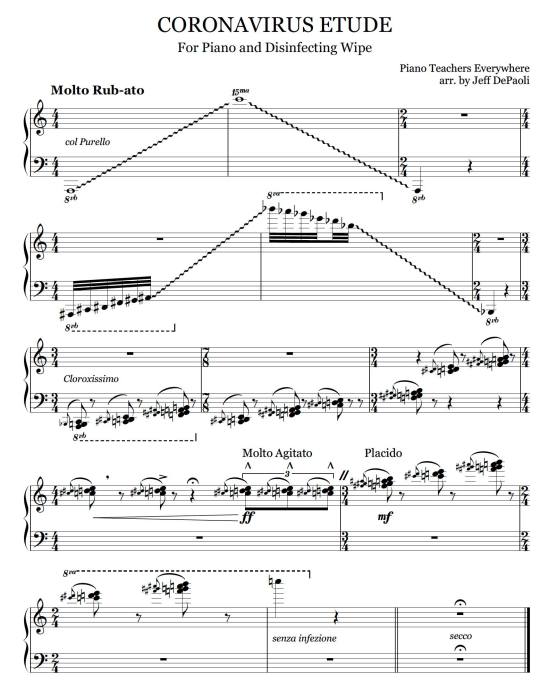

For Piano and Clorox wipe.
Live performances of this new work by various artists every hour, on the hour, at piano studios all around the world!
Varèse
Edgard Varèse was born in Paris, December 22, 1885 and died in New York, November 6, 1965. Although born in France, Varèse lived and worked most of his life in the United States. A pioneer of the avant-garde movement in music, Varèse experimented with electronic music, musique concréte;, and some highly original experimentation in the uses and organization of rhythm. The works for which he is best known are those in which he completely rejects traditional melody and harmony, instead building these compositions from blocks of sounds, relying on tone color, texture and rhythm. Varèse’s most original work exemplifying this technique is probably Ionisation, which is scored for a huge percussion ensemble, piano, and sirens.
Vaughan Williams
Ralph Vaughan Williams lived between 1872 and 1958. He is considered to be a romantic composer. His works include Fantasia on Greensleeves, The Pilgrim’s Progress, Fantasia on a Theme of Tallis and Mass in G Minor.
Verdi
Giuseppe Verdi lived between 1813 and 1901. He is considered to be a romantic composer. He was an Italian operatic composer who achieved his first major success with Nabucco (1842). He was the leading figure of Italian music in the nineteenth century and made important contributions to the development of opera.
The singing melodies of his popular operas, like Rigoletto, La Traviata, Il Trovatore, Aida, have come to represent Italian opera to much of the world. The late operas Otello and Falstaff crowned his achievement.
de Victoria
One of the works of Tomás Luis de Victoria was chosen in Best 100 Classical Pieces of the Millenium.
Vivaldi
Antonio Vivaldi lived from 1678 until 1741 and was considered to be a baroque composer. He was an Italian composer of instrumental music and opera. He was important in the development of the concerto. Vivaldi was ordained as a priest in 1703, but gave up saying Mass due to a chest illness. From 1704 until 1740, he taught violin at an orphanage, gave recitals, played the violin in operatic performances and produced some operas of his own.
The concertos that Vivaldi wrote helped define the genre in the Baroque and into the Classical era. These normally comprised three movements (fast, slow, fast); the fast movement regularly employed a ritornello form. In this form, an orchestral melody alternates with the freer sections that feature the soloist or soloists. The repetition of the ritornello provides a point of reference for the listener, allowing the soloist to stand out. It also allows the composer a greater degree of freedom in how the soloist’s material is treated.
Vivaldi’s concertos also stand out for the degree of inventiveness that he brought to them. While challenging the player, they also engage the listener. One of his most famous groups of concertos, The Four Seasons, demonstrates this well, and shows the more dramatic and colorful potential of the genre. Each concerto represents a different season, and the music illustrates in sound a picture created by an accompanying poem. Vivaldi uses his ingenuity to take the mundane sounds of daily life (the barking of a dog, the buzzing of flies), along with more dramatic sounds (a violent spring storm), and portray them in purely musical language that stands on its own merit. These early examples of program music well deserve their place in the popular canon of classical music.
Works:
Orchestral music, including over 239 violin concertos, including Le quattro stagioni (The Four Seasons), Op.8, Nos.1-4, c.1725), other solo concertos (bassoon, cello, oboe, flute, recorder), double concertos, ensemble concertos, sinfoniasChamber music, including sonatas for violin, cello and flute, trio sonatas
Vocal music, including oratorios (Juditha triumphans, 1716), Mass movements (Gloria), Magnificat, psalms, hymns and motets
Secular vocal music, including solo cantatas and operasHis most famous work, The Four Seasons, was written in 1725.
Vivaldi was a contemporary of Johann Sebastian Bach.
Dallapiccola
Luigi Dallapiccola was an Italian composer known for his lyrical twelve-tone compositions.
Debussy
Claude Debussy lived between 1862 and 1918. He is considered to be a impressionistic composer, because he tried to capture the mood of the action instead of the action itself, and was known as the Father of Impressionistic Music. Debussy’s work influenced another Impressionistic composer, Maurice Ravel.
The French Impressionistic painters like Auguste Renoir were painting at the same time that Debussy was composing and that influenced his music. “Clair de Lune” is a famous example of this as it creates the feeling of rippling water.
Debussy liked to create tonal “impressions” rather than conventional melodies. “Rêverie” was one of his first successes, although the critics of the 1890’s said things like “strangeness”, “dissonance”, “ugliness” and “difficulties” about it, missing the fragile loveliness and vague shimmer which were stylistic innovations.
Debussy was playing piano and composing by the time he was 12.
DeForest
Lee DeForest was born in 1873 in Council Bluffs, Iowa. We’re sure his parents had big plans for him; but they could never have realized how their son, Lee, would change the world.
DeForest seemed to be a born inventor. He held patents for hundreds of different items including the photoelectric cell and the surgical radio knife. But none had as much impact on the world as his invention of the electron tube, specifically the triode, a three element vacuum tube, which later became the audion tube ~~ possibly the most significant invention that made radio possible.
Wireless radio broadcasting was unthinkable in the early 1900s and DeForest was considered a fraud. He was arrested for selling stock to underwrite the development of his invention, which no one believed would work. He was forced into selling the rights to his patent to American Telephone and Telegraph for $500,000; considered by most to be foolish of AT&T. The rest is history.
Lee DeForest’s 1950 autobiography is called “Father of Radio”.
Delius
Frederick Delius was born in Bradford, England. His father owned a wool company and hoped that his son would follow a career in business. Delius, however, wanted to study music. In 1884, he left England for Florida, where he worked on a plantation as an orange grower. Delius proved to be a failure as an orange grower, and began supporting himself as a musician. During 1886 – 1887, he composed Florida Suite.
Des Prez
Josquin Des Prez was born around 1440 and he died: August 27, 1521 in Cond?-sur-l-Escaut, France.
He was a French/Franco-Flemish composer and generally acknowledged as the greatest composer of the High Renaissance.
Martin Luther, who had a good knowledge of music, said of Josquin Desprez, “he alone is the master of the notes, they have to do as he bids them.” Indeed, Josquin was acknowledged by nearly all his contemporaries as the greatest composer of his time. If so, he stands as the first among many great musicians, for the composers of what we often term the Netherlands School created one of the richest periods in Western musical history. His contemporaries — including Antoine Brumel (c.1460-c.1515), Pierre de la Rue (c.1460-1518) and Loyset Comp?re (c.1445-1518) — and the previous generation — led by Johannes Ockeghem (c.1410-1497) — created a style of music that can rightly be compared to the art of Leonardo da Vinci and Michelangelo.
As for Josquin himself, we know surprisingly little of his early life. We know that in the 1470s he began service in the court of Cardinal Ascanio Sforza, and that by 1489 he was a member of the papal choir in Rome. But we know nothing of his early training, or even when he came to Italy (it was believed that he came in 1459 as a choirboy in the Milan cathedral, but it seems that this was a case of mistaken identity). Later in his life he served Duke Ercole d’Este in Ferrara, and possibly King Louis XII of France. The final years of his life were spent in the town of Cond?-sur-l’Escaut in northern France (possibly his birthplace). The rest of his biography is still subject to scholarly speculation.
What we do know is just what Josquin’s contemporaries knew: that he created wonderful music. What stands out most in this music is his care for the words. This is seen in part by the way he uses imitation to allow each voice to present the text before the texture becomes too dense to be clear. He also made use of homophonic textures to give the text an added clarity. Some of his works, especially his Masses, use the older cantus firmus technique. Here he uses the borrowed melody to create a huge scaffolding upon which he constructs the other melodies. Some of these pieces display a high level of technical complexity. At the same time, he could create pieces of marvelous simplicity and elegance, as he did so often in his motets and chansons.
Musical Examples:
- Inviolata, integra et casta es Maria
- Miserere mei, Deus
- Missa “La sol fa re mi” (Agnus Dei II)
- Tu solus, qui facis mirabilia
Works:
- Sacred works, including 18 masses (Missa “La sol fa re mi”, 2 L’homme arm?
- Masses, Missa “Pange lingua”), more than 100 motets
- Secular works, including nearly 70 French chansons and settings of German,
Spanish and Italian texts
Diaghilev
Sergei Pavlovich Diaghilev lived from 1872 until 1929. He was a ballet impresario, born in Novgorod, Russia. Diaghilev obtained a law degree, but was preoccupied with the arts. In 1898 he became editor of Mir Iskousstva (World of Art), and during the next few years arranged exhibitions and concerts of Russian art and music. His permanent company was founded in 1911, and remained perilously in existence for 20 years, triumphantly touring Europe. Many of the great dancers, composers, and painters of his period contributed to the success of his Ballets Russes. He also encouraged several major choreographers (eg Fokine, Nijinsky, Balanchine), and gave them opportunities for artistic collaboration.
Dispeker
Thea Dispeker molded operatic talent from Lauritz Melchior to Richard Leech and lived to be 97 years old.
Dispeker owned a classical music artists agency for more than 50 years. In her career, she influenced musicians such as Richard Tucker, Judith Blegen, Roberta Peters and Pablo Casals, among others.
In 1947, she helped found the Little Orchestra Society for children’s concerts and went into business for herself.
Even in her 80s and 90s, Dispeker continued to seek out young singers and musicians to promote. Her portfolio also included the Swedish baritone Hakan Hagegard.
Her agency, Thea Dispeker Inc., received an International Society for the Performing Arts Foundation award of merit in 1997, its 50th anniversary year.
Dittersdorf
Carl Ditters von Dittersdorf lived from 1739 until 1799. He was a composer and violinist. He had composition lessons from Giuseppe Bonno in his native Vienna and served as a violinist in the orchestra of the Prince of Sachsen-Hildburghausen, followed by a position in the imperial theatre. There followed a period as Kapellmeister to the Bishop of Grosswardein, where, in 1762, he succeeded Michael Haydn. In 1769 he became Kapellmeister to the Prince-Bishop of Breslau, at this period acquiring the patent of nobility that added to the name of Ditters the honorific von Dittersdorf. Conditions in Johannisberg, the seat of the Prince-Bishop, deteriorated in the political circumstances of the time, and on the death of his employer in 1795, he moved with his family to join the household of a nobleman in Bohemia.
Dohnányi
Ernő Dohnányi lived from 1877 until 1960. He was born in Poszony (now Bratislava) in 1877 and opted for further musical study in Budapest rather than, more conventionally, in Vienna, setting an example that was followed by his younger contemporary Bartok. He played a leading part in forming the musical culture of Hungary, although there were difficulties with the regime that replaced the first republican government of the country. Due to his overt opposition to the association of Hungary with National Socialist Germany, he found it necessary to spend his final years in America, dying in New York in 1960.
As a composer Dohnányi was versatile, continuing existing traditions of music, while as a pianist he enjoyed international fame.
Domingo
Opera king Plácido Domingo
joins the Global Music Network and serves up an aria for online listeners. Live events and interviews, along with jazz and classical clips.
Donizetti
Gaetano Donizetti was born in in Bergamo, November 29, 1797 and died in Bergamo, April 8, 1848.
Inheriting the bel canto tradition from Rossini, Donizetti’s operas are today mostly admired for their many attractive melodies and fine ensembles. Although he composed over seventy operas, only a handful have remained in the general repertory, but those are generally regarded as outstanding examples of the Italian Bel Canto period. Donizetti’s most famous opera is surely Lucia di Lammermoor, based on a novel by Sir Walter Scott. The plot concerns a young girl who is tricked by her brother into thinking her lover has been unfaithful to her and forces her into a marriage of political convenience. During the wedding scene, Lucia’s lover makes an unexpected entrance, and all the protagonists give vent to their varied emotions in the celebrated Sextet from Lucia di Lammermoor. As was popular in Italian opera of the time, Lucia then goes mad, giving the prima donna an opportunity to display great acting and vocal skill in an extended scena.
The Italian operatic tradition was continued and taken to sublime heights later in the nineteenth century in the works of Giuseppe Verdi.
Dowland
John Dowland lived from 1562 until 1626. He was an English composer, singer and lutenist who wrote about 90 works for the Renaissance lute, several psalm harmonizations and many sacred songs.
Driggo
Riccardo Drigo was born and educated in Padua but he spent most of his life – from 1878 until 1915 – among Russian royalty as conductor ot the Marinsky Theater. He lived from 1846 until 1930.
Du Fay
Guillaume Du Fay was born on August 5, 1397(?) in Cambrai, France and died on November 27, 1474 in Cambrai, France. He was a French composer and was considered the leading composer of the early Renaissance.
The fifteenth century saw the rise of a new musical style, one in which harmonies began to center on full triads and the setting of the text became an important concern to composers. Guillaume Du Fay is one of the most important figures in the transition from the medieval to Renaissance style, which took place mainly among composers associated with the rich court of Burgundy. For this reason, Du Fay and his contemporaries are usually referred to as the “Burgundian School.”
Guillaume Du Fay probably received his early musical training in the cathedral choir at Cambrai, in northern France. But his career took a decidedly international turn early on. By the age of twenty-five he had gone to Italy. During his years there, he worked for courts in Pesaro, Ferrara and sang in the Papal choir in Rome. During that time he also earned a degree in canon law, probably at the University of Bologna. He spent the latter part of his life back at the cathedral in Cambrai. Du Fay wrote both sacred and secular music; he is perhaps best known for his cantus firmus Masses. Before he died, he composed a Requiem Mass (now lost) to be sung at his funeral, and asked that four of the best singers from the cathedral sing his motet Ave regina caelorum (Hail, Queen of Heaven) to him on his deathbed.
Du Fay’s music set the tone for the Renaissance (one scholar credits him with defining the “central style” of the period). His triad-based harmonies and arching melodies create a pleasant balance of melody and harmony. In his sacred music, he changed the overall sound by a more regular use of four-voice textures. At the same time, we can still find the medieval concern with structure and isorhythm in his sacred music, especially his cantus firmus Masses.
Sacred works including at least 7 complete Mass settings, numerous Mass movements and pairs, 30 motets and 60 other sacred works (hymns, etc.)
Secular works including more than 50 rondeaux, 10 ballades, 4 virelais, 15 other works.
Dukas
Paul Dukas’ The Sorcerer’s Apprentice was featured in the Walt Disney movie Fantasia and Fantasia 2000.
Dvorák
Antonín Dvorák’s piece, “Humoresque” became one of the most famous pieces ever written nearly overnight. It was later discovered that this could be played simultaneously with Steven Foster’s “Way Down Upon the Swanee River”.
Dvorák, a native of Bohemia, traveled in the United States in 1892 and found American music to be “magical” and “spacious”. When Dvorák visited the United States, he encouraged American composers to use their native music. He himself incorporated folk melodies into 19th century Romantic music. His compositions include Slavonic Dances, Fifth Symphony, The Water Nymph, Carnival, Gypsy Melodies.
Dvorák lived from 1841 until 1904.

They’ve listened to your amazing feedback and have added your most requested songs, squashed tons of bugs and added iOS 17 compatibility.
You asked, and they listened and added a sparkling collection of most requested songs in 2023 for your students to enjoy “Barbie Girl” from the new ‘Barbie movie, “Circle of Life” from ‘The Lion King’, “He’s a Pirate” from ‘Pirates of the Caribbean’ and “Rainbow Connection” from ‘The Muppet Movie’.
Available in 3 versions, all new songs can be found in the ‘Top 2023 Requests’ section in the song library.
It will be fun watching your child improve their piano skills all while having fun using Piano Maestro in lessons each week!
As your child’s teacher (or YOUR teacher!), I’m looking forward to seeing the progress they will make when they start using it at home each day. This guide will help you understand how this app will benefit your child and how to get it set up on your own iPad.
Overview
What is Piano Maestro?
Piano Maestro is the ultimate piano practice tool that will have students quickly playing their favorite classical, pop, rock, TV and video game songs and themes. It is available in the App Store and works on the iPad.
What skills does it improve?
• Note reading
• Sight reading
• Rhythm
• Inner pulse
• Confidence
What makes it so fun?
• Upbeat background tracks
• Stunning graphics
• Instant rewards and feedback
• Satisfaction of playing REAL music
It works with an acoustic piano?
Yes! Your child practices on your real acoustic or digital piano. Piano Maestro listens from the iPad’s built-in microphone. No wires needed.
I’m already paying for lessons. What value does this add?
Sometimes I wish I could be there with your child to encourage them to keep practicing daily. I’m sure it’s not always easy, as unforeseen challenges will arise.
Since our time each week is just too short, this app will give me eyes on the ground and it will keep them practicing longer and improving more quickly.
How will it be used in lessons?
I will spend a few minutes of each lesson helping your child master a couple of new songs all while having fun! I will also teach them how to use the practice options at home.
At the end of the lesson, we will choose Home Challenge assignments within the app that will show up in your account at home. I’ll get updates when progress is made.
Getting Started
Wow, this sounds awesome. Now, how do I get started?
1) Download Piano Maestro on your iPad from the AppStore
2) Create a JoyTunes account with a parent’s email, under which, you can have multiple profiles for each member of the family.
3) Create a profile for each family member (that means you too Mom and Dad!) inside the Parent/Teacher zone (top right-hand corner of the main screen)
4) Connect to your teacher, me! After creating a profile in the “profiles” tab of the parent/teacher zone, select the student’s profile and click “connect to teacher.” Once I approve the connection to your child, they will receive full access to all content for FREE! I will then also begin receiving weekly progress reports.
5) Start Playing – I will now start assigning you homework, meanwhile, get started on Journey Mode.
When you connect to the O’Connor Music Studio, Piano Maestro is free for as long as you study here.

We often use this app in the O’Connor Music Studio. There is a new update coming very soon that looks like it will be even better.
Note Rush boosts your note reading speed and accuracy, building a strong mental model of where each written note is on your instrument.

Note Rush is like a virtual flash card deck for all ages that listens to you play each note, giving instant feedback and awarding stars based on speed and accuracy.
Race against the clock to improve your performance or hide the timer to gently engage those just starting out with the staff.
Includes built-in levels for piano and a range of other instruments as well as custom level design.
If you want to use it at home, the current cost is only $4.99 (not a subscription, one-time only) but it will be going up soon to 8.99.
More info at https://www.noterush.app/


Cécile Chaminade’s Flute Concertino in D major, Op. 107, was composed in 1902 for flute and piano and later arranged by herself for flute and orchestra.The piece remains a standard and popular part of the flute repertoire.
Helen Haeun Kim is an active flutist, her performances appeared on premier venues such as London’s Royal Albert Hall, BBC Radio 3 & 4, TBN UK, and Prague’s Církev československá husitská. Most recently, Ms. Kim had recitals in Morocco, Germany, France, and Czech Republic in 2019.
Ms. Kim currently works for Dallas Symphony Orchestra as a Teaching Artist and teaches flute at the Birdville High School in North Richland Hills.
Liz Sellers, Pender pianist, began studying the piano at age three and came to the public’s attention when she won the grand prize at the Grand Prix Seoul Music Festival at age eight.
Her portfolio consists of piano performance, visual art, as well as directing choral and orchestral ensembles. Previously she served as the music director at the Marine Corps Air Station in New River Chapel, Jacksonville, North Carolina. She has worked as a lecturer, music educator, and opera coach at Craven Community College, the International Christian School, as well as several adult community choirs and ensembles in France, Italy, Scotland, South Korea, Switzerland, and the United States. As a concert pianist, she has performed at the Edinburgh International Festival Fringe (2014); with the Moscow State Symphony Orchestra (2016); and in 2018 delivering a concert at Carnegie Hall.
Ms. Sellers was granted the Master of Music degree in Piano Performance with a second major in Chamber Music from the Royal Conservatoire of Scotland. She received a Bachelor of Music degree in Piano Performance, with a second major in Violin, and Composition from the University of Sung-Kyul, Seoul, South Korea. Liz received the Certified Diploma Execution with a major in Piano Performance from the Ecole Normale de Musique de Paris in France.
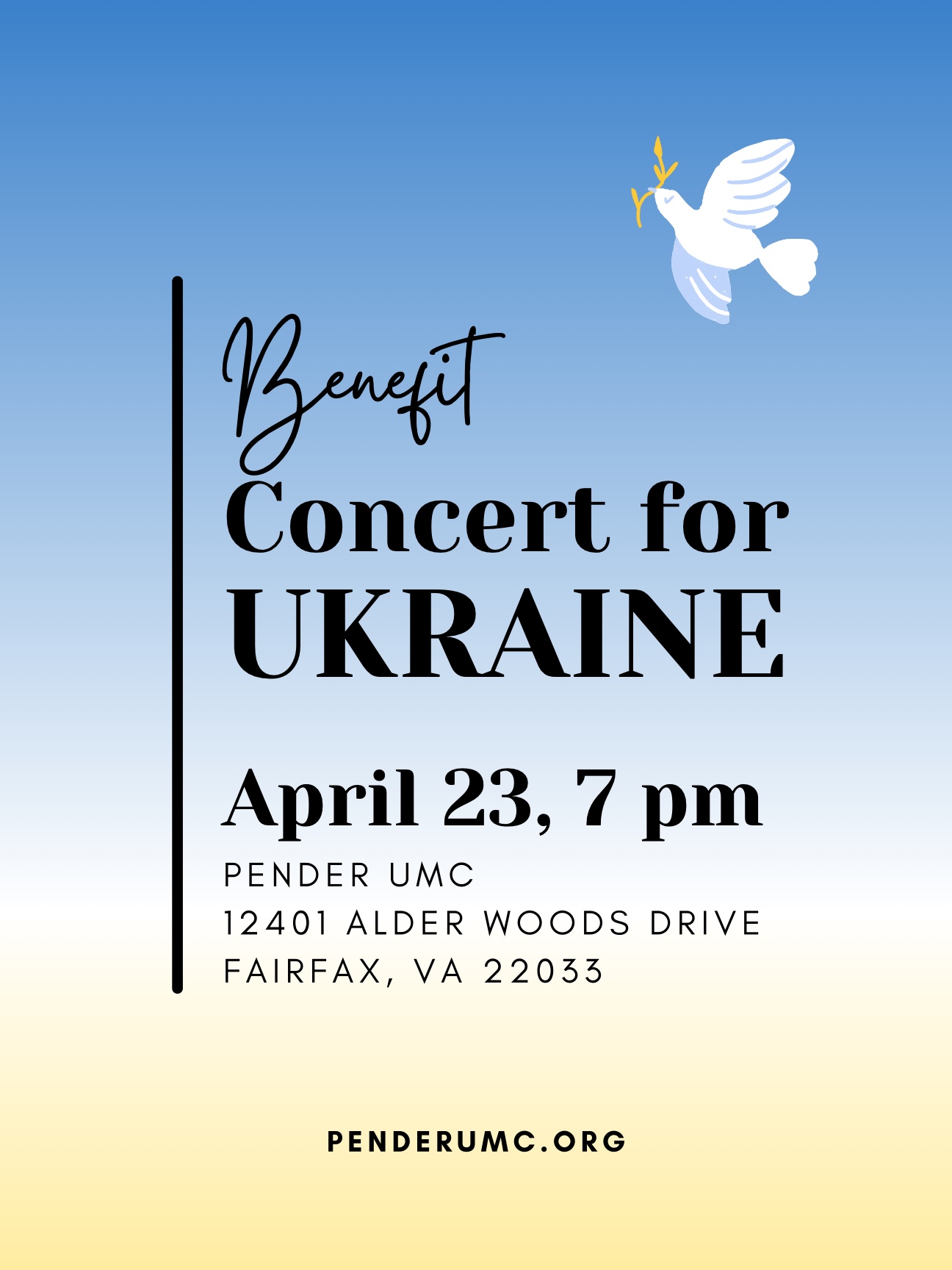
The Pender Concert Supporting Ukraine on April 23 featured Liz Sellers on piano, Brian on harp, and local professional musicians, including woodwind quintet, drums, organ, guitar, flute, penny whistle, singing and violin.
Concert repertoire included: Harp arrangements by Debussy, Piano trio of Jazz/Baroque, Flute Concertino by Chaminade, Woodwind Quintet with music of Duke Ellington, The Widor Toccata Organ Symphony Movement V and an Irish session!
There was no charge for this concert but there was a free will offering taken to support Ukraine through Advance #982450, UMCOR International Disaster Response and Recovery. This fund provides direct assistance to those in Ukraine as well as assistance to Ukrainians fleeing to neighboring countries.
One hundred percent of all Advance contributions go to the designated cause. (The independent charity watchdog, “Charity Watch,” gives UMCOR an “A+” ranking, and includes the UM organization on a highly selective list of charities it recommends when considering how to support the Ukrainian people. Read more)
The United Methodist community in Ukraine, though quite small, is actively engaged in assisting neighbors in need. Global Ministries is in touch with the church’s leadership as well as with church leaders in countries welcoming those who are fleeing from violence in Ukraine.
Click this link and choose UMCOR to send direct aid. In the memo line, put Advance #982450, UMCOR International Disaster Response and Recovery.
Thank you for your support!
The dramatic opening selection of Pender’s Concert Supporting Ukraine was “Suite for Woodwind Quintet” composed by Scott Pender, performed by the Morpheus Chamber Players.
I. Introduction – Moderato
II. Adagio Cantabile
III. Introduction – Con Brio
The Morpheus Chamber Players are Alisha Coleman (clarinet, Gwen Jones (flute), Jeff Kahan (oboe), Wendy Chinn (French horn) and
Lisa Eckstein (bassoon).
We were fortunate to have the composer, Scott Pender, in the audience.
The Pender Concert Supporting Ukraine on April 23 featured Liz Sellers on piano, Brian on harp, and local professional musicians, including woodwind quintet, drums, organ, guitar, flute, penny whistle, singing and violin.
Concert repertoire included: Harp arrangements by Debussy, Piano trio of Jazz/Baroque, Flute Concertino by Chaminade, Woodwind Quintet with music of Duke Ellington, The Widor Toccata Organ Symphony Movement V and an Irish session!
There was no charge for this concert but there was a free will offering taken to support Ukraine through Advance #982450, UMCOR International Disaster Response and Recovery. This fund provides direct assistance to those in Ukraine as well as assistance to Ukrainians fleeing to neighboring countries.
One hundred percent of all Advance contributions go to the designated cause. (The independent charity watchdog, “Charity Watch,” gives UMCOR an “A+” ranking, and includes the UM organization on a highly selective list of charities it recommends when considering how to support the Ukrainian people. Read more)
The United Methodist community in Ukraine, though quite small, is actively engaged in assisting neighbors in need. Global Ministries is in touch with the church’s leadership as well as with church leaders in countries welcoming those who are fleeing from violence in Ukraine.
Click this link and choose UMCOR to send direct aid. In the memo line, put Advance #982450, UMCOR International Disaster Response and Recovery.
Thank you for your support!
Liz Sellers, Pianist/Organist at Pender UMC in Fairfax, VA, and violinist Anthony Shields performed Violin Sonata No. 5 in F major, Op. 24 by Ludwig van Beethoven during Pender’s new Concert Series which began on April 23, 2022.
The Violin Sonata No. 5 in F major, Op. 24, is a four movement work for violin and piano by Ludwig van Beethoven. It was first published in 1801. The work is commonly known as the Spring Sonata (Frühlingssonate), although the name “Spring” was apparently given to it after Beethoven’s death.
Liz and Anthony played the first movement.
The Pender Concert Supporting Ukraine on April 23 featured Liz Sellers on piano, Brian on harp, and local professional musicians, including woodwind quintet, drums, organ, guitar, flute, penny whistle, singing and violin.
Concert repertoire included: Harp arrangements by Debussy, Piano trio of Jazz/Baroque, Flute Concertino by Chaminade, Woodwind Quintet with music of Duke Ellington, The Widor Toccata Organ Symphony Movement V and an Irish session!
There was no charge for this concert but there was a free will offering taken to support Ukraine through Advance #982450, UMCOR International Disaster Response and Recovery. This fund provides direct assistance to those in Ukraine as well as assistance to Ukrainians fleeing to neighboring countries.
One hundred percent of all Advance contributions go to the designated cause. (The independent charity watchdog, “Charity Watch,” gives UMCOR an “A+” ranking, and includes the UM organization on a highly selective list of charities it recommends when considering how to support the Ukrainian people. Read more)
The United Methodist community in Ukraine, though quite small, is actively engaged in assisting neighbors in need. Global Ministries is in touch with the church’s leadership as well as with church leaders in countries welcoming those who are fleeing from violence in Ukraine.
Click this link and choose UMCOR to send direct aid. In the memo line, put Advance #982450, UMCOR International Disaster Response and Recovery.
Thank you for your support!
Brian Stevenson, Director of Music Ministries at Pender UMC in Fairfax, VA, performed En bateau (Sailing) from The Petite Suite, L 65, by Claude Debussy on the harp during Pender’s new Concert Series which began on April 23, 2022.
Debussy’s music captures perfectly a mood of water-borne serenity and languor, opening with a kind of musical sigh that made the Petite Suite immediately popular with a wide audience.
The Pender Concert Supporting Ukraine on April 23 featured Liz Sellers on piano, Brian on harp, and local professional musicians, including woodwind quintet, drums, organ, guitar, flute, penny whistle, singing and violin.
Concert repertoire included: Harp arrangements by Debussy, Piano trio of Jazz/Baroque, Flute Concertino by Chaminade, Woodwind Quintet with music of Duke Ellington, The Widor Toccata Organ Symphony Movement V and an Irish session!
There was no charge for this concert but there was a free will offering taken to support Ukraine through Advance #982450, UMCOR International Disaster Response and Recovery. This fund provides direct assistance to those in Ukraine as well as assistance to Ukrainians fleeing to neighboring countries.
One hundred percent of all Advance contributions go to the designated cause. (The independent charity watchdog, “Charity Watch,” gives UMCOR an “A+” ranking, and includes the UM organization on a highly selective list of charities it recommends when considering how to support the Ukrainian people. Read more)
The United Methodist community in Ukraine, though quite small, is actively engaged in assisting neighbors in need. Global Ministries is in touch with the church’s leadership as well as with church leaders in countries welcoming those who are fleeing from violence in Ukraine.
Click this link and choose UMCOR to send direct aid. In the memo line, put Advance #982450, UMCOR International Disaster Response and Recovery.
Thank you for your support!
Sylvia Mulherin, organist at St. George’s UMC in Fairfax, VA, performed Toccata Organ Symphony Movement V by Charles-Marie Widor at Pender’s new Concert Series which began on April 23, 2022.
The Pender Concert Supporting Ukraine on April 23 featured Liz Sellers on piano, Brian on harp, and local professional musicians, including woodwind quintet, drums, organ, guitar, flute, penny whistle, singing and violin.
Concert repertoire included: Harp arrangements by Debussy, Piano trio of Jazz/Baroque, Flute Concertino by Chaminade, Woodwind Quintet with music of Duke Ellington, The Widor Toccata Organ Symphony Movement V and an Irish session!
There was no charge for this concert but there was a free will offering taken to support Ukraine through Advance #982450, UMCOR International Disaster Response and Recovery. This fund provides direct assistance to those in Ukraine as well as assistance to Ukrainians fleeing to neighboring countries.
One hundred percent of all Advance contributions go to the designated cause. (The independent charity watchdog, “Charity Watch,” gives UMCOR an “A+” ranking, and includes the UM organization on a highly selective list of charities it recommends when considering how to support the Ukrainian people. Read more)
The United Methodist community in Ukraine, though quite small, is actively engaged in assisting neighbors in need. Global Ministries is in touch with the church’s leadership as well as with church leaders in countries welcoming those who are fleeing from violence in Ukraine.
Click this link and choose UMCOR to send direct aid. In the memo line, put Advance #982450, UMCOR International Disaster Response and Recovery.
Thank you for your support!
 MaryO'Studio