I found this article from the New York Times very interesting about the Steinway Store moving.
The little room where Rachmaninoff practiced, the famous basement where up-and-coming virtuosos catnapped under the pianos, the palatial rotunda conceived by the architecture firm that designed Grand Central Terminal — Steinway & Sons is saying goodbye to all that and moving to a corner of a 1970s office building 14 blocks away.
Steinway sold its 1920s building on West 57th Street in 2012, with a deadline to leave by the end of December. Executives of the piano company are now close to signing a 15-year lease for 40,000 square feet of space at 1133 Avenue of the Americas, at West 43rd Street.
The manuscript of Mozart’s A major piano sonata K331 has recently been discovered in Budapest. Having spent the majority of its life in the Budapest’s National Széchényi Library for decades, the coveted manuscript was rediscovered by Haydn scholar Balazs Mikusi.
The piece was composed in 1783 and contains Mozart’s most popular jam, “Turkish March,” which has become a piano lesson staple all over the world.
Although, unfortunately, Mikusi can’t say how or when these pages found their way to Hungary; they reveal subtle differences from the published editions of the sonata. The key variances are seen in the phrasing, dynamics and occasionally the notes themselves.
“It is very rare that a Mozart manuscript pops up. Moreover the A Major Sonata had no known manuscript, so it is a really big discovery,” he said.
The library has only released teasing images of the manuscript, nothing more.
Wanted: Temporary space for the world’s largest piano. Must have flat access, as requires forklift.
A piano handcrafted in a garage near Timaru, weighing in at 1.4 tonnes and with a length of 5.7 metres, is rolling through Wellington next month and its maker is hunting for a place to show it off.
It took Adrian Mann, 25, four years to build the piano, and he has spent the past few years giving people around New Zealand a chance to play it – he even tried, unsuccessfully, to get Elton John to give it a tinkle.
It all started when, as a curious 15-year-old, he wanted to see how long a piece of piano wire would be if it were not wrapped in copper.
It will be fun watching your child improve their piano skills all while having fun using Piano Maestro in lessons each week!
As your child’s teacher (or YOUR teacher!), I’m looking forward to seeing the progress they will make when they start using it at home each day. This guide will help you understand how this app will benefit your child and how to get it set up on your own iPad.
Overview What is Piano Maestro?
Piano Maestro is the ultimate piano practice tool that will have students quickly playing their favorite classical, pop, rock, TV and video game songs and themes. It is available in the App Store and works on the iPad.
What skills does it improve?
• Note reading
• Sight reading
• Rhythm
• Inner pulse
• Confidence
What makes it so fun?
• Upbeat background tracks
• Stunning graphics
• Instant rewards and feed back
• Satisfaction of playing REAL music
It works with an acoustic piano?
Yes! Your child practices on your real acoustic or digital piano. Piano Maestro listens from the iPad’s built in microphone. No wires needed.
I’m already paying for lessons and books. What value does this add?
Sometimes I wish I could be there with your child to encourage them to keep practicing daily. I’m sure it’s not always easy, as unforeseen challenges will arise.
Since our time each week is just too short, this app will give me eyes on the ground and it will keep them practicing longer and improving more quickly.
How will it be used in lessons?
I will spend a few minutes of each lesson helping your child master a couple of new songs all while having fun! I will also teach them how to use the practice options at home.
At the end of the lesson, we will choose Home Challenge assignments within the app that will show up in your account at home. I’ll get updates when progress is made.
Getting Started
Wow, this sounds awesome. Now, how do I get started?
1) Download Piano Maestro on your iPad from the AppStore
2) Create a JoyTunes account with a parent’s email, under which, you can have multiple profiles for each member of the family.
3) Create a profile for each family member (that means you too Mom and Dad!) inside the Parent/Teacher zone (top right hand corner of main screen)
4) Connect to your teacher, me! After creating a profile in the “profiles” tab of the parent/teacher zone, select the student’s profile and click “connect to teacher.” Once I approve connection to your child, they will receive full access to all content for FREE! I will then also begin receiving weekly progress reports.
5) Start Playing – I will now start assigning you homework, meanwhile get started on Journey Mode.
There is one change in the video below – when you connect to the O’Connor Music Studio, Piano Maestro is free forever.
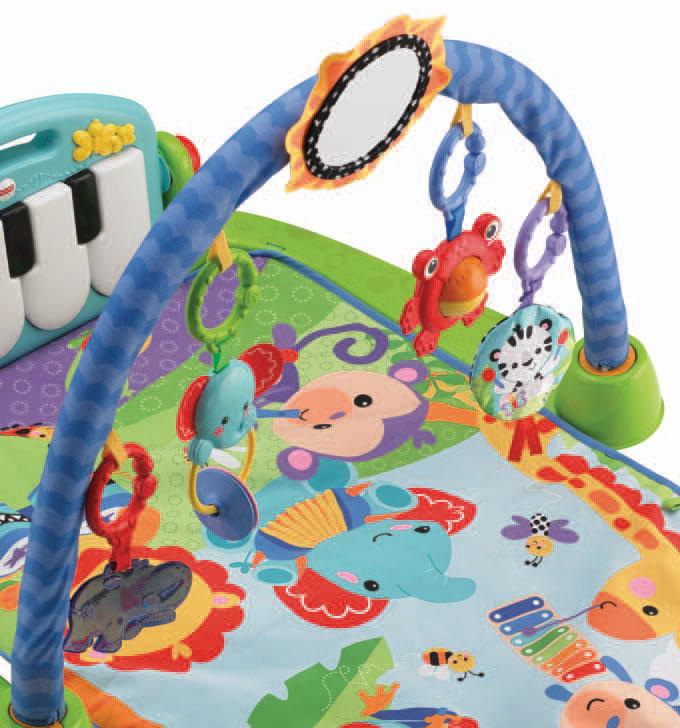
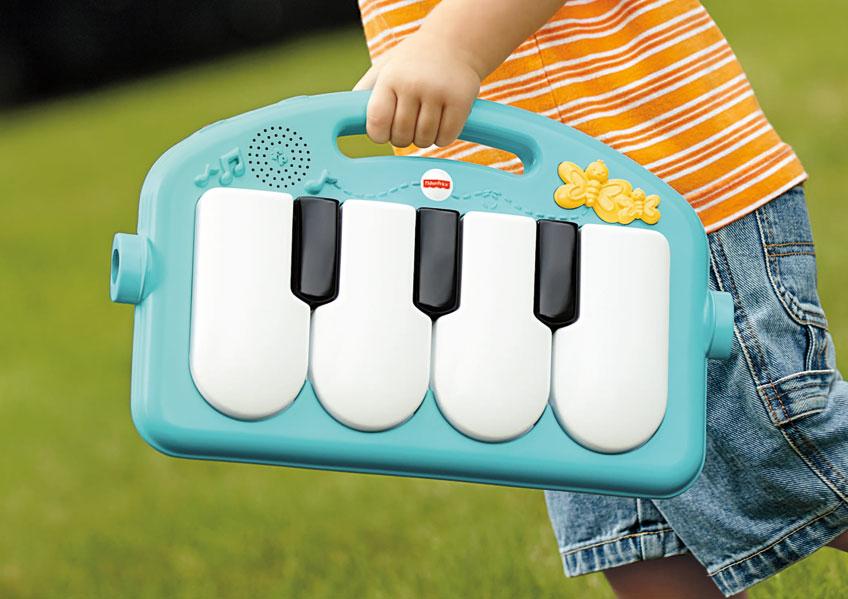
Baby kicks. Music plays. And that’s just the beginning. Movable toys on the overhead gym encourage baby to bat and grasp. Move the arch down for tummy-time play, or let baby sit and entertain you with a piano concert! And now with a removable piano, you can take the musical fun wherever you and baby go!
Features
Four ways to play: Lay & play; Tummy time; Sit & play; Take-along
Music rewards baby as she kicks the piano keys
Five busy activity toys & a large mirror
Toys include a hippo teether, elephant clackers, rollerball frog, and more
Short or long-play music—up to 15 minutes
Soft, comfy mat
Power/volume control
Requires 3 AA batteries
Toys overhead encourage batting and grasping, including a hippo teether, elephant clackers, rollerball frog and more!
Stretching & kicking
With four ways to play, this musical toy grows with your little one! From laying and playing, to tummy time and sitting up, busy activities at each stage are just the beginning of the fun. Baby’s in charge of the action as her little kicky feet activate music. Moveable toys overhead encourage batting and grasping, including a hippo teether, elephant clackers, rollerball frog and more.
When it’s time to change modes, move the arch down for tummy time or let baby sit up and entertain you with a piano concert. Remove the piano and take the fun on-the-go. Includes long and short play modes with up to 15 minutes of music. Power and volume control for quiet play.
Removable piano provides musical fun wherever you and baby go!
Learning through play!
As baby plays, new discoveries are made and key developmental skills get stronger and stronger. As baby stretches and kicks at the piano keys or bats at and reaches for the busy activity toys, gross motor skills are enhanced. Music, lights and bright colors stimulate baby’s senses.
Help baby learn the connection between actions and reactions. Put baby’s foot within reach of the piano. From there, it’s bound to happen: baby’s foot will connect and activate a fun and rewarding response from the gym!
Beethoven’s first published works—his Opus No.1—were three trios for piano, violin and cello and already they show a marked advance on Haydn’s trios in the comparative interdependence of the three parts. Their freedom from Haydn’s oppressive formality looks forward to the first mature trios, the pair that comprises Opus 70, displaying all sorts of harmonic twists, thematic innovations and structural idiosyncrasies, these trios make much of the piano part and contain plenty of dramatic outbursts that are typical of Beethoven’s middle period.
Even more arresting is the first of the Opus 70 trios (1808) nicknamed ”The Ghost” because of its mysterious and haunting Largo. Its sibling boasts a cheerful bombastic finale that is the most entertaining music that Beethoven composed for this combination of instruments.
The “Archduke” Trio Opus 97 (1811) was Beethoven’s last full – scale work for piano trio and is typically conclusive. The third movement is its centre of gravity, a highly moving set of variations with the cello dominating the thematic content. It opens with a hymn-like theme and progresses to a coda which magnificently sums up the movements ideas. The finale might be less powerful than that of Opus 70 No. 2, but it nevertheless has a sweeping rhythmic power. Again, it is beyond the shadow of a doubt that Beethoven defined the piano trio form that it retained throughout the 19th century by allowing the string instruments the status of genuinely equal partners in this superlative performance.
“I used to play piano, when I was a child,” Fitzgerald explained. “My mother liked it, because she could just say, ‘Go play piano!’ and I’d go off and play it by myself.”
Fitzgerald stopped playing when she was young, due to the large size of her family. None of her brothers or sisters were much interested in the instrument, and she began to feel uncomfortable about her hobby.
She explained that big families can’t afford everything, and that keeping an expensive object like a piano for just one person would have been selfish.
So Fitzgerald gave up her piano, grew up, and moved on. But she always remembered her love of the piano. And when she moved into the Cartmell Home, and found out about the lessons, she was hooked.
“I decided to give it a try,” she said, laughing, “I’ve already got one foot in the grave! When else will I get the chance to?”
Although Fitzgerald’s skill with the instrument has atrophied since she was younger, (she laughs while pointing out that her music practice book is designed for children) her innate talents are as sharp as ever.
“I’ve always had an ear for music” she explains, “I can play a tune just from hearing it.”
These days, there is much pressure for parents to begin their children in activities from an early age. We know that children tend to pick up new skills easily and we want for them to have an opportunity to become experts at these new skills. We also see curiosity, desire and eagerness to learn in our children and want to capitalize on that.
Music lessons are no exception. We often get calls asking the question, “When is the best time to enroll my child in piano lessons?” The answer to that is a tricky one, and varies for each child. The right age for one may not be the right age for another. Here are a few questions to ask yourself if you are considering enrolling your child in music lessons:
1. Does my child have an attention span to sit still for chunks of time and listen to instruction?
Many teachers today are very creative in using off-bench activities during lessons and have a plethora of activities to make lessons fun and engaging. However, the fact remains that your child will need to sit at the piano for some periods of time during the lesson. It is important that your child have the attention span to do this.
Picture a seven-foot grand piano in a studio. The lid’s missing, so you can see all the strings. Researchers suspend a rod embedded with 32 microphones over the piano’s body.
“We played this middle C at a very soft level, a medium level, and a very loud level,” says Agnieszka Roginska, a professor in NYU’s music technology program. She says using a pianist to play middle C over and over wouldn’t be scientific. So they’re using a disklavier, a fancy player piano triggered by electronics. “So we could hit the same note, with the same velocity, thousands of times,” she says.
They’d record the piano in one spot. Then move the microphones eight inches. Record the note. Move the mics again. Record the note. Over and over and over, until they reach the back of the piano. At the end, they get “what is basically a very dense acoustical scan of the radiation pattern of the grand piano,” Roginska says.
Lee Eckroth couldn’t hold back a smile as piano music filled the air Wednesday afternoon on the streets of downtown Corvallis.
The moment marked the culmination of months of work from by Eckroth, Corvallis Imagination Music & Art founder David Lundahl and dozens of volunteers who’d banded together to create the first Play Corvallis, Play.
The art installation features eight theme-decorated pianos, placed at outdoor locations around Corvallis. It is open to the public from 7 a.m. to 10 p.m. daily through Aug. 16 as a prelude event to the Imagination Music and Art festival at Bruce Starker Arts Park on Aug. 15 and 16.
Play Corvallis, Play is intended to inspire appreciation of the arts, and it is just what it sounds like: an invitation to residents to stop and play the piano to showcase local musical creativity and art as a way of drawing attention to the fundraising at Corvallis public schools.






 MaryO'Studio