November 3, 2016 ~ Today in Music History

today


.1587 ~ Samuel Scheidt, German organist and composer

.1801 ~ Vincenzo Bellini, Italian composer

OCMS 1911 ~ Vladimir Ussachevsky, Russian-born American composer
More information about Ussachevsky

.1933 ~ John Barry, Academy Award~winning composer

.1941 ~ The classic Jerry Gray arrangement of String of Pearls was recorded by the Glenn Miller Orchestra on Bluebird 78s. The recording featured the trumpet of Bobby Hackett.

.1948 ~ Lulu (Marie McDonald McLaughlin Lawrie), Singer. She changed her name to Lulu (and The Luvvers) in Scotland, early in her career. Married to singer Maurice Gibb

.1954 ~ Adam Ant (Stuart Goddard), Singer

.1956 ~ The classic MGM film, The Wizard of Oz, was first seen on television. The film cost CBS $250,000 to show. The movie was shown 18 times between 1956 and 1976, and you can probably catch it again no matter what year it is.

.1957 ~ Sam Phillips, owner of legendary Sun Records in Memphis, TN, released Great Balls of Fire, by Jerry Lee Lewis. Looking carefully at the original label, one will find credit to Lewis and “his pumping piano.”

.1960 ~ James Prime, Keyboards with Deacon Blue

.1960 ~ “The Unsinkable Molly Brown”, opened on Broadway. The play would become an American theater standard and a smashing career launch for Shirley MacLaine.

.1962 ~ Billboard magazine dropped the “Western” from its chart title. The list has been known as Hot Country Singles ever since.

.1972 ~ Singers Carly Simon and James Taylor were married in Carly’s Manhattan apartment. The couple was said to be the highest-paid couple in the world next toElizabeth Taylor and Richard Burton. Carly and ‘Sweet Baby’ James would divorce years later, but they are still good friends.

.1990 ~ Mary Martin died

.2000 ~ Mary Hunter Wolf, one of the first female directors on Broadway died at the age of 95. Wolf made her Broadway debut directing the 1944 production of Horton Foote’s “Only the Heart.” The following year, she directed the first black Broadway musical, “Carib Song.” After directing a string of successful plays and musicals, Wolf was hired as an associate director for Jerome Robbins’ “Peter Pan,” starring Mary Martin. In 1947 Wolf was tapped to direct a new musical “High Button Shoes,” but was dismissed by the show’s producers before rehearsals began. Wolf sued, charging that her contract had been broken because she was a woman. Two years later the New York Supreme Court ruled in her favor. During her third year at Wellesley College, Wolf visited her aunt, author Mary Austin, in Santa Fe, N.M. where she found herself introduced into the circle of D.H Lawrence, Willa Cather and Sinclair Lewis. She soon abandoned her studies to pursue a directing career.

Getting Ready for Halloween: Toccata and Fugue in d minor by J.S Bach

toccata-d-minor


Johann Sebastian Bach’s towering monument of organ music, with its deep sense of foreboding, will forever be associated with Halloween.

Get a free copy of the sheet music at IMSLP or borrow a copy from the O’Connor Music Studio.  I have this arranged for organ, piano, duet, 2-piano, simplified…

If you want this in a book with other Bach transcriptions, amazon has this: Toccata and Fugue in D Minor and the Other Bach Transcriptions for Solo Piano, arranged by Ferruccio Busoni.

Here, Virgil Fox performs it on his Allen Digital Touring Organ.


Diane Bish plays the Massey Memorial Organ at the Chautauqua Institution and talks about this instrument.


Play along with pianist Cyprien Katsaris if you wish!


And, the most fun…

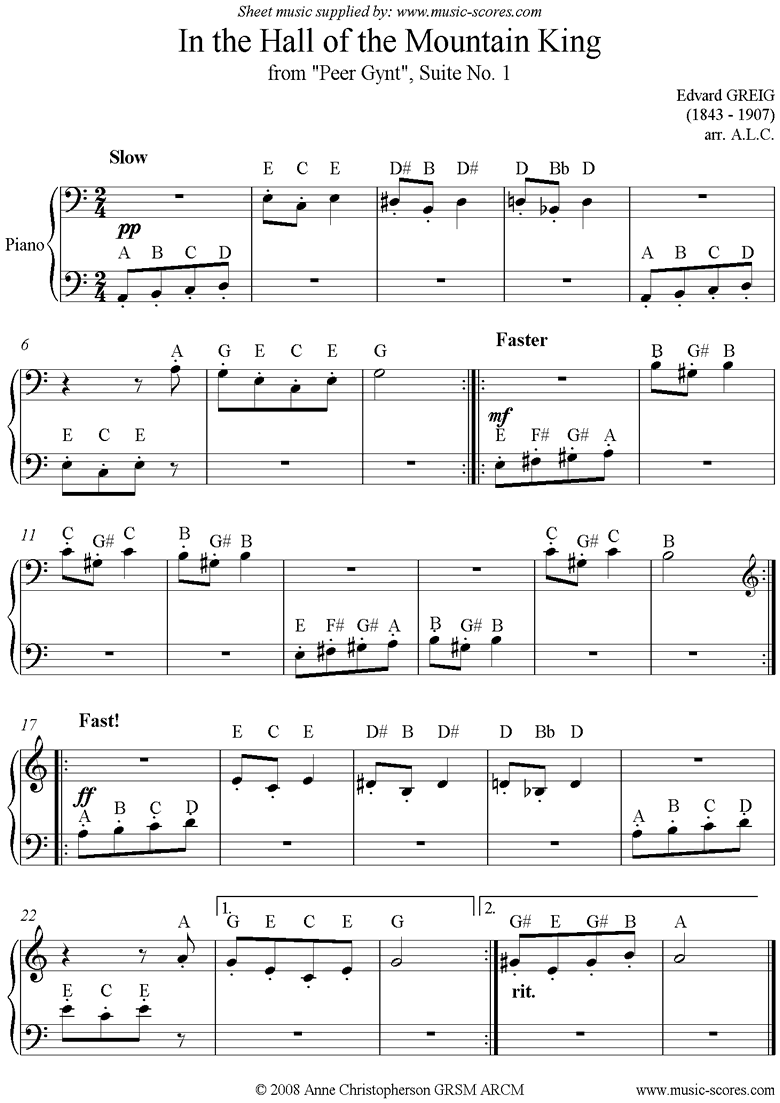
Getting Ready for Halloween: In the Hall of the Mountain King by Edvard Grieg

hall-mountain


“In the Hall of the Mountain King” is a piece of orchestral music composed for the sixth scene of act 2 in Henrik Ibsen’s 1867 play Peer Gynt. It was originally part of Opus 23 but was later extracted as the final piece of Peer Gynt, Suite No. 1, Op. 46. Its easily recognizable theme has helped it attain iconic status in popular culture, where it has been arranged by many artists, including for the piano.

Borrow a copy of the sheet music from the O’Connor Music Studio.  I have this arranged for piano, duet, 2-piano, simplified…


8 part vocal orchestra (plus a tiny pair of cymbals)


Pianist Paul Barton


Solo piano sheet music – Video Score


Orchestral version

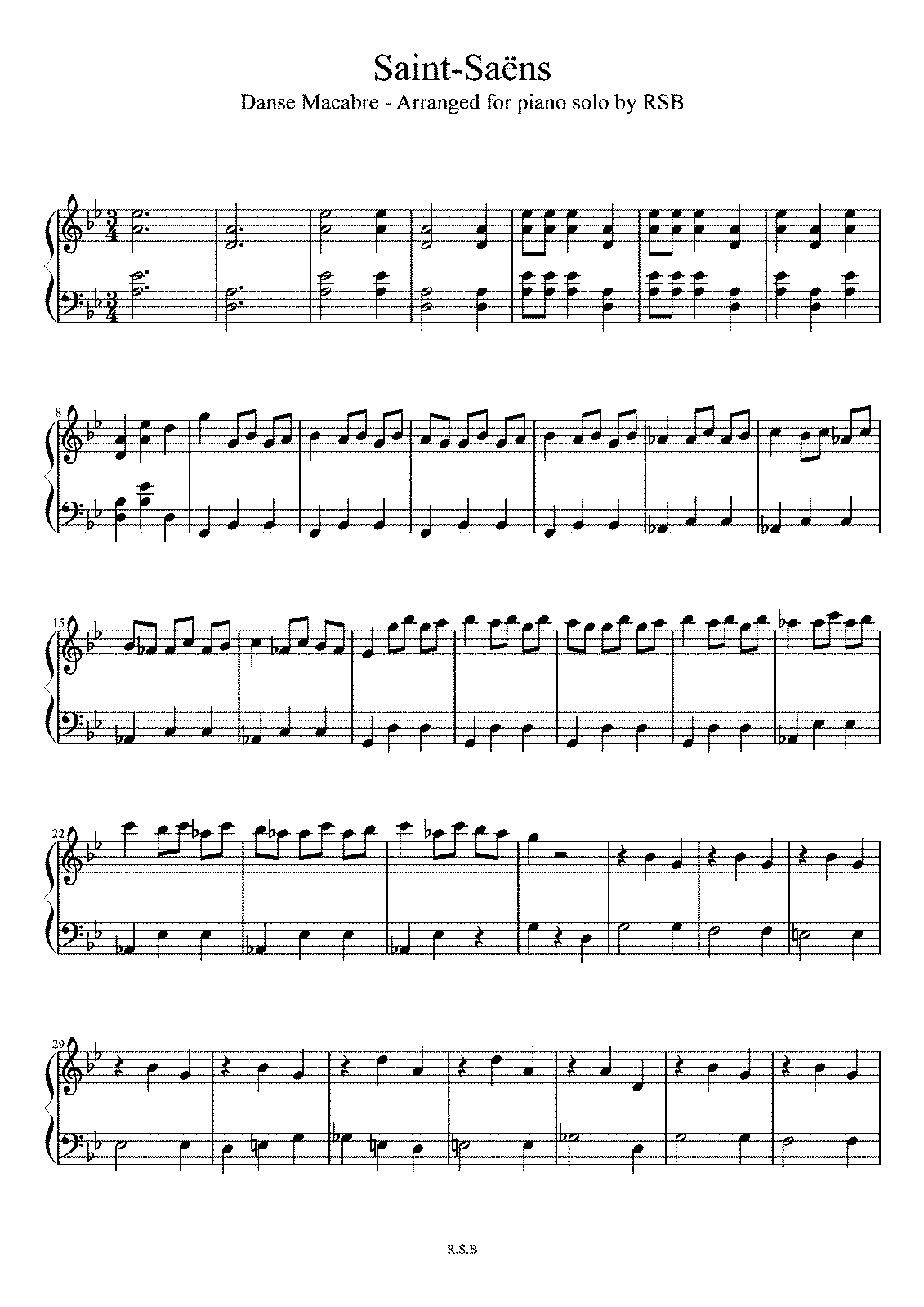
Getting Ready for Halloween: Danse Macabre by Camille Saint-Saëns

danse-macabre

Danse macabre, Op. 40, is a tone poem for orchestra, written in 1874 by French composer Camille Saint-Saëns. It started out in 1872 as an art song for voice and piano with a French text by the poet Henri Cazalis, which is based on an old French superstition. In 1874, the composer expanded and reworked the piece into a tone poem, replacing the vocal line with a solo violin.

Get a free copy of the sheet music at IMSLP (Look for Arrangements and Transcriptions) or borrow a copy from the O’Connor Music Studio.  I have this arranged for organ, piano, duet, simplified…

Amazon has a great Dover edition for solo piano.  This splendid compilation features a variety of the composer’s best piano works, all reproduced from authoritative sources. Taking its title from the popular orchestral work “Danse Macabre” (presented here in the brilliant arrangement by Liszt), this collection also includes “Allegro appassionato,” “Album” (consisting of six pieces), “Rhapsodie d’Auvergne,” “Theme and Variations,” plus six etudes, three waltzes, and six etudes for left hand alone.

This video originally aired on PBS in the 1980s:


For two pianos:


Piano Tutorial:


Orchestra:

Getting Ready for Halloween: Funeral March of a Marionette by Charles Gounod

funeral

The Funeral March of a Marionette (Marche funèbre d’une marionnette) is a short piece by Charles Gounod. It was written in 1872 for solo piano and orchestrated in 1879. It is perhaps best known as the theme music for the television program Alfred Hitchcock Presents, which originally aired from 1955 to 1965.

In 1871-72, while residing in London, Gounod started to write a suite for piano called “Suite Burlesque”. After completing one movement, the Funeral March of a Marionette, he abandoned the suite and had the single movement published by Goddard & Co. In 1879 he orchestrated the piece. The instrumentation is: piccolo, flute, 2 oboes, 2 clarinets in A, 2 bassoons, 2 horns in D, 2 trumpets in A, 3 trombones, ophicleide, timpani, bass drum, triangle, strings. The work is in the key of D minor, with a central section in D major. Various arrangements by other hands exist.

There is a program underlying the Funeral March of a Marionette: The Marionette has died in a duel. The funeral procession commences (D minor). A central section (D major) depicts the mourners taking refreshments, before returning to the funeral march (D minor).
The score contains the following inscriptions in appropriate places:

La Marionnette est cassée!!! (The Marionette is broken!!!)
Murmure de regrets de la troupe (Murmurs of regret from the troupe)
Le Cortège (The Procession)
Ici plusieurs des principaux personnages de la troupe s’arrêtent pour sa rafrâichir (Here many of the principal personages stop for refreshments)
Retour a la maison (Return to the house). (Wikipedia)

Download this music in several versions from IMSLP.  Click on Arrangements and Transcriptions.  There are also some arrangements for piano at the O’Connor Music Studio.

On Alfred Hitchcock:

From Faber Piano Adventures Performance Book Level 3B No.7 (Also available in the OCMS Library):

Piano 4-hands:

With animation:

On organ:

Mannheim Steamroller:

And, finally, a light show!

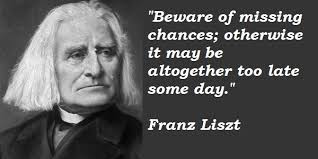
Happy Birthday to Franz Liszt!

liszt-quote

Franz Liszt was born in Raiding, near Ödenburg, October 22, 1811 and died in Bayreuth, July 31, 1886. He was a Hungarian composer and pianist who was a major influence during the romantic period. Liszt was an outstanding pianist at seven, composed at eight and made concert appearances at nine. In addition to being a piano virtuoso, he was also a critic, conductor, city music director, literary writer and transcriber of the works of other composers. He transcribed Beethoven’s Symphonies for the piano.

Franz Liszt began his career as the outstanding concert pianist of the century, who, along with the prodigious violinist Niccoló Paganini (1782-1840), created the cult of the modern instrumental virtuoso. To show off his phenomenal and unprecedented technique, Liszt composed a great deal of music designed specifically for this purpose, resulting in a vast amount of piano literature laden with dazzling, and other technical marvels. In this vein, Liszt composed a series of virtuosic rhapsodies on Hungarian gypsy melodies, the best-known being the all too familiar Hungarian Rhapsody no. 2. Liszt developed the rhapsody as a form of serious music. This kind of music is worlds apart from the generally more introspective, poetic music of pianist-composer Frédéric Chopin.

Liszt was wildly handsome and hugely talented. He was extremely popular in Paris during the 1830’s. It is said that women actually fainted at his piano recitals. He was the first to position the piano so that its lid reflected the sound and the audience could see his profile as he performed.

Liszt was the first to write a tone poem, which is an extended, single-movement work for orchestra, inspired by paintings, plays, poems or other literary or visual works, and attempting to convey the ideas expressed in those media through music. Such a work is Les Préludes, based on a poem in which life is expressed as a series of struggles, passions, and mysteries, all serving as a mere prelude to . . .what? The Romantic genre of the symphonic poem, as well as its cousin the concert overture, became very attractive to many later composers, including Saint-Saëns, TchaikovskyDvorák, Sibelius, and Richard Strauss.


     Liszt’s birthday

     anniversary of Liszt’s death

    Listen to Liszt’s transcription of Meyerbeer’s Hellish Waltz from Robert du Diable, which probably caused more public commotion than any other piano piece in history.


     Read quotes by and about Liszt

     Liszt was the first recitalist

     In Praise of Pianos and the Artists Who Play Them

     History of the Piano

     Franz Liszt

October 4, 2016 ~ Today in Music History

today


• 1812 ~ Fanny Perisiani, Italian coloratura soprano

• 1881 ~ The player piano was invented by Edward Leveaux of Sussex, England, who received a patent for it this day. There were many player piano inventions going on throughout the world during this time. Leveaux happened to be the lucky chap who received the patent England was handing out.

• 1929 ~ Leroy Van Dyke, Singer

• 1939 ~ A barber from Canonsburg (near Pittsburgh), PA, who had quite a singing voice, recorded That Old Gang of Mine with the Ted Weems Orchestra. That singer was the feature of the Weems band for many years before going solo as a radio, TV and stage star. You know him as ‘The Incomparable Mr. C.’, Perry Como. His string of hits for RCA Victor spans four decades. He was an NBC mainstay for years and years.

• 1943 ~ Is You is or is You Ain’t My Baby? was the musical question by Louis Jordan and His Tympany Five on this day on Decca Records.

• 1947 ~ James Fielder, Bass with these groups: Buffalo Springfield, Mothers of Invention and Blood, Sweat & Tears

• 1948 ~ Gordon MacRae hosted the premiere of a radio classic. The Railroad Hour debuted on ABC radio. The theme song was I’ve Been Working on the Railroad and the show was sponsored by….America’s Railroads.

• 1949 ~ John Aler, American tenor

• 1959 – Chris Lowe, Keyboards with Pet Shop Boys

• 1966 ~ It was, indeed, a Sunny Day for singer Bobby Hebb, who received a shiny gold record award for his song.

• 1967 ~ Woody (Woodrow Wilson) Guthrie passed away

• 1970 ~ Janis Joplin died from a drug overdose. She was 27. Joplin, known for her passionate, bluesy, vocal style, was the lead singer of Big Brother and the Holding Company. She became a superstar with hits like, Down on Me, Pearl (her nickname) and Every Little Piece of My Heart; but Me and Bobby McGee was her only certified top 40 hit. The Bette Midler movie, The Rose, was based on Joplin’s life.

• 1999 ~ Art Farmer passed away

• 2000 ~ International diplomat and Newport Music Festival director David Meredith Evans died at the age of 64.

• 2001 ~ Irmgard Farden Aluli, considered the most prolific female Hawaiian composer since Queen Liliuokalani, died after suffering complications from colon cancer surgery. She was 89. Aluli, affectionately nicknamed “Aunty”, became the first living member to be inducted into the Hawaiian Music Hall of Fame in 1998. In August, the Prince Kuhio Hawaiian Civic Club honored her as a cultural living treasure. She wrote more than 200 songs, including Boy from Laupahoehoe and E maliu Mai. Aluli began performing publicly after graduating from St. Andrew’s Priory in 1929. She was a member of the Annie Kerr Trio in the 1930s. In the late 1960s, Aluli, her daughters and a niece formed the group Puamana.

• 2001 ~ Jazz guitarist John Collins, who played with Nat King Cole for over a decade, died at the age of 83. Collins was born in Montgomery, Ala., and grew up in Chicago. His mother, Georgia Gorham, was a pianist and bandleader. Collins briefly played clarinet before switching to guitar and moving to New York, where he played with prominent jazzmen such as pianist Art Tatum. Collins accompanied singer Billie Holiday and saxophonist Lester Young in the 1940s and played in bands led by Benny Carter and Fletcher Henderson. He served in the Army during World War II, and played in Army bands. Esquire magazine gave Collins its New Star award as best guitarist of 1947, his lone jazz poll honor. Collins’ 14-year association with Cole began in 1951, when he replaced guitarist Oscar Moore. Collins played with Cole until the latter’s death in 1965. Collins went on to tour Europe with his own group. He played occasionally around Southern California in the 1990s but worked mainly as a private teacher.

September 18, 2016 ~ Today in Music History

today

• 1763 ~ An instrument named the spinet was mentioned in The Boston Gazette newspaper on this day. John Harris made the spinet, a small upright piano with a three to four octave range. There is no verifiable evidence to support the rumor that a man named Spinetti made the first spinet.

• 1809 ~ The Theatre Royal at Covent Garden re-opened after being destroyed by fire the year before. The Theatre Royal at Covent Garden began in Bow Street in 1732. It was designed by E.M. Barry in classical style. He also built for the theatre’s management the Floral Hall next door in glass and iron, meant to be a straightforward rival to the Bedford’s flower market. Both of Barry’s buildings are now part of the rebuilt Royal Opera House at Covent Garden complex.

• 1838 ~ Emil Scaria, Austrian bass-baritone

• 1910 ~ Josef Tal, Polish-born Israeli composer and pianist

• 1917 ~ The Honolulu Ad Club registered a patent for the ukulele.

• 1927 ~ The Columbia Broadcasting System was born on this day, although its rival, NBC, had been on the air for some time. The Tiffany Network, as CBS was called, broadcast an opera, The King’s Henchman, as its first program. William S. Paley put the network together, purchasing a chain of 16 failing radio stations. The controlling interest cost between $250,000 and $450,000. The following year, the 27-year-old Paley became President of CBS. It only took one more year for him to profit 2.35 million dollars as the network grew to over 70 stations. In 1978 Paley received the First Annual ATAS (Academy of Television Arts and Sciences) Governor’s Award as Chairman of the Board of CBS.

• 1929 ~ Teddi King, Singer

• 1933 ~ Jimmie Rodgers, Singer

• 1939 ~ Frankie (Frances) Avalon (Avellone), American rock-and-roll singer

• 1947 ~ Country singers Ernest Tubb and Roy Acuff performed at Carnegie Hall in New York City. It was the first country show for the NYC venue.

• 1948 ~ The Original Amateur Hour returned to radio on ABC, two years after the passing of the program’s originator and host, Major Bowes. Bowes brought new star talent into living rooms for 13 years. Ted Mack, the new host, had also started a TV run with The Original Amateur Hour on the DuMont network in January of 1948.

• 1949 ~ Kerry Livgren, Guitar, keyboards with Kansas

• 1952 ~ Dee Dee Ramone (Douglas Colvin), Drummer with The Ramones

• 1955 ~ What had been The Toast of the Town on CBS Television (since 1948) became The Ed Sullivan Show. This “rilly big shew” remained a mainstay of Sunday night television until June 6, 1971. Sullivan was a newspaper columnist/critic before and during the early years of this pioneering TV show.

• 1957 ~ The Big Record, hosted by ‘the singing rage’, Miss Patti Page, debuted on CBS-TV. The Big Record was a live musical showcase featuring established artists singing their big songs. The Big Record lasted one big season.

• 1962 ~ Joanne Catherall, Singer with Human League

• 1967 ~ Ricky Bell, Singer with New Edition

• 1969 ~ Tiptoeing through late night TV, Tiny Tim announced his engagement to Miss Vicki Budinger. Johnny Carson, host of The Tonight Show, was so enthralled with the falsetto voiced singer that he invited the couple to get married on the show. They did on December 17, 1969 and TV history was made.

• 1970 ~ Rock radio mourned the loss of rock music legend, Jimi Hendrix. He died at age 27 of an overdose of sleeping pills. His Purple Haze and Foxy Lady became anthems for a generation at war in Vietnam.

• 1997 ~ Jimmy Witherspoon passed away

Parent’s Guide to the Piano Maestro App for iPad

Piano Mania

It will be fun watching your child improve their piano skills all while having fun using Piano Maestro in lessons each week!

As your child’s teacher (or YOUR teacher!), I’m looking forward to seeing the progress they will make when they start using it at home each day. This guide will help you understand how this app will benefit your child and how to get it set up on your own iPad.

Overview
What is Piano Maestro?

Piano Maestro is the ultimate piano practice tool that will have students quickly playing their favorite classical, pop, rock, TV and video game songs and themes. It is available in the App Store and works on the iPad.

What skills does it improve?
• Note reading
• Sight reading
• Rhythm
• Inner pulse
• Confidence

What makes it so fun?
• Upbeat background tracks
• Stunning graphics
• Instant rewards and feed back
• Satisfaction of playing REAL music

It works with an acoustic piano?

Yes! Your child practices on your real acoustic or digital piano. Piano Maestro listens from the iPad’s built in microphone. No wires needed.

I’m already paying for lessons and books. What value does this add?

Sometimes I wish I could be there with your child to encourage them to keep practicing daily. I’m sure it’s not always easy, as unforeseen challenges will arise.

Since our time each week is just too short, this app will give me eyes on the ground and it will keep them practicing longer and improving more quickly.

How will it be used in lessons?

I will spend a few minutes of each lesson helping your child master a couple of new songs all while having fun! I will also teach them how to use the practice options at home.

At the end of the lesson, we will choose Home Challenge assignments within the app that will show up in your account at home. I’ll get updates when progress is made.

Getting Started
Wow, this sounds awesome. Now, how do I get started?

1) Download Piano Maestro on your iPad from the AppStore
2) Create a JoyTunes account with a parent’s email, under which, you can have multiple profiles for each member of the family.
3) Create a profile for each family member (that means you too Mom and Dad!) inside the Parent/Teacher zone (top right hand corner of main screen)
4) Connect to your teacher, me! After creating a profile in the “profiles” tab of the parent/teacher zone, select the student’s profile and click “connect to teacher.” Once I approve connection to your child, they will receive full access to all content for FREE! I will then also begin receiving weekly progress reports.
5) Start Playing – I will now start assigning you homework, meanwhile get started on Journey Mode.

When you connect to the O’Connor Music Studio, Piano Maestro is available for as long as you study here.

Are Your Children Are Ready To Begin Music Lessons?

child-piano

These days, there is much pressure for parents to begin their children in activities from an early age.  We know that children tend to pick up new skills easily and we want for them to have an opportunity to become experts at these new skills.  We also see curiosity, desire and eagerness to learn in our children and want to capitalize on that.

Music lessons are no exception.  We often get calls asking the question, “When is the best time to enroll my child in piano lessons?”  The answer to that is a tricky one, and varies for each child.  The right age for one may not be the right age for another.  Here are a few questions to ask yourself if you are considering enrolling your child in music lessons:

1.   Does my child have an attention span to sit still for chunks of time and listen to instruction?

Many teachers today are very creative in using off-bench activities during lessons and have a plethora of activities to make lessons fun and engaging.  However, the fact remains that your child will need to sit at the piano for some periods of time during the lesson.  It is important that your child have the attention span to do this.

Read more at  How do we know if children are ready to begin music lessons? « Piano Pedagogy @ The New School for Music Study.