January 7 in Music History

today

. 1762 ~ The first public concert by Wolfgang Amadeus Mozart, age 6 and his sister Nannerl, age 12 was on this day.

. 1857  ~ First performance of Franz Liszt‘s Piano Concerto No. 2 in A, in Weimar. Liszt conducted  and the soloist was his pupil, Hans von Bronsart.

. 1876 ~ William Yeates Hurlstone

. 1899 ~ Francis Poulenc, French composer
More information about Poulenc

. 1922 ~ Jean-Pierre Rampal, French flutist
More information about Rampal

. 1924 ~ George Gershwin completed the incomparable score of Rhapsody in Blue. Incidentally, George was only 26 years old at the time. George didn’t even have an interest in music until his family got him a piano when he was twelve. Nine years later he had his first hit, Swanee, with lyrics written by Irving Caesar. Rhapsody in Blue was commissioned in 1924 by Paul Whiteman and then orchestrated by Ferde Grofe of Grand Canyon Suite fame. This first orchestration of Gershwin’s score was never quite right. Grofe’s style didn’t gel with Gershwin’s. Several other artists attempted to do justice to Rhapsody in Blue, never quite making the grade. Some thirty years later, orchestra leader Hugo Winterhalter with Byron Janis at the piano did a jazzed up version; pretty close to the way Gershwin had described his piece. However, it wasn’t until Gershwin’s original solo piano was accompanied by a jazz band led by Michael Tilson Thomas, that the true arrangement of Rhapsody in Blue was heard. No matter how you hear it, Rhapsody in Blue will remain the signature of one of the most influential of composers, songwriters and pianists in American music history.

. 1926 ~ A famous marriage that endured for many years is remembered this day. It’s the wedding anniversary of George Burns and Gracie Allen who were married by a Justice of the Peace in Cleveland, Ohio.

. 1930 ~ Jack Greene, The Green Giant, CMA Male Vocalist, Album, Single and Song of the Year

. 1940 ~ The gate to Gene Autry’s Melody Ranch opened. The ‘singing cowboy’ would entertain on CBS radio for the next 16 years.

. 1941 ~ Good-for-Nothin’-Joe was recorded by the sultry Lena Horne. She sang the classic song with Charlie Barnet and his orchestra on Bluebird Records.

. 1942 ~ Paul Revere, Singer, keyboards with Paul Revere and The Raiders

. 1946 ~ Jann Wenner, Publisher of Rolling Stone Magazine

. 1947 ~ “Rudolph the Red-Nosed Reindeer” was the #1 song on the U.S. pop charts

. 1948 ~ Kenny Loggins, American pop-rock singer, Grammy Award-winning songwriter and guitarist

. 1950 ~ Ernest Tubb made his first appearance at The Grand Ole Opry in Nashville, TN. Ernest also did a 15-minute radio program each day that became very popular in West Texas. So popular, in fact, that he bought the radio station that had aired the program for years and years: KGKL in San Angelo, Texas.

. 1955 ~ The first black singer at the Metropolitan Opera was Marian Anderson, who appeared as Ulrica in Verdi’s “The Masked Ball”.

. 1958 ~ The Flying V guitar, which is a favorite of rock musicians, was patented this day by the Gibson Guitar Company.

. 1985 ~ Yul Brynner returned to the Broadway stage this night as “The King and I” returned to where Yul first began his reign, 33 years before. Through his career to that date, Brynner appeared in 4,434 shows without missing a single performance.

. 2002 ~ Jon Lee, drummer for the Welsh rock band Feeder, died at the age of 33. The trio’s biggest hit single was the 2001 single Buck Rogers, which reached No. 5 on the British charts. Feeder released its first full-length album, “Polythene,” in England in 1997; it was released in the United States in early 1998. The band released its third album, “Echo Park,” last year, which debuted at No. 5 in Britain and swiftly sold more than 100,000 copies.

. 2002 ~ Nauman Steele Scott III, co-owner of Black Top Records which gained an international reputation for its blues, rhythm-and-blues and zydeco recordings, died. Scott suffered from heart disease. He was 56. Scott owned Black Top Records with his brother, Hammond. The label featured such artists as Earl King, Snooks Eaglin and the Neville Brothers. Black Top releases picked up two Grammy nominations and have won more than 30 W.C. Handy Blues Awards.

. 2018 ~ Ray Thomas, Moody Blues Founding Member, died at the age of 76. Born in 1941, Thomas founded The Moody Blues in 1964 with fellow musicians including Mike Pinder and Denny Laine.


January 1 in Music History

new-year-ani

Happy New Year!

• 1701 ~ Johann Joachim Agrell, Composer
More information about Agrell

• 1735 ~ Paul Revere, American patriot and music engraver

• 1764 ~ In a stunning demonstration of prodigious talent, the Royal Family at Versailles in France was treated to a brilliant recital by an eight year old musician. His name was Wolfgang Amadeus Mozart.

• 1878 ~ Edwin Franko Goldman, Composer

1900 ~ Xavier Cugat (Francisco de Asís Javier Cugat Mingall de Brue y Deulofeo). Spanish violinist, composer and band leader, married to Abbe Lane and Charo
More information about Cugat

• 1916 ~ Earl Wrightson, Actor, singer

• 1923 ~ Milt Jackson, Vibes with The Modern Jazz Quartet

• 1925 ~ Lucrezia Bori and John McCormack of the famous Metropolitan Opera in New York City made their singing debuts on radio this day. The broadcast over what was WEAF Radio (now WABC) encouraged others to sing on radio. Some of those were Hootie and the Blowfish, and Barry Manilow.

• 1928 ~ Frank Pourcel, Composer, violinist

• 1942 ~ Country Joe McDonald, Singer with Country Joe & the Fish

• 1953 ~ A sad day in country music, as the legendary Hank Williams died at the young age of 29. Undisputedly, the biggest star in the history of country music, Hank Williams’ legacy is being carried on by his son, Hank Williams, Jr.

• 1955 ~ Elvis Presley appeared at The Eagles Hall in Houston Texas. Presley went on to play over 250 shows in 1955.

• 1958 ~ Johnny Cash played his first-ever prison concert —a concert that helped set Merle Haggard, then a 20-year-old San Quentin inmate, on the path toward becoming a country music legend.

• 1968 ~ A group known as The Blue Velvets decided to change its name this day and it’s a good thing they did. The new name soon became a national pop music favorite as Creedence Clearwater Revival climbed to stardom.

• 1972 ~ Maurice Chevalier passed away. Chevalier was a French actor, Cabaret singer and entertainer.

• 1984 ~ Alexis Korner passed away. Korner was a British blues musician and radio broadcaster, who has sometimes been referred to as “a founding father of British blues”.

• 2000 ~ Ray Walston, who found commercial success playing a comical devil in the play “Damn Yankees” and an extraterrestrial on the sitcom “My Favorite Martian,” of natural causes at the age of 86. Walston caught the biggest break of his career when he won a Tony in 1955 for his performance in Broadway’s “Damn Yankees.” The smash musical told the story of a frustrated baseball fan who sells his soul. His screen debut came in the 1957 movie “Kiss Them For Me” with Cary Grant, and the next year he played the devil again in the film version of “Damn Yankees.” Walston snagged the role that would stick with him for a lifetime – that of a lovable alien on the TV show “My Favorite Martian” in 1963. The show was immensely popular, but Walston felt so typecast that he tried to highlight his dramatic abilities by returning to the stage when the TV comedy went off the air in 1966. He stayed in theater for several years before re-emerging with a succession of solid supporting roles in movies and television. Nearly 30 years after the end of the lighthearted “My Favorite Martian,” Walston’s role on “Picket Fences” as acerbic Judge Henry Bone earned Walston successive Emmys in 1995-96.

• 2016 ~ Chart-topping R&B singer Natalie Cole, who followed her famous father in the music business with hits like “This Will Be (An Everlasting Love) and “Unforgettable,” died at age 65.

maryorhhappynewyear

December 12 ~ This Day in Music History

hanukkah

Hanukkah
Hanukkah Music
Hanukkah Music Lyrics


Hanukkah 2017 begins at sunset (4:48 at the O’Connor Music Studio) on Tuesday, December 12 and ends on Wednesday, December 20.

Christmas Music: Still, Still, Still

• 1887 ~ Kurt Atterberg

• 1915 ~ Frank (Francis Albert) Sinatra, American actor and singer of popular music

• 1918 ~ Joe Williams (Joseph Goreed), Jazz singer, sang with Count Basie, actor on The Bill Cosby Show

• 1938 ~ Connie Francis (Concetta Franconero), American singer and actress

• 1941 ~ Terry Kirkman, Wind instruments, keyboards with The Association

• 1941 ~ Dionne Warwick, American Grammy Award-winning of popular music

• 1942 ~ Mike Pindar, Keyboards with The Moody Blues

• 1943 ~ Dickie Betts, Guitar with The Allman Brothers and also Great Southern

• 1943 ~ Mike Smith, Organs, singer with The Dave Clark Five

• 1943 ~ Grover Washington, Jr., American jazz saxophonist

• 1946 ~ Clive Bunker, Drummer with Jethro Tull

• 1949 ~ Paul Rodgers, Piano, vocals with Free, Bad Company, The Firm

• 1959 ~ Sheila E. (Escovedo), Drummer, singer

• 1959 ~ Paul Rutherford, Singer with Frankie Goes to Hollywood

• 1984 ~ The group known as Band Aid, 38 of Britain’s top rock musicians, recorded Do They Know This is Christmas? for Ethiopian famine victims. Despite the best of intentions, much of the food raised never got to the starving Ethiopians. In fact, much of it was found rotting on docks, not fit for human consumption. More than a Band-Aid was needed to fix that political mess.

• 1989 ~ Lindsay Crosby, son of crooner Bing Crosby, died

• 2002 ~ Actor Brad Dexter, who rode with Yul Brynner as one of the “Magnificent Seven” and became a confidant of both Marilyn Monroe and Frank Sinatra, died. He was 85. Burly and handsome, he was often cast as a tough guy in supporting roles, which included 1958’s “Run Silent, Run Deep,” starring Burt Lancaster and Clark Gable, and 1965’s “None but the Brave,” starring Sinatra. He made his film debut in the “The Asphalt Jungle” in 1950, but his most prominent role came in 1960’s “The Magnificent Seven,” in which he starred with Brynner, Steve McQueen, Charles Bronson and James Coburn. Born Boris Milanovich in Goldfield, Nev., Dexter made guest appearances on the 1950s television shows “Zane Gray Theater,” “Death Valley Days” and “Wagon Train.” In January 1953, he married singer Peggy Lee, but they divorced eight months later. Soon after his divorce, Dexter befriended Monroe. In 1954, he tried unsuccessfully to persuade her to stay with her husband, Joe DiMaggio. His friendship with Sinatra took on legendary proportions during the filming of “None but the Brave” in 1964. On location in Hawaii, Sinatra nearly drowned and Dexter saved his life.

• 2002 ~ Marvin O. Herzog, who traveled the world with his for 58 years, died of pancreatic cancer. He was 70. Herzog was a polka celebrity who regularly booked 170 appearances a year. He and his band would travel more than 75,000 miles a year in a converted Greyhound bus. For years, Herzog was the star and co-sponsor of Frankenmuth’s Summer Music Fest, which drew about 25,000 visitors annually to the town known for its Bavarian events and shopping. Born in Frankenmuth, Herzog lived there his entire life. He quit his job at Star of the West Milling in 1973 to concentrate full-time on polka music. He played a Cordovox – a mix of organ and accordion. Herzog recorded 32 albums, including his Schnitzelbank and Octoberfestrecords in German as well as Polish, Italian and English polkas. He had a radio show and co-hosted a television show. Herzog was inducted into the International Polka Association Hall of Fame in 1979.

December 3 ~ This Day in Music History

today


Christmas Music: Angels We Have Heard On High

• 1596 ~ Nicola Amati, Italian violin maker, teacher of Guarneri and Stradivari

• 1729 ~ Padre Antonio Francisco Javier Jose Soler, Spanish composer whose works span the late Baroque and early Classical music eras. He is best known for his keyboard sonatas, an important contribution to the harpsichord, fortepiano and organ repertoire.

• 1876 ~ Hermann Goetz died.  He was a German composer.

OCMS 1883 ~ Anton Webern, Austrian composer and conductor
Read quotes by and about Webern
More information about Webern

• 1907 ~ Connie (Connee) Boswell, Singer Connie or Connee (a spelling she preferred later in life), who also played several musical instruments, arranged vocals for herself and her two sisters. Although she was stricken with polio and worked from her wheelchair, she never let this get in the way of being part of her jazz-singing trio. The Boswell Sisters’ talent was quickly recognized and by the time Connee was 24 years old, the sisters were doing vaudeville, radio, playing New York’s Paramount Theatre, recording with the Dorsey Brothers: You Oughta Be in Pictures; making films and appearing on the U.S.A.’s first public TV broadcast. One thing led to another and Connie went solo, entertaining World War II troops, making films, appearing on Broadway and recording with big names like Woody Herman’s; even a duet classic with Bing Crosby: Basin Street Blues. Her musical influence spanned many generations and music styles. If you’d have asked Ella Fitzgerald, she would have told you, “They just don’t make ’em like Connee Boswell anymore.”

OCMS 1923 ~ Maria Callas (Calogeropoulous), American soprano
More information about Callas Read quotes by and about Callas

• 1925 ~ The first jazz concerto for piano and orchestra was presented at Carnegie Hall in NYC. Commissioned by Walter Damrosch, American composer George Gershwin presented Concerto In F, and was also the featured soloist playing a flugelhorn in a slow, bluesy style as one of his numbers.

• 1927 ~ Phyllis Curtin, Singer: soprano with the New York City OperaMetropolitan Opera, Vienna Staatsoper, La Scala, Teatro Colon; coordinator of Voice Dept and Opera at Yale School of Music, Dean Emerita of Boston Univ School for the Arts

• 1927 ~ Ferlin Husky (aka: Simon Crum, Terry Preston), Singer

• 1930 ~ Andy (Howard Andrew) Williams, American Emmy Award-winning entertainer, singer

• 1931 ~ Jaye P. (Mary Margaret) Morgan, Singer, performer

• 1941 ~ Johann Christian Sinding, Norwegian composer

• 1944 ~ Frank Sinatra was in the Columbia Records studio recording Old Man River.

• 1948 ~ Ozzy (John) Osbourne, Songwriter, singer

• 1949 ~ Mickey Thomas, Singer with Jefferson Starship

• 1953 ~ Kismet opened on Broadway in New York. The show ran for 583 performances.

• 1955 ~ Elvis Presley’s first release on RCA Victor Records was announced. No, it wasn’t Hound Dog or Heartbreak Hotel. The first two sides were actually purchased from Sam Phillips of Sun Records: Mystery Train and I Forgot to Remember to Forget. Elvis was described by his new record company as “The most talked about personality in recorded music in the last 10 years.”

• 1960 ~ Camelot opened at the Majestic Theatre in New York City. Richard Burton and Julie Andrews played the leading roles in the musical written by Lerner and Loewe. Robert Goulet got rave reviews for his songs, If Ever I Would Leave You,Then You May Take Me to the Fair and How to Handle a Woman, among others. Camelot had a run of 873 performances. Broadway went Hollywood in the 1967 film version of Camelot. Its run was not quite as successful.

• 1968 ~ The O’Kaysions received a gold record for Girl Watcher. The song had a promotional reprise in the 1990s as a theme for Merv Griffin’s Wheel of Fortune, with the revamped lyrics, I’m a Wheel Watcher…

• 1977 ~ After 29 weeks in the #1 position on the album charts (a record, literally…), Rumours, by Fleetwood Mac, was replaced at the top spot by the album Simple Dreams, sung by Linda Ronstadt.

• 1999 ~ Handel’s Messiah Gets Modern Makeover in Ireland

• 2000 ~ Kevin Mills, a member of the Christian rock groups Newsboys and White Heart, died after a motorcycle accident in Hollywood. He was 32. Mills, of Louisville, Ky., was a singer and bass player, his family said. He also was a member of the Screen Actors Guild and appeared on TV in “An Inconvenient Woman” in 1991. White Heart started in 1982. Newsboys, an Australian band now based near Nashville, was formed four years later. Newsboys have sold nearly 3 million records and earned three Grammy nominations on the religious rock circuit.

• 2000 ~ Washington Honored Eastwood, Baryshnikov, Others

• 2002 ~ Rich Dangel, credited with creating the opening guitar chords of garage band staple Louie Louie, died of an aneurysm at his home. He was 60. Dangel was a member of the seminal Northwest rock band the Wailers, who introduced the nation to the Northwest sound – raw, unpolished and catchy. He may be best known for coming up with the power chords that opened the Wailers’ 1961 regional hit, Louie, Louie, written by rhythm-and-blues singer Richard Berry and taken to the top of the national charts by another Northwest band, the Kingsmen from Portland, Ore. Dangel co-wrote his first chart hit, “Tall Cool One” with fellow Wailer John Greek when he was still in high school. The song resulted in the group’s first album, “The Fabulous Wailers,” a cross-country tour and a 1959 appearance on Dick Clark’s “American Bandstand.”

November 3 ~ This Day in Music History

today


.1587 ~ Samuel Scheidt, German organist and composer

.1801 ~ Vincenzo Bellini, Italian composer

OCMS 1911 ~ Vladimir Ussachevsky, Russian-born American composer
More information about Ussachevsky

.1933 ~ John Barry, Academy Award~winning composer

.1941 ~ The classic Jerry Gray arrangement of String of Pearls was recorded by the Glenn Miller Orchestra on Bluebird 78s. The recording featured the trumpet of Bobby Hackett.

.1948 ~ Lulu (Marie McDonald McLaughlin Lawrie), Singer. She changed her name to Lulu (and The Luvvers) in Scotland, early in her career. Married to singer Maurice Gibb

.1954 ~ Adam Ant (Stuart Goddard), Singer

.1956 ~ The classic MGM film, The Wizard of Oz, was first seen on television. The film cost CBS $250,000 to show. The movie was shown 18 times between 1956 and 1976, and you can probably catch it again no matter what year it is.

.1957 ~ Sam Phillips, owner of legendary Sun Records in Memphis, TN, released Great Balls of Fire, by Jerry Lee Lewis. Looking carefully at the original label, one will find credit to Lewis and “his pumping piano.”

.1960 ~ James Prime, Keyboards with Deacon Blue

.1960 ~ “The Unsinkable Molly Brown”, opened on Broadway. The play would become an American theater standard and a smashing career launch for Shirley MacLaine.

.1962 ~ Billboard magazine dropped the “Western” from its chart title. The list has been known as Hot Country Singles ever since.

.1972 ~ Singers Carly Simon and James Taylor were married in Carly’s Manhattan apartment. The couple was said to be the highest-paid couple in the world next toElizabeth Taylor and Richard Burton. Carly and ‘Sweet Baby’ James would divorce years later, but they are still good friends.

.1990 ~ Mary Martin died

.2000 ~ Mary Hunter Wolf, one of the first female directors on Broadway died at the age of 95. Wolf made her Broadway debut directing the 1944 production of Horton Foote’s “Only the Heart.” The following year, she directed the first black Broadway musical, “Carib Song.” After directing a string of successful plays and musicals, Wolf was hired as an associate director for Jerome Robbins’ “Peter Pan,” starring Mary Martin. In 1947 Wolf was tapped to direct a new musical “High Button Shoes,” but was dismissed by the show’s producers before rehearsals began. Wolf sued, charging that her contract had been broken because she was a woman. Two years later the New York Supreme Court ruled in her favor. During her third year at Wellesley College, Wolf visited her aunt, author Mary Austin, in Santa Fe, N.M. where she found herself introduced into the circle of D.H Lawrence, Willa Cather and Sinclair Lewis. She soon abandoned her studies to pursue a directing career.

Happy Halloween: Toccata and Fugue in d minor by J.S Bach

toccata-d-minor


Johann Sebastian Bach’s towering monument of organ music, with its deep sense of foreboding, will forever be associated with Halloween.

Get a free copy of the sheet music at IMSLP or borrow a copy from the O’Connor Music Studio.  I have this arranged for organ, piano, duet, 2-piano, simplified…

If you want this in a book with other Bach transcriptions, amazon has this: Toccata and Fugue in D Minor and the Other Bach Transcriptions for Solo Piano, arranged by Ferruccio Busoni.

Here, Virgil Fox performs it on his Allen Digital Touring Organ.


Diane Bish plays the Massey Memorial Organ at the Chautauqua Institution and talks about this instrument.


And, the most fun…

Halloween Music: In the Hall of the Mountain King by Edvard Grieg

hall-mountain


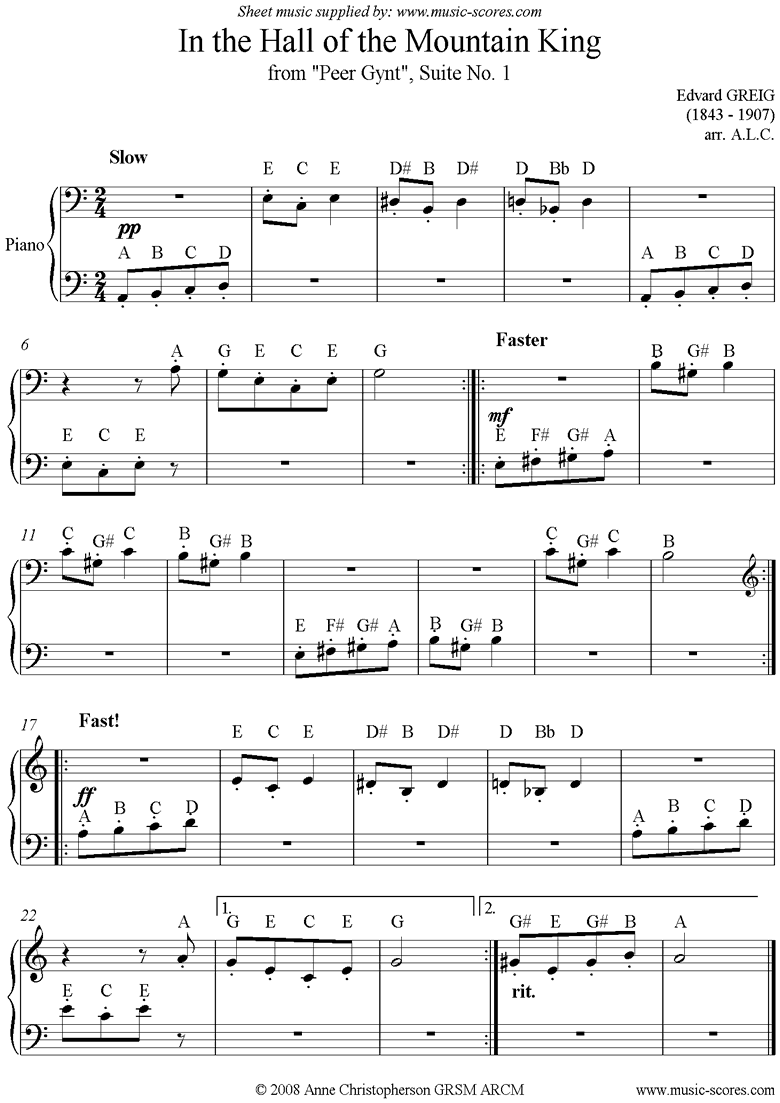
“In the Hall of the Mountain King” is a piece of orchestral music composed for the sixth scene of act 2 in Henrik Ibsen’s 1867 play Peer Gynt. It was originally part of Opus 23 but was later extracted as the final piece of Peer Gynt, Suite No. 1, Op. 46. Its easily recognizable theme has helped it attain iconic status in popular culture, where it has been arranged by many artists, including for the piano.

Borrow a copy of the sheet music from the O’Connor Music Studio.  I have this arranged for piano, duet, 2-piano, simplified…


8 part vocal orchestra (plus a tiny pair of cymbals)


Pianist Paul Barton


Solo piano sheet music – Video Score


Orchestral version

Halloween Music: Danse Macabre by Camille Saint-Saëns

danse-macabre

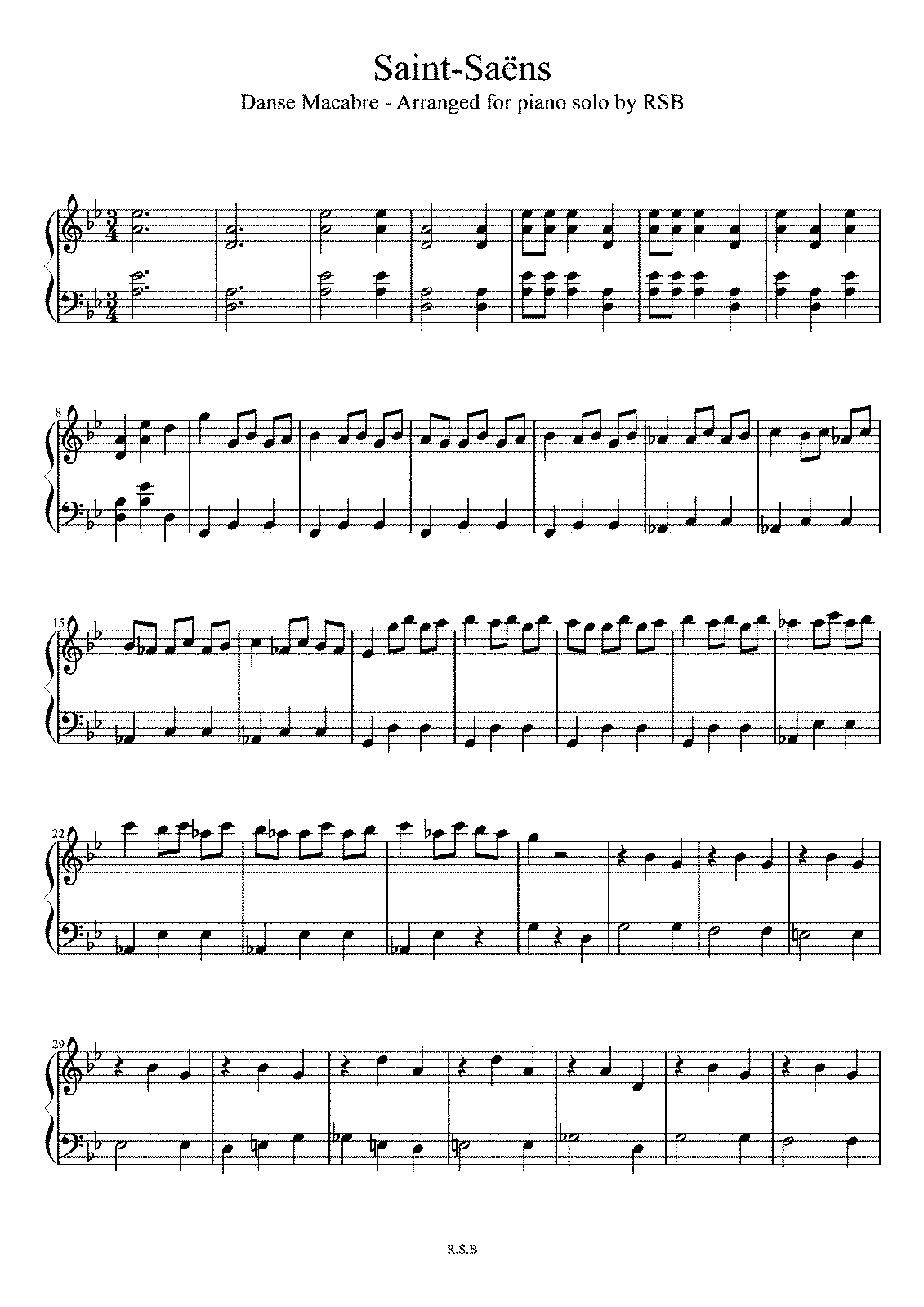
Danse macabre, Op. 40, is a tone poem for orchestra, written in 1874 by French composer Camille Saint-Saëns. It started out in 1872 as an art song for voice and piano with a French text by the poet Henri Cazalis, which is based on an old French superstition. In 1874, the composer expanded and reworked the piece into a tone poem, replacing the vocal line with a solo violin.

Get a free copy of the sheet music at IMSLP (Look for Arrangements and Transcriptions) or borrow a copy from the O’Connor Music Studio.  I have this arranged for organ, piano, duet, simplified…

Amazon has a great Dover edition for solo piano.  This splendid compilation features a variety of the composer’s best piano works, all reproduced from authoritative sources. Taking its title from the popular orchestral work “Danse Macabre” (presented here in the brilliant arrangement by Liszt), this collection also includes “Allegro appassionato,” “Album” (consisting of six pieces), “Rhapsodie d’Auvergne,” “Theme and Variations,” plus six etudes, three waltzes, and six etudes for left hand alone.

This video originally aired on PBS in the 1980s:


For two pianos:


Piano Tutorial:


Orchestra:

Halloween Music: Funeral March of a Marionette by Charles Gounod

funeral

The Funeral March of a Marionette (Marche funèbre d’une marionnette) is a short piece by Charles Gounod. It was written in 1872 for solo piano and orchestrated in 1879. It is perhaps best known as the theme music for the television program Alfred Hitchcock Presents, which originally aired from 1955 to 1965.

In 1871-72, while residing in London, Gounod started to write a suite for piano called “Suite Burlesque”. After completing one movement, the Funeral March of a Marionette, he abandoned the suite and had the single movement published by Goddard & Co. In 1879 he orchestrated the piece. The instrumentation is: piccolo, flute, 2 oboes, 2 clarinets in A, 2 bassoons, 2 horns in D, 2 trumpets in A, 3 trombones, ophicleide, timpani, bass drum, triangle, strings. The work is in the key of D minor, with a central section in D major. Various arrangements by other hands exist.

There is a program underlying the Funeral March of a Marionette: The Marionette has died in a duel. The funeral procession commences (D minor). A central section (D major) depicts the mourners taking refreshments, before returning to the funeral march (D minor).
The score contains the following inscriptions in appropriate places:

La Marionnette est cassée!!! (The Marionette is broken!!!)
Murmure de regrets de la troupe (Murmurs of regret from the troupe)
Le Cortège (The Procession)
Ici plusieurs des principaux personnages de la troupe s’arrêtent pour sa rafrâichir (Here many of the principal personages stop for refreshments)
Retour a la maison (Return to the house). (Wikipedia)

Download this music in several versions from IMSLP.  Click on Arrangements and Transcriptions.  There are also some arrangements for piano at the O’Connor Music Studio.

On Alfred Hitchcock:

From Faber Piano Adventures Performance Book Level 3B No.7 (Also available in the OCMS Library):

Piano 4-hands:

With animation:

On organ:

Mannheim Steamroller:

And, finally, a light show!

Happy Birthday, Franz Liszt!

liszt-quote

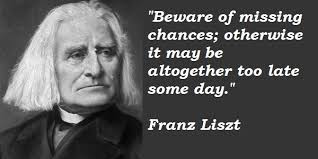
Franz Liszt was born in Raiding, near Ödenburg, October 22, 1811 and died in Bayreuth, July 31, 1886. He was a Hungarian composer and pianist who was a major influence during the romantic period. Liszt was an outstanding pianist at seven, composed at eight and made concert appearances at nine. In addition to being a piano virtuoso, he was also a critic, conductor, city music director, literary writer and transcriber of the works of other composers. He transcribed Beethoven’s Symphonies for the piano.

Franz Liszt began his career as the outstanding concert pianist of the century, who, along with the prodigious violinist Niccoló Paganini (1782-1840), created the cult of the modern instrumental virtuoso. To show off his phenomenal and unprecedented technique, Liszt composed a great deal of music designed specifically for this purpose, resulting in a vast amount of piano literature laden with dazzling, and other technical marvels. In this vein, Liszt composed a series of virtuosic rhapsodies on Hungarian gypsy melodies, the best-known being the all too familiar Hungarian Rhapsody no. 2. Liszt developed the rhapsody as a form of serious music. This kind of music is worlds apart from the generally more introspective, poetic music of pianist-composer Frédéric Chopin.

Liszt was wildly handsome and hugely talented. He was extremely popular in Paris during the 1830’s. It is said that women actually fainted at his piano recitals. He was the first to position the piano so that its lid reflected the sound and the audience could see his profile as he performed.

Liszt was the first to write a tone poem, which is an extended, single-movement work for orchestra, inspired by paintings, plays, poems or other literary or visual works, and attempting to convey the ideas expressed in those media through music. Such a work is Les Préludes, based on a poem in which life is expressed as a series of struggles, passions, and mysteries, all serving as a mere prelude to . . .what? The Romantic genre of the symphonic poem, as well as its cousin the concert overture, became very attractive to many later composers, including Saint-Saëns, TchaikovskyDvorák, Sibelius, and Richard Strauss.


     Liszt’s birthday

     anniversary of Liszt’s death

    Listen to Liszt’s transcription of Meyerbeer’s Hellish Waltz from Robert du Diable, which probably caused more public commotion than any other piano piece in history.


     Read quotes by and about Liszt

     Liszt was the first recitalist

     In Praise of Pianos and the Artists Who Play Them

     History of the Piano

     Franz Liszt