. 1905 ~ Nadia Boulanger made her public concert debut at the piano.
. 1924 ~ Christa Ludwig, German mezzo-soprano
. 1935 ~ Theresa Berganza, Spanish mezzo-soprano
. 1937 ~ David Del Tredici, American composer
. 1942 ~ Fats Waller recorded The Jitterbug Waltz in New York for Bluebird Records. The Jitterbug Waltz was inspired by some piano exercises that Waller’s son Maurice had been practicing on the piano.
. 1955 ~ The Ballad of Davy Crockett, by Bill Hayes, reached the number one spot on the pop music charts and stayed for five weeks beginning this day. The smash hit song sold more than 7,000,000 records on more than 20 different labels. Everyone seemed to be singing the song that saluted the frontier hero who was “Born on a mountain top in Tennessee…” Coonskin caps were seen everywhere as the Crockett craze spread like a frontier fire.
. 1963 ~ Peter, Paul and Mary released the single, Puff The Magic Dragon.
. 1971 ~ Simon & Garfunkel’s Bridge Over Troubled Water LP and single won six Grammys including Record, Song and Album of the Year. Aretha Franklin won the Best Female R&B Performance Grammy for Don’t Play That Song. B.B. King won the Best Male R&B Vocal Performance Grammy for The Thrill Is Gone.
. 1983 ~ Arthur Godfrey passed away
. 1985 ~ A Chorus Line played performance number 4,000 this night at New York’s famed Shubert Theatre. The show originally opened in July, 1975, and became the longest-running show to light up the Great White Way in September, 1983.
. 1999 ~ Honoring a roster of music artists that range from The Beatles to the Backstreet Boys, the Recording Industry Association of America presented the first Diamond Awards, given in recognition of albums and singles that have sold a million copies or more.
. 1999 ~ Clarence “Gatemouth” Brown and the late Roosevelt Sykes were inducted into the Blues Foundation Hall of Fame.
. 2014 ~ Mitch Leigh, American musical composer (Man of La Mancha), died at the age of 86
. 2017 ~ James Cotton, American blues vocalist and harmonica player, died at the age of 81
. 1563 ~ John Bull, English composer, musician and organ builder, credited with composing Britain’s national anthem “God Save The King/Queen” (debated), died about the age of 68
. 1710 ~ Thomas Arne, English composer
More information about Arne
. 1890 ~ Vaslav Nijinsky, Ukrainian ballet dancer
. 1891 ~ Clara Schumann gave her final piano performance.
. 1921 ~ Gordon MacRae, Singer
. 1923 ~ Dr. Lee DeForest demonstrated his putting sound on motion picture film. One of the pioneers of radio in the early 1900s, DeForest came up with a snappy name for his invention; he called it phonofilm. Today, we call it a soundtrack.
. 1937 ~ Charles-Marie Widor died. He was a was a French organist, composer and teacher.
. 1939 ~ Artie Shaw and his band recorded the standard, Deep Purple, in New York for the Bluebird label. Listening carefully after the first minute or so, one can hear Helen Forrest sing the vocal refrain. Larry Clinton and his orchestra had a number one song with a similar arrangement of the same tune that same year. It later was a hit for saxophonist, Nino Tempo and his sister, April Stevens in 1963. Hundreds of versions of this song have been recorded through the years, making it one of the most popular standards of all time.
. 1940 ~ Al Jarreau, Singer
. 1946 ~ Liza Minnelli, American actress and singer of popular music
More information about Minnelli
. 1948 ~ James Taylor, American folk-rock singer, songwriter, and guitarist
. 1955 ~ One of the great groups of jazz appeared for the first time at Carnegie Hall in New York City. The Dave Brubeck Quartet presented a magnificent concert for jazz fans.
. 1969 ~ Wedding bells rang in London for singer, Paul McCartney and his new bride, photographer, Linda Eastman.
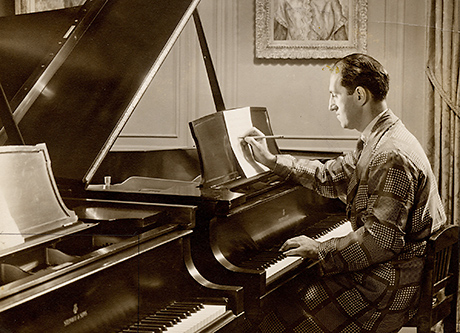
The Gershwin family donated the Steinway to the University as part of the George and Ira Gershwin initiative that is focused on research and study of the brothers’ music.
According to Marc Gershwin, George and Ira’s nephew, “I wanted the instrument to be accessible to the students and faculty who would be preserving the legacy of George and Ira Gershwin’s music… I’m delighted that the piano will once again be in regular use [by students and faculty], and am thrilled that it has been restored to performance condition.” [Two other Gershwin Steinways are in museums.]
From what I know of George he would have wanted it this way. Unlike some composers George was a gifted pianist. He had a rich social life and enjoyed playing his music for anyone who would listen.
There’s a lesson in that thought. If you have something valuable, sometimes it becomes more valuable – or at least more appreciated – when people can see it and use it. If you look at the piano as an instrument of technology that is it, then it makes sense that organizations give people access to technology – as well as resources – to do their work.
. 1678 ~ Antonio Lucio Vivaldi, Italian Baroque composer. The creator of hundreds of spirited, extroverted instrumental works, Vivaldi is widely recognized as the master of the Baroque instrumental concerto, which he perfected and popularized perhaps more than any of his contemporaries. A group of four violin concerti from Vivaldi’s Op. 8, better known as “The Four Seasons”, may well be the most universally recognizable musical work from the Baroque period. Perhaps the most prolific of all the great European composers, he once boasted that he could compose a concerto faster than a copyist could ready the individual parts for the players in the orchestra.
More information about Vivaldi
(MaryO’Note: Spring from The Four Seasons is available in the Piano Maestro App for piano students)
. 1801 ~ The U.S. Marine Band performed for the first time at a presidential nomination. That president was Thomas Jefferson.
. 1839 ~ Ignace Antoine Ladurner, pianist/composer, died at the age of 72
. 1877 ~ The ballet of Swan Lake, composed by Peter Ilyich Tchaikovsky, was performed for the first time in the famous Bolshoi Theatre in Moscow, Russia
and
. 1915 ~ Carlos Surinac, Catalan Spanish-born composer and conductor
. 1918 ~ Frank Wigglesworth, American composer
. 1925 ~ Enzo Stuarti, Opera singer
. 1928 ~ Samuel Adler, German-born American composer
. 1929 ~ Bernard Haitink, Dutch conductor
. 1932 ~ Miriam (Zensile) Makeba, South African born singer who was the first black South African to attain international stardom.
. 1934 ~ Barbara McNair, Singer, TV hostess of The Barbara McNair Show, actress
. 1942 ~ Dick Jurgen’s orchestra recorded One Dozen Roses on Okeh Records in Chicago.
. 1942 ~ The Stage Door Canteen opened on West 44th Street in New York City. The canteen became widely known as a service club for men in the armed forces and a much-welcomed place to spend what would otherwise have been lonely hours. The USO, the United Service Organization, grew out of the ‘canteen’ operation, to provide entertainment for American troops around the world.
. 1943 ~ Irving Berlin picked up the Best Song Oscar for a little ditty he had written for the film, Holiday Inn: White Christmas at the 15th Academy Awards.
. 1944 ~ Bobby Womack, Songwriter, singer
. 1948 ~ Chris Squire, Bass with Yes
. 1948 ~ Shakin’ Stevens (Michael Barratt), Singer, actor
. 1951 ~ Chris Rea, Guitarist with these groups Chris Rea Band and Ambrosia; singer, songwriter
. 1969 ~ Chastity Bono, Singer, daughter of Sonny & Cher
. 1978 ~ Andy Gibb reached the top of the music charts as (Love is) Thicker Than Water reached #1 for a two-week stay. The Bee Gees also set a record on this day as their single, How Deep Is Your Love, from the Saturday Night Fever soundtrack stayed in the top 10 for an unprecedented 17 weeks.
. 1981 ~ Lyricist E.Y. ‘Yip’ Harburg died in an auto accident in Hollywood, CA at the age of 82. Two of his most successful hits were Over the Rainbow from The Wizard of Oz and It’s Only a Paper Moon, popularized by Nat King Cole and many others.
. 2001 ~ Glenn Hughes, a singer who performed as the mustachioed, leather-clad biker in the disco band the Village People, died at the age of 50. The group, which was the brainchild of producer Jacques Morali, featured men dressed as an Indian, a soldier, a construction worker, a police officer, a cowboy and Hughes’ character, a biker. The band released its first single, San Francisco (You’ve Got Me), in 1977. It followed the next year with its first hit, Macho Man. The band then produced a string of hits, including Y.M.C.A., In theNavy and Go West. Collectively the Village People sold 65 million albums and singles. Although disco fell out of fashion in the 1980s, Hughes stayed with the band until 1996, when he left to sing in Manhattan cabarets.
. 2003 ~ Fedora Barbieri, a mezzo-soprano whose passionate singing sometimes stole the scene from opera diva Maria Callas, died. She was 82. Born in Trieste in 1920, Barbieri performed on stages ranging from Milan’s La Scala to New York’s Metropolitan Opera House to London’s Covent Garden. Barbieri’s career started in 1940 and for her 80th birthday, she sang the role of Mamma Lucia in Pietro Mascagni’s “Cavalleria Rusticana” in Florence. Her repertoire included roles in operas by Giuseppe Verdi and Giacomo Puccini. Barbieri died in Florence, which she had adopted as her home and where she gave many performances.
. 2003 ~ Emilio Estefan Sr., father of the Latin music mogul, died at the age of 83. Estefan Sr. played the plump and comical ambassador in a music video for the Miami Sound Machine’s hit song Conga, which featured singer Gloria Estefan, wife of Estefan Jr. The Miami Sound Machine’s office was once located in Estefan Sr.’s garage. His son later built a home for his parents on his Star Island compound. Estefan Sr. was born in Santiago de Cuba and moved to Spain with Estefan Jr. in 1966. His wife and another son stayed in Cuba because the boy was of military draft age and couldn’t leave until 1980. Estefan Sr. came to Miami in 1968, a year after Estefan Jr., and opened a clothing business in Hialeah.
. 2009 ~ Joseph Bloch died. He was an American concert pianist and professor of piano literature at the Juilliard School in New York City. During a career at Juilliard that spanned five decades, Bloch’s students included Emanuel Ax, Van Cliburn, Misha Dichter, Garrick Ohlsson, Jeffrey Siegel and Jeffrey Swann.
. 2011 ~ Johnny Preston, American pop singer (Running Bear), died at the age of 71
Presidents’ Day (celebrated on the third Monday in February), was originally established in 1885 in recognition of George Washington. The holiday became popularly known as Presidents’ Day after it was moved as part of the 1971 Uniform Monday Holiday Act, an attempt to create more three-day weekends for the nation’s workers. Presidents’ Day is now popularly viewed as a day to celebrate all U.S. presidents past and present.
Wondering how many U.S. Presidents played musical instruments?
Thomas Jefferson (1743 – 1826) Third president of the United States, drafted the Declaration of Independence, and played the violin and cello.
John Quincy Adams (1767 – 1848) The sixth president of the United States formulated the Monroe Doctrine, and played the flute.
John Tyler (1790-1862) The tenth president of the United States was the first Vice President to become President by the death of his predecessor. He played the violin.
Abraham Lincoln (1809-1865) The sixteenth president of the United States issued the Emancipation Proclamation and played the violin.
Ulysses S. Grant (1822- 1884) The eighteenth president of the United States certainly scrapes the bottom of the list. He was tone deaf and famously commented, “I only know two tunes. One of them is Yankee Doodle and the other isn’t.”
Chester Alan Arthur (1829 – 1886) Became the 21st president of the United States following the assassination of President James A. Garfield. He played the banjo.
Franklin Roosevelt (1882-1945) The 32nd President of the United States and the fifth cousin to President Theodore Roosevelt, played the piano and sang soprano in his school choir.
Woodrow Wilson (1856 – 1924) The 28th president of the United States and creator of the League of Nations, played the violin and sang tenor in his college glee club.
Warren Harding (1865-1923) The 29th president of the United States organized the Citizen’s Cornet Band, available for both Republican and Democratic rallies. He once remarked that, “I played every instrument but the slide trombone and the E-flat cornet.”
Calvin Coolidge (1872-1933) The 30th president of the United States was determined to preserve old moral and economic precepts amid American prosperity. He played the harmonica.
Harry Truman (1884 – 1972) The 33rd president of the United States who served during the conclusion of World War II, played the piano.
Richard Nixon (1913 – 1994) The 37th president of the United States, who ended American fighting in Vietnam and later resigned from office in the aftermath of the Watergate Scandal, was a classically-trained pianist and also played the accordion. He composed and played this piece, set to concerto form with “15 Democratic violinists.” Nixon takes a dig at Harry Truman just before playing.:
Ronald Reagan (1911-2004) The 40th president of the United States implemented the Reagan Revolution, which aimed to reinvigorate the American people and reduce their reliance upon Government. He played the harmonica.
Bill Clinton (born 1946) The 42nd president of the United States and the first Democratic president since Franklin D. Roosevelt to win a second term, plays the saxophone.
Barack Obama (born 1961) The 44th president of the United States and first African American president has broken into song on several recent occasions. President Obama sang Amazing Grace at the funeral for South Carolina State Senator Clementa Pinckney:
. 1571 ~ Michael Praetorius, German organist, composer and theorist
. 1621 ~ Michael Praetorius, German composer (In Dulce Jubilo), died on his 50th birthday
More information about Praetorius
. 1797 ~ Heinrich Engelhard Steinway, German piano manufacturer
More information about Steinway
. 1847 ~ Robert Fuchs, Austrian composer and music teacher
. 1857 ~ Mikhail Glinka, Russian composer (“Ruslan and Ludmilla”), died at the age of 53
More about Glinka
. 1905 ~ Harold Arlen, (Hyman Arluck) American composer of musicals and songs
More information about Arlen
. 1918 ~ Hank Locklin (Lawrence Hankins Locklin), Country singer
. 1932 ~ George Burns and Gracie Allen debuted as regulars on The Guy Lombardo Show on CBS radio. The couple was so popular that soon, they would have their own Burns & Allen Show. George and Gracie continued on radio for 18 years before making the switch to TV. All in all, they were big hits for three decades.
. 1941 ~ Brian Holland, Songwriter
. 1941 ~ Duke Ellington and his orchestra recorded one of big band’s all-time classics on this day. Take the “A” Train was recorded at Victor’s Hollywood studio and became the Duke’s signature song.
. 1944 ~ Mick Avory, Drummer with The Kinks
. 1951 ~ Melissa Manchester, Singer
. 1958 ~ Get A Job, by The Silhouettes, reached the top spot on the music Tunedex. It remained at #1 for two weeks. Talk about sudden change in American popular music! One week earlier, the number one song was Sugartime, by The McGuire Sisters, a song that definitely was not classified as rock ‘n’ roll. Get A Job was replaced by Tequila, an instrumental by a studio group known as The Champs.
. 1959 ~ Ali (Alistair) Campbell, Guitarist, lead singer with UB40
. 1964 ~ Jack Teagarden [Weldon Leo Teagarden], American trombonist and actor (Meet Band Leaders), died from bronchial pneumonia at the age of 58
More about Teagarden
. 1965 ~ This was a sad day in music, as singer Nat ‘King’ Cole died in Santa Monica, CA. The music legend was 45.
. 1986 ~ Whitney Houston reached the #1 spot on the music charts. Her single, How Will I Know, replaced a song recorded by her first cousin, Dionne Warwick (That’s What Friends Are For). Whitney is the daughter of singer Cissy Houston.
. 1992 ~ William Schuman passed away. Schuman was an American composer and arts administrator.
. 2010 ~ Adam Kaczyński, Polish pianist and composer, died at the age of 76
. 2016 ~ George Gaynes, American singer, actor and voice artist (Tootsie, Police Academy, General Hospital), died at the age of 98
In music, a scale is any set of musical notes ordered by fundamental frequency or pitch.
An arpeggio (it. /arˈpeddʒo/) is a musical technique where notes in a chord are played or sung in sequence, one after the other, rather than being played together like a chord. This word comes from the Italian word “arpeggiare”, which means “to play on a harp”. An alternative translation of this term is “broken chord”.
Founded in Manhattan in 1853, Steinway & Sons is widely considered to be one of the greatest piano makers in the world. Its grand pianos grace the world’s grandest stages and are played by the best pianists.
1885 ~ Alban Berg, Austrian composer
More information about Berg
. 1909 ~ Carmen Miranda (Maria do Carmo Miranda Da Cunha), ‘Brazilian Bombshell’, singer, dancer, actress
. 1914 ~ Gypsy Rose Lee (Rose Hovick), Actress, dancer, stripper, subject of Broadway show and film, Gypsy, sister of actress, June Havoc
. 1914 ~ Ernest Tubb, Country Music Hall of Famer, headlined 1st country music show at Carnegie Hall
. 1923 ~ Kathryn Grayson, Singer, actress in Kiss Me Kate, Show Boat, The Kissing Bandit, It Happened in Brooklyn, Anchors Aweigh
. 1937 ~ Hildgarde Beherns, German Soprano
. 1939 ~ Barry Mann, Songwriter, with Cynthia Weil on dozens of ’60s and ’70s ‘Brill Building’ hits, singer
. 1940 ~ Brian Bennett, Drummer with The Shadows
. 1940 ~ The old piano played for dances in the Tattersall house in High Forest for many year – as long ago as the Civil War period – will be played once more when the Olmsted County Historical association formally opens its museum in the basement of the Rochester, MN public library.
. 1942 ~ Carole King (Klein), American pop-rock singer and songwriter
. 1944 ~ Barbara Lewis, Singer
. 1960 ~ Ernst von Dohnanyi, Hungarian composer, pianist and conductor, died at the age of 82
. 1963 ~ (James) Travis Tritt, Grammy Award-winning singer
. 1964 ~ Several days after their arrival in the U.S., The Beatles made the first of three record-breaking appearances on “The Ed Sullivan Show”. The audience viewing the Fab Four was estimated at 73,700,000 people in TV land. The Beatles sang She Loves You and I Want to Hold Your Hand. One could barely hear the songs above the screams of the girls in the audience.
. 1966 ~ Liza Minnelli brought her night club act to the Big Apple. She opened in grand style at the Persian Room of the Plaza Hotel in New York.
. 1969 ~ A young lady named Roslyn Kind made her quiet TV debut this night on “The Ed Sullivan Show”. Ed said she’s “…America’s teenager who wasn’t protesting or playing a guitar.” She only appeared once. Her sister appeared many times. Roslyn Kind is the sister of Barbra Streisand.
. 1970 ~ Sly and The Family Stone received a gold record for the single, Thank You (Falettinme Be Mice Elf Agin). Sly (Sylvester) Stewart was a DJ in Oakland, CA.
. 1981 ~ Bill Haley died on this day in Harlingen, TX. He was 55. Haley, with his Comets, recorded what became known as the anthem of rock and roll: Rock Around the Clock, from the movie, “Blackboard Jungle”. The song turned into a multimillion-dollar hit and one of many hits Haley and the Comets had, including Dim Dim the Lights, Razzle Dazzle, Crazy Man Crazy, Rock the Joint, See You Later Alligator and Shake Rattle & Roll. Bill Haley was inducted into the Rock and Roll Hall of Fame in 1987.
. 1710 ~ William Boyce, English organist/composer (Cathedral Music), born in London (d. 1779)
. 1818 ~ Henry Charles Litolff, piano virtuoso, composer of Romantic music and music publisher
. 1871 ~ Wilhelm Stenhammar [Carl Wilhelm Eugen Stenhammar], Swedish composer considered the finest Swedish pianist of his time, born in Stockholm, Sweden (d. 1927)
. 1883 ~ Herbert “Eubie” Blake, American jazz pianist, vaudevillian, songwriter and composer
More information about Blake
. 1920 ~ Oscar Brand, Folk singer, composer, music director of NBC-TV Sunday, host of Let’s Sing Out
. 1921 ~ Wilma Lee Cooper (Leary), Country singer with husband, Stoney and the group, Clinch Mountain Clan with her daughter, Carol Lee
. 1931 ~ The American opera, “Peter Ibbetson”, by Deems Taylor premiered at the Metropolitan Opera House in New York City.
. 1941 ~ The Tommy Dorsey Orchestra and Frank Sinatra teamed to record Everything Happens to Me for Victor Records in New York City.
. 1948 ~ Jimmy Greenspoon, Organist with Three Dog Night
. 1949 ~ Alan Lancaster, Bass with Status Quo
. 1959 ~ Brian Travers, Saxophone with UB40
. 1962 ~ (Troyal) Garth Brooks, American Grammy Award-winning singer: In Another’s Eyes (1998 with Trisha Yearwood), Friends in Low Places and The Thunder Rolls. His LP Ropin’ the Wind was the first LP in history to debut at #1 on Billboard’s pop and country charts, The Chase, In Pieces, Fresh Horses, Sevens, Double Live has sold over 80 million albums — second only to The Beatles.
. 1962 ~ David Bryan, Keyboards with Bon Jovi
. 1964 ~ 3,000+ fans crowded the JFK airport in New York to receive the four stars of the music sensation, The Beatles. One word summarizes the reaction to The Beatles on their first US tour: hysteria.
. 1969 ~ Tom Jones, ‘The Prince of Wales’, premiered on ABC-TV after the network acquired the rights to the singing sensation’s popular United Kingdom show. The network paid a British production company an estimated $20 million for those rights. And they cried in one of Tom’s hankies all the way to the bank.
. 1974 ~ Barry White’s Love Unlimited Orchestra received a gold record for the disco hit Love’s Theme.
. 1985 ~ New York, New York became the official anthem of the Big Apple. The announcement was made by then New York mayor, Ed “How’m I Doin’?” Koch. Frank Sinatra fans rejoiced at the honor.
. 2001 ~ Dale Evans died at the age of 88. She was an actress-singer who became “Queen of the West” by starring with husband Roy Rogers in 27 cowboy films and writing their theme song, Happy Trails.
. 2002 ~ Bert Conway, an actor and director whose 60-year career included theater, movies and television, died of heart failure. He was 87. The son of vaudeville performers, Conway was born in Orange, N.J. He had a walk-on part in the original 1937 Group Theater staging of Clifford Odets’ “Golden Boy” and later had the lead as a reform school youth in Lee Strasberg’s production of “Dance Night.” After serving in the Army in World War II, Conway went to Hollywood. He began directing plays in 1947. His work included the first interracial production of “Golden Boy” for the Negro Art Theater in Los Angeles. In 1950, he returned to New York to act in and direct plays. His work included an off-Broadway revival of “Deep Are the Roots” and appearances with Joseph Papp’s New York Shakespeare Festival. He also appeared in several road company productions, had small roles in the movies “The Three Musketeers,” “Little Big Man” and “The Arrangement,” and on TV’s “St. Elsewhere.”
. 2009 ~ Blossom Dearie, American jazz singer and pianist, died of natural causes at the age of 84




 MaryO'Studio