For Parents (or Adult Students)


I have several copies of this book for the music studio so parents can check it out to see if it would be useful for them to buy for home use.  If any of the studio parents have this book already, please let me know what you think.

Some of my adult students have this and have found it helpful in doing theory assignments.


From Amazon:

Help Your Kids with Music is a step-by-step visual guide to music theory and is the perfect primer to help students gain a solid foundation in music, no matter their age, skill level, or instrument.

Help Your Kids with Music clearly explains key concepts in five step-by-step chapters:

  • The Basics explains the types of instruments, notation for keyboard and stringed instruments, the “musical alphabet,” and counting a beat.
  • Rhythm covers the length of notes and rests, as well as basic rhythms and meters, phrasing, syncopation, tempo, and using a metronome.
  • Tone and Melody includes everything a student needs to know about tones and how they work together to build a melody.
  • Chords and Harmony shows how intervals work together and includes examples for horn and woodwind instruments.
  • Form and Interpretation helps students understand how musical form can aid appreciation and interpretation for classical, jazz, blues, and other musical styles.

Sample pages:


Daily Listening Assignments 2008


This summer, I’ve decided to add a new feature to piano lessons.  I know that many families travel during the summer months and it’s sometimes difficult to practice.

These daily assignments, June through August will help you and your students learn a bit more about the pieces they’re learning during the year – or maybe give ideas for something that they’d like to learn.

Each piece has a bit of composer info and several different interpretations, some of which are very humorous.  Some of the assignments appear in Piano Maestro so be sure to have that handy, if your student uses that.

Some days give hints that the assignment of the day may be played (or reviewed) at the next lesson so please be sure that your student takes note of that (no pun intended!)

Find them here, under Daily Listening Assignment starting June 1 at 9:00 am.

Have a safe and musical summer!

Help Your Kids with Music


I am ordering this book for the music studio so parents can check it out to see if it would be useful for them to buy for home use.  If any of the studio parents have this book already, please let me know what you think.

Thanks!

From Amazon:

Help Your Kids with Music is a step-by-step visual guide to music theory and is the perfect primer to help students gain a solid foundation in music, no matter their age, skill level, or instrument.

Help Your Kids with Music clearly explains key concepts in five step-by-step chapters:

  • The Basics explains the types of instruments, notation for keyboard and stringed instruments, the “musical alphabet,” and counting a beat.
  • Rhythm covers the length of notes and rests, as well as basic rhythms and meters, phrasing, syncopation, tempo, and using a metronome.
  • Tone and Melody includes everything a student needs to know about tones and how they work together to build a melody.
  • Chords and Harmony shows how intervals work together and includes examples for horn and woodwind instruments.
  • Form and Interpretation helps students understand how musical form can aid appreciation and interpretation for classical, jazz, blues, and other musical styles.

Sample pages:


Daily Listening Assignments


This summer, I’ve decided to add a new feature to piano lessons.  I know that many families travel during the summer months and it’s sometimes difficult to practice.

These daily assignments, June through August will help you and your students learn a bit more about the pieces they’re learning during the year – or maybe give ideas for something that they’d like to learn.

Each piece has a bit of composer info and several different interpretations, some of which are very humorous.  Some of the assignments appear in Piano Maestro so be sure to have that handy, if your student uses that.

Some days give hints that the assignment of the day may be played (or reviewed) at the next lesson so please be sure that your student takes note of that (no pun intended!)

Find them here, under Daily Listening Assignment starting June 1 at 9:00 am.

Have a safe and musical summer!

JoyTunes Piano Maestro Update Today

Piano-Maestro-End-Game


The day has arrived, the new Piano Maestro update is now out (it will take a few hours to appear in the App Store)! Based on your feedback you’ll find a lot of goodies inside, as well as the new plans.

Highlights include 5 new method books (like lesson book 3 from Alfred’s Premier Piano Course and 3 new books from Jennifer Eklund’s Spotlight series), over 50 avatars, practice options for learn levels, fun animation to mark method books, ability to add notes to Home Challenges, enhanced teacher reports, tons of exciting new songs and various enhancements, like new MIDI sounds, no more conflicts with other MIDI apps and notation fixes.

We updated the FAQ so check that out too. https://welcome.joytunes.com/faq-teachers/

Just a reminder to make sure you update to the latest version (Mine is here now).

Thanks for your continued support and all the valuable input and feedback you have given us over the last few weeks. Let us know what you think!

See yesterday’s post for a video on how to download the new app, if you need help.

JoyTunes / Piano Maestro Update Tomorrow!

Piano-Maestro-End-Game


Once the new version tomorrow (Wednesday, August 190, 2016) is out you can manually update the app by exiting out of the app, go to the App Store and you’ll see the update tab where you’ll see Piano Maestro with “Update” next to it , tap on that and it will update to the latest version.

If you have automatic updates for apps switched on from your iPad settings under iTunes & App Store, Piano Maestro will automatically be updated.

This tutorial by David might help

Piano Maestro has become a paid app as of this update.  JoyTunes, the makers of Piano Maestro, very recently announced they will no longer be able to continue offering full access to the app on free accounts for students and will be introducing new membership plans. Pop songs, method books and other licensed content, plus home access will become premium as they can no longer continue to absorb the royalty payments.

They also announced the new version will have tons of new exciting songs, as well as 5 new method books from top publishers.

The O’Connor Music Studio will cover the cost of studio access for Piano Maestro.

Home access will be available for 50% off at $30 a year per family (due by August 18th).

I highly encourage you to use this at home if you have an iPad so your student can continue to have full access to all the fun licensed pop songs, exercises & content at home. It will be the best screen time of the week at your house!

If you want to continue to use Piano Maestro at home as well as in lessons the cost will be an additional $5.00 per month or $30 annually for the 2016-2017 school year.

You can purchase Piano Maestro through the App Store for $59.99 per year on your own or take the special discounted price I’ve secured for our Studio families.  The music is super fun and who doesn’t love to see a motivated musician? I’ve seen in my studio that the kids that use Piano Maestro really progress faster, I’d hate for you to miss out!

Please let me know your choice as soon as possible, or no later than August 18
• I prefer a monthly (Sept-June) $3 tech fee.
• I prefer a yearly (Sept-June) $30 tech fee.
• I will buy Piano Maestro for $59.99 directly from the App Store.
• I prefer not to use Piano Maestro at home, so there will be no additional cost

Thanks!

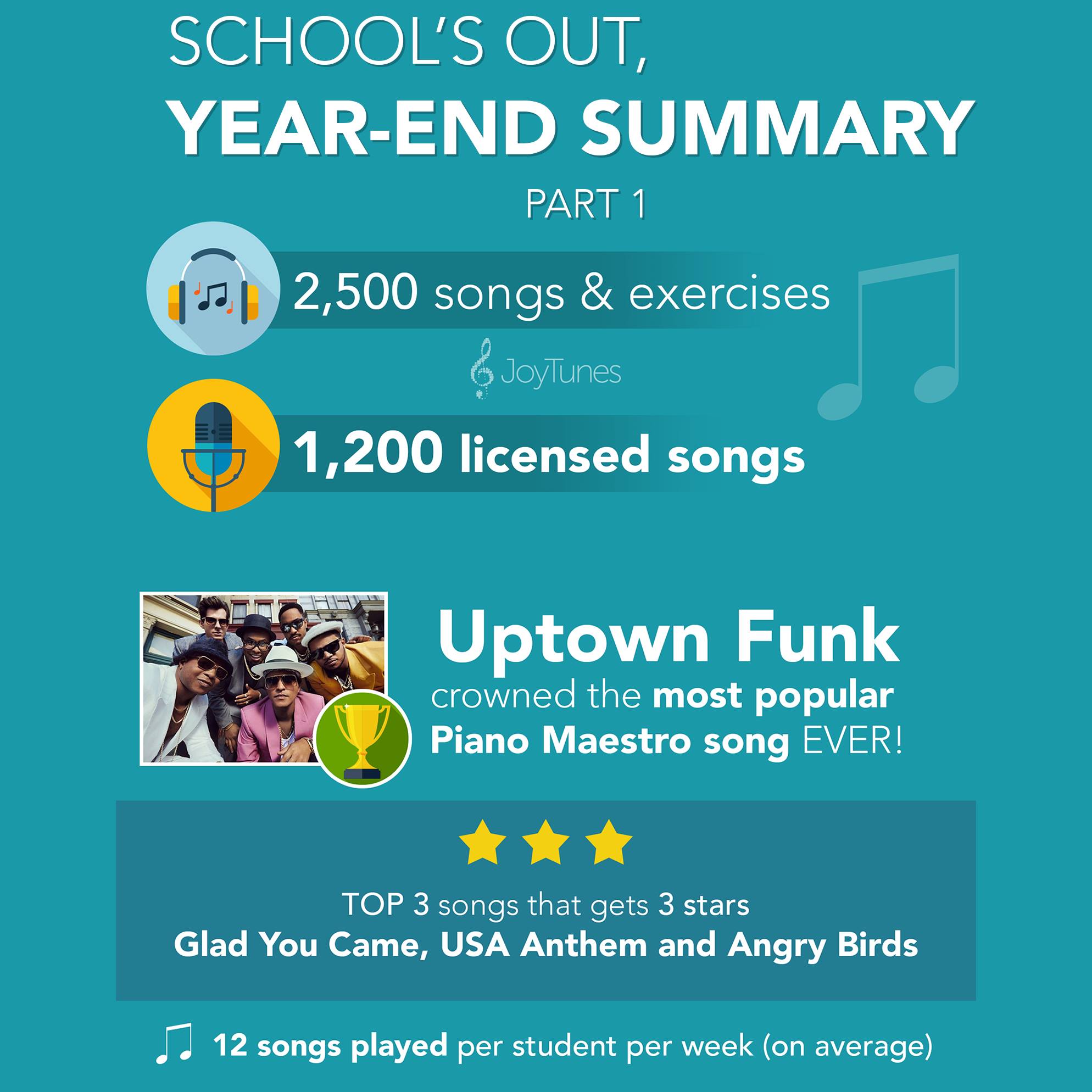
JoyTunes Piano Maestro Year End Summary

joytunes-2016a


From JoyTunes:

To celebrate the end of the teaching year, we thought you’d enjoy some very cool Piano Maestro stats that show how students practice more at home, parents are more involved and lots of other revealing info in our end-of-year infographic we’ve prepared for you!

We’ll be rolling it out in stages so without further ado enjoy the first one! Stay tuned for the next part coming soon.
Are there any stats that surprised you?

Music for Very Young Children


fun-with-music


MOMs, DADS, are you looking for a place to have fun and fellowship with your children and other parents? We begin our 3rd year on Sept. 18th at 10am on Fridays in the Cornerstone Room (Rm. 215) at Pender United Methodist Church on Route 50. This program is for all parents and their children, ages 0 to 5.

The morning starts with 30 minutes of age appropriate interactive music followed by a snack and then playing with toys while the parents enjoy a time of fellowship and breakfast. These activities all take place in the same room.

This program continues though the school year and each semester there is a fee of $30 per family to cover the food and snacks.

For more information, please email Roberta Pont by clicking on this link.

Pender is located at 12401 Alder Woods Drive which is off Route 50 just east of the Fairfax County Parkway, about 10 minutes away from the O’Connor Music Studio.

From the Fairfax County Parkway: Take the exit marked Route 50, East. Get in left lane as soon as possible. Turn left at first light. Follow Alder Woods Drive to the church entrance on the left.

From I-66: Take the exit marked Route 50, West. Turn right at the third traffic light. Follow Alder Woods Drive to the left to the church entrance on the left.

NOTE: When you enter Alder Woods Drive you will see Christ Presbyterian Church in front of you.  They are very nice people, but that’s not where you’re headed. Go left. When Alder Woods Drive curves to the right, Pender Church will be on the left side.

Why Students Really Quit Their Musical Instrument (and How Parents Can Prevent It) – National Association for Music Education (NAfME)

piano-teacher
A great article from the National Association for Music Education (NAfME)

The real reasons that students quit is often beyond their own understanding.  It is up to teachers and parents to create moments for students to want to continue on their instrument during the early years of study in order for the child to be successful and stay with the craft.

Here are reasons students quit, and ways to combat them:

Parents need to find music just as important as other subjects.  The sad truth is that many non-music teachers and administrators do not find music equally as important as math or English language-arts, but parents need to.  Besides, you wouldn’t let your child quit math, would you?  Many kids would jump at that opportunity.  Music is a core subject…period.  The more parents treat it as such, the less students will quit.

Students don’t know how to get better.  Without the proper tools and practice habits to get better at anything, students will become frustrated and want to quit.  It is the role of the music educator and the parents to give students ownership over their learning.  Teachers must teach students why, how, where, and when to practice, and parents must obtain minimal knowledge about how students learn music in order to properly support them at home.

Parents and students think they aren’t musically talented.  Sure, there are some kids who pick up an instrument and sound decent immediately, but they will hit a wall later and have to work hard to overcome it.  Most everyone else won’t sound that great at first.  Playing a musical instrument is a craft that, if practiced correctly, is something that all children can find success in.  As long as students know how to practice and that it needs to be done regularly, they will get better.

Students discontinue playing over the summer.  Statistics show that students who do not read over the summer find themselves extremely behind once school starts.  The same goes for playing an instrument.  A year of musical instruction can quickly go down the tubes over the summer vacation if students do not find small ways to play once in a while.  Picking up an instrument for the first time after a long layoff can be so frustrating that a student will not want to continue into the next school year.

The instrument is in disrepair.  A worn down cork, poor working reed, or small dent can wreak havoc on a child’s playing ability.  Sometimes the malfunction is so subtle that the student thinks they are doing something wrong, and frustration mounts.  Students, parents and teachers need to be aware of the basics of instrument maintenance and be on top of repairs when needed.

Teachers don’t create enough performing opportunities during the year.  The best way to motivate students musically is through performance.  Weeks or even months on end of practicing without performing for an audience gets old very quick, and student will definitely quit.  Teachers should schedule performances every six weeks or so in order for students to stay engaged and practicing.  Parents can help by creating small performance opportunities at home — a Friday night dinner concert or a planned performance for visiting family members are great ideas.

There is not enough “fun”music to practice.  It’s very important for parents to be aware of music that interests their child, because it exists in sheet music form for download or purchase.  It’s important that all students play music that is aligned to their interests in addition to other pieces that are worked on in school.

Other activities are pulling at the child.  Between art lessons, sports, karate, and other activities, parents grow weary of having “one more thing” to be on top of schedule-wise.  Parents need to understand that the enduring social and psychological benefits of music are as enormous as those of sports — in the same and different ways.  Budget time accordingly and children will have 10 minutes a day to practice an instrument, for sure.

Much like any worthwhile venture, practicing a musical instrument has its ups and downs.  Kids need to be reminded to practice, of course — but they should not be constantly pushed, and they should not be completely left alone.  It’s a balancing act where sometimes the parents will need to give their child a break for a few days and other times will need to bribe them to practice.  Either way, all children are capable of thriving with a musical education, and students will indeed thank their parents for not letting them quit.

via Why Students Really Quit Their Musical Instrument (and How Parents Can Prevent It) – National Association for Music Education (NAfME).