The American Fotoplayer is a type of photoplayer developed by the American Fotoplayer Company between the years of 1912 and 1925. The Fotoplayer is a type of player piano specifically developed to provide music and sound effects for silent movies.
…
The appeal of the Fotoplayer to theatre owners was the fact that it took no musical skill to operate. The Fotoplayer would play the piano and pipe organ mechanically using an electric motor, an air pump, and piano rolls while the user of the Fotoplayer would follow the onscreen action while pulling cords, pushing buttons, and pressing pedals to produce relatable sounds to what was occurring onscreen. These actions could create sounds such as a steamboat whistle, a bird chirp, wind, thunder, a telephone bell, as well as many others. On Fotoplayers specifically, most effects were created using leather cords with wooden handles on the ends which the effects were directly connected to. For example, the steamboat whistle sound effect was created using a household bellows with a whistle at the end. Pulling the cord compressed the bellows, delivering a gust of air into the whistle. Creating a drum roll on the other hand was a bit more complicated. A clockwork device was needed to time the strikes of the drum which required constant winding.
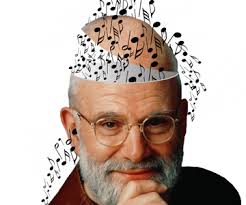
Writer and neurologist Oliver Sacks, who died on Sunday, August 30, 2015 at age 82, spent his life wondering on the myriad connections among biology, thought, emotion and perception.
For those of us who obsess over the how and why of music, Sacks’ work on sound and its effects on the brain – and vice versa – was particularly illuminating. His book on the subject, “Musicophilia: Tales of Music and the Brain,” remains essential reading for those who want to understand the mechanics of music.
Through bountiful research and mesmerizing case studies, Sacks addressed topics including music and amnesia, music therapy, musical prodigies and those who suffer from debilitating aural hallucinations.
These days, there is much pressure for parents to begin their children in activities from an early age. We know that children tend to pick up new skills easily and we want for them to have an opportunity to become experts at these new skills. We also see curiosity, desire and eagerness to learn in our children and want to capitalize on that.
Music lessons are no exception. We often get calls asking the question, “When is the best time to enroll my child in piano lessons?” The answer to that is a tricky one, and varies for each child. The right age for one may not be the right age for another. Here are a few questions to ask yourself if you are considering enrolling your child in music lessons:
1. Does my child have an attention span to sit still for chunks of time and listen to instruction?
Many teachers today are very creative in using off-bench activities during lessons and have a plethora of activities to make lessons fun and engaging. However, the fact remains that your child will need to sit at the piano for some periods of time during the lesson. It is important that your child have the attention span to do this.
Life very often throws some curious coincidences my way. Just as I was preparing a presentation for architecture students at the Goa College of Architecture on ‘Architecture and Music’ and looking at the relationship of the Fibonacci sequence to music, what should appear in my newsfeed but the announcement of the famed piano firm Steinway and Sons unveiling its 600,000th piano, incorporating the iconic Fibonacci spiral in its design.
The veneer of the “Fibonacci” piano features the eponymous spiral made from six individual logs of Macassar Ebony, “creating a fluid design that represents the geometric harmony found in nature.”
In the words of designer Frank Pollaro, who spent over 6000 work-hours over four years in its creation: “Designing Steinway & Sons’ 600,000th piano was an honour and a challenge. To me, knowing that this piano would become part of history meant that it had to be more than just a beautiful design, but also needed to visually convey a deeper message…as I considered the number 600,000, the Fibonacci spiral came to mind. The way in which it continues to grow but stay true to its form is very much like Steinway and Sons over these many years. Combining the universal languages of music and mathematics suddenly made perfect sense.”
Mind you, 600,000 is not a number in the Fibonacci sequence; I checked. 600,000 is between the 29th and 30th numbers in the Fibonacci series, which are 514,229 and 832,040 respectively. But Pollaro was nevertheless highlighting an interesting relationship between music and mathematics.
Named after the Italian mathematician Leonardo Fibonacci (c. 1170- c. 1250) who brought the Indian-Arabic numeral system to Europe, the Fibonacci series appear in nature and in music, and finds application in architecture and in instrument design, much before the Fibonacci Steinway.
The basic ideas of the Fibonacci progression are contained in the writings of Indian scholar Pingala (300-200 BC) in his treatise on Sanskrit prosody.
The Fibonacci numbers have the following integer sequence: 0, 1, 1, 2, 3, 5, 8, 13, 21, 34, 55, 89, 144, 233, 377, 610, 987 and onward. Each added number is the sum of two previous numbers before it.
In nature, the Fibonacci sequence underpins phyllotaxis (arrangement of leaves on a stem), branching in trees, fruit sprouts of a pineapple among many other examples, and even the shape of the human external ear, and the cochlear apparatus of the inner ear.
It can be applied to the western musical scale as well, with the caveat that the starting note one makes the measurement from (or the ‘root’ note) is designated as 1 and not 0. By this token, there are 13 notes in a scale through its octave. There are 8 notes in a diatonic scale (hence the top note is called an ‘oct’ave). The 5th and 3rd notes create the basic foundation of musical chords. All these are Fibonacci numbers.
The very notes in the scale are based on natural harmonics created by ratios of frequencies. Ratios found in the first seven numbers of the Fibonacci series (0, 1, 1, 2, 3, 5, 8) are related to key frequencies of musical notes. Thus if we take an arbitrary frequency of 440 Hz, the root note has a ratio of 1/1, but the octave above it has a frequency of 880 Hz (2/1 of 440); a fifth above has a frequency of 660 Hz (3/2 of 440), and so on for other notes in the scale.
In last Sunday’s article, I had mentioned the ‘golden proportion’ or phi, which underpins the proportions of the Parthenon temple in the Acropolis in Athens, Greece. This ‘golden ratio’ (also called the ‘golden section’, ‘golden mean’ or the ‘divine proportion’) of 1:1618 or 0.618 has influenced composition in painting and photography, prompting the notion of dividing a canvas into thirds vertically and horizontally, and to position a subject of interest ‘about one-third’ of the way across instead of in the centre.
This ‘golden ratio’ can be obtained by dividing a Fibonacci number (in the higher reaches, not the first few) by its immediate predecessor. The quotient approximates phi (φ). Thus 987/610= 1.61803, and its inverse is 0.618.
The climax or high point of many songs and other compositions is often found at the ‘phi’ (φ) point (61.8 per cent) of the work. We have seen this to be true in the first movement of
S. Bach’s G minor sonata for solo violin.
In many compositions in sonata form, the addition of a coda causes the recapitulation (the return of the original idea that started the work) to begin at the 61.8 per cent point.
The legendary violin maker Antonio Stradivari seemed to be aware of the ‘golden section’ and used it in the placement of the f-holes on his violins. The proportions of the violin conform to the ratios of ‘phi’ (φ). The spiral of a violin scroll also obeys the Fibonacci progression.
Isn’t it amazing, how the visual and aural world, indeed nature itself can all be unified by the same mathematical sequence?[NT]
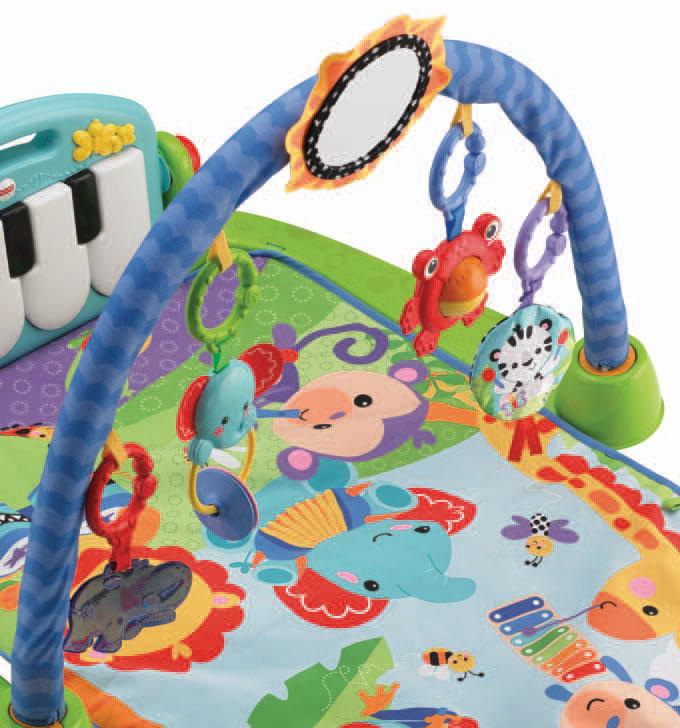
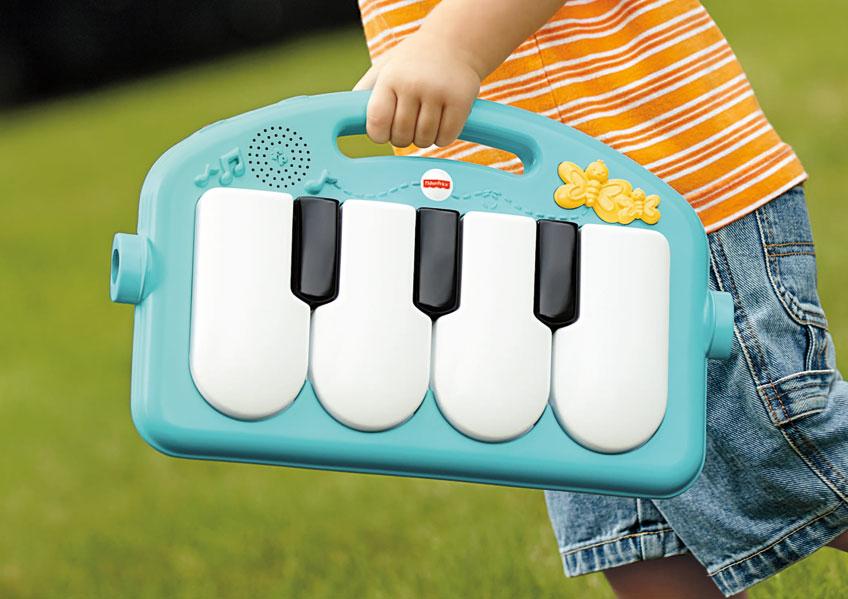
Baby kicks. Music plays. And that’s just the beginning. Movable toys on the overhead gym encourage baby to bat and grasp. Move the arch down for tummy-time play, or let baby sit and entertain you with a piano concert! And now with a removable piano, you can take the musical fun wherever you and baby go!
Features
Four ways to play: Lay & play; Tummy time; Sit & play; Take-along
Music rewards baby as she kicks the piano keys
Five busy activity toys & a large mirror
Toys include a hippo teether, elephant clackers, rollerball frog, and more
Short or long-play music—up to 15 minutes
Soft, comfy mat
Power/volume control
Requires 3 AA batteries
Toys overhead encourage batting and grasping, including a hippo teether, elephant clackers, rollerball frog and more!
Stretching & kicking
With four ways to play, this musical toy grows with your little one! From laying and playing, to tummy time and sitting up, busy activities at each stage are just the beginning of the fun. Baby’s in charge of the action as her little kicky feet activate music. Moveable toys overhead encourage batting and grasping, including a hippo teether, elephant clackers, rollerball frog and more.
When it’s time to change modes, move the arch down for tummy time or let baby sit up and entertain you with a piano concert. Remove the piano and take the fun on-the-go. Includes long and short play modes with up to 15 minutes of music. Power and volume control for quiet play.
Removable piano provides musical fun wherever you and baby go!
Learning through play!
As baby plays, new discoveries are made and key developmental skills get stronger and stronger. As baby stretches and kicks at the piano keys or bats at and reaches for the busy activity toys, gross motor skills are enhanced. Music, lights and bright colors stimulate baby’s senses.
Help baby learn the connection between actions and reactions. Put baby’s foot within reach of the piano. From there, it’s bound to happen: baby’s foot will connect and activate a fun and rewarding response from the gym!
Play Corvallis, Play pianos are about to hit the streets, but first a giant gift to the community must be unwrapped at 6 p.m. Friday by the riverfront downtown.
“On Friday, we want to celebrate Corvallis and the citizens for being involved in music,” said Lee Eckroth, who came up with the street piano program last year. “Our reveal that day is a gift to the community and it’s pretty special.”
After the gift is opened, theme-painted pianos will start being available for free playing in various locations around town.
Eckroth was inspired to start the event after a family vacation in Boston a few years ago. He said the city had a street pianos program and his daughter, Morgan, thought it would be cool to bring that idea to Corvallis.
A mutual friend introduced Eckroth to Dave Lundahl, organizer of the Corvallis Imagination Music and Arts Festival, and the two decided to collaborate. The idea was to use both events to generate money for art and music programs in area K-12 public schools.
Eckroth said, “I put out a message to the community in February of 2014 that there was a guy looking to collect pianos. All of sudden I had 10 pianos in my garage.”
From June until the beginning of last August, Eckroth invited local residents and volunteers to use his driveway as a studio to paint whatever theme they wanted on the pianos. Themes included an all-orange piano called the Beaver Believer, or fruits and veggies, and more. One, called Happy Hands, featured a painted handprint of every volunteer. The pianos appeared outside locations such as the public library, the Oregon State University Valley Library and the downtown American Dream Pizza on Second Street.
“Last year we were amazed with what happened with the pianos,” Lundahl says. People were planning parties around the pianos, and impromptu concerts emerged from players of all different ages.
“We were giving people the opportunity to come out of their shells and express themselves,” Eckroth says.
The pianos, each with its own sponsor, will be re-released one by one between 7 a.m. and 10 p.m. every day in various locations until August 16. And like last year, when the pianos go away for the winter, they will be sent to different families to enjoy in their homes until next summer.
See if a prospective teacher allows a trial lesson to test how the personalities mesh. And be sure to ask lots of questions. What’s the teacher’s background as a musician and as an instructor? What kinds of teaching materials and music does she use? How much practice time is expected for students, and does that vary by the student’s age? Does the teacher have access to student ensembles? What kinds of performance opportunities will he provide? Will the teacher allow the student to record the lesson? This can be a terrific practice aid, especially when it comes to remembering how something is supposed to sound. Does she teach any music theory or composition? What are the expectations for students and for their parents?
A good teacher can be a friendly, encouraging and inspiring presence — even when a student hits rough patches. He will point out the student’s weaknesses without being harsh or dismissive, suggest innovative ways to overcome challenges, and create engaging ways to tackle even rote activities like playing scales or honing fine motor skills. The instructor’s age and experience might or might not be a deciding factor; for example, I’m consistently impressed by the range of tricks my own child’s very youthful private teacher has up her sleeve to turn what could easily be drudgery into fun. Not to mention the huge helpings of good humor and patience she brings to her tiny charges!
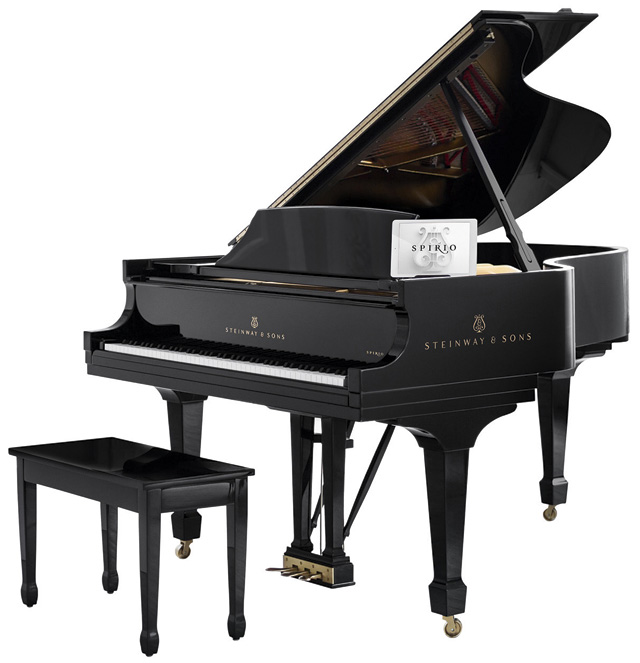
Renowned piano manufacturer Steinway has launched a self-playing piano. Programmed via its own iPad and linked up to play more than 1,700 different pieces of music, the Spirio high-resolution system will be offered exclusively on select Steinway grands. Able to replicate the virtuosity of the most talented of pianists, this player piano is bound to impress unsuspecting dinner guests. Spirio Model O, £77,150 (020 7487 3391, http://www.steinway.co.uk)
There’s more to a song than meets the ear, as Neil deGrasse Tyson finds out when he interviews singer/songwriter/producer Josh Groban. Josh shares how he got started playing his family’s electronic Casio piano while he was still in diapers, and whether he was a science geek in school.
In studio, concert pianist and MIT Lecturer in Music, Elaine Kwon, and co-host Chuck Nice add their voices to the chorus to help us hear the science woven into the songs. You’ll learn how artists breathe life into their music, and about the qualitative difference between human generated and automated music.
Explore the importance of the acoustics of a performance space, the effect music has on people, the difference between melody and harmony, the ranges the human voice is capable of, and which was more important, Charlie Parker’s personal style or his sax.
Plus, Neil and Josh discuss “acoustic panty removers”, Chuck admits to singing first soprano in his church choir, and we find out whether Rachmaninoff really had “big hands” and what rubato means.
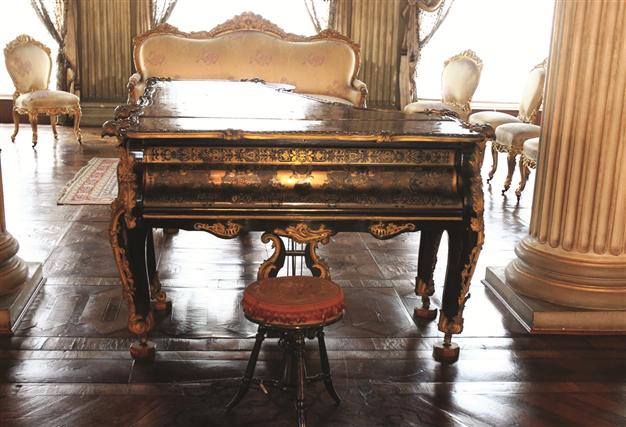
The pianos in Istanbul’s Dolmabahçe Palace, which hosted some 1 million people last year, draw great interest from local and foreign visitors for their magnificence and harmony with their surroundings.
National Palace guide Osman Nihat Bişgin said Dolmabahçe Palace was a Tanzimat (reform-era) palace, adding, “All features of the reform era are clearly seen in Dolmabahçe Palace. This process, which we call the Europeanization and westernization process, made western music enter Dolmabahçe Palace.”
He said the palace had a total of 12 pianos, and all of them had ornamentations suitable to the style and harmony of the palace.
Bişgin said the palace opened in 1856 and the pianos were brought there nearly at the same time. “The wives of sultans were taking piano education in the palace, particularly in the final years of the Ottomans. There are many pianos and none of them were inactive; all of them were being played,” he said.
He said most of the piano brands in the palace were Hertz, Pleyel, Gaveau and Erard, and that the number of grand pianos was less.
Speaking of a striking green piano in Zülvecheyn Hall on the upper floor of the palace, Bişgin said it was a classical Pleyel-brand palace piano.
“Since the magnificence and glory was dominant in the palace, the pianos draw our attention visually. Their sound is not very famous, but they are very important and famous visually,” he said.
Bişgin said Zülvecheyn Hall had gilded ornamentation on its white and beige ceiling, adding, “We see enormous harmony between the piano and the ceiling.”
He said the furniture in Dolmabahçe Palace was in its original place, and added, “We can say that the pianos belong to these halls. The pianos in the Zülvecheyn and Süfera halls were designed to add visual richness to halls like them. They are not generally played.”
Crystal piano and chair in the Glass Kiosk
As for the rare crystal piano in the Glass Kiosk, Bişgin said the following: “The Glass Kiosk is a big venue hidden behind the walls of the palace. Mustafa Kemal Atatürk greeted the public in this place. It is like a winter garden surrounded with glass. In harmony with this kiosk, there is a crystal piano. It is a Paris-made Gaveau piano. Its chair is crystal, too.”
Another piano in the palace is a plain black German-made Steinway. Bişgin said its sound was very strong and it was very valuable.
“It was produced as a Hamburg Steinway in 1912. Then the factory moved to the U.S. Accordingly, there were only five Steinway pianos made in Germany. This is one of them. Its estimated price is 200,000 euros. It also has the emblem of the sultan Abdulmecid,” Bişgin added.
Speaking of the piano, which was used during the acceptance of ambassadors in the Süfera Hall, Bişgin said, “Süfera is the plural of the word sefir [ambassador]. This hall was created to address foreigners. The furniture is gold-plated; the ceiling is the same. There is a boulle-work piano here to show the beauty of metal and gold. This piano is wonderful for decoration.”





 MaryO'Studio